Novelhalla
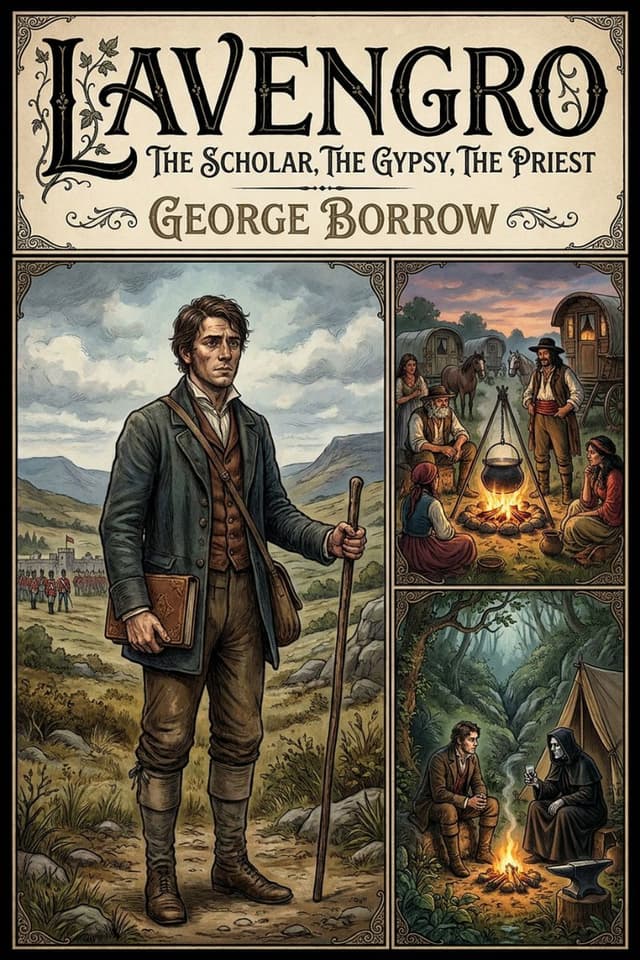
Lavengro: The Scholar, The Gypsy, The Priest
Read Lavengro: The Scholar, The Gypsy, The Priest by George Borrow for free on Novelhalla, and try out our easy-to-read modern edition of this classic book. You can also download the EPUB and read it on any device if you prefer!
The Plot
Lavengro is a semi-autobiographical novel that blurs the boundaries between memoir and fiction so thoroughly that readers have debated for over a century and a half where one ends and the other begins. It follows a young man named George through his wandering childhood, his frustrated literary ambitions in London, and his eventual escape into the life of an itinerant tinker on the roads of England.
The Scholar
The narrator, George, is born the son of a militia officer who fought against Napoleon. Because his father's regiment moves constantly, George grows up in barracks towns across England, Scotland, Ireland, and Wales. He has an older brother, handsome and charismatic, who is their father's obvious favorite. George is the strange one, the solitary child who wanders off alone.
At six years old, George discovers Robinson Crusoe, and the book awakens in him an insatiable hunger for reading and languages. This passion will define his life. While other boys learn to be soldiers or lawyers, George teaches himself Latin, then Greek, then Welsh, then Danish, then Armenian, absorbing languages with uncanny ease. His tutors and acquaintances marvel at his gift.
One day, wandering on the outskirts of a garrison town, the boy encounters a band of Romani travelers. They threaten him until he shows them his pet viper, which he carries in his jacket. The gypsies, impressed by his fearlessness, nickname him Sapengro, or snake master. A young gypsy boy named Jasper declares that he and George will be brothers. This friendship will recur throughout George's life.
Grub Street
George's father wants him to be respectable. After an apprenticeship to a solicitor, during which George neglects his law studies to translate medieval Welsh poetry, he goes to London to seek his fortune as a writer. He carries letters of introduction and high hopes.
London nearly destroys him. The publishing world he encounters is rapacious and indifferent. A publisher sets him to work on hackwork compilations and translations for starvation wages, exploiting his linguistic gifts while crushing his literary ambitions. George sinks into poverty and depression.
One day, walking through Cheapside, George climbs onto the balustrade of a bridge to see something below. An old apple-woman nearby thinks he is about to throw himself over and begs him not to. They become friends. She tells him her life story, and he tells her his troubles. The city is full of such encounters, strange and vivid people who appear suddenly and share their stories before disappearing again.
The Gypsy
George's health and spirits fail. He leaves London and takes to the open road, traveling through the English countryside as a tinker, mending pots and pans. It is on these roads that he comes into his own.
He reunites with Jasper Petulengro, who is now a Romani king, as well as a horseshoer, boxer, and jockey. Jasper gives him a new name: Lavengro, meaning word-master, because of his astonishing facility with the Romani language. Through Jasper, George meets Mrs. Herne, a malignant old crone who despises him for learning the secrets of her people.
George decides to become a tinker himself. One day he encounters the Flaming Tinman, a notorious bully who terrorizes the roads, along with his wife Moll and a remarkable young woman named Isopel Berners. Isopel, called Belle, is the daughter of a gypsy mother and a noble father, tall and strong, capable of knocking down a man with a single blow.
What follows is a picaresque series of adventures on the English roads: fights, escapes, debates with priests, encounters with poisoners, rescues by strangers, and an ambiguous romance conducted through Armenian grammar lessons. George moves between the world of the gypsies and the world of the gorgios, belonging fully to neither, accumulating stories and languages and bruises.
Note: Lavengro and its sequel The Romany Rye form a single continuous narrative and are best read together.
About the Author: George Borrow
The Soldier's Son
George Henry Borrow was born on July 5, 1803, in East Dereham, Norfolk. His father, Thomas Borrow, was an army recruiting officer, and George spent his childhood following the regiment from posting to posting across England, Scotland, and Ireland. This peripatetic upbringing would shape both his restlessness and his gift for languages.
He was educated, when he was educated at all, at the Royal High School of Edinburgh and Norwich Grammar School. But his real education happened elsewhere, in chance encounters and solitary study. He learned Latin from a schoolmaster in Ireland who traded lessons for a pack of playing cards. He learned Irish from a fellow student named Murtagh. He taught himself Welsh, Danish, German, French, Spanish, Italian, Russian, and more, picking up languages the way other boys collected stamps.
By the time he reached adulthood, Borrow had acquired a working knowledge of dozens of languages. Estimates vary, some claiming he knew as many as fifty or sixty, though such figures may be exaggerated. What is certain is that his linguistic facility was extraordinary, perhaps unmatched among English writers.
The Veiled Period
Borrow studied law briefly, serving an apprenticeship to a Norwich solicitor, but his heart was never in it. After his father's death in 1824, he went to London to make his fortune as a writer. The experience was bitter. He worked as a hack for unscrupulous publishers, compiling reference books and translating obscure works for minimal pay.
A period of deep depression followed, what Borrow called his "horrors" and what biographers have termed his "veiled period." He may have wandered the roads of England during these years, living among gypsies and tinkers. The facts are uncertain, perhaps deliberately obscured by Borrow himself.
The Bible Society
In 1833, at the age of thirty, Borrow's fortunes changed. The British and Foreign Bible Society hired him as an agent, first to oversee the printing of a Manchu translation of the New Testament in St. Petersburg, then to distribute Bibles in Spain and Portugal.
The Spanish mission, from 1835 to 1840, transformed Borrow into a writer. Spain was in civil war. The Catholic Church was hostile to Protestant scripture. The roads were dangerous, full of bandits and beggars. Borrow traveled thousands of miles, was arrested and imprisoned, argued with priests and officials, and had adventures enough for several lifetimes.
He returned to England with material for his first major book. The Zincali (1841), an account of the gypsies of Spain, was moderately successful. The Bible in Spain (1843) was a sensation. It made Borrow famous overnight. Readers were captivated by his vivid adventures, his colorful characters, his cheerful courage in the face of danger.
The Disappointment
Borrow married Mary Clarke in 1840, a widow several years older than himself with a small estate at Oulton in Suffolk. There he settled down to write the book that would follow up his success: a fictionalized autobiography of his early years.
Lavengro took eight years to complete, and when it finally appeared in 1851, it puzzled and disappointed readers who expected more of The Bible in Spain's straightforward adventure. Reviewers complained that they could not tell what was true and what was invented. They found the treatment of gypsy life insufficiently quaint. The first edition of 3,000 copies sold so slowly that no reprint was needed for twenty years.
The Romany Rye (1857), which continued the story, fared no better. Borrow lashed out at his critics in a bitter appendix, which only damaged his reputation further. He made one more overseas journey, to Istanbul in 1844, and wrote one more book of note, Wild Wales (1862), an account of a walking tour through the principality.
The Late Years
Mary Borrow died in 1869. Borrow spent his final years in Lowestoft, cared for by his stepdaughter Henrietta. He continued to visit Romani encampments and in 1874 published Romano Lavo-Lil, a dictionary of the Anglo-Romani dialect, his last significant work.
Borrow died on July 26, 1881, and was buried with his wife in Brompton Cemetery, London. He was seventy-eight years old.
Only after his death did Lavengro and The Romany Rye find the audience they deserved. Theodore Watts, writing in 1893, declared that there were passages in Lavengro unsurpassed in the prose literature of England. The book was reprinted almost every year for the next six decades.
Fun Facts About the Book
What Does "Lavengro" Mean?
The title is a Romani word meaning "word-master" or "language-master." It was the nickname the gypsies gave to Borrow because of his extraordinary ability to learn their language. The word is derived from "lav," meaning word, and "engro," a suffix denoting a person skilled in something, like "petulengro" (horseshoe-master, i.e., blacksmith) or "sapengro" (snake-master).
Neither Memoir Nor Novel
Lavengro is impossible to classify. Borrow himself called it "a dream, partly of study, partly of adventure." He began writing it as a straightforward autobiography, even advertising it as "Lavengro, an Autobiography." But by the time he finished, fact and fiction were so intertwined that neither he nor anyone else could separate them. Characters based on real people interact with invented figures. Events are rearranged, embellished, or possibly invented whole. This drove Victorian reviewers to distraction.
The Norwich Library Fire
Borrow's first publication was a translation of Friedrich Maximilian Klinger's Faustus. In it, he cheekily altered one passage to describe a town full of ugly people as resembling "the inhabitants of an English town, called Norwich, when dressed in their Sunday's best." The Norwich public subscription library responded by burning his book.
Jasper Petulengro Was Real
The character of Jasper Petulengro was based on Ambrose Smith, a Norfolk gypsy whom Borrow knew from childhood. "Petulengro" means "shoeing-smith" or blacksmith in Romani. The real Ambrose Smith was a prominent figure among the English Romanichal.
A Fifty-Language Man
Borrow's linguistic abilities were legendary, though the exact number of languages he knew is disputed. Claims range from thirty to sixty. He translated the Gospel of Luke into both Romani and Basque. He published a dictionary of the English Romani dialect. He could read Russian, Manchu, Armenian, Welsh, Danish, and dozens of other languages. D. H. Lawrence, an admirer, noted that Borrow read as many as fifty-one languages and translated from forty-seven of them.
The Wind on the Heath
The most famous passage in Lavengro is a conversation between George and Jasper about death and the sweetness of life. Jasper's declaration has become one of the most quoted passages in English nature writing: "There's night and day, brother, both sweet things; sun, moon, and stars, brother, all sweet things; there's likewise a wind on the heath. Life is very sweet, brother; who would wish to die?" And later: "There's the wind on the heath, brother; if I could only feel that, I would gladly live for ever."
Ahead of Its Time on Mental Health
Modern readers have noticed that Lavengro contains remarkably accurate descriptions of what we would now call panic attacks, depression, and obsessive-compulsive disorder. The Welsh preacher Peter Williams's conviction that he has committed the unforgivable sin is a classic case of scrupulosity. George's own "horrors" read like clinical depression. These passages were written decades before such conditions were medically recognized.
Matthew Arnold's Echo
Just two years after Lavengro appeared, Matthew Arnold published his poem "The Scholar-Gypsy" (1853). The title directly echoes Borrow's subtitle, "The Scholar, the Gypsy, the Priest." Arnold's poem, about an Oxford scholar who abandons his studies to live with gypsies, shares Borrow's romantic fascination with the Romani life as an escape from modern civilization.
Theodore Roosevelt Was a Fan
The Bible in Spain was read avidly by, among others, Thackeray, Darwin, Churchill, and Theodore Roosevelt. England bought thousands of copies. American pirate editions ran into 20,000 copies each. Though Lavengro was initially a commercial failure, Borrow's earlier success had made him one of the most celebrated adventure writers of his generation.
Themes
The Romance of the Road
Lavengro celebrates the open road as an escape from the confinements of respectable society. George's happiest moments come not in London's literary world but wandering the English countryside with gypsies, tinkers, and vagabonds. The book helped inspire a late Victorian and Edwardian fascination with tramping, camping, and gypsy life among artistic and intellectual circles.
Language as Identity
For George, learning a language is a way of becoming someone else, of entering another world. His gift for languages allows him to cross boundaries that confine ordinary people. He can speak to gypsies in Romani, to Welsh poets in their own tongue, to Russian officials in Russian. Language is not merely communication but transformation.
The Outsider's Perspective
George never quite fits anywhere. He is too strange for respectable society, too educated for the road people, too restless for any settled life. This outsider status gives him a unique perspective on English society, allowing him to see through its hypocrisies and pretensions while also appreciating the virtues of its margins.
The Sweetness of Life
Despite poverty, depression, and constant wandering, Lavengro ultimately affirms life. Jasper Petulengro's famous speech about the wind on the heath is the book's spiritual center. Life is sweet, even in hardship, perhaps especially in hardship. The simple pleasures of sun and moon, night and day, wind on the heath, are worth more than wealth or fame.
The Authentic Self
George's journey is a search for his authentic self, which he cannot find in the roles society offers him: lawyer, hack writer, respectable gentleman. Only on the open road, living by his wits and his hands, does he become fully himself. The book suggests that true identity may require abandoning the identities imposed by family and society.
The Book's Legacy
Lavengro failed in its own time but has endured as a minor classic of English literature. The historian G. M. Trevelyan called it "a book that breathes the spirit of that period of strong and eccentric characters." Theodore Watts-Dunton declared that it contained passages unsurpassed in English prose.
The book influenced a line of writers fascinated by gypsy life and the romance of the road. D. H. Lawrence admired Borrow deeply and drew on Lavengro for his own work, particularly The Virgin and the Gipsy. Virginia Woolf found inspiration in Borrow's picaresque structure and eccentric characters. George Meredith called Borrow "the prince of Vagabonds" whom he never tired of reading.
Borrow's sympathetic portrayal of the Romani people was unusual for its time and helped establish a tradition of serious literary engagement with gypsy culture. His Romano Lavo-Lil remains an important early document of the English Romani dialect.
The "wind on the heath" passage has taken on a life of its own, quoted by nature writers, outdoors enthusiasts, and anyone seeking to express the simple joy of being alive in the natural world.
Perhaps most importantly, Lavengro pioneered a genre that would flourish in the twentieth century: the autobiographical novel that refuses to distinguish between fact and fiction. Borrow anticipated the blurred boundaries of modern autofiction by more than a century.