Novelhalla
The Bostonians
Read The Bostonians by Henry James for free on Novelhalla, and try out our easy-to-read modern edition of this classic book. You can also download the EPUB and read it on any device if you prefer!
The original edition of this book was published in two volumes. We've combined them into a single edition, so if you're looking for the original text, you won't find it through the "Read Classic" button. Head over to our Gutenberg.com if you'd like to find the originals.
The Plot
The Cousins
Basil Ransom is a young man from Mississippi with almost nothing to his name. The Civil War destroyed his family's fortune, and he's come north to New York to start over as a lawyer. It's not going well. His practice is struggling, his articles go unpublished, and the city doesn't care about a proud Southerner with old-fashioned ideas about how the world should work.
When he visits his cousin Olive Chancellor in Boston, the two couldn't be more different. Olive is intense, wealthy, passionately committed to the cause of women's rights, and deeply suspicious of men in general and Southern conservatives in particular. She invites Basil to a gathering at the home of the elderly reformer Miss Birdseye, a woman who has given her entire life to every progressive cause imaginable, from abolition onward.
That's where they both see Verena Tarrant for the first time.
The Girl Who Can Move a Room
Verena is young, beautiful, and has a strange gift. When she speaks, people listen. Not because of what she says, exactly, but because of the way she says it. There's something almost hypnotic about her. Her father is a faith healer and small-time charlatan who has been grooming her for the public stage, laying his hands on her head before she speaks as if channeling some kind of spiritual force. It's all a bit of a show. But the effect is real. Verena lights up a room, and the room lights up for her.
Olive is transfixed. She sees in Verena the perfect instrument for the feminist cause: a voice that can actually reach people, a face that commands attention, a woman who can be shaped into something extraordinary. Olive wants Verena for the movement. She wants Verena for herself. The line between those two desires is one Olive cannot, or will not, examine too closely.
Basil is transfixed too. But he doesn't care about Verena's speeches. He thinks the whole women's movement is misguided nonsense. What he sees is a lovely, charming girl being pulled into a world she doesn't truly belong in. He wants to rescue her from all of it. He wants to marry her.
The Tug of War
Olive moves fast. She draws Verena into her life, her home, her world. She funds Verena's education, introduces her to the right people, and quietly, firmly extracts a promise: Verena will never marry. The two women become inseparable. They study together, plan together, and build toward Verena's debut as a major public speaker. Olive's devotion is total and possessive, and Verena, who is warm and agreeable by nature, finds it easier to go along than to push back.
But Verena has a problem. She likes men. She likes attention. She keeps attracting suitors, including the wealthy young Henry Burrage, whose society mother would love to absorb Verena into the family. Olive fends them all off, growing more anxious with each threat.
Then Basil comes back.
The Southern Gentleman
He shows up in New York, in Boston, at social gatherings, on the Cape. He's persistent and direct in a way that Olive's world of high-minded idealism has no defense against. He tells Verena plainly that her public speaking career is a waste, that she's being used, that her real destiny is private happiness with a man who loves her. It's patronizing and infuriating and Verena can't stop thinking about it.
The novel becomes a slow, excruciating contest between Olive and Basil, with Verena caught in the middle. Olive offers her purpose, sisterhood, a cause larger than herself. Basil offers romance, domesticity, a conventional life that Verena's nature keeps pulling her toward despite everything she's been told to believe. And Verena, sweet and impressionable and genuinely uncertain, cannot figure out what she actually wants.
The Music Hall
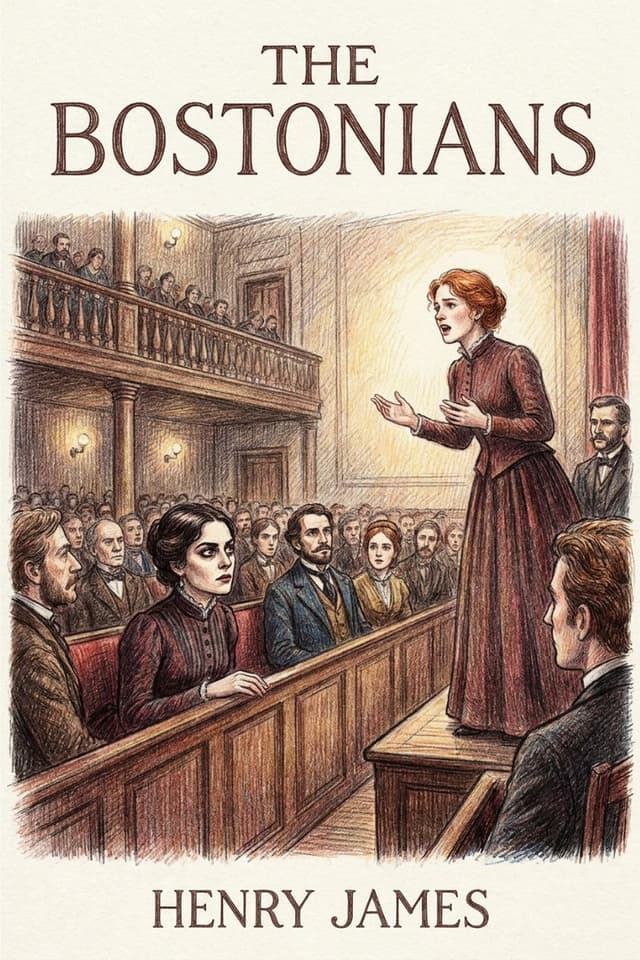
Everything builds toward a single event: Verena's grand debut at the Boston Music Hall, the moment when she will step onto a major stage and speak to a packed audience about the rights of women. It is supposed to be Olive's triumph, the culmination of everything she has worked for.
Basil is in the audience.
And Verena, backstage, is falling apart.
What happens in that concert hall is something you'll have to read for yourself.
About the Author: Henry James
A Privileged Childhood
Henry James was born in 1843 in New York City into a family that was wealthy, brilliant, and relentlessly intellectual. His father was a philosopher and theologian who counted Emerson and Thoreau among his friends. His older brother William would become one of the founders of American psychology. His sister Alice would later be recognized for her extraordinary private journals. The James children were dragged back and forth across the Atlantic throughout their youth, educated by private tutors in Geneva, Paris, London, and Bonn. Henry was absorbing cultures before most children learn geography.
Becoming a Writer
James briefly attended Harvard Law School at nineteen, realized he had no interest whatsoever in law, and devoted himself entirely to literature. By his mid-twenties he was publishing stories and reviews in major American magazines. He left the United States in 1875 and spent the rest of his life in Europe, settling first in Paris and then permanently in England. He never married. An "obscure hurt" to his back suffered in 1861 kept him out of the Civil War and may have shaped his lifelong tendency toward observation over participation.
The Master
James produced an astonishing body of work: twenty-two novels, over a hundred short stories, plays, travel writing, literary criticism, and memoirs. His early novels like The American and Daisy Miller explored clashes between American innocence and European sophistication. The Portrait of a Lady, published in 1881, established him as a major figure. His later works, including The Wings of the Dove, The Ambassadors, and The Golden Bowl, grew increasingly complex and experimental, pioneering techniques of psychological interiority that would become central to modernist fiction.
Final Years
In 1915, appalled by America's refusal to enter World War I, James became a British citizen as an act of protest. He died in London on February 28, 1916, at the age of seventy-two. He had been nominated for the Nobel Prize in Literature three times. Today he is considered one of the greatest novelists in the English language, a writer who bridged the gap between Victorian realism and literary modernism.
Fun Facts About the Book
The Book That Tanked
The Bostonians was a commercial and critical failure when it was published. Reviewers found it tedious and overlong. The serialization in The Century Magazine was widely disliked. Mark Twain said he would rather be damned than read it. James was so stung by the reception that he never attempted another overtly political novel.
James Disowned It
When James assembled the definitive New York Edition of his collected works in 1907, he left The Bostonians out. He also excluded The Europeans and Washington Square. He later admitted he didn't have the courage to reread it for revision. Some scholars believe the real reason was more personal.
The Alice Problem
James's own sister, Alice James, lived for years in what was known as a "Boston marriage" with her companion Katharine Loring, a devoted and strong-willed woman who traveled with Alice and cared for her through chronic illness. The parallels between Alice and Katharine's relationship and the Olive-Verena dynamic are impossible to ignore, and James may have excluded the novel from his collected works partly out of family discretion.
Boston Marriage
The term "Boston marriage" was already in use in the late 19th century to describe two women living together in a long-term committed relationship. Whether these arrangements were romantic, sexual, or simply practical companionship was left deliberately ambiguous by polite society. The Bostonians is one of the earliest American novels to explore this territory, and Olive Chancellor's feelings for Verena remain one of the most debated aspects of the book.
The Miss Birdseye Controversy
Contemporary readers believed that the character of Miss Birdseye was a thinly veiled portrait of Elizabeth Palmer Peabody, a real and revered Boston reformer, educator, and sister-in-law to Nathaniel Hawthorne. James denied the connection, but the resemblance was close enough to cause genuine offense in Boston literary circles.
Inspired by a French Novel
James drew his initial idea from Alphonse Daudet's novel L'Evangeliste, about an older woman who draws a younger woman under her sway for a religious cause. James transplanted the concept to Boston and swapped religion for feminism, adding the complication of a male rival and transforming the story into something entirely his own.
Superman vs. the Suffragettes
The 1984 Merchant Ivory film adaptation starred Christopher Reeve, fresh off three Superman films, as Basil Ransom, with Vanessa Redgrave as Olive Chancellor. Redgrave earned an Academy Award nomination for Best Actress for the role. The film also featured Jessica Tandy and Linda Hunt in supporting parts.
Themes
Who Owns Verena?
The central question of the novel isn't really about feminism or conservatism. It's about possession. Both Olive and Basil want to claim Verena, to shape her into what they need her to be. Olive wants a partner and a voice for the movement. Basil wants a wife who will abandon public life and devote herself to him. Neither one is much interested in what Verena herself might want, because Verena, frustratingly, doesn't seem entirely sure.
The Personal Is Political
Every relationship in the novel is tangled up with ideology. Olive's love for Verena is inseparable from her feminism. Basil's courtship is inseparable from his conservative belief that women belong in the domestic sphere. Even Verena's own gift for public speaking is compromised by the suspicion that it might be more performance than conviction. James refuses to let anyone off the hook.
North and South, Still at War
The Civil War is over, but the cultural war between the North and South is alive in every conversation between Olive and Basil. He represents a defeated but unrepentant Southern worldview. She represents the reforming, moralizing energy of New England. Their battle over Verena is also a battle over the soul of post-war America.
The Emptiness of Idealism
James treats the Boston reform community with affection but also with devastating satire. The activists are sincere but often ridiculous. Their meetings are full of passion and short on practical results. Miss Birdseye is noble but also a bit of a joke. The newspapers treat the movement as entertainment. James suggests that idealism, no matter how genuine, can become its own kind of performance.
Women's Autonomy
For a novel that satirizes feminism, The Bostonians is surprisingly sharp about why the movement exists in the first place. The women in the novel have limited options. Their intelligence and ambition have few legitimate outlets. Olive's intensity and possessiveness are partly the result of a world that gives her nowhere else to direct her considerable energies. The novel may mock the movement, but it also makes the case for its necessity.
The Book's Legacy
The Bostonians was largely ignored for decades after its publication, dismissed as one of James's lesser efforts. Its revival began in the mid-20th century, when critics started recognizing its remarkably modern themes: the politics of identity, the blurred lines between personal desire and political commitment, and the question of what it means to have a public voice in a democracy that rewards spectacle.
The novel's treatment of Olive Chancellor's feelings for Verena has made it a landmark in LGBTQ literary history. While James never makes Olive's desires fully explicit, the emotional intensity of her attachment to Verena is unmistakable, and modern readers have found in the novel one of the most psychologically rich portraits of same-sex desire in 19th-century fiction.
The 1984 Merchant Ivory film brought the story to a wider audience, with Vanessa Redgrave's performance giving Olive a depth and sympathy that many felt exceeded even what James himself had managed on the page. The film earned multiple award nominations and remains one of the more successful adaptations of James's notoriously difficult-to-film novels.
Today the novel reads as startlingly relevant. The tug-of-war over a charismatic young woman's voice, the weaponization of personal relationships for political ends, the question of whether public performance can ever be authentic: these are not 19th-century problems. They are right now problems. The Bostonians may have failed in its own time, but time has caught up to it.