Novelhalla
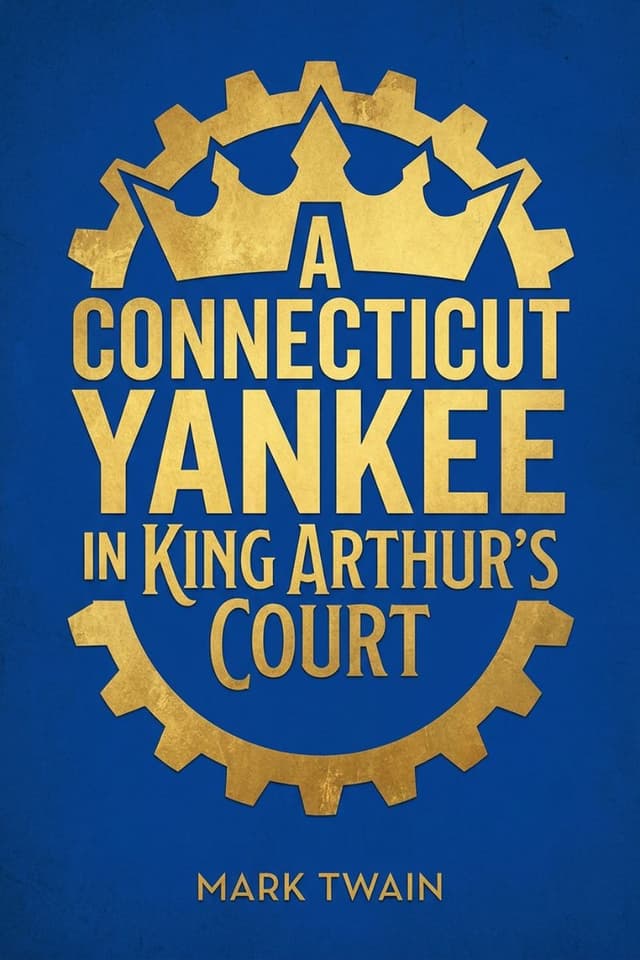
A Connecticut Yankee in King Arthur's Court
Read A Connecticut Yankee in King Arthur's Court by Mark Twain for free on Novelhalla, and try out our easy-to-read modern edition of this classic book. You can also download the EPUB and read it on any device if you prefer!
The Plot
A Stranger at Warwick Castle
It starts with a chance meeting. A tourist wandering through Warwick Castle in England falls into conversation with an odd, friendly stranger who talks about ancient armor as if he'd personally known the men who wore it. Later that night, the stranger shows up at the tourist's hotel room, settles in by the fire, and starts telling the strangest story you've ever heard. When he gets too tired to keep going, he hands over a weathered manuscript and says the rest is all written down.
A Very Bad Day at the Factory
The stranger is Hank Morgan, a head superintendent at the Colt arms factory in Hartford, Connecticut. He's a practical, no-nonsense nineteenth-century man who can build just about anything: guns, engines, telegraphs, you name it. He's also not one to back down from a fight, which is how he ends up getting clobbered over the head with a crowbar by one of his own workers.
When Hank wakes up, he's lying under an oak tree in a green countryside he doesn't recognize. A knight in full armor is charging at him with a lance. Hank assumes he's stumbled onto a circus or escaped from an asylum. Then he's marched off to a towering castle called Camelot, and it slowly sinks in that the year is 528 AD and he's a prisoner in the court of King Arthur.
Camelot Isn't What the Poems Promised
The legendary Round Table turns out to be a rowdy bunch of grown men bragging about their jousting, telling the same tired stories, and barely able to read. The common people live in filth and fear, the Church and the nobility run everything, and the most powerful man in the room might be Merlin, a crusty old magician whose reputation is built on tricks Hank sees through immediately.
Unfortunately, being clever doesn't help much when you've been sentenced to be burned at the stake. Hank's only hope is the one thing nobody in sixth-century Britain has: a nineteenth-century education. He knows things these people can't imagine, and he happens to remember a very specific detail about the sky. If he can play it right, he won't just survive. He might end up running the place.
The Boss
Hank has big plans for Camelot. Why should a kingdom live in the dark when he knows how to build factories, schools, newspapers, and telephones? Why should knights wander around fighting each other when they could be selling soap? He takes on a title the people give him, "The Boss," and starts quietly dragging medieval England toward the modern world.
But Merlin hasn't forgotten being upstaged, the Church is watching very carefully, and old habits run deeper than Hank expects. Before long he's sent off on a quest he doesn't want, alongside a young woman named Sandy who can talk for hours without ever getting to the point. He'll cross paths with the terrifying Morgan le Fay, face down magicians and miracles, and eventually talk the king himself into disguising himself as a peasant to see how his people really live. That last idea seems brilliant at the time.
Meanwhile, a challenge from the knight Sir Sagramore is hanging over Hank's head, and the whole kingdom is waiting to see what happens when a man with a factory's worth of knowledge goes up against a world that has no intention of changing.
About the Author: Mark Twain
A Missouri Boyhood
Mark Twain was born Samuel Langhorne Clemens on November 30, 1835, in Florida, Missouri, the same year Halley's Comet passed by Earth. He grew up in Hannibal, a small town on the Mississippi River that would later become the model for St. Petersburg in Tom Sawyer and Huckleberry Finn. His father died when he was eleven, and he left school soon after to work as a printer's apprentice.
River Pilot and Wanderer
As a young man, Clemens fulfilled a childhood dream by becoming a licensed steamboat pilot on the Mississippi. The Civil War shut down river traffic, and after a very brief stint with a volunteer militia, he headed west to Nevada with his brother Orion. He tried his luck at silver mining, failed, and wound up writing for a Virginia City newspaper, where he first signed his work "Mark Twain," a riverboat term meaning two fathoms of safe water.
Fame and Family
A comic short story about a jumping frog made him nationally known in 1865, and his travel book The Innocents Abroad made him a bestselling author. In 1870 he married Olivia Langdon, and the couple eventually built a grand, eccentric house in Hartford, Connecticut. The Hartford years were his most productive, giving the world The Adventures of Tom Sawyer, The Prince and the Pauper, Adventures of Huckleberry Finn, and A Connecticut Yankee.
Money Troubles and Tragedy
Twain loved inventions and poured a fortune into the Paige typesetting machine, a marvel of engineering that never worked reliably. Combined with the failure of his publishing company, it drove him into bankruptcy in the 1890s. He went on a grueling worldwide lecture tour to pay off his debts and succeeded, but the years that followed brought heavy personal losses, including the deaths of his daughter Susy and his wife Livy.
Final Years
In his later life, Twain became a white-suited celebrity, famous for his wit and increasingly known for his dark, skeptical views on human nature. He had once predicted he'd go out with Halley's Comet, and he was right. He died on April 21, 1910, in Redding, Connecticut, one day after the comet's closest approach.
Fun Facts About the Book
It All Started in a Bookstore
The idea for the novel came during a rainy day in Rochester, New York, in December 1884. Twain and fellow author George Washington Cable were on a joint lecture tour and ducked into a bookstore to get out of the weather. Cable handed Twain a copy of Sir Thomas Malory's Le Morte d'Arthur and suggested he read it on the road.
"Sir Mark Twain"
Twain fell hard for Malory's old-fashioned language. For the rest of the tour, he and Cable talked to each other in mock-medieval speech on trains and in hotels, and they even sent their manager a telegram written in Malory style, signed "Sir Mark Twain" and "Sir Geo. W. Cable."
The Illustrations Twain Called Better Than the Book
The first edition featured 221 illustrations by Dan Beard, and Twain loved them so much he said they were better than the book itself. Beard slipped in some sly jokes of his own, including drawing Merlin with the face of the poet Alfred Tennyson, whose dreamy Arthurian poems were exactly the kind of romance Twain was poking fun at. Beard later became one of the founders of the Boy Scouts of America.
A Different Title Overseas
The British edition was released as A Yankee at the Court of King Arthur, since "Connecticut" didn't mean much to English readers.
Hank Is a Hartford Man
Twain lived in Hartford while writing the book, and he made Hank a worker at the real Colt arms factory there. The city was one of America's great manufacturing hubs, so it made sense as the hometown for a man who believes machinery can fix the world.
A Time Traveler Before Time Travel
The novel came out in 1889, six years before H.G. Wells published The Time Machine. It's often cited as one of the earliest stories about a modern person landing in the past, and it practically invented the idea of someone using future knowledge to change history.
A Five-Year Project
Twain worked on the book on and off from 1884 to 1889. What began as a lighthearted send-up of knights and chivalry grew darker and more complicated as he kept writing, and as his own life and finances got more complicated too.
Twain's Own Love of Machines
Hank's faith in technology mirrors Twain's own. While writing the novel, Twain was sinking huge sums into the Paige typesetter, which he was convinced would change the world. Readers who know how that investment turned out often find Hank's story extra interesting.
Themes
Progress and Its Price
Hank believes that science, industry, and education can lift anyone out of misery. The novel takes that belief seriously and lets you cheer for it, but it also keeps asking what happens when one man decides he knows what's best for an entire society.
Superstition Versus Reason
Merlin's "magic" and Hank's science are constantly set against each other. Much of the comedy comes from Hank staging scientific tricks as miracles, but the book also asks why people are so willing to believe in wonders, and whether a showman with a machine is all that different from a showman with a spell.
The Myth of the Good Old Days
Writers like Tennyson and Sir Walter Scott had painted the age of chivalry as noble and romantic. Twain wanted to show what it might have actually been like: dirty, cruel, and ruled by people who'd never done a day's work. It's a hilarious takedown of nostalgia for a past that never really existed.
Kings, Commoners, and Human Dignity
When Hank and Arthur travel among ordinary people, the book confronts the realities of hereditary rule, unfair laws, and lives spent in service to others. Twain is fascinated by how people come to accept their own oppression, and by how hard it is to imagine a different life once you've been raised to believe you deserve less.
Training and Human Nature
Hank keeps running into the same wall: people act the way they've been raised to act. The novel wrestles with whether human beings can truly be changed, or whether centuries of habit are stronger than any good idea.
The Book's Legacy
After Tom Sawyer and Huckleberry Finn, this is the Twain story that's been adapted most often for the screen. A silent film came out in 1921, and in 1927 Richard Rodgers and Lorenz Hart turned it into a hit Broadway musical that ran for 421 performances and returned in a 1943 revival. Will Rogers starred in a 1931 film version, and Bing Crosby crooned his way through Camelot in a popular 1949 musical. Later takes include a Bugs Bunny special, Disney's Unidentified Flying Oddball, a 1989 TV movie, and loose updates like Martin Lawrence's Black Knight.
Its biggest influence might be on science fiction itself. The basic idea of a modern person dropped into the past who tries to change history with what they know has become a whole genre, from L. Sprague de Camp's Lest Darkness Fall to countless modern time-travel and "isekai" stories.
The book also holds a special place in Twain's career. It's funnier than people expect, sharper than people remember, and much stranger than its cheerful movie versions suggest. It's Twain at the peak of his powers, laughing at kings, knights, churches, and his own century all at once, and slowly letting the jokes turn into something deeper.