Novelhalla
Main Street
Read Main Street by Sinclair Lewis for free on Novelhalla, and try out our easy-to-read modern edition of this classic book. You can also download the EPUB and read it on any device if you prefer!
The Plot
The Dream
Carol Milford is young, college-educated, and burning with a vision. Growing up in Minneapolis and working as a librarian in St. Paul, she has convinced herself that somewhere out there is a drab little prairie town just waiting for someone like her to transform it into something beautiful. She wants to be the person who brings culture, art, and civic pride to a place that doesn't know it needs those things yet.
Then she meets Will Kennicott. He's a country doctor from a small Minnesota town called Gopher Prairie. He's practical, good-natured, and proud of his hometown in the way only someone who has never questioned it can be. He talks about the place like it's the heart of America. Carol listens, and she sees her chance. She marries him.
The Arrival
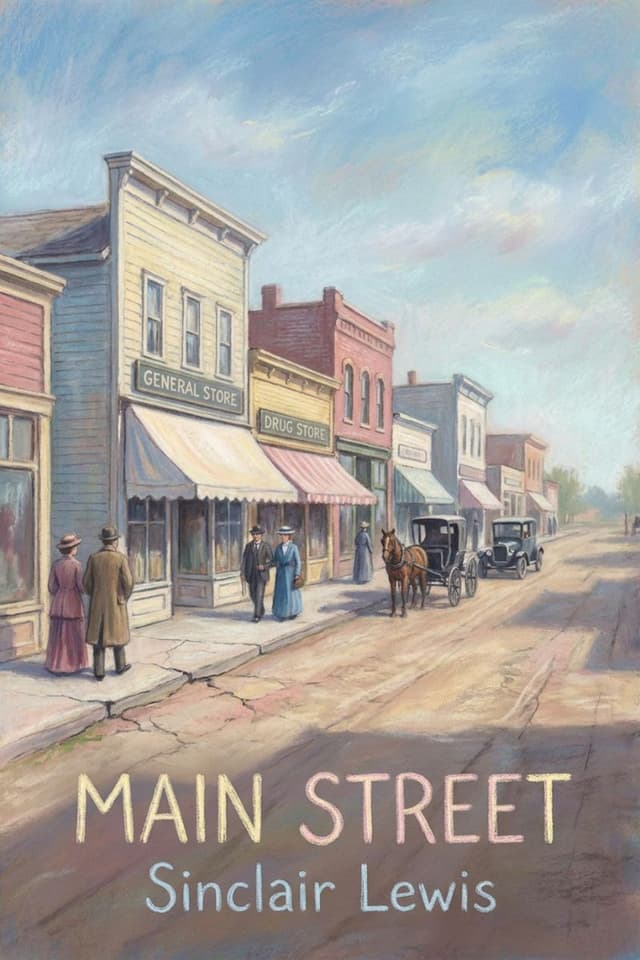
The train pulls into Gopher Prairie, and Carol's fantasy starts crumbling before she even steps off the platform. The town is flat, treeless, and architecturally hopeless. Main Street is a stretch of two-story brick buildings flanked by lumber wagons and Fords. Three thousand people live here, and most of them seem perfectly content with things exactly the way they are.
Carol is not content. She redecorates the Kennicott house with modern furniture. She throws an elaborate party unlike anything Gopher Prairie has seen. She proposes a new city hall, a proper library, a theater group. She has ideas for everything.
The town watches her. And the town talks.
The Resistance
Every initiative Carol launches runs into the same wall. The women of the Jolly Seventeen, the town's exclusive social club, smile politely and change the subject. The Thanatopsis literary society turns every discussion into gossip. The businessmen want things exactly as profitable and predictable as they've always been. Even Carol's few allies have limits. Guy Pollock, a quiet bachelor lawyer, understands her frustration but confesses he's caught what he calls the "Village Virus," a slow deadening of ambition that comes from staying too long in a place like this. Vida Sherwin, the high school teacher, shares some of Carol's instincts but counsels patience that sounds a lot like surrender.
The only person who truly matches Carol's rebellious energy is Miles Bjornstam, the town handyman everyone calls "The Red Swede." He's a socialist, a Democrat, an atheist in a town full of Baptists, and he doesn't care who knows it. The town treats him like a pariah. Carol finds him refreshing. But even Miles can't hold out forever against the weight of Gopher Prairie's judgment.
The Trap
Carol's theater group puts on a play so bad it makes her want to disappear. Her proposals for civic improvement are politely ignored or quietly sabotaged. She has a baby, Hugh, and the rhythms of motherhood and small-town domesticity begin to close around her. She watches herself becoming the thing she swore she'd never be: comfortable. Numb.
Meanwhile, the town isn't finished with the people who don't fit. Fern Mullins, a young teacher from Minneapolis, arrives with the same kind of energy Carol once had. She's smart, physical, unguarded. It takes almost nothing for Gopher Prairie to destroy her reputation. Cy Bogart, a teenage troublemaker, gets Fern tangled in a scandal at a barn dance, and the town's gossip machine does the rest. Fern leaves on the train, the way everyone who doesn't belong eventually does.
And then there's Erik Valborg. He's a tailor's assistant with artistic ambitions and a romantic streak, and he and Carol find in each other the kind of intellectual companionship neither has anywhere else in town. Whether it stays intellectual is a question the whole town is watching very, very closely. Will Kennicott is watching too.
The Breaking Point
Carol is caught between a husband she respects but can't fully connect with, a town that tolerates her only when she behaves, and a growing certainty that if she stays much longer, the Village Virus will finish what it started. The world beyond Gopher Prairie is enormous and changing fast. World War I is raging. Women are finding new kinds of work, new kinds of freedom.
The train that carried Fern Mullins away, that carried Miles Bjornstam away, that carries away everyone the town can't absorb, is still running. And Carol knows exactly where the station is.
Whether she has the courage to buy a ticket, and what she'll find if she does, is the question at the center of everything.
About the Author: Sinclair Lewis
The Outsider from Sauk Centre
Harry Sinclair Lewis was born in 1885 in Sauk Centre, Minnesota, the son of a country doctor. He was the youngest of three boys, and from the start he didn't fit. Red-haired, awkward, shy, with a face scarred by acne, Lewis was an outsider in his own hometown. His mother died of tuberculosis when he was six. His father remarried the following year. Lewis spent his childhood reading voraciously, reportedly working through every book in the public library. At thirteen, he tried to run away from home to become a drummer boy in the Spanish-American War. His father caught him before he got far.
Yale and Wandering
Lewis left Minnesota in 1902 for Oberlin Academy, then entered Yale in 1903. He didn't quite fit there either, but he found his voice as a writer, becoming the only freshman to publish in the Yale Literary Magazine. Restless as always, he left Yale in 1906 to work as a janitor at Upton Sinclair's utopian commune in New Jersey, sailed cattle boats to England, and traveled to Panama. He finally graduated in 1908 and spent the next several years bouncing between publishing jobs, freelance writing, and travel. He married Grace Livingston Hegger, an editor at Vogue, in 1914. His first five novels were competent but forgettable.
The Breakthrough
Everything changed in 1920. Lewis had been taking notes for a realistic novel about small-town life since 1916, drawing heavily on his memories of Sauk Centre. The result was Main Street, and it detonated. His biographer Mark Schorer called it the most sensational event in twentieth-century American publishing. The book sold 180,000 copies in its first six months and made Lewis famous overnight. He followed it with a string of masterworks through the 1920s: Babbitt, Arrowsmith, Elmer Gantry, and Dodsworth. Each one took aim at a different pillar of American life: the businessman, the scientist, the preacher, the expatriate.
The Nobel and the Decline
In 1930, Lewis became the first American to win the Nobel Prize for Literature. But the prize came at the peak. His second marriage, to the journalist Dorothy Thompson, ended in divorce. His son Wells, from his first marriage, was killed by a sniper in France during World War II. Lewis's later novels never matched the power of his 1920s work. He struggled with alcoholism that worsened through the decades. His reputation faded even as younger writers like Hemingway and Faulkner eclipsed him. Lewis spent his final years largely alone in Europe, increasingly isolated and aware that his best work was behind him. He died on January 10, 1951, in a clinic outside Rome. He was sixty-five. His ashes were returned to Sauk Centre and buried in the family plot.
Fun Facts About the Book
The Pulitzer That Wasn't
Main Street was chosen for the 1921 Pulitzer Prize by the selection jury. Then the board of trustees at Columbia University overruled them. They had quietly changed the award criteria from novels representing the "whole" character of American life to those representing the "wholesome" character of American life. That single added syllable was enough to disqualify Lewis's blistering satire. The prize went to Edith Wharton for The Age of Innocence instead. When Lewis won the Pulitzer five years later for Arrowsmith, he refused it, still furious about what had happened with Main Street.
The Autobiography Hidden in Plain Sight
Lewis didn't just base Gopher Prairie on his hometown. He essentially split himself into the novel's two leads. He once wrote that Carol was "sensitive and articulate," and inscribed his wife's copy with the dedication "To Gracie, who is all the good part of Carol." But Lewis admitted he was also Will Kennicott, the pragmatic, downright side. The marriage at the center of Main Street is, in some sense, a war between the two halves of Lewis's own personality.
Warner Bros.' First Movie
The novel's success led to a stage adaptation in 1921 and a silent film in 1923. That film holds a peculiar distinction: it was the first movie ever produced by Warner Bros. studio. The company that would later give the world Casablanca and The Dark Knight got its start adapting a satire about small-town Minnesota.
A Publishing Earthquake
Nobody expected Main Street to be a hit. Lewis hoped for 10,000 copies. His publisher predicted maybe 20,000 or 25,000. The printers couldn't keep up with demand, and booksellers had to be rationed copies. A fox-trot song called "Main Street" appeared almost immediately. Within months, the novel was sitting between the Bible and Ben-Hur in boarding house parlors across America.
The Town That Banned It
The public library in Alexandria, Minnesota, just down the road from Sauk Centre, banned the book. Small-town residents across the Midwest recognized themselves in Lewis's portrait and didn't appreciate it. Meanwhile, Sauk Centre's high school sports teams were eventually nicknamed "the Main Streeters" by rival schools, a label the town eventually embraced.
Lewis the Mimic
Lewis was famous for his ability to absorb and reproduce the speech patterns, mannerisms, and conversational tics of real people. His dialogue in Main Street has an almost documentary quality. H.L. Mencken praised the novel specifically for its uncanny accuracy of speech. Lewis could walk into a room, listen for an hour, and then perform every person in it.
Themes
The Village Virus
Guy Pollock gives this condition its name in the novel, but Carol watches it at work everywhere. The Village Virus is what happens to ambitious, thoughtful people who stay too long in a place that rewards conformity and punishes difference. It's a slow erosion of will, a gradual acceptance that things are fine the way they are. The novel asks whether anyone can resist it, or whether the only cure is leaving.
The Myth of Small-Town America
Before Main Street, the dominant cultural image of the American small town was sentimental and warm. Lewis attacked that myth with surgical precision. His Gopher Prairie isn't evil. It's something harder to fight: mediocre. The pettiness, the gossip, the suspicion of anything unfamiliar, the pride in ordinariness. Lewis argued that these weren't charming quirks. They were a kind of suffocation.
Women and the Limits of Choice
Carol Kennicott has no money of her own, no profession she can practice in Gopher Prairie, and no real power beyond persuasion. Her options are to accept her husband's world or leave it. The novel never lets you forget how narrow those options are. Every woman in the book, from the energetic Vida Sherwin to the doomed Fern Mullins to the loyal Bea Sorenson, is shaped and constrained by what the town will allow.
The Outsider's Dilemma
Carol wants to improve Gopher Prairie, but she wants to improve it according to her own vision, which the town sees as foreign and condescending. The novel is honest about this tension. Carol's taste isn't always better than the town's. Her plans are sometimes naive, her frustration sometimes selfish. But the town's reflexive rejection of anything new is just as destructive. Neither side can fully hear the other, and that impasse is the novel's most painful truth.
Conformity as Social Control
Gopher Prairie doesn't need laws to enforce its values. It has gossip. Every character who steps out of line is watched, discussed, and ultimately driven out or ground down. Miles Bjornstam. Fern Mullins. Erik Valborg. Even Carol herself. The surveillance is constant and the judgment is swift. Lewis shows how a community can weaponize politeness and neighborliness into instruments of control.
The Marriage Question
Will Kennicott is not a villain. He's decent, hardworking, and genuinely loves Carol. But he cannot understand what she wants because he has never wanted anything beyond what he already has. The marriage at the novel's center is a portrait of two fundamentally different ways of being in the world, living under the same roof and talking past each other. Lewis refuses to take easy sides.
The Book's Legacy
Main Street didn't just sell millions of copies. It changed the way Americans talked about themselves. Before Lewis, the small town was sacred ground in the national imagination. After him, it was fair game. The phrase "Main Street" entered the language as shorthand for provincialism, conformity, and the gap between American ideals and American reality.
The novel helped launch what critics called the "revolt from the village," a literary movement that included writers like Sherwood Anderson and Edgar Lee Masters. Lewis proved that American fiction could be both popular and critical, that readers would buy a book that told them uncomfortable truths about their own culture.
His influence reached writers like Kurt Vonnegut, John Updike, and Tom Wolfe, all of whom acknowledged Lewis as a pioneer in realistic, satirical fiction about American life. Garrison Keillor's Lake Wobegon stories owe a quiet debt to Gopher Prairie, playing the same territory with more affection but the same sharp eye.
The novel also helped make Lewis the first American to win the Nobel Prize for Literature in 1930. The Nobel committee specifically cited Main Street in their presentation speech. In 1998, the Modern Library ranked it number sixty-eight on its list of the hundred best English-language novels of the twentieth century.
More than a hundred years after its publication, Main Street remains startlingly relevant. Its portrait of a culture suspicious of expertise, hostile to change, and fiercely protective of its own mediocrity reads less like history and more like a dispatch from last week. Carol Kennicott's frustration, her loneliness, her stubborn refusal to stop wanting more, still resonates with anyone who has ever felt like the only person in the room who thinks things could be better.