Novelhalla
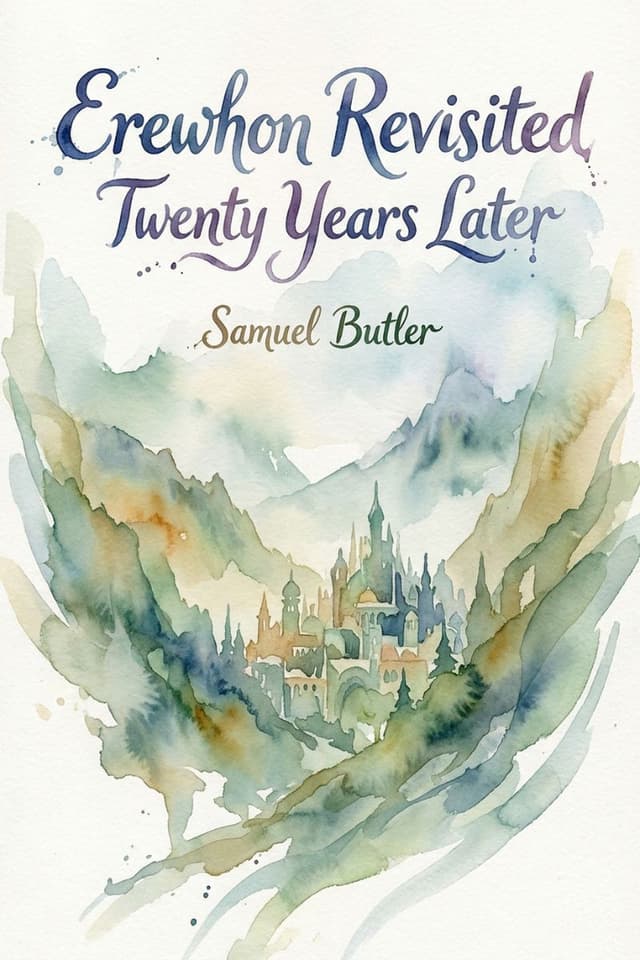
Erewhon Revisited Twenty Years Later
Read Erewhon Revisited Twenty Years Later by Samuel Butler for free on Novelhalla, and try out our easy-to-read modern edition of this classic book. You can also download the EPUB and read it on any device if you prefer!
The Plot
Erewhon Revisited is a sequel set twenty years after the events of the original Erewhon. The story is narrated by John Higgs, son of the original explorer.
Background from Erewhon
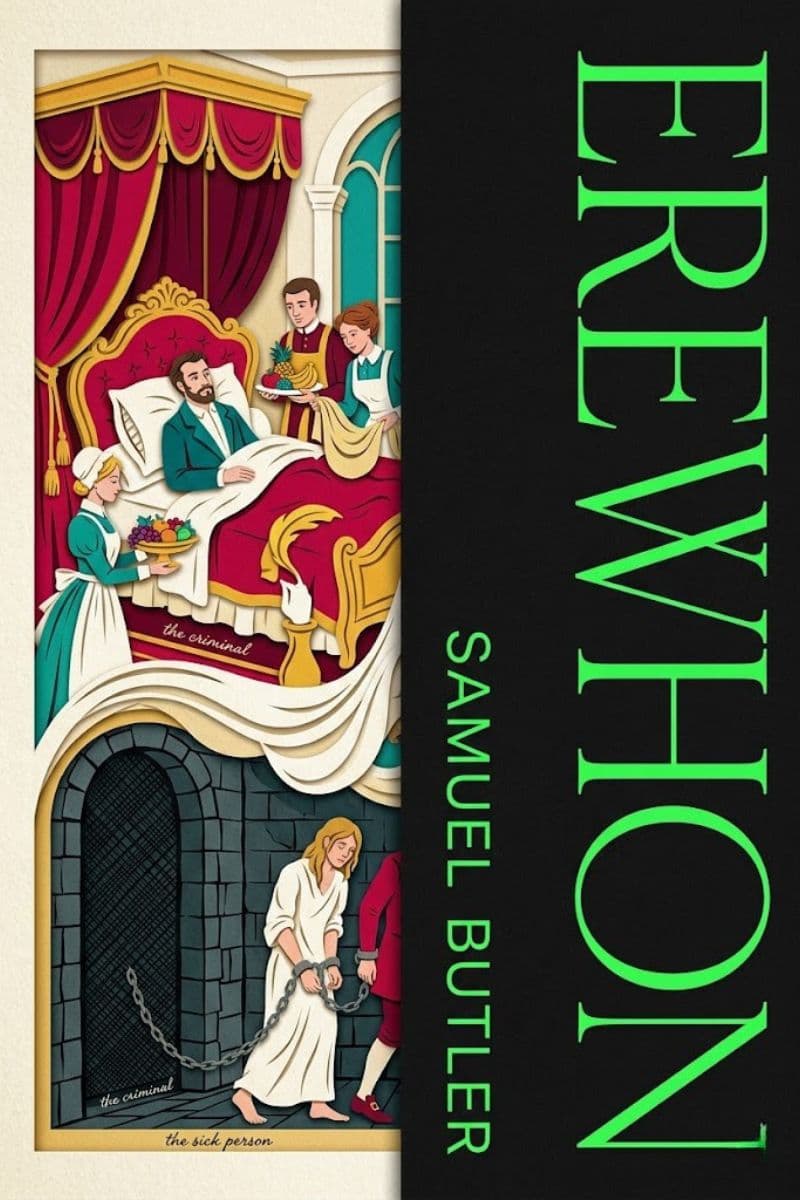
In the first novel, an unnamed English protagonist discovers the hidden land of Erewhon while working as a sheep farmer in New Zealand. He finds a society where illness is treated as a crime punishable by imprisonment, while criminal behavior is treated compassionately as a disease to be cured. All machines have been destroyed after philosophers warned they would evolve to dominate humanity. The protagonist falls in love with Arowhena, daughter of his host family, and eventually escapes with her by hot air balloon, returning to England where they marry.
The Sequel
Twenty years later, the protagonist (now revealed to be named Higgs) returns to Erewhon after his wife's death. What he discovers astonishes him: his dramatic balloon escape has been interpreted as a miraculous ascension into heaven. He is now worshipped as "the Sunchild," and an entire religion called Sunchildism has sprung up around him.
A temple has been built at a town renamed Sunchildston. His casual remarks from his original visit have been transformed into sacred texts, though badly garbled in transmission. Eyewitnesses claim to have seen horses flying alongside his balloon (actually birds) and have even preserved what they believe to be holy droppings from these celestial creatures.
Higgs reunites with Yram, a woman he had a relationship with during his first visit. She is now married to the mayor and is mother to George, Higgs's illegitimate son. George has grown into a capable young man who works as a ranger guarding the mountain passes.
About the Author: Samuel Butler
Early Life
Samuel Butler was born on December 4, 1835, at the rectory in Langar, Nottinghamshire. His father was the Reverend Thomas Butler, and his grandfather was Dr. Samuel Butler, the famous headmaster of Shrewsbury School who later became Bishop of Lichfield. Butler attended Shrewsbury School and then St. John's College, Cambridge, where he studied classics.
Crisis of Faith
After university, Butler began preparing for ordination in the Church of England, as his family expected. But working with the poor in London caused him to question his faith deeply. He refused to take holy orders, causing a bitter conflict with his domineering father. When Butler expressed interest in becoming an artist instead, his father refused to fund it.
New Zealand Adventure
A compromise was reached: Butler's father would finance him to seek his fortune as a sheep farmer in New Zealand. Butler arrived at Lyttelton in January 1860, just after narrowly avoiding death by canceling his berth on a ship that was lost at sea with all hands.
Finding all the known sheep country already claimed, Butler explored the mountain headwaters of Canterbury's rivers. He discovered the land that would become his Mesopotamia Station, named for its position between rivers. After a famous race against a rival claimant to the Christchurch Land Office, he secured his claim and built the station into a 55,000-acre operation that doubled his initial capital in four years.
During this time, Butler explored the Southern Alps, discovering mountain passes that now bear his name. He also began writing, contributing articles to the Christchurch Press including "Darwin Among the Machines" (1863), which would become the seed of Erewhon.
Return to England
Butler returned to England in 1864, possibly due to a failed romance. He settled in rooms at Clifford's Inn in London, where he would live for the rest of his life. He tried to become a painter, exhibiting some works at the Royal Academy, but eventually turned to writing.
Literary Career and Controversies
Erewhon was published anonymously in 1872 and was Butler's only commercial success, earning him about 69 pounds. He spent much of his later life antagonizing both the religious establishment and the scientific community. He wrote several books attacking Darwin's theory of natural selection, championing instead Lamarckian evolution, which made him unpopular with both camps.
Butler also produced deliberately provocative scholarship: The Authoress of the Odyssey (1897) argued that Homer's epic was written by a young Sicilian woman, while Shakespeare's Sonnets Reconsidered (1899) contended that Shakespeare wrote his sonnets for a male lover.
Later Years and Death
Poor book sales and bad investments kept Butler financially dependent on his family until his father's death in 1886 finally gave him independence. He spent his summers traveling in Italy, which he loved, and maintained a small circle of close friends including Henry Festing Jones, who would later write his biography.
Butler died in London on June 18, 1902. His autobiographical novel The Way of All Flesh, a devastating attack on Victorian family life that he had worked on for years, was published posthumously in 1903 and cemented his reputation as a major literary figure.
Fun Facts About the Book
Publication Troubles
When Butler submitted Erewhon Revisited to his regular publisher Longman, they rejected it for fear of offending their High Church clientele, even when Butler offered to pay the printing costs himself. Butler wrote to George Bernard Shaw admitting the book was "far more wicked than Erewhon" and asking for advice. Shaw recommended his own publisher, Grant Richards, and the book finally appeared in 1901.
Written Quickly
While the original Erewhon took nearly ten years to write and was composed with great difficulty, Butler wrote Erewhon Revisited easily between November 1900 and April 1901, just months before his death.
A More Unified Work
Butler himself acknowledged that Erewhon was essentially a collection of satirical essays loosely strung together with minimal plot. He considered Erewhon Revisited the superior work in literary craftsmanship, with a genuine story and developed characters. The Cambridge History of English and American Literature agreed, noting that while the sequel has less imaginative freedom, it surpasses the original in "sharp brilliance of wit and criticism, in intellectual unity and coherence."
The Hanky-Panky Professors
The villainous professors who guard Sunchildism are named Hanky and Panky, giving us a satirical origin for the phrase suggesting deception and trickery. They represent the religious authorities who have too much invested in their faith to allow mere facts to interfere.
Holy Horse Droppings
One of the book's most pointed satirical details involves the Erewhonians preserving what they believe to be sacred droppings from the horses that supposedly flew alongside the Sunchild during his ascension. These were actually just bird droppings, demonstrating how mundane reality gets transformed into sacred relics.
Misremembered Scripture
The Sunchildist religion is based on garbled versions of things Higgs actually said, some of which were themselves Christian teachings he had tried to share. Butler uses this to suggest how religious doctrines might become distorted through oral transmission and selective memory.
The Name Game
Like the original novel, Erewhon Revisited plays with reversed and scrambled names. "Erewhon" is an anagram of "nowhere" (with the h and w transposed). "Yram" is "Mary" spelled backward. The naming convention satirizes how utopian literature creates exotic-sounding names that are often simple wordplay.
Autobiographical Elements
Just as the character Levin in Anna Karenina represents much of Tolstoy himself, many of Butler's protagonists reflect his own experiences. Higgs's New Zealand adventures draw directly from Butler's years at Mesopotamia Station. The mountain journey "over the range" into Erewhon is based on Butler's actual explorations of the Southern Alps.
Themes
How Religions Begin
The central question of Erewhon Revisited is: how does a religion start? Butler shows how a single spectacular event (the balloon escape) that seems miraculous to witnesses, combined with the human tendency to embellish stories over time, can give rise to an entire faith complete with temples, priests, sacred texts, and martyrs.
Institutional Self-Preservation
Professors Hanky and Panky know that Sunchildism is based on misunderstandings, but they have built their careers and status on it. They would rather silence or kill the actual Sunchild than allow him to undermine their religion. Butler suggests this dynamic occurs in all established religious institutions.
The Corruption of Original Teachings
Higgs recognizes his own words in Sunchildist scripture, but they have been transformed beyond recognition. Statements he made have been distorted, reversed, or combined in ways that contradict his original meaning. Butler implies this happened to Christianity as well, with Paul's teachings diverging from Jesus's original message.
Truth Versus Usefulness
The novel raises uncomfortable questions about whether truth matters if a belief system functions socially. Many Erewhonians benefit from Sunchildism regardless of whether the Sunchild actually ascended to heaven. Butler examines whether religion's value lies in its truth claims or in its social utility.
The Returning God
Erewhon Revisited explores a question that has fascinated theologians: what if the founder of a religion returned and saw what had been done in his name? Would he recognize his own teachings? Would his followers accept him, or would they reject him as a threat to their established faith?
The Book's Legacy
Erewhon Revisited has been somewhat overshadowed by its more famous predecessor, but scholars have recognized its sharper satirical focus and improved storytelling. While Erewhon scattered its satire across many Victorian targets, Erewhon Revisited concentrates its attack on organized religion with greater precision.
The original Erewhon influenced major dystopian writers: the "Butlerian Jihad" in Frank Herbert's Dune is named after Butler's warnings about machine consciousness, and Aldous Huxley acknowledged Erewhon's influence on Brave New World. Both novels together established Butler as a pioneer of speculative fiction that uses imaginary societies to critique real ones.
Butler's work anticipated later scholarship on the social construction of religion, the evolution of religious movements, and the gap between founders' intentions and institutional practice. His satirical approach to these questions proved more durable than the explicitly atheist attacks of his contemporaries.