Novelhalla
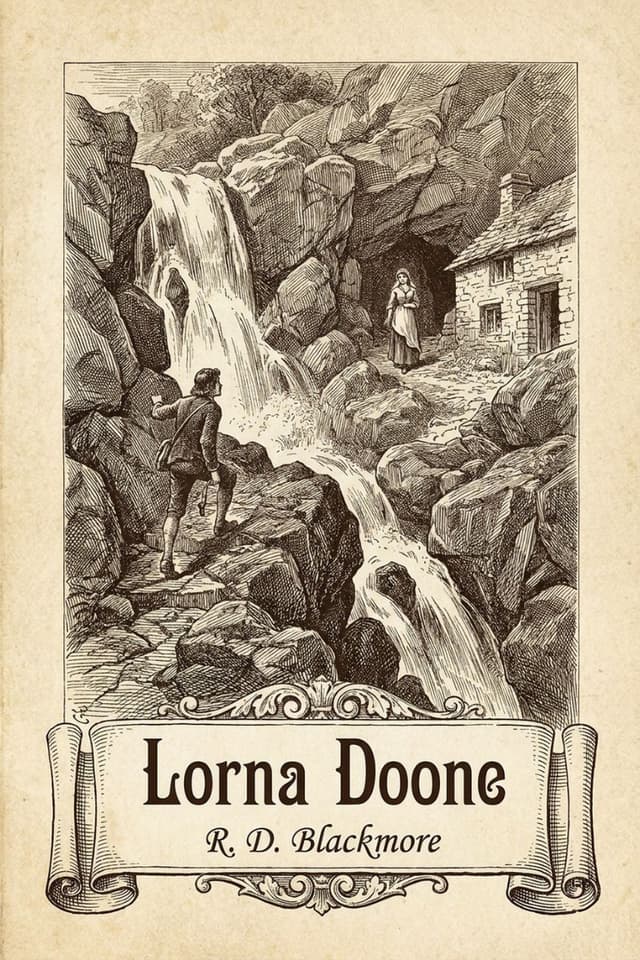
Lorna Doone
Read Lorna Doone by R. D. Blackmore for free on Novelhalla, and try out our easy-to-read modern edition of this classic book. You can also download the EPUB and read it on any device if you prefer!
The Plot
The Boy on the Moor
John Ridd is twelve years old when his father is murdered.
The killers are the Doones, a clan of former aristocrats turned outlaws who have taken over a hidden valley on the wild Exmoor moors. They rob, they terrorize, and when they kill, nobody does a thing about it. The local magistrates are too afraid. The farmers are too scattered. And the Doones are too well-armed and too well-hidden in their fortress valley, where the only way in is a narrow pass that a handful of men could defend against an army.
John goes home to his mother and his sisters. He is the man of the house now. He puts his anger aside and does what needs doing: he works the farm, grows impossibly large, and becomes the strongest man in the district. But he doesn't forget. And he doesn't forgive.
The Girl in the Valley
Then, as a young man, John does something reckless. He climbs up a waterfall, through a gap in the hills, and stumbles into the Doone Valley itself. And there he finds Lorna.
She is beautiful, she is a prisoner, and she is, as far as anyone knows, a Doone. The granddaughter of old Sir Ensor, the aging patriarch of the clan. She has been raised among outlaws, sheltered by her grandfather but surrounded by violence she cannot escape. She is gentle and frightened and completely out of place in a den of thieves.
John falls in love with her on the spot. Which creates a problem so enormous it almost doesn't need stating. This is the family that killed his father. And she belongs to them.
The Secret
They begin meeting in secret. Through hidden paths and moonlit rendezvous in the valley, John and Lorna build something real and tender in the shadow of constant danger. Lorna tells John about her life with the Doones, about her love for her aging grandfather and her terror of everything else, especially Carver Doone.
Carver is the heir apparent, the most brutal and dangerous man in the clan, and he has plans for Lorna. She is to be his wife whether she consents or not. The idea of Lorna belonging to the same man who murdered John's father turns the love story into something with teeth.
Meanwhile, the countryside around Exmoor is growing restless. The Doones have pushed too far, robbed too many, killed too many. The farmers want them gone. The king's men are circling. And the political situation across England is fracturing, as the death of King Charles II sets off a power struggle that will drag even this remote corner of the moors into national upheaval.
The Escape
When old Sir Ensor dies and Carver takes power, everything accelerates. John helps Lorna escape the valley and brings her to his family's farm. His mother and sisters are not exactly thrilled. This is a Doone under their roof. But Lorna's kindness wins them over, and for a brief stretch, something like happiness seems possible.
It doesn't last. Carver wants Lorna back. The Doones attack the farm. A family necklace that Lorna has treasured since childhood is stolen, and its recovery sets off a revelation that changes everything. Lorna, it turns out, is not a Doone at all. She was kidnapped as a child, the sole survivor of a noble family murdered by the very outlaws who raised her.
She is an heiress. A lady of rank and fortune. And the law says she must go to London.
The Distance
John Ridd is a farmer. A strong, good, honest farmer, but a farmer all the same. Lorna is now Lady Lorna Dugal, ward of a nobleman, moving in circles that John can barely imagine, let alone enter. Their love is as real as it ever was, but the gap between their worlds has become a canyon.
And that's before the Monmouth Rebellion throws everything into chaos. The Duke of Monmouth lands with an army to challenge King James for the throne. The Doones, sensing opportunity, pick a side. John gets swept up in events far beyond his control, and before long he is a wanted man, caught up in accusations of treason he had nothing to do with.
He has to clear his name, protect his family, and somehow find a way back to Lorna. But Carver Doone is still out there. And Carver does not forget either.
About the Author: R. D. Blackmore
Early Life
Richard Doddridge Blackmore was born in 1825 at the vicarage in Longworth, Berkshire. His mother died of typhus when he was just three months old, and he was sent to live with his aunt. It was a childhood marked by loss and displacement, but it gave him something that would define his literary career: years spent in the wild, beautiful countryside of Devon and the Exmoor moors, where he absorbed the landscapes, the local speech, and the folk tales that would become Lorna Doone.
Education and False Starts
Blackmore attended Blundell's School in Tiverton, Devon, the same school where his novel opens, and went on to Exeter College, Oxford. He trained as a barrister and was called to the Bar, but ill health, likely including epilepsy, made a courtroom career impossible. He tried teaching classics at a grammar school in Twickenham. That didn't stick either.
The Fruit Grower
An inheritance from an uncle allowed Blackmore to buy sixteen acres at Teddington, near London, where he built a house he named after his favorite dog, a Gordon Spaniel called Gomer. He became a devoted fruit grower, constructing high-walled gardens for his orchards, and by all accounts was prouder of his pears than his prose. The fruit business was never very profitable, which meant he kept writing novels to supplement his income.
The Writer
Blackmore published poems under a pseudonym, translated Virgil, and wrote two novels before Lorna Doone. His third novel was rejected by publishers before being issued anonymously in 1869 in a limited print run of 500 copies. Only 300 sold. It seemed destined for obscurity. Then a rumor spread that the novel was secretly about the family of the Marquess of Lorne, who had recently married into the royal family. Sales exploded. By the time readers realized it wasn't a roman a clef, they didn't care. The book was magnificent on its own terms.
Later Years
Blackmore wrote eleven more novels after Lorna Doone, none of which came close to matching its success. His wife Lucy, who had been in delicate health throughout their marriage, died in 1888. Blackmore was devastated and spent his remaining years at Teddington, looked after by his wife's nieces. He died in January 1900. Thomas Hardy, who admired Blackmore greatly, once wrote to him about their shared sympathy for the English countryside. Blackmore would have appreciated the comparison, but he probably would have preferred to talk about fruit.
Fun Facts About the Book
A Spectacular Flop (At First)
The first edition of Lorna Doone, published anonymously in three volumes in 1869, sold 300 of its 500-copy print run. It was essentially a failure. The following year, a cheap one-volume edition was released, and a combination of word of mouth and a viral rumor about royal connections turned it into a sensation. It has never been out of print since.
The Royal Rumor
The novel's sudden popularity was fueled by a widespread belief that "Lorna Doone" was a thinly veiled portrait of the Marquess of Lorne's family, who had recently married Princess Louise, Queen Victoria's daughter. It was completely untrue, but by the time the rumor was debunked, the novel had found its audience.
Blackmore Invented the Name "Lorna"
The name "Lorna" did not exist before this novel. Blackmore appears to have coined it, possibly drawing on Scottish sources. After the book's success, it became a popular given name in Britain and remains in use today.
The Doones Were (Probably) Real
Local Exmoor legend holds that a clan of outlaws really did occupy a remote valley in the area during the 17th century. The historical evidence is thin and much debated, but the folk traditions were strong enough that Blackmore could build on them. He always maintained that Lorna Doone was a romance, not a historical novel, and asked readers not to hold him to strict accuracy.
Blundell's School
The novel opens at Blundell's School in Tiverton, Devon, which Blackmore himself attended as a boy. The schoolyard fight that kicks off the story is one of the most vivid school scenes in Victorian fiction. The school still exists and is proud of the connection.
The Great Winter
The brutal winter described in the novel, where snow buries entire farmhouses and the countryside grinds to a halt, was based on the real "Great Winter" of 1683-1684, one of the coldest periods in recorded English history. Blackmore's descriptions of the frozen landscape are among the most celebrated passages in the book.
Ned Kelly's Favorite Book
The Australian bushranger and outlaw Ned Kelly reportedly loved Lorna Doone. Some historians have speculated that the Doones' use of iron armor in the novel may have inspired Kelly's famous homemade suit of armor, which he wore during his last stand at Glenrowan in 1880.
Puccini Almost Made It an Opera
The Italian composer Giacomo Puccini considered adapting Lorna Doone as an opera but ultimately abandoned the idea. Given Puccini's gift for sweeping romance and tragedy, the pairing would have been remarkable.
The Cookie
Nabisco introduced a shortbread cookie called "Lorna Doone" in 1912. The connection to the novel is vague at best. A former Nabisco marketing manager admitted that no record exists explaining why they chose the name, though the company believed shortbread had Scottish associations and the character seemed to fit.
Side Characters
Tom Faggus
John's cousin by marriage, Tom Faggus is a charming highwayman with a legendary horse and a gift for talking his way out of trouble. He is based loosely on a real historical figure. Tom provides much of the novel's humor and dash, a lovable rogue who steals scenes almost as effectively as he steals purses.
Carver Doone
The villain of the novel is a towering, merciless figure who dominates every scene he enters. Carver is not a subtle antagonist. He is brute force given a name, the kind of character who makes you turn pages faster because you know something terrible is coming whenever he appears.
The Counsellor
Carver's father is the brains of the Doone operation, a smooth and manipulative schemer who is far more dangerous than his son precisely because he doesn't look dangerous. He plays the long game while Carver swings the sword.
Themes
Love Across Enemy Lines
The central tension of the novel is a love story built on impossible ground. John loves the woman raised by the men who killed his father. The question of whether love can survive that kind of history drives everything forward.
Class and Worth
John is a farmer. Lorna becomes an heiress. The novel constantly tests whether goodness, strength, and loyalty can bridge the gap between social stations. Blackmore's sympathies are clearly with John, the honest yeoman, but the novel doesn't pretend the class divide is easy to cross.
Revenge and Mercy
John spends the entire novel wrestling with his desire for vengeance against the Doones. The book asks what revenge costs, whether it can coexist with love, and what it means to choose mercy in a world that rewards violence.
Landscape as Character
Exmoor is not just a backdrop. The moors, the valleys, the rivers, and the weather are alive in this novel in a way that goes beyond scenic description. The landscape shapes the characters, dictates their choices, and reflects their inner lives. When winter comes, it nearly kills everyone. When spring arrives, hope returns with it.
Law and Lawlessness
The Doones exist because the law cannot reach them. The novel explores what happens when communities are left to fend for themselves against power they cannot match, and what it takes for ordinary people to finally say enough.
Historical Context
The Monmouth Rebellion
The novel is set during a real and turbulent period of English history. When King Charles II dies in 1685, his Catholic brother James takes the throne. Charles's illegitimate Protestant son, the Duke of Monmouth, lands in the West Country with an army to challenge James. The rebellion ends in defeat at the Battle of Sedgemoor, followed by the brutal "Bloody Assizes" under Judge Jeffreys. Blackmore weaves this history through the plot, using it to raise the stakes and pull John into events far beyond his small farm.
The West Country
Exmoor in the 17th century was genuinely remote and wild. Communities were isolated, roads were terrible, and local justice was unreliable. The idea of an outlaw clan holding a valley and terrorizing farmers was not as far-fetched as it might sound. Blackmore drew on real folk traditions of the area to build a world that feels both romantic and grounded.
The Book's Legacy
Lorna Doone turned Exmoor into a literary destination. The "Doone Valley" along the Badgworthy Water became a pilgrimage site for readers almost immediately after the novel's success, and tourists still visit today. A memorial stone to Blackmore stands along the stream.
The novel has been adapted for film and television at least ten times, from a 1912 silent film through a beloved 2000 BBC adaptation starring Richard Coyle and Amelia Warner, with a young James McAvoy and Aidan Gillen in supporting roles. A 1990 version featured Sean Bean. The story's combination of romance, action, and landscape has proved irresistible to filmmakers.
Blackmore's influence on English regional fiction is significant. Thomas Hardy read Lorna Doone and wrote to Blackmore about their shared sensibilities. Robert Louis Stevenson admired him. Critics have compared what Blackmore did for Devon to what Walter Scott did for the Scottish Highlands and Hardy did for Wessex.
The novel remains one of the great English romances, a book where the love story is earned through danger, patience, and sacrifice, and where the landscape is as unforgettable as the characters. It is big, sprawling, sometimes leisurely, and utterly committed to making you care about a farmer who fell in love with the wrong girl in the right way.