Novelhalla
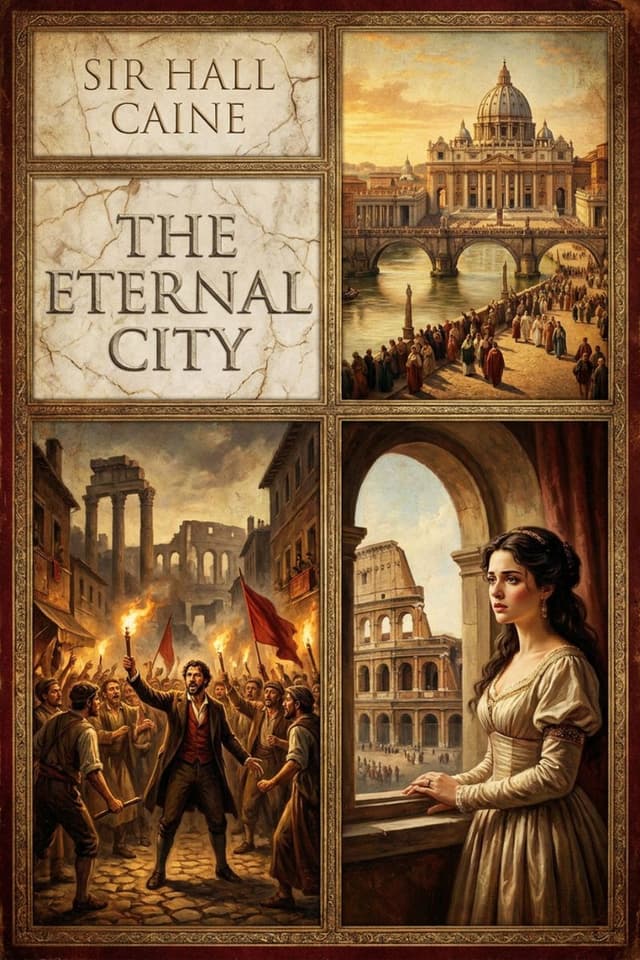
The Eternal City
Read The Eternal City by Sir Hall Caine for free on Novelhalla, and try out our easy-to-read modern edition of this classic book. You can also download the EPUB and read it on any device if you prefer!
The Plot
A Boy in the Snow
On a bitter December night in London, a ragged Italian boy of ten or twelve wanders the streets of Soho. He carries an accordion strapped to his shoulder and a cage with a grey squirrel tucked under his arm. David Leone is one of many children brought from Italy to England by a padrone, a man who profits from their street performances and begging. Cold, hungry, and forbidden to return to his lodgings until the appointed hour, David collapses in the snow outside a house in the Italian quarter.
The man who finds him is Dr. Roselli, a charitable physician living in exile under an assumed name. In truth, he is Prince Donatello Donatelli Donatellini Donatella (called Prince Donatello), an Italian noble banished for conspiracy against the government. The doctor takes the dying boy inside, revives him, and when the squirrel is found dead from the cold, he watches his young daughter Roma try to comfort the weeping child. From that night, David becomes part of the household.
Twenty Years Later
The story leaps forward two decades to the last day of the nineteenth century. Rome prepares for the Pope's Jubilee, and the city swarms with pilgrims, politicians, and schemers. The corrupt Baron Bonelli, Prime Minister of Italy, hosts a gathering of dignitaries at his palace overlooking the Piazza of St. Peter's. Among his guests is a beautiful young woman known throughout Roman society as Donna Roma.
Roma is the orphaned daughter of Dr. Roselli, who was eventually tricked back to Italy, captured, and transported to imprisonment. Left alone after her father's exile, she became the ward of Baron Bonelli. Society whispers that she is more than his ward. The Baron has made her rich and influential, but he holds her in an invisible cage of obligation and compromising knowledge.
Below the balcony where Roma watches the procession, a man addresses the crowd. David Rossi, as he now calls himself, has become a socialist deputy in Parliament, a champion of the poor who preaches the brotherhood of man. He does not know that Roma watches from above, and she does not know that this fiery orator is the ragged boy she once comforted. Neither remembers the other's face.
The Baron's Plot
Baron Bonelli fears David Rossi. The socialist deputy has denounced corruption in government, called for reform, and gathered the working people of Rome to his cause. Worse, Rossi has publicly criticized the unnamed woman who holds such improper influence over the Prime Minister. Roma, hearing of this insult without knowing its source, vows to destroy the man who attacked her.
The Baron is delighted to let her try. He encourages Roma to draw Rossi into her circle, to learn his secrets, to find evidence that will destroy him. What neither Roma nor the Baron anticipates is what happens when the two finally meet and recognize each other as the lost children of Dr. Roselli's household. The boy and girl who grew up together discover that their childhood bond has deepened into something more powerful and more dangerous.
Love Against Duty
Roma's mission to destroy David transforms into something she never anticipated. She cannot serve the Baron and love David Rossi. Yet the Baron's hold on her tightens. He knows secrets that could destroy her, and he has the power of the state behind him. David, meanwhile, faces conspiracy charges stemming from his association with Roma's father years ago. The government wants him silenced, one way or another.
As Roma and David grow closer, the Baron's schemes grow more desperate and more dangerous. Roma finds herself caught between impossible loyalties, forced to choose between the man who controls her past and the man who offers her a future. The novel builds toward a crisis where love, duty, and survival collide in the shadow of St. Peter's dome.
About the Author: Hall Caine
Early Life
Thomas Henry Hall Caine was born on May 14, 1853, in Runcorn, Cheshire, though he would always emphasize his connection to the Isle of Man, where his father had roots. He hated the name Thomas and never used it, even after he was knighted. His childhood was marked by poverty, disease, and the deaths of siblings. The family settled in working-class Liverpool, where young Hall developed a fierce appetite for self-education.
He was apprenticed to an architect and worked as a surveyor while devouring books and writing articles for newspapers and magazines. His grandmother on the Isle of Man filled his imagination with tales of Manx folklore, fairies, and witches. He began giving lectures around Liverpool, and one of these, on the poet and painter Dante Gabriel Rossetti, changed his life.
Secretary to Rossetti
Rossetti, impressed by a young man who understood his work, invited Caine to London. From 1881 until Rossetti's death in 1882, Caine lived with the ailing poet as his secretary, assistant, and nurse. The experience transformed him. He moved in the circles of the Pre-Raphaelites and formed friendships with literary figures including Bram Stoker, who would later dedicate Dracula to him.
Rossetti urged Caine to try his hand at fiction, and after the poet's death, Caine retreated to the Isle of Wight to write his first novel. The Shadow of a Crime appeared in 1885, followed by several others drawing on his Cumbrian heritage. When Rossetti advised him to write about what he knew best, Caine turned to the Isle of Man. The Deemster (1887) established him as a major novelist, and each subsequent book sold better than the last.
The Bestselling Author
The Christian (1897) became the first novel to sell over a million copies in Britain. Caine was suddenly the most commercially successful novelist of his era, earning more per word than Dickens or Thackeray had ever managed. His books were translated into dozens of languages and adapted for stage and screen. Queen Alexandra was a devoted fan, and Caine was invited aboard the royal yacht when King Edward VII visited the Isle of Man.
The Eternal City (1901) surpassed even The Christian, becoming the first novel to sell a million copies worldwide. It was serialized, produced as a play on the West End and Broadway, and eventually filmed twice. At the peak of his fame, Caine was mentioned in the same breath as Anatole France and Gabriele D'Annunzio as representing his nation's literature abroad.
Later Years and Decline
Caine bought Greeba Castle on the Isle of Man in 1896 and served in the Manx House of Keys from 1901 to 1908. He championed copyright reform, prison reform, and humanitarian causes. During World War I, he wrote propaganda urging America to join the Allies and edited King Albert's Book to raise money for Belgian refugees. He was knighted in 1918 and made a Companion of Honour in 1922.
But literary tastes changed. Critics who had always been lukewarm about his melodramatic style became openly contemptuous. His 1921 novel The Master of Man sold poorly, and reviewers dismissed him as a Victorian relic. He died at Greeba Castle on August 31, 1931, largely forgotten by the literary establishment that had once celebrated him.
Fun Facts About the Book
First Novel to Sell a Million Copies Worldwide
The Eternal City achieved a milestone no novel had reached before: one million copies sold across all markets. In English alone it went through twenty-six editions and was translated into thirteen languages. The initial print run of 100,000 copies sold out almost immediately.
Born as a Play
Unlike most novels adapted for the stage, The Eternal City was conceived as a drama first. Caine wrote a play about a woman who betrays her husband to save his life, then expanded it into the massive novel. After publication, he created a shortened "theatre edition" that stripped away political commentary to follow the play's storyline.
Broadway and West End
The stage version opened at His Majesty's Theatre in London on October 2, 1902, with incidental music by the Italian composer Pietro Mascagni, famous for Cavalleria Rusticana. The American production premiered at the Victoria Theatre in New York six weeks later, starring Viola Allen as Roma. By 1903, six different companies were performing the play simultaneously across England, America, Australia, and South Africa.
Two Film Versions
The 1915 silent film starred Pauline Frederick in her screen debut and was shot on location in Rome before World War I interrupted production. It was one of the most expensive American films of its era and was praised as a landmark achievement, though it is now considered lost. A 1923 remake starred Barbara La Marr, Bert Lytell, and Lionel Barrymore, with actual footage of Benito Mussolini and King Victor Emmanuel III appearing as themselves.
The Pope Problem
The fictional Pope in the novel is portrayed sympathetically as a saintly man who gave away his fortune to help poor children. However, certain revelations about characters' backgrounds caused outrage among Catholics. The 1915 film was banned in Quebec, and producers feared a church-wide boycott that could have destroyed their company.
Caine's Research
To write the novel, Caine traveled to Rome, met with politicians and church officials, and secured a private audience with Pope Leo XIII. He also consulted with anarchists, nihilists, and labor leaders across Europe. The three years he spent researching and writing the book convinced him that the socialist movements he portrayed were about to reshape the continent, a prediction that proved accurate within two decades.
Samson and Delilah
Caine described the central situation of the novel as inspired by the ancient story of Samson and Delilah, though he transforms it in unexpected ways. The story came to Caine in a dream, and he wrote the first draft immediately upon waking.
Two Versions in Print
Caine was so committed to both the political and romantic aspects of his story that he kept two versions in print simultaneously. The original full-length novel ran to 638 pages and contained extensive commentary on socialism, religion, and Italian politics. The abridged "theatre edition" of 1902 cut nearly 200 pages, stripping away the political material to focus purely on the love story. This edition is the complete original, with all of Caine's social and political vision intact.
Themes
Love Against Power
The novel pits human love against the machinery of state power. Roma and David's feelings for each other threaten to topple governments and expose corruption, which is precisely why Baron Bonelli must destroy them. The question the novel asks is whether love is strong enough to survive when the full weight of political authority is brought against it.
The Cost of Social Justice
David Rossi embodies the idealist who sacrifices everything for a cause larger than himself. He preaches the brotherhood of man, the relief of the poor, the end of corruption. But the novel shows how such idealism makes enemies of the powerful and puts everyone close to the idealist at risk. The fight for justice has a price, and others often pay it.
Betrayal and Salvation
The novel asks whether good intentions can excuse terrible actions, and whether love can survive the worst kinds of compromise. When duty and devotion pull in opposite directions, which wins? Caine structures the story around impossible moral choices where every path leads to someone's destruction.
Church and State
Set against the backdrop of late nineteenth-century Rome, the novel examines the uneasy relationship between the Vatican and the Italian government. The Pope has been stripped of temporal power but retains moral authority. The Prime Minister commands armies but lacks legitimacy. Both watch David Rossi warily, uncertain whether he threatens them or offers salvation.
The Sins of the Fathers
David's unknown parentage haunts the story. Who was his father? Why was his mother so desperate that she abandoned him to a padrone? As the political crisis intensifies, questions about David's origins take on unexpected significance, connecting his personal search for identity to the larger struggles consuming Rome.
The Book's Legacy
The Eternal City represented the peak of Hall Caine's extraordinary popularity. No novelist of his generation sold more copies or reached wider audiences. The book was a genuine cultural phenomenon, discussed in newspapers, adapted across media, and read by millions on multiple continents.
The novel anticipated the political upheavals that would transform Europe in the twentieth century. Its portrayal of socialist movements, its sympathy with the working poor, and its critique of corrupt oligarchy seemed prophetic after the Russian Revolution and the rise of fascism. David Rossi's speeches about bread taxes and battleships could have been delivered by actual reformers of the era.
The stage and film adaptations kept the story in public consciousness for decades. Pauline Frederick's performance in the 1915 film launched a major Hollywood career, and the story proved irresistible to filmmakers drawn to its Roman settings, religious themes, and melodramatic plot.
Yet Caine's reputation collapsed almost completely after his death. Literary scholars dismissed him as a purveyor of sentimental romance, and his books fell out of print. The very popularity that made him famous became evidence against his seriousness. He was too successful, critics suggested, to have been any good.
Recent reassessments have been kinder. Scholars now recognize Caine as a significant figure in publishing history, a pioneer of mass-market fiction, and an author who used popular forms to address serious social issues. The Eternal City, whatever its melodramatic excesses, grapples genuinely with questions of power, justice, and love that remain relevant today.
The novel also holds particular significance for certain communities. Members of Soka Gakkai, the Japanese Buddhist organization, studied The Eternal City in their youth, finding in David Rossi's unwavering commitment to justice a model for their own resistance to militarism and authoritarianism. The book's message about standing firm against corrupt power has resonated with readers facing their own struggles against unjust systems.