Novelhalla
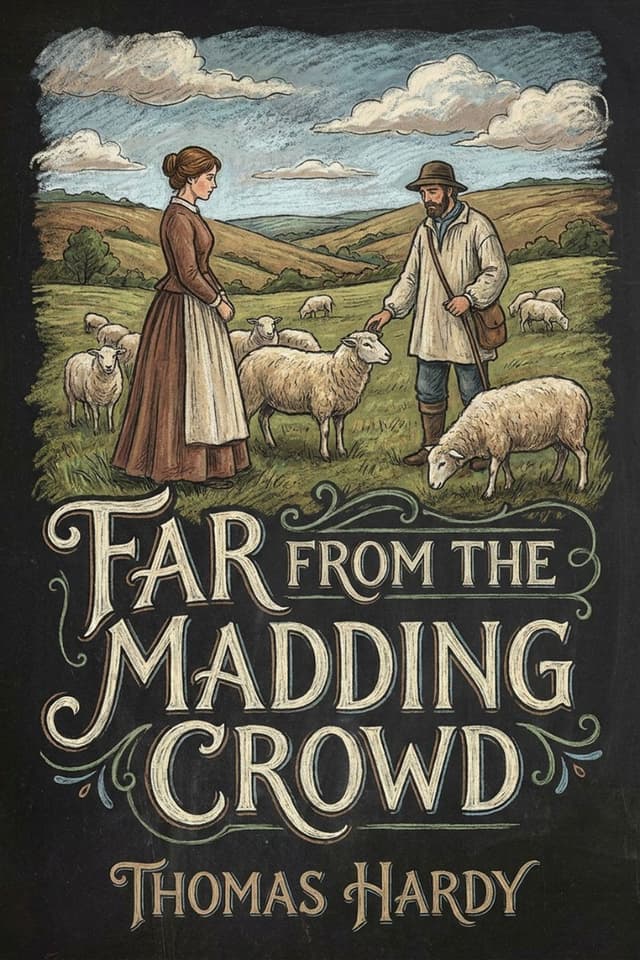
Far from the Madding Crowd
Read Far from the Madding Crowd by Thomas Hardy for free on Novelhalla, and try out our easy-to-read modern edition of this classic book. You can also download the EPUB and read it on any device if you prefer!
The Plot
Far from the Madding Crowd is a pastoral drama of love and consequence set in the fictional county of Wessex in Victorian England. It tells the story of a headstrong young woman and the three very different men who pursue her.
Gabriel Oak
The novel opens with Gabriel Oak, a hardworking young shepherd who has recently saved enough money to lease his own farm. One winter morning, he catches sight of a beautiful young woman sitting in a wagon, and while she thinks no one is watching, he sees her admire herself in a small mirror. She is vain, perhaps, but captivating.
This is Bathsheba Everdene. Gabriel encounters her several times over the following weeks, and she saves his life one night when he falls asleep in his cottage without opening a window to let out the smoke from his fire. Gabriel falls in love with her, and soon works up the courage to propose marriage.
Bathsheba refuses him. She likes Gabriel well enough, but she values her independence. She has no wish to be any man's property. "I want somebody to tame me," she tells him, "and you would never be able to."
Shortly afterward, disaster strikes Gabriel. His inexperienced sheepdog drives his entire flock over a cliff, and they all perish. Gabriel loses everything. He is forced to seek work as a common laborer.
Weatherbury
By coincidence, Gabriel finds work at a farm in the village of Weatherbury. And by a greater coincidence, the farm has just been inherited by none other than Bathsheba Everdene. She has come into property from a deceased uncle and is determined to manage it herself, an unusual ambition for a woman in that era.
Gabriel becomes her shepherd. He watches over her flock and, in his quiet way, watches over her. He is patient and loyal, offering honest advice even when she does not wish to hear it. She comes to rely on him, though she does not love him.
William Boldwood
A neighboring farmer named William Boldwood is a prosperous man in his forties, a confirmed bachelor who has shown no interest in women. One Valentine's Day, Bathsheba impulsively sends him an anonymous card sealed with the words "Marry Me." It is meant as a joke, a thoughtless prank.
But Boldwood is not a man who takes such things lightly. The valentine awakens something in him, an obsessive passion that will not be quieted. He discovers that Bathsheba sent the card, and he becomes consumed with desire for her. He proposes marriage, and when she hesitates, he presses her relentlessly.
Bathsheba regrets her thoughtless prank. She does not love Boldwood, but she feels responsible for the feelings she has awakened. She is caught between guilt and resistance.
Sergeant Troy
Then a third man enters the picture. Sergeant Francis Troy is a dashing young soldier, handsome and reckless, with an easy charm and a talent for flattery. One night, Bathsheba's dress becomes tangled in his spur on a dark path, and they must stand close together to untangle it. It is the beginning of a dangerous attraction.
Troy is everything Gabriel is not: impulsive, seductive, unreliable. He dazzles Bathsheba with a display of swordsmanship in a hollow among the ferns, the blade flashing around her body without ever touching her skin. She is thrilled and terrified. She falls in love.
What Bathsheba does not know is that Troy has a history. A young woman named Fanny Robin, a former servant at Bathsheba's farm, loved Troy and believed he would marry her. He abandoned her.
Consequences
Bathsheba marries Troy in secret. Gabriel is heartbroken. Boldwood is devastated. And Troy proves to be exactly what Gabriel warned: a careless husband who gambles away money, neglects the farm, and treats Bathsheba with indifference.
The marriage unravels as the past catches up with them all. Fanny Robin's fate casts a long shadow. Boldwood's obsession grows darker. And Gabriel remains, as he has always been, steadfast in his devotion.
The novel moves toward a climax of violence and revelation, as the consequences of passion, pride, and impulsive choices come due. In Hardy's Wessex, the countryside may be beautiful, but fate is not kind, and the heart wants what it should not have.
About the Author: Thomas Hardy
Early Life
Thomas Hardy was born on June 2, 1840, in Higher Bockhampton, a hamlet near Dorchester in the county of Dorset, England. His father was a stonemason and builder; his mother, Jemima, was well-read and ambitious for her children. Hardy grew up in a thatched cottage on the edge of open heathland, surrounded by the rural life that would later fill his novels.
Hardy was a sickly child, but intellectually precocious. His mother taught him to read before he was four and instilled in him a love of books. He attended local schools in Dorchester, where he learned Latin and showed academic promise. But the family lacked the means for a university education, and at sixteen, Hardy's formal schooling ended.
Architecture
In 1856, Hardy was apprenticed to John Hicks, a local architect who specialized in church restoration. Architecture would shape Hardy's eye for detail and his sense of place, skills that would later enrich his writing.
In 1862, Hardy moved to London to work as a draftsman in the office of Arthur Blomfield, a prominent ecclesiastical architect. He won prizes from the Royal Institute of British Architects and the Architectural Association. But Hardy never felt at home in London. He was acutely conscious of class divisions and his own feelings of social inferiority. He missed Dorset.
During his London years, Hardy read voraciously. He encountered the works of John Stuart Mill, Charles Darwin, and the poets who would influence him throughout his life. He began writing poetry, but no publisher would take it. After five years, concerned about his health and discouraged by his literary failures, he returned to Dorset.
The Turn to Fiction
Back in Dorset, Hardy worked again for Hicks and began writing prose. His first novel, The Poor Man and the Lady, was rejected by several publishers, though one editor encouraged him to continue. He persevered, publishing Desperate Remedies in 1871 and Under the Greenwood Tree in 1872.
In 1870, while on an architectural assignment to restore a church in Cornwall, Hardy met Emma Lavinia Gifford, the sister-in-law of the local rector. Their courtship was romantic and intense. Emma encouraged his writing and believed in his talent. They married in 1874.
Far from the Madding Crowd
That same year, Hardy published Far from the Madding Crowd in serial form in the prestigious Cornhill Magazine, edited by Leslie Stephen (father of Virginia Woolf). It was his first major success. The novel's popularity allowed Hardy to abandon architecture and devote himself entirely to writing. It also introduced his fictional Wessex, the "partly real, partly dream-country" that would unify all his subsequent novels.
Later Novels
Hardy followed Far from the Madding Crowd with a series of increasingly ambitious novels: The Return of the Native (1878), The Mayor of Casterbridge (1886), The Woodlanders (1887), Tess of the d'Urbervilles (1891), and Jude the Obscure (1895).
His later novels grew darker and more critical of Victorian society, particularly its rigid morality around sex, religion, and marriage. Tess of the d'Urbervilles was controversial for its sympathetic portrayal of a "fallen woman." Jude the Obscure was so harshly attacked that the Bishop of Wakefield reportedly burned his copy. Hardy, wounded by the criticism, abandoned fiction and returned to the poetry he had always loved.
Max Gate and Later Life
In 1885, Hardy and Emma moved into Max Gate, a house Hardy designed himself near Dorchester. His brother built it. There Hardy lived for the rest of his life, writing in his study while the marriage slowly deteriorated.
Hardy and Emma grew estranged over the years. They had no children. Emma retreated to attic rooms she called her "sweet refuge and solace," while Hardy pursued friendships with other women, including Florence Dugdale, who would become his secretary and, eventually, his second wife.
Emma died suddenly on November 27, 1912. Hardy was devastated. Despite their long estrangement, her death triggered an extraordinary outpouring of grief and guilt. He returned to Cornwall to revisit the places where they had courted forty years before. The poems he wrote in the months after her death, collected as Poems of 1912-13, are among the finest elegies in the English language.
In 1914, Hardy married Florence Dugdale, nearly forty years his junior. He continued to write poetry, publishing over nine hundred poems before his death.
Thomas Hardy died on January 11, 1928, at the age of eighty-seven. His ashes were interred in Poets' Corner at Westminster Abbey. His heart, at his request, was buried separately in the churchyard at Stinsford, beside Emma.
Fun Facts About the Book
The Birth of Wessex
Far from the Madding Crowd was the first Hardy novel to use the name "Wessex" for its setting. Hardy borrowed the word from early English history, where it designated an extinct Anglo-Saxon kingdom in southwest England. He would go on to develop Wessex into an elaborate fictional world, mapping real Dorset villages onto invented names and creating what he called a "partly real, partly dream-country." Today, "Hardy's Wessex" is a recognized literary landscape, and tourists still visit Dorset to walk in the footsteps of his characters.
An Ironic Title
The title comes from Thomas Gray's famous poem "Elegy Written in a Country Churchyard" (1751), which contains the lines: "Far from the madding crowd's ignoble strife / Their sober wishes never learn'd to stray." Gray was idealizing the peaceful, uneventful lives of country folk. Hardy's title is an ironic literary joke: his novel is anything but peaceful, filled with passion, jealousy, violence, and tragedy. He was subverting his readers' expectations of pastoral calm.
Published Anonymously
When Far from the Madding Crowd first appeared as a serial in Cornhill Magazine in 1874, Hardy's name was not attached to it. The quality of the prose led some readers to speculate that the anonymous author might be George Eliot, who had recently published her masterpiece Middlemarch. Hardy must have been flattered by the comparison.
Leslie Stephen, Editor
The novel was commissioned by Leslie Stephen, the distinguished editor of Cornhill Magazine. Stephen was a towering figure in Victorian letters, a philosopher, critic, and mountaineer. He was also the father of Virginia Woolf and Vanessa Bell. Stephen became a mentor and friend to Hardy, though he also asked Hardy to tone down some passages he considered too frank for the magazine's family audience.
The Best Illustrator He Ever Had
The original serial was illustrated by Helen Paterson, a talented young artist who was one of the founding staff members of The Graphic newspaper. Hardy was delighted with her work. In 1906, he wrote that she was "the best illustrator I ever had." He also confessed that when he met her in person, her "peculiar charm" made him wish, at sixty-six, that he had married her instead of Emma. Helen Paterson married the Irish poet William Allingham in 1874, the same year Far from the Madding Crowd was published, and her later illustrations were signed "H. Allingham."
A Young Henry James Was Unimpressed
Not everyone loved the novel. A young Henry James reviewed it with condescension, writing: "Everything human in the book strikes us as factitious and insubstantial; the only things we believe in are the sheep and the dogs." Posterity has largely disagreed with James.
Julie Christie and Two Film Adaptations
The most celebrated film adaptation is John Schlesinger's 1967 version, starring Julie Christie as Bathsheba, with Alan Bates as Gabriel Oak, Peter Finch as Boldwood, and Terence Stamp as Troy. The film was nominated for an Oscar for Best Original Music Score and remains a classic of British cinema. A 2015 adaptation directed by Thomas Vinterberg starred Carey Mulligan as Bathsheba, with a screenplay by David Nicholls.
The Original Katniss Everdeen
Suzanne Collins, author of The Hunger Games, took the surname "Everdeen" directly from Bathsheba Everdene (slightly altering the spelling). Collins has said: "Katniss Everdeen owes her last name to Bathsheba Everdene, the lead character in Far from the Madding Crowd. The two are very different, but both struggle with knowing their hearts." Both are strong-willed women courted by multiple suitors, forced to navigate difficult choices in worlds that would constrain them.
Adapted for Stage, Opera, Ballet, and Comic Strip
Beyond film, Far from the Madding Crowd has been adapted as a stage play (Hardy himself wrote a version in 1879 called "The Mistress of the Farm"), an opera, a ballet, and even a comic strip in The Guardian newspaper. The story's archetypal love triangle and rural setting have proved endlessly adaptable.
Hardy Married the Same Year
The novel's success allowed Hardy to marry Emma Gifford in September 1874 and to give up architecture for good. The earnings from Far from the Madding Crowd gave him financial independence as a writer.
Themes
Independence and Its Costs
Bathsheba Everdene is remarkable for her determination to manage her own farm and her own life. She refuses Gabriel's first proposal because she values her freedom. But Hardy shows that independence has its costs. Bathsheba's self-reliance can shade into willfulness, and her desire to be her own master leads her to make choices that harm herself and others. The novel asks whether true independence is possible, especially for a woman in Victorian England.
The Varieties of Love
Each of Bathsheba's three suitors represents a different kind of love. Gabriel offers patient, selfless devotion. Boldwood is consumed by obsessive passion. Troy brings seductive charm and reckless desire. Hardy explores how these different loves affect both the lover and the beloved, and what happens when love is unrequited or betrayed.
Consequences of Impulsive Actions
The novel's plot turns on impulsive choices: Bathsheba's thoughtless valentine to Boldwood, her sudden marriage to Troy, her initial refusal of Gabriel. Hardy shows how a single careless act can set in motion a chain of consequences that cannot be undone. In Wessex, as in life, we are bound by what we have done.
Rural Life and Its Passing
Hardy lovingly depicts the rhythms of agricultural work: lambing, shearing, the harvest, the hiring fairs. But he also hints at a world in transition. The old ways are changing; machines are coming. Far from the Madding Crowd captures a vanishing England, beautiful and harsh, where people lived close to the land and the seasons.
Fate and Character
Hardy's novels are often described as fatalistic, and there is a sense in Far from the Madding Crowd that characters are shaped by forces beyond their control. But Hardy also shows that character is fate. Bathsheba's pride, Boldwood's repression, Troy's recklessness, Gabriel's steadfastness: these qualities determine their destinies as much as any external circumstance.
The Faithful Servant
Gabriel Oak is the moral center of the novel. He loses everything and rebuilds. He loves without expectation. He offers honest counsel even when it angers the woman he loves. He waits. In a world of passion and folly, Gabriel represents constancy and quiet virtue. Hardy seems to suggest that such faithfulness, though unglamorous, is the truest form of love.
The Book's Legacy
Far from the Madding Crowd launched Thomas Hardy's career as one of the great novelists of the English language. It introduced his Wessex, the landscape that would become synonymous with his name. It gave us Bathsheba Everdene, a heroine whose independence and complexity made her feel modern even in 1874.
The novel has never been out of print. It has been adapted for film, television, stage, opera, and more. Its influence extends from literary fiction to popular culture: Suzanne Collins borrowed Bathsheba's surname for Katniss Everdeen, hero of The Hunger Games.
But the novel endures not just because of its influence. It endures because Hardy's portrait of love, in all its varieties, remains true. The patient devotion of Gabriel, the dangerous obsession of Boldwood, the seductive recklessness of Troy: these are recognizable human types, and Bathsheba's struggle to know her own heart is a struggle readers still understand.
Far from the Madding Crowd is also Hardy's warmest novel. His later works would grow darker, more tragic, more pessimistic about human possibility. Here, despite the suffering, there is redemption. Faithfulness is rewarded. The ending, while earned through pain, offers hope.
For readers who want to enter Hardy's world, Far from the Madding Crowd is the perfect place to begin: a novel of the English countryside, of love and folly and consequence, written with the eye of an architect and the heart of a poet.