Novelhalla
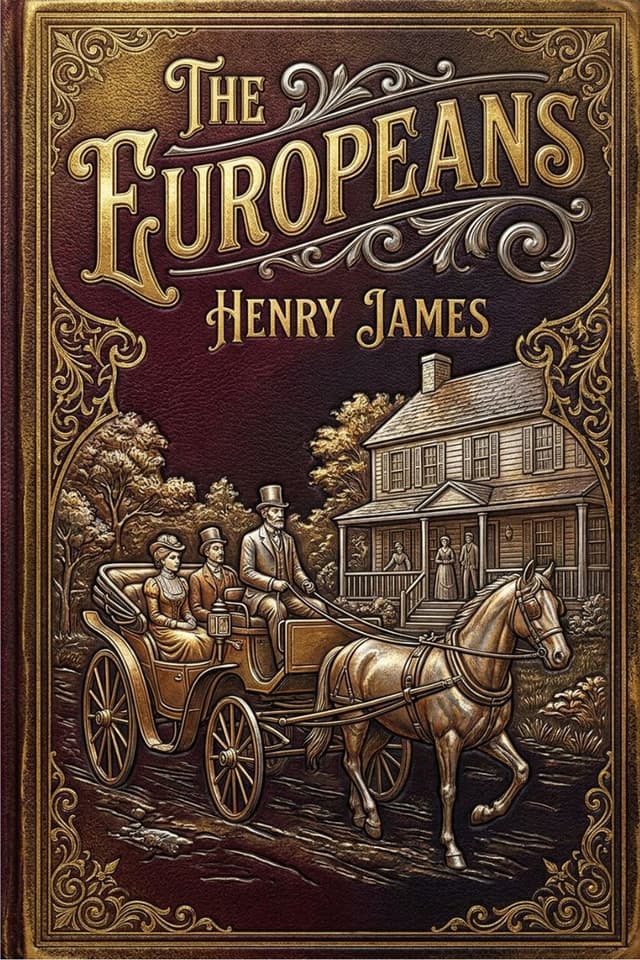
The Europeans
Read The Europeans by Henry James for free on Novelhalla, and try out our easy-to-read modern edition of this classic book. You can also download the EPUB and read it on any device if you prefer!
The Plot
The Arrival
Eugenia Münster and her younger brother Felix Young have spent their entire lives in Europe, drifting from France to Italy to Spain to Germany. They speak four languages, own almost nothing, and carry themselves like people who've seen the inside of every palace and garret on the continent. Eugenia is technically a baroness, having entered into a morganatic marriage with a minor German prince. But the prince's family wants the marriage dissolved for political reasons, and Eugenia can feel the ground shifting beneath her.
So the siblings do something unexpected. They cross the Atlantic to visit relatives they've never met: the Wentworths, their mother's American family, living in the quiet countryside outside Boston.
It is the 1850s. New England is all church on Sundays, long silences at dinner, and a thousand different ways to be proper. The Wentworths are wealthy, devout, and deeply suspicious of anything that smells like pleasure.
Into this world walk two people who are basically made of pleasure.
The Wentworths
Mr. Wentworth is the patriarch, a pale, rigid man who treats moral duty the way other men treat breathing. He has two daughters and a son. Charlotte, the eldest, is pretty and obedient and does exactly what her father expects. Gertrude, the younger, is something else entirely. She's restless, bookish, spending her Sundays reading The Arabian Nights instead of going to church. The family has decided she should marry Mr. Brand, a bland Unitarian minister who loves her in that earnest, suffocating way that makes a person want to run.
Then there's Clifford, the son, who has just been suspended from Harvard for drinking. The family doesn't talk about it much.
Living nearby are the Actons: Robert, a confident young man who made his fortune in China, and his younger sister Lizzie. Robert is sharp, worldly by New England standards, and the only bachelor in the neighborhood with real money.
Eugenia notices this immediately.
Two Very Different Games
Felix and Eugenia are both playing the same hand, but with completely different styles. Felix is sunshine. He's an artist, a portrait painter, charming and warm and genuinely delighted by everything about these strange American cousins. When he meets Gertrude, it's like watching two puzzle pieces click. She's starving for someone who sees the world as an adventure rather than a moral test. Felix sees it no other way.
Eugenia is more complicated. She's elegant, sophisticated, a little theatrical, and not above telling small lies to smooth the surface of a conversation. She settles into a cottage on the Wentworth property and begins cultivating Robert Acton with the careful attention of someone who knows exactly what she wants. She flirts. She hints that she might sign the document that would dissolve her marriage. She dangles the possibility of herself.
Acton is fascinated. He might even be falling in love. But he has one weakness that Eugenia doesn't fully appreciate: he is obsessed with honesty. And Eugenia keeps getting caught in small untruths.
The Tangles
Felix paints Gertrude's portrait. Long afternoons together, conversation that keeps getting more personal, more real. She tells him her family wants her to marry Mr. Brand. She doesn't love Mr. Brand. Felix has noticed that Charlotte, the dutiful older sister, seems to light up whenever the minister walks into a room. Everyone is matched up wrong.
Meanwhile, Mr. Wentworth confides in Felix that Clifford's drinking is a serious concern. Felix, in a move that is either brilliantly manipulative or charmingly naive, suggests that time spent with a cultivated older woman might settle the boy down. He means Eugenia. Clifford starts visiting the Baroness, which creates its own set of complications, especially when Acton begins to wonder whether the younger man is more than just a visitor.
The whole household is a web of mismatched affections, unspoken feelings, and competing ideas about what makes a life worth living. The Wentworths value duty and propriety above all else. Felix and Eugenia represent freedom, passion, and the unsettling possibility that happiness might actually matter.
The Reckoning
The question hovering over everything is whether these two worlds can actually meet. Felix loves Gertrude, but he's a penniless bohemian artist, and Mr. Wentworth is not the kind of father who blesses unconventional marriages. Eugenia is playing her cards with Acton, but each small deception chips away at the trust she needs him to have. And somewhere in the background, a document sits unsigned, a marriage waits to be dissolved or reclaimed, and everyone is running out of time to figure out what they actually want.
The New England autumn is closing in. Eugenia is growing restless and disillusioned. Felix is more determined than ever. And the question of who will bend, who will break, and who will simply pack up and leave has not yet been answered.
About the Author: Henry James
A Restless Childhood
Henry James was born in New York City in 1843 into a family that practically vibrated with intellectual energy. His father was a prominent theologian and philosopher who counted Ralph Waldo Emerson and Henry David Thoreau among his friends. His older brother William would become one of the founders of modern psychology. His sister Alice became a celebrated diarist. The James children were dragged across the Atlantic repeatedly, educated by private tutors in Geneva, Paris, London, and Bonn. By the time Henry was eighteen, he'd lived in more European cities than most people visit in a lifetime.
Finding His Voice
James briefly attended Harvard Law School before realizing he had absolutely no interest in the law. What he wanted to do was write. He started publishing stories and reviews in his early twenties, contributing to magazines like The Nation and The Atlantic Monthly. By his mid-twenties, he was considered one of the best short story writers in America. But America itself was starting to feel small to him. He made several extended trips to Europe, meeting Charles Dickens, George Eliot, and John Ruskin along the way. In 1875, at thirty-two, he left the United States for good.
The International Theme
James settled first in Paris, then permanently in England, and spent the rest of his career writing about the collision between American innocence and European sophistication. The Americans (1877), Daisy Miller (1878), and The Europeans (1878) all come from this early period, when he was working out the theme that would define his life's work. The Portrait of a Lady (1881) established him as a major novelist. His later works grew increasingly complex and experimental, with sentences that could go on for half a page and characters whose inner lives were rendered with almost unbearable precision.
Later Life and Legacy
James tried writing plays in the 1890s and failed spectacularly. He retreated to prose and produced some of his most ambitious work, including The Wings of the Dove, The Ambassadors, and The Golden Bowl. He never married. He poured his emotional life into his writing and his friendships, maintaining close bonds with Edith Wharton and Robert Louis Stevenson among others. In 1915, dismayed by America's reluctance to enter World War I, he became a British citizen. He died in London in February 1916 at seventy-two. He was nominated for the Nobel Prize in Literature three times but never won.
Fun Facts About the Book
James Called It Slight
When his brother William criticized the novel as lightweight, Henry mostly agreed. He admitted in a letter that he was "aware of its extreme slightness." But "slight" in James's case still means psychologically precise, wickedly funny, and deeply felt. Many critics consider it one of his most purely enjoyable books.
He Left It Out of His Collected Works
When James assembled the definitive New York Edition of his fiction between 1907 and 1909, he excluded The Europeans entirely. The reasons are debated. Some scholars think he considered it too minor. Others suggest the mixed reception it got at the time of publication left a lasting sting. Whatever the reason, it's a curious omission for a novel that has only grown in reputation since.
The Subtitle
James gave the novel the subtitle "A Sketch," signaling that he considered it something lighter and more compact than a full novel. At barely over 150 pages, it's the work of a writer deliberately keeping things contained, almost theatrical in its tight setting and small cast.
A Reverse James
Most of James's famous novels send Americans to Europe, where they get tangled up in the corruption and sophistication of the Old World. The Europeans flips the formula. Here, it's the Europeans who come to America and find themselves baffled by a different kind of rigidity. It's one of the very few times James told this particular version of his signature story.
The Absurd Prince
Eugenia's husband bears one of the more magnificent names in all of fiction: Prince Adolf of Silberstadt-Schreckenstein. "Schreckenstein" roughly translates from German as "fright stone" or "terror rock." James was clearly having fun.
The Morganatic Marriage
Eugenia's marriage to the prince is morganatic, meaning she married someone of higher rank but was not entitled to his title or inheritance, and their children could not inherit. This was a real legal arrangement in European aristocratic circles, and it places Eugenia in a uniquely precarious position: she has the social polish of a baroness but none of the security.
Themes
Pleasure vs. Duty
The novel's central tension is between people who believe life should be enjoyed and people who believe it should be endured. The Wentworths aren't miserable exactly, but they've organized their entire existence around restraint, propriety, and moral seriousness. Felix and Eugenia represent the radical idea that beauty, art, and pleasure might have value in themselves. The novel doesn't fully take sides, but it's hard to miss where James's sympathies lie.
Honesty and Performance
Eugenia is a performer. She arranges herself, decorates her cottage, tells small social lies, and manages impressions the way a director stages a scene. The Wentworths, and especially Robert Acton, value transparency above almost everything else. The novel asks a sharp question: is Eugenia dishonest, or is she simply operating by a different set of social rules? And is the New England obsession with plain dealing really as virtuous as it claims to be, or is it just another kind of rigidity?
Women and Choice
Eugenia and Gertrude are both trapped, just in different ways. Eugenia's marriage is being dissolved around her by forces she can't control. Gertrude is being pushed toward a man she doesn't love because her family has decided it's appropriate. The novel quietly maps the limited options available to women on both sides of the Atlantic, and watches as each woman tries to carve out some space for her own desires.
Old World vs. New World
This is the big James theme, and The Europeans is one of his sharpest takes on it. Europe represents experience, sophistication, moral complexity, and a certain comfort with surfaces. America represents earnestness, moral certainty, suspicion of artifice, and a deep discomfort with anything that can't be plainly stated. Neither side comes out looking entirely right.
The Cost of Innocence
The Wentworths' innocence isn't just charming. It's also a kind of narrowness. They can't quite see Eugenia for who she is because they have no framework for someone like her. Their goodness is real, but it comes with blind spots. James is gentle about this, but he doesn't let them off the hook.
The Book's Legacy
The Europeans occupies a special place in James's career as the novel that proves he could be fun. It's short, witty, and populated with characters who practically beg to be cast in a film. The social comedy is sharper and lighter than almost anything else he wrote, and the romantic tangles have the feeling of a well-constructed stage play.
The 1979 Merchant Ivory film adaptation, starring Lee Remick as Eugenia, was the first of the production company's famous literary period dramas. It was nominated for the Palme d'Or at Cannes and earned a Best Costume Design nomination at the Academy Awards. The film launched the visual style that Merchant Ivory would become famous for: lush autumn landscapes, meticulous period costumes, and dialogue lifted almost verbatim from the source material.
For readers coming to James for the first time, The Europeans is often recommended as the ideal entry point. It has all of his signature concerns, the clash of cultures, the psychology of attraction, the way manners can both reveal and conceal, but without the dense, labyrinthine prose of his later work. It's James at his most accessible and, in many ways, his most charming.
The novel also resonates surprisingly well with modern readers. The tension between being authentic and being strategic, between living for yourself and living up to expectations, between the culture you come from and the one you're trying to enter, these are not problems that belong to the 1850s. They belong to anyone who has ever walked into a room full of people who operate by different rules and had to decide how much of themselves to reveal.