Novelhalla
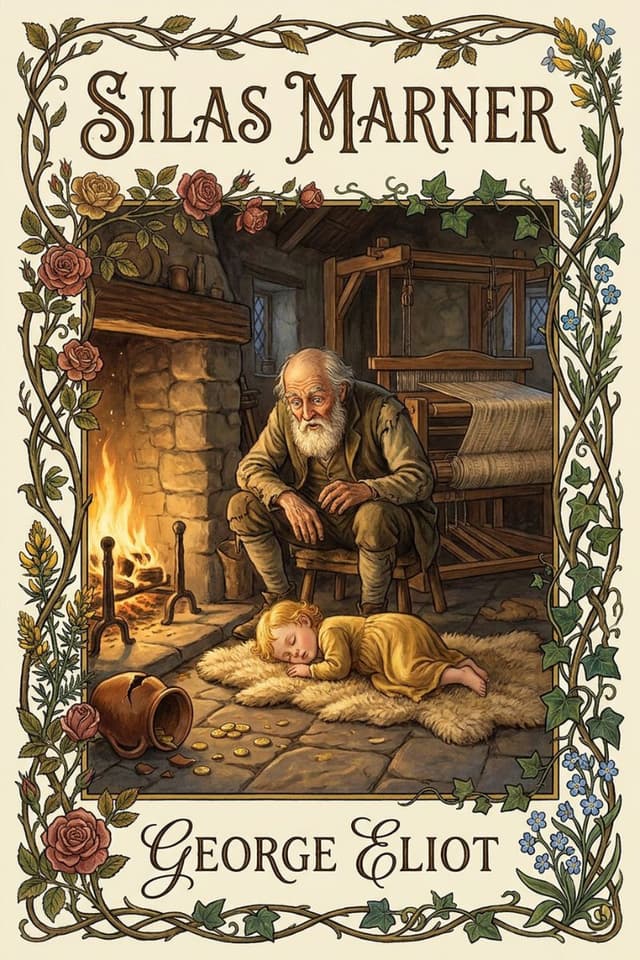
Silas Marner
Read Silas Marner by George Eliot for free on Novelhalla, and try out our easy-to-read modern edition of this classic book. You can also download the EPUB and read it on any device if you prefer!
The Plot
Silas Marner is a fable-like story of loss and redemption set in the English countryside during the early nineteenth century. It follows a solitary weaver who loses everything, then discovers that what replaces it might be worth far more.
Lantern Yard
Silas Marner begins his life as a respected young man in Lantern Yard, a small Calvinist religious community in an industrial town in northern England. He is devout, earnest, and engaged to a young woman named Sarah. His closest friend is William Dane.
Silas suffers from occasional cataleptic fits, moments when he falls into a trance-like state. In Lantern Yard, these fits are regarded as evidence of his special closeness to God.
Then disaster strikes. Silas is falsely accused of theft, and the congregation turns against him. His engagement is broken. His faith in God and humanity shatters. He leaves Lantern Yard with nothing but his loom and his bitterness.
Raveloe
Silas settles in Raveloe, a village in the rural Midlands. He takes up residence in a stone cottage on the outskirts of the village, near an abandoned quarry called the Stone Pits. There he sets up his loom and begins to weave.
The villagers view Silas with suspicion. He comes from elsewhere. He keeps to himself. He suffers from strange fits. When he uses herbal remedies to help a sick neighbor, people whisper that he must have dealings with the devil.
Silas withdraws completely from human contact. He works ceaselessly, and his earnings accumulate. He hides his gold coins beneath the floorboards and counts them each night, running his fingers through the shining pile. The gold becomes his only companion. Fifteen years pass this way.
The Cass Family
Meanwhile, trouble brews at the Red House, home of Squire Cass, the most prominent landowner in Raveloe. The Squire's two eldest sons have grown into very different men.
Godfrey Cass is the elder, handsome and good-natured but weak-willed. He carries a secret that could ruin him. He longs to marry Nancy Lammeter, a respectable young woman, but something from his past stands in the way.
Dunstan Cass, the younger brother, is dissolute and cruel. He knows Godfrey's secret and uses it as leverage. When Dunstan needs money, he's willing to do whatever it takes to get it.
Collision
The lives of Silas Marner and the Cass family are about to intersect in ways none of them could predict. A theft. A snowy night. A child wandering toward a light in the window. The weaver who has lost everything is about to find something that will change his life forever.
What follows is a story about the things we treasure, the secrets we keep, and the unexpected forms redemption can take.
About the Author: George Eliot
Mary Ann Evans
George Eliot was the pen name of Mary Ann Evans, born November 22, 1819, in Warwickshire, England. She was the third child of Robert Evans, the respected manager of a large estate called Arbury Hall, and his second wife, Christiana Pearson.
Mary Ann grew up on the estate where her father worked, surrounded by the rural English life that would later fill her novels. Her father, though not formally educated, was a man of practical intelligence and integrity. Mary Ann was his favorite child, and she often accompanied him on his rounds, absorbing the rhythms of country life and the conversations of farmers, servants, and gentry.
Her mother was distant and unwell, and Mary Ann felt unloved by her. Twin brothers born after her died in infancy. She was closest to her older brother Isaac, though they would become estranged in adulthood. When Mary Ann was sixteen, her mother died, and she left school to keep house for her father.
Education and Crisis of Faith
Despite the interruption of her formal education, Mary Ann was intellectually voracious. She learned French, German, Italian, Latin, and later Greek and Hebrew. She read widely in theology, philosophy, and literature. Her early years were marked by intense evangelical piety, a fervor that would later reverse itself dramatically.
In 1841, Mary Ann and her father moved to Coventry, where she encountered a circle of freethinkers who challenged her religious beliefs. She read works of German biblical criticism that treated the scriptures as human documents rather than divine revelation. By 1842, she had broken with Christianity, refusing to attend church. Her father was appalled. After a period of painful conflict, they reached an uneasy truce: she would accompany him to services, though she no longer believed.
Mary Ann's first major intellectual work was a translation of David Strauss's Life of Jesus, a foundational text of biblical criticism. She completed it in 1846, though it was published anonymously. She later translated Ludwig Feuerbach's Essence of Christianity, which argued that God was a projection of human needs and ideals.
London and George Henry Lewes
After her father's death in 1849, Mary Ann traveled to Switzerland and then settled in London, where she became assistant editor of the Westminster Review, a leading intellectual journal. She was at the center of London's progressive circles, meeting philosophers, scientists, and writers.
Among these was George Henry Lewes, a journalist, critic, and philosopher. Lewes was married, but his wife had left him for another man with whom she had children. Victorian law prevented Lewes from obtaining a divorce because he had initially condoned his wife's adultery.
In 1854, Mary Ann and Lewes began living together as husband and wife, though they could never legally marry. The scandal was immense. Mary Ann's brother Isaac cut off all contact with her. She was ostracized from polite society. But the relationship proved to be the making of her as a writer. Lewes encouraged her to try fiction, managed her literary career, and shielded her from hostile reviews. They lived together in devoted partnership for twenty-four years.
George Eliot
Mary Ann began writing fiction in her late thirties, adopting the pen name George Eliot. She chose a male name partly to ensure her work would be taken seriously and partly to separate her literary reputation from the scandal of her personal life. The name "George" honored Lewes; "Eliot" was, she said, "a good, mouth-filling word."
Her first fiction, Scenes of Clerical Life, appeared in 1857. Her first novel, Adam Bede (1859), was an immediate sensation. The Mill on the Floss (1860) and Silas Marner (1861) followed in quick succession, establishing her as one of the foremost novelists of her age.
Her masterpiece, Middlemarch (1871-1872), is often considered one of the greatest novels in the English language. Virginia Woolf called it "one of the few English novels written for grown-up people." Her final novel, Daniel Deronda (1876), was more controversial but equally ambitious.
Final Years
George Henry Lewes died in 1878. Mary Ann was devastated by the loss of her partner of nearly a quarter century. But in 1880, she surprised everyone by marrying John Walter Cross, a longtime friend who was twenty years her junior. Her brother Isaac, silent for decades, finally wrote to congratulate her on becoming a respectable married woman.
The marriage lasted only seven months. Mary Ann Evans Cross died on December 22, 1880, her sixty-first birthday, of kidney disease. She was buried in Highgate Cemetery in London, in the same section as George Henry Lewes.
Fun Facts About the Book
Written in Five Months
Silas Marner was composed remarkably quickly. George Eliot wrote it between November 1860 and March 1861, about five months. At roughly 60,000 words, it is by far her shortest novel. She described the story as having come to her suddenly, "as a sort of legendary tale."
A Fairy Tale for Adults
Though Silas Marner is realistic in its depiction of village life, it has the structure of a fairy tale. The miser with his gold, the mysterious stranger, the golden-haired child who appears as if by magic: these are the elements of folk narrative. Eliot deliberately blended realism with legend to create something unique.
Immediate Success
Silas Marner was popular from the moment of its publication. Contemporary reviewers praised it extravagantly. The Saturday Review in 1861 compared Eliot's characterization favorably to Dickens and her humor to Shakespeare. The novel has never gone out of print.
School Textbook
For generations, Silas Marner was assigned reading in British and American schools, which made it one of George Eliot's most widely read works. Many readers first encountered the novel as students, giving it a mixed reputation: beloved by some, resented by others who were forced to read it too young.
Why "George Eliot"?
Mary Ann Evans chose her pen name carefully. "George" honored George Henry Lewes, the man she loved. "Eliot," she said, was chosen because it was "a good, mouth-filling word." The masculine pseudonym helped ensure her work would be judged on its merits rather than dismissed as women's writing.
Ben Kingsley and Steve Martin
The novel has been adapted many times. The most acclaimed straight adaptation is the 1985 BBC television film starring Ben Kingsley as Silas. In 1994, Steve Martin wrote, produced, and starred in A Simple Twist of Fate, a modern American retelling in which Martin plays a reclusive furniture maker who adopts an abandoned child. Martin was reportedly drawn to the story's grand Victorian themes of fate, coincidence, and redemption.
At Least Five Silent Films
Between 1911 and 1922, at least five silent film adaptations of Silas Marner were produced, testifying to the story's early cinematic appeal. The tale's visual elements, the lonely cottage, the hidden gold, the child in the snow, translated naturally to the screen.
The Name Eppie
The child in the novel is named "Eppie" as a nickname for Hephzibah, a biblical name meaning "my delight is in her" from the Book of Isaiah. It is a fitting name for the character who becomes Silas's greatest joy.
Eliot's Own Crisis of Faith
The novel's treatment of faith and doubt reflects Eliot's own spiritual journey. Like Silas, she experienced a devastating loss of religious belief. But where Silas eventually finds a new, gentler faith through human love and community, Eliot herself remained skeptical of organized religion while embracing what she called a "religion of humanity."
An Opera Too
Composer John Joubert wrote an opera based on Silas Marner in 1961, exactly one hundred years after the novel's publication. The story has also been adapted for radio, stage, and even an episode of the children's TV series Wishbone.
Themes
Redemption Through Love
The central theme of Silas Marner is the possibility of redemption. Silas is a broken man, betrayed by his friend, abandoned by his community, stripped of his faith. He retreats into miserliness and isolation. But unexpected grace enters his life, and through love, he rediscovers his capacity for connection. Eliot suggests that human love has the power to heal even the deepest wounds.
Faith and Community
Silas's crisis of faith is also a crisis of community. In Lantern Yard, religious belief and social belonging were inseparable. When the congregation casts him out, he loses not just his faith but his entire world. In Raveloe, he must slowly rebuild both. The novel suggests that faith and community are intertwined, and that belonging to others is essential to human flourishing.
Gold and Love
Eliot contrasts material wealth with spiritual riches. Silas hoards gold as a substitute for human connection, counting his coins each night as a miser counts his blessings. But gold cannot love him back. The novel asks what we truly value and whether the things we cling to are worthy of our devotion.
Moral Consequences
The plot of Silas Marner operates according to a clear moral logic. Characters face the consequences of their choices, for good or ill. Eliot creates a world in which actions matter and character shapes destiny. Secrets have a way of coming to light. Kindness is repaid. Cruelty finds its reward.
The Individual and Society
Silas Marner explores the relationship between individuals and the communities they inhabit. Silas's isolation is a kind of death; his reintegration into village life is a resurrection. The novel suggests that human beings need one another, that we find meaning and identity through our connections with others.
The Past and Memory
Silas Marner is a novel about how the past shapes the present. Characters cannot escape what they have done or what has been done to them. The past haunts until it is confronted, accepted, and reconciled. Only then can healing begin.
The Book's Legacy
Silas Marner has endured for over 160 years as one of the most beloved works of Victorian fiction. Its combination of realistic village life with fairy-tale structure gives it a timeless quality that continues to appeal to readers.
The novel established George Eliot's reputation for psychological insight and moral seriousness while demonstrating that she could also write with warmth, humor, and accessibility. Though Middlemarch would later be recognized as her masterpiece, Silas Marner remained her most widely read work.
The story's themes of redemption, found family, and the power of love to transform lives resonate across cultures and generations. The image of the lonely miser saved by a golden-haired child has become archetypal.
Eliot's portrayal of English village life influenced later novelists who wrote about rural communities. Her blend of realism and moral fable created a template that others would follow.
The novel remains a testament to George Eliot's belief in the transformative power of human connection. In a world where isolation is easy and community is hard, Silas Marner offers a gentle reminder that we need one another, and that love, when it comes, can make us whole again.