Novelhalla
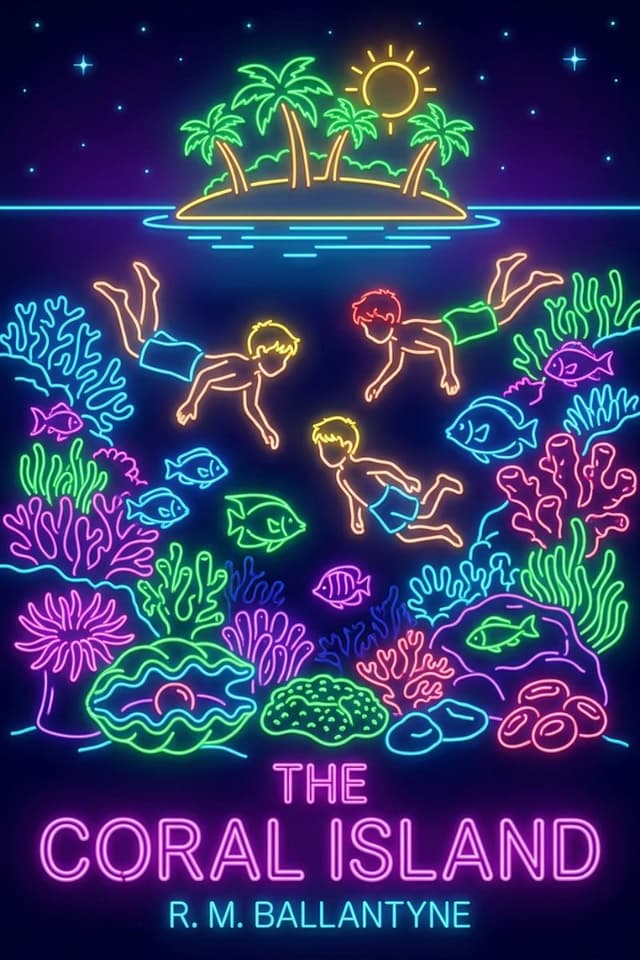
The Coral Island
Read The Coral Island by R. M. Ballantyne for free on Novelhalla, and try out our easy-to-read modern edition of this classic book. You can also download the EPUB and read it on any device if you prefer!
The Plot
Three Boys, One Wreck
Ralph Rover is fifteen years old and hungry for the sea. He's the son of a captain, raised on stories of coral islands in the South Pacific where summer never ends and the trees drip with fruit. So when he gets the chance to sail, he takes it. On board he meets two fast friends: Jack Martin, eighteen, tall and steady, the kind of person everyone follows without being asked; and Peterkin Gay, fourteen, small and funny and absolutely incapable of taking anything seriously.
Then the storm comes.
Five days of fury. Two masts ripped away. The ship driven toward a coral reef with no rudder and no chance. When it's over, Ralph, Jack, and Peterkin are the only survivors, washed up on the shore of an island so beautiful it barely looks real. White sand. Turquoise water. Palm trees bending under the weight of their own fruit. A lagoon so calm it could be glass.
They have a broken telescope, a small axe, and an iron-bound oar. That's it.
Paradise Found
What follows is pure invention and joy. The three boys build a life from nothing. They figure out fire. They hunt wild pigs. They fashion tools, construct a shelter, build a boat. They explore underwater caves and tidal pools, dodge sharks in the lagoon, and stumble across the mysterious remains of someone who came before them and didn't make it.
The island is generous, and the boys are resourceful. Jack's read enough adventure stories to identify half the plants. Peterkin keeps everyone laughing. Ralph watches and records everything with the careful eye of someone who knows this is the greatest experience of his life.
For a while, it's paradise. Three friends against nature, and nature is mostly cooperating.
But they're not alone out here. Not really.
Visitors
The first sign of trouble comes from the sea. Two outrigger canoes appear in the distance, one chasing the other. The groups of islanders land on the beach and the boys watch, hidden in the trees, as a battle unfolds that is nothing like the adventure stories Jack grew up reading. This is real violence. Real death. And when the victors turn on their prisoners, the boys face a choice they never imagined: stay hidden and safe, or step into something far bigger and more dangerous than island survival.
They step in.
It earns them a powerful friend in the chief Tararo. But Tararo and his people leave, and the boys return to their quiet paradise. For a time.
The Pirate Ship
Then the schooner appears.
A crew of British pirates, rough and dangerous men who make their living stealing sandalwood across the Pacific. The boys hide in a cave and wait for them to leave. But Ralph makes a mistake. He ventures out too soon, thinking the pirates have gone, and in an instant everything changes.
Ralph is captured. Dragged aboard the pirate ship. Separated from Jack and Peterkin with no way to get back to them.
What happens next takes Ralph across the South Pacific on a vessel crewed by violent men doing terrible things. He witnesses horrors he never imagined and forms an unlikely bond with a pirate called Bloody Bill, a man whose rough exterior hides something more complicated. Ralph sees island life from a completely different angle now: the beauty and the brutality, the missionaries and the warriors, the forces reshaping an entire world.
And the whole time, one question burns: can he get back to the island? Can he find his friends? And if he does, will they still be there?
The Return
Ralph does make it back to the Coral Island. But the adventure isn't over. It's barely halfway done.
The three boys, reunited, sail to another island where they encounter Tararo again, along with his daughter Avatea, a young woman caught between two worlds, two chiefs, and two futures. The boys decide to help her. It is, as Peterkin might say, the kind of decision that sounds noble right up until it gets you captured.
Whether the boys can talk, fight, or luck their way out of what comes next is a question the book has been building toward from the very first page. And the answer isn't what you'd expect from a story about three kids on a beach.
About the Author: R.M. Ballantyne
An Edinburgh Boy in the Wilderness
Robert Michael Ballantyne was born in Edinburgh in 1825, the youngest son in a large family connected to the printing trade. His uncle James Ballantyne was the printer for Sir Walter Scott. When a banking crisis collapsed the family business, the Ballantynes fell on hard times, and at sixteen Robert was shipped off to Canada to work as an apprentice clerk for the Hudson's Bay Company.
He spent the next six years in the wilds of Rupert's Land, traveling by canoe and dog sled, trading furs with Indigenous peoples, and enduring the kind of isolation that would break most teenagers. He was often alone, with nothing to read and nowhere to go. So he wrote. Long, vivid letters to his mother, descriptions of everything he saw. He later credited those letters with teaching him how to write.
The Accidental Author
Ballantyne returned to Scotland in 1847 and took a job with a publishing firm in Edinburgh. An elderly family friend who had enjoyed his letters from Canada offered to finance their publication, and his first book, Hudson's Bay, appeared in 1848. A publisher named William Nelson suggested he try writing adventure stories for boys. The result was The Young Fur Traders in 1856, and suddenly Ballantyne had a career.
He wrote The Coral Island the following year, working from a house on the seafront in Burntisland, across the Firth of Forth from Edinburgh. He had never been to the South Pacific. He relied on missionary accounts and other people's books, borrowing so heavily from some of them that modern scholars have called it startling. He also got the thickness of coconut shells wrong, a mistake that embarrassed him so much that he resolved to only write about things he had experienced firsthand from then on.
The Research Years
Ballantyne took that resolution seriously. Before writing The Lighthouse, he lived with the keepers on the Bell Rock. For Deep Down, he went underground with the tin miners of Cornwall. For The Lifeboat, he rode with the rescue crews on the English coast. He became one of the most prolific writers in Victorian England, producing over a hundred books in a forty-year career, nearly all of them adventure stories for young readers.
Final Years
In 1866 he married Jane Grant, and they had six children. He spent his later years in Harrow, London, supplementing his writing income with public lectures about his Canadian adventures, complete with magic lantern slides and fur trade souvenirs. Around 1890 he developed what was likely Meniere's disease, causing debilitating vertigo. He traveled to Rome seeking treatment and died there on February 8, 1894. He is buried in Rome's Protestant Cemetery.
Fun Facts About the Book
The Coconut Problem
Ballantyne described coconuts in the novel as being soft and easy to break open, which is spectacularly wrong. When readers pointed out the mistake, Ballantyne was mortified. He made a personal rule from that point on to research his subjects through direct experience. It's one of literary history's more charming examples of an author's error leading to a genuine transformation in working methods.
Never Been to the South Seas
Despite writing one of the most famous South Pacific adventure stories ever published, Ballantyne never set foot on a coral island. He pieced together his tropical paradise from missionary accounts, naturalists' reports, and at least one earlier American novel, James F. Bowman's The Island Home. One scholar described the book as "a fruit cocktail of other writing about the Pacific."
Stevenson's Tribute
Robert Louis Stevenson grew up reading The Coral Island and loved it. When he wrote Treasure Island in 1881, he openly drew on Ballantyne's work. He dedicated the book with a poem that honored Ballantyne by name, calling him "Ballantyne the brave." The influence is visible throughout: Jim Hawkins is essentially Ralph Rover in a different ocean, and the pirate dynamics echo Ballantyne's structure closely.
The Anti-Coral Island
A century later, William Golding read The Coral Island and had the opposite reaction from Stevenson. He thought Ballantyne's vision of boys as naturally good and civilized was naive. So he wrote Lord of the Flies as a direct response, using the same basic setup (British boys stranded on a tropical island) but arriving at much darker conclusions. He even named his characters Ralph, Jack, and a nickname derived from Peterkin (Piggy) to make the connection unmistakable.
Sold for a Pittance
Ballantyne's publisher, T. Nelson & Sons, bought the copyright outright for somewhere between fifty and sixty pounds. When the novel became a massive bestseller that never went out of print, Ballantyne tried to buy the rights back and was refused. He never earned another penny from his most famous book.
One of the First
The Coral Island was one of the first adventure novels to feature exclusively young protagonists. Before Ballantyne, the stranded-on-an-island genre (known as the Robinsonade, after Robinson Crusoe) featured adult heroes. Putting three teenagers at the center of the action was a genuine innovation that helped launch an entire tradition of young adult adventure fiction.
The Christmas Release
The first edition is dated 1858, but it was actually on sale in bookshops by early December 1857, timed for the Christmas market. Backdating books to the following year was common practice at the time, especially for holiday releases.
Side Characters
Bloody Bill
The most memorable figure in the novel beyond the three boys. A pirate with a fearsome reputation and a surprisingly complex inner life, Bill becomes Ralph's unlikely protector aboard the schooner. His story is one of the book's most unexpected threads, and his relationship with Ralph adds a layer of moral weight to what could have been a simple adventure tale.
Tararo
The Polynesian chief whose path crosses with the boys more than once. Tararo is powerful, dangerous, and operates by a code the boys don't fully understand. His daughter Avatea becomes central to the story's final act, and his decisions shape the fates of everyone around him.
Themes
Friendship Under Pressure
The bond between Ralph, Jack, and Peterkin is the engine of the entire story. They are different in almost every way: the thinker, the leader, the joker. But their loyalty to each other never wavers, even when they're separated by ocean and violence. The novel argues that the right companions can make almost anything survivable.
Innocence Meets the World
The boys begin the story as sheltered products of Victorian England. The island educates them in ways no school could. They encounter beauty and horror in equal measure, and watching them try to process violence, cruelty, and moral complexity through the lens of their upbringing is one of the book's most compelling tensions.
Survival and Ingenuity
A huge portion of the book is devoted to the sheer pleasure of figuring things out. How to make fire. How to build a boat. How to catch a pig. Ballantyne makes problem-solving feel like adventure, and the boys' resourcefulness is infectious. It's the same appeal that makes every castaway story work: the fantasy of starting from nothing and making a life with your hands.
The Clash of Worlds
The novel is set against the backdrop of the nineteenth-century Pacific, where European missionaries, traders, and pirates are reshaping island societies. Ballantyne's perspective is firmly Victorian, and modern readers will find much to critique in how he portrays Indigenous peoples. But the collision of cultures is real, and the story doesn't shy away from showing how violent and disorienting that collision can be for everyone involved.
The Book's Legacy
The Coral Island was a phenomenon when it was published and remained a staple of British childhood reading for a century. It helped define the adventure genre for young readers and directly inspired two of the most important books in the English language: Treasure Island and Lord of the Flies.
Stevenson saw it as a blueprint and built on it. Golding saw it as a lie and tore it apart. That a single novel could inspire both responses tells you something about its power. The Coral Island presents a vision of youth as inherently good, brave, and capable. Lord of the Flies argues the opposite. The argument between these two books is really an argument about human nature, and it's one we're still having.
Modern readers will find the novel's attitudes toward race and empire uncomfortable, and they should. Ballantyne wrote from within a worldview that is dated and often offensive. But the core of the story, three friends against the world, figuring things out together, refusing to give up on each other, still works. That's why it keeps getting read, adapted, and argued about more than 160 years after a man who had never seen the South Pacific sat down by the Scottish coast and imagined it.