Novelhalla
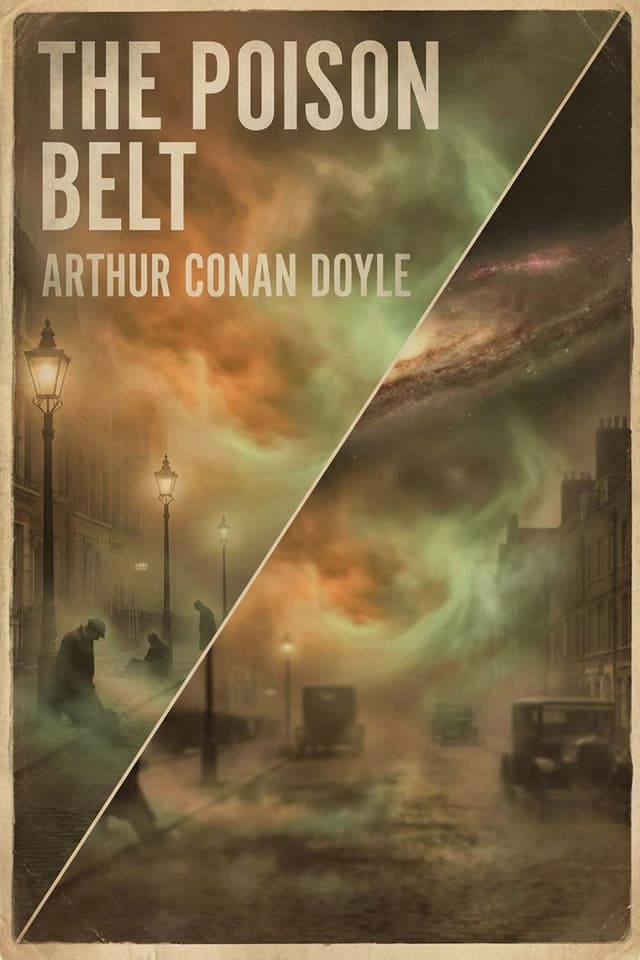
The Poison Belt
Read The Poison Belt by Arthur Conan Doyle for free on Novelhalla, and try out our easy-to-read modern edition of this classic book. You can also download the EPUB and read it on any device if you prefer!
The Plot
A Cryptic Summons
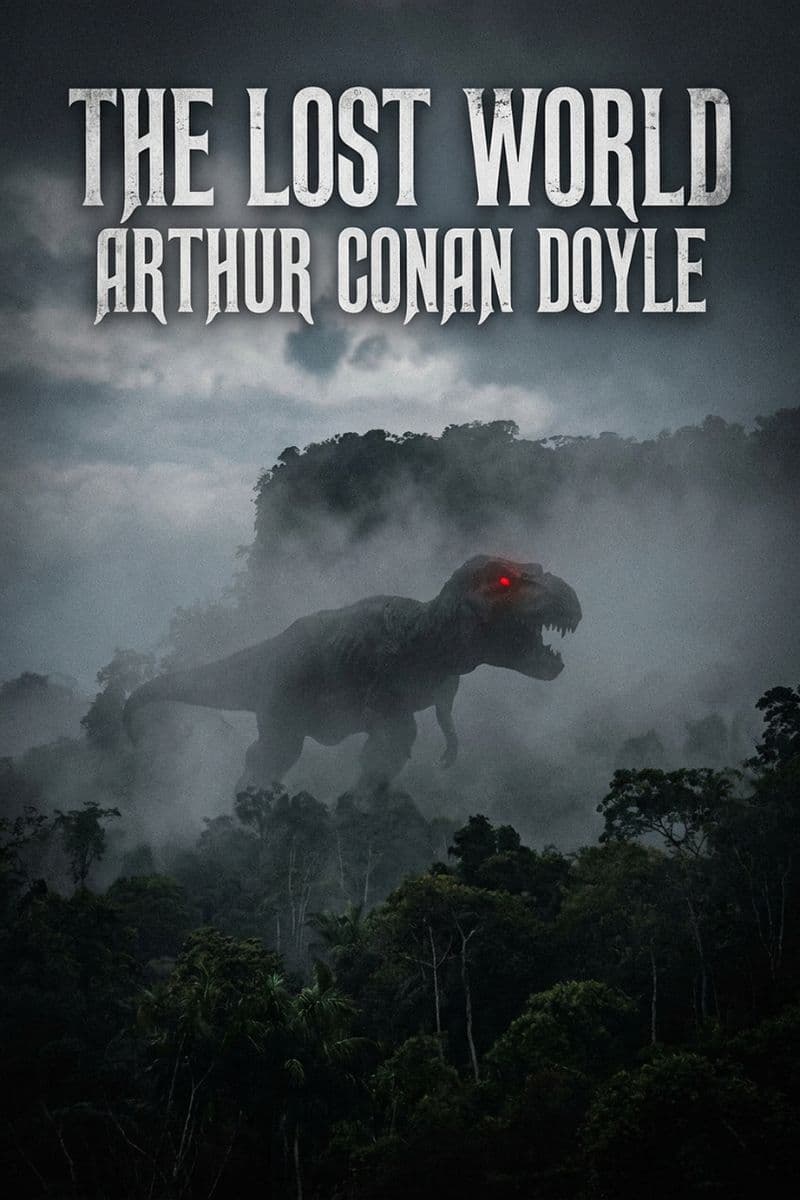
It has been three years since Professor George Edward Challenger led his expedition to the Lost World, that isolated South American plateau where dinosaurs still roamed. The adventure made him famous, though his abrasive personality has ensured he remains as unpopular as ever with the scientific establishment. His companions from that journey have scattered back to their ordinary lives: Edward Malone to his newspaper, Lord John Roxton to his gentlemanly pursuits, Professor Summerlee to his quiet academic existence.
Then the telegrams arrive. Challenger is summoning them to his country home in Sussex. The message is urgent, the tone imperious, the instruction peculiar: bring oxygen.
Malone receives his summons at the Daily Gazette offices. Lord John gets his at his club. Professor Summerlee, who has spent years feuding with Challenger over scientific matters, receives his with characteristic skepticism. But none of them can resist. When Challenger calls, you answer. The man may be insufferable, but he is never boring, and he is never wrong about matters of science.
The Journey
The train ride from London begins normally enough. But as the journey progresses, Malone notices something strange. People are behaving oddly. A man on the platform laughs too loudly at nothing. A conductor snaps at passengers with uncharacteristic rudeness. In the streets visible from the train window, there seems to be an unusual number of arguments and altercations.
Lord John remarks that he nearly shot his own reflection that morning, mistaking it for an intruder. Professor Summerlee confesses to a moment of inexplicable rage at his housekeeper. Malone himself has been feeling strangely emotional, prone to tears and sudden bursts of irritation.
By the time they reach Challenger's home, the evidence is unmistakable. Something is affecting people's minds. Something is loosening the restraints of civilization. And whatever it is, it is getting worse.
The Sealed Room
Challenger greets them with grim satisfaction. He has been monitoring astronomical data, tracking strange disturbances in the spectrum of light from distant stars. He has correlated these observations with reports from around the world: mass hysteria in Sumatra, unexplained deaths, animals behaving erratically.
His conclusion is terrifying. The Earth is drifting into a belt of poisonous ether, an invisible cosmic substance that permeates all of space. As the planet moves deeper into this toxic region, the ether is affecting all life. First come the behavioral changes: heightened emotions, loss of inhibition, irrational violence. Then comes death.
Challenger has prepared. He has sealed one room of his house, made it as airtight as possible, and stockpiled cylinders of oxygen. The oxygen, he believes, will counteract the effects of the poison, at least for a time. He has invited his former companions not for rescue but for company. If these are to be humanity's final hours, he wants to spend them with the only people he respects.
His wife Jessie joins them. The servants are left outside. There is only so much oxygen.
Watching the World Die
The five of them settle into the sealed room as the poison belt tightens its grip on the Earth. Through the windows, they watch the catastrophe unfold.
The servants continue their duties for a time, moving more and more slowly, until they collapse at their posts. In the distance, they can see figures falling in the fields. A car crashes on the road below, its driver slumped over the wheel. Birds drop from the sky. The family dog curls up on the lawn and does not rise again.
Inside the room, the oxygen keeps them alive and clear-headed. They talk. They argue. Challenger and Summerlee continue their eternal scientific debates even as the world ends around them. Lord John maintains his aristocratic composure. Malone takes notes, the journalist's instinct persisting even when there may be no one left to read his words.
They discuss philosophy and mortality. They wonder what, if anything, comes after death. They speak of regrets and hopes and the strange privilege of witnessing something no human beings have ever witnessed: the end of everything.
The Last Cylinder
The oxygen runs low. One cylinder empties, then another. Challenger calculates how long they have left. Hours, not days. The sealed room that protected them has become a tomb with a timer.
They watch through the windows as London goes silent. The great city, visible in the distance, shows no signs of life. No smoke rises from chimneys. No trains move on the tracks. The entire world has become a graveyard, and they are the last mourners.
Finally, the last cylinder begins to fail. The hiss of oxygen fades. The air grows thin.
Challenger opens the window. If they must die, they will face it together, breathing the same poisoned air that killed the rest of humanity. They stand at the threshold, the professor and his wife, the adventurer, the skeptic, and the journalist, waiting for the end.
What happens next, Doyle asks the reader to discover for themselves. The Earth has passed through something unprecedented. Whether anyone survives to tell the tale, whether there is any tale left to tell, whether the silence is permanent or temporary, the answer lies in the final pages.
About the Author: Arthur Conan Doyle
The Edinburgh Student
Arthur Ignatius Conan Doyle was born on May 22, 1859, in Edinburgh, Scotland, into a large Irish Catholic family. His father, Charles Doyle, was a civil servant and illustrator who struggled with alcoholism and was eventually institutionalized. His mother, Mary Foley Doyle, was a vivacious woman with a gift for storytelling who sparked her son's imagination with tales of adventure and chivalry.
Doyle was educated by Jesuits, first in England and then in Austria, receiving a rigorous classical education. By the time he enrolled at the University of Edinburgh to study medicine in 1876, he had abandoned Catholicism, though he retained a lifelong interest in questions of mortality and the afterlife.
At Edinburgh, Doyle encountered Dr. Joseph Bell, a surgeon whose extraordinary powers of observation and deduction would later inspire the creation of Sherlock Holmes. Bell could examine a patient and deduce their occupation, habits, and recent activities from the smallest details. Doyle watched, learned, and remembered.
The Struggling Doctor
Doyle graduated in 1881 and spent several years as a ship's surgeon, traveling to the Arctic on a whaling vessel and to West Africa. These voyages awakened his sense of adventure and provided material for his early fiction. He established a medical practice in Southsea, near Portsmouth, but patients were scarce. To fill the empty hours, he wrote.
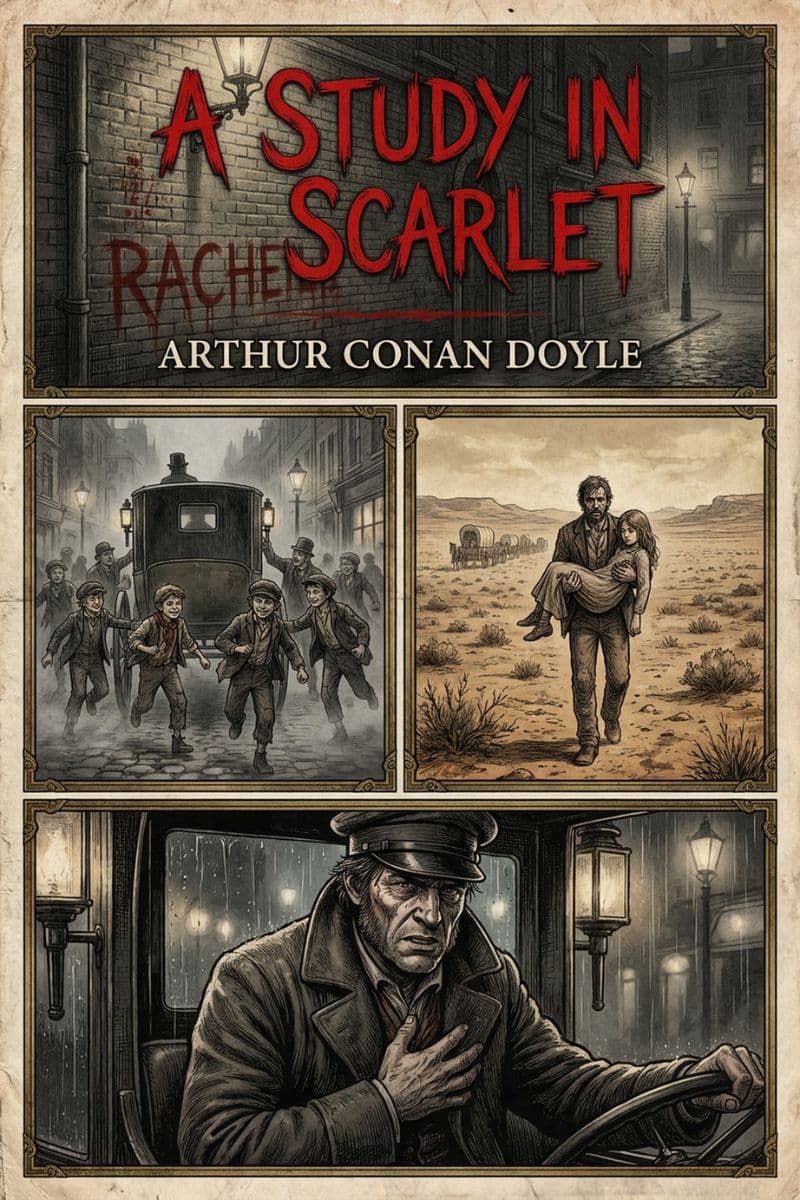
His first Sherlock Holmes story, A Study in Scarlet, appeared in 1887. It attracted little attention. But when the Strand Magazine began publishing Holmes stories in 1891, the detective became a sensation. Doyle found himself famous, wealthy, and increasingly resentful of the character who overshadowed all his other work.
In 1893, weary of Holmes, Doyle killed him off at the Reichenbach Falls. The public outcry was extraordinary. Young men wore black armbands in mourning. Doyle received furious letters and even death threats. He held out for a decade before resurrecting Holmes in 1903, though he never stopped wishing he could escape his creation's shadow.
The Adventurer and Believer
Doyle lived the kind of life he wrote about. He was a large, athletic man who played cricket and football, learned to ski, and took up motoring in its earliest days. He twice ran for Parliament, unsuccessfully. He investigated and helped overturn miscarriages of justice, contributing to the establishment of the Court of Criminal Appeal. He served as a war correspondent during the Boer War and wrote a defense of British conduct that led to his knighthood in 1902.
He married twice: first to Louise Hawkins in 1885, who died of tuberculosis in 1906, and then to Jean Leckie in 1907. He had five children between his two marriages.
The great tragedy of Doyle's later life was the First World War. His son Kingsley died of wounds and influenza in 1918. His brother Innes died the following year. The losses drove Doyle deeper into spiritualism, a belief system he had flirted with for decades. He became convinced that the dead could communicate with the living, and he spent the final years of his life as spiritualism's most prominent advocate, traveling the world to lecture on the subject.
His friendship with the magician Harry Houdini foundered on this issue: Houdini, dedicated to exposing fraudulent mediums, could not accept Doyle's credulous enthusiasm. Doyle, for his part, believed that Houdini himself possessed genuine supernatural powers and simply refused to acknowledge them.
The Final Years
Doyle died on July 7, 1930, at his home in Crowborough, Sussex. He had suffered a heart attack the previous autumn but continued his spiritualist lecturing until his health completely failed. He was found one morning in his garden, clutching his heart with one hand and a flower in the other. He was seventy-one years old.
At his funeral, his family and the spiritualist community celebrated rather than mourned, believing he had simply passed to the other side. A few days later, thousands filled the Royal Albert Hall for a seance at which a medium claimed to have contacted him.
He left behind over two hundred short stories, twenty-three novels, plays, poetry, and extensive nonfiction. He wished to be remembered for his historical novels, his spiritualist writings, his work for justice. Instead, he is remembered for Sherlock Holmes. It was a fate he spent his life resisting and could never escape.
Fun Facts About the Book
The Sequel Nobody Expected
The Poison Belt was a sequel to The Lost World, published just a year earlier in 1912. But where The Lost World was a globe-trotting adventure full of dinosaurs and ape-men, The Poison Belt confines its characters to a single room for most of its length. Doyle seemed to be deliberately challenging himself to create drama from conversation and contemplation rather than action.
The Ether That Wasn't
The novel's scientific premise rests on the concept of "luminiferous ether," a hypothetical substance that nineteenth-century physicists believed permeated all of space and served as the medium through which light traveled. The Michelson-Morley experiment of 1887 had already cast serious doubt on the ether's existence, and Einstein's theory of relativity would soon render it obsolete. But in 1913, the idea still had enough currency for Doyle to build a story around it.
A Plagiarism Controversy
Shortly after The Poison Belt's publication, French author J.-H. Rosny aine accused Doyle of plagiarizing his story "La Force mysterieuse," which also featured a cosmic phenomenon affecting life on Earth. Doyle defended himself in letters to The Times, arguing that both stories drew independently from astronomical observations. Rosny eventually withdrew the accusation.
The First Cosy Catastrophe
Critics have identified The Poison Belt as one of the earliest examples of the "cosy catastrophe," a peculiarly British genre in which characters witness the end of civilization from a position of relative comfort. The tradition would continue through John Wyndham's The Day of the Triffids and beyond. There is something very English about watching the apocalypse unfold while drinking tea.
The Servants Left Outside
Modern readers often notice a detail that passed without comment in 1913: Challenger saves himself, his wife, and his distinguished guests, but leaves his servants outside the sealed room to die. This reflects Edwardian class assumptions so ingrained that Doyle apparently saw nothing remarkable about them. The servants continue performing their duties until they collapse.
Spiritualism Foreshadowed
Though Doyle's public embrace of spiritualism came after the First World War, The Poison Belt already shows his interest in questions of death and the afterlife. The characters' philosophical discussions as they await the end touch on what, if anything, lies beyond. Challenger himself would convert to spiritualism in a later novel, The Land of Mist, reflecting Doyle's own journey.
Radio and Readings
The BBC produced a radio drama of The Poison Belt in 1944, following their successful adaptation of The Lost World. A five-part reading aired on BBC Radio 4 during Christmas 1983, performed by Peter Pacey. The story's confined setting and emphasis on dialogue make it well-suited to audio adaptation.
Themes
The Fragility of Civilization
As the poison belt affects people's behavior, the thin veneer of civilization peels away with alarming speed. People who seemed perfectly respectable become violent, irrational, dangerous. The novel suggests that the self-control we take for granted is more fragile than we imagine, dependent on conditions we do not understand and cannot control.
Humanity's Cosmic Insignificance
Challenger describes Earth as a "third-rate sun, with its rag tag and bobtail of insignificant satellites," drifting through an ocean of ether toward some unknown fate. The novel presents humanity not as the center of creation but as an accident of cosmic geography, vulnerable to forces we cannot predict or prevent. This anticipates the cosmic pessimism of later science fiction.
The Uses of Knowledge
What good is scientific understanding when it can predict doom but not prevent it? Challenger's genius allows him to foresee the catastrophe, but he cannot stop it. The best he can do is prepare a room and stockpile oxygen, buying himself and his friends a few extra hours. The novel asks whether knowledge is worthwhile for its own sake, even when it cannot save us.
Facing Death with Dignity
Much of the novel consists of conversations among people who believe they are about to die. They argue, philosophize, comfort each other, and maintain their composure. The novel is interested in how people behave when all hope is gone, and it suggests that character reveals itself most clearly in extremity.
Scientific Arrogance and Humility
The debates between Challenger and Summerlee embody two approaches to science. Challenger is bold, intuitive, willing to make sweeping claims. Summerlee is cautious, skeptical, resistant to speculation. Both attitudes have their place, and the novel suggests that true wisdom lies in knowing when to embrace each one.
The Book's Legacy
The Poison Belt occupies a curious position in literary history. It is overshadowed by both Sherlock Holmes and The Lost World, rarely adapted and seldom discussed. Yet its influence on the genre of apocalyptic fiction is significant.
The novel pioneered what would become a durable formula: a small group of survivors witnessing global catastrophe from a position of relative safety, discussing the end of everything while maintaining British composure. John Wyndham, J.G. Ballard, and countless other writers would explore similar territory. The "cosy catastrophe" became a recognizable subgenre, and The Poison Belt was there at the beginning.
The novel also anticipates environmental anxieties that would not become widespread for decades. The idea of invisible atmospheric contamination threatening all life prefigures concerns about pollution, ozone depletion, and climate change. Doyle's cosmic poison belt is not so different from the invisible threats that occupy contemporary imaginations.
Professor Challenger himself remains one of Doyle's most memorable creations: brilliant, insufferable, convinced of his own genius, and usually right. He appeared in five stories altogether, the last being "When the World Screamed" in 1928. Doyle clearly enjoyed writing him, perhaps because Challenger could say things that the author himself could not.
The Poison Belt asks a simple question: if you knew the world was ending, how would you spend your final hours? The answer it offers is characteristically Edwardian: with tea, conversation, and stiff upper lips. But beneath the period trappings lies something more universal, a meditation on mortality that speaks to any reader who has ever contemplated the end.