Novelhalla
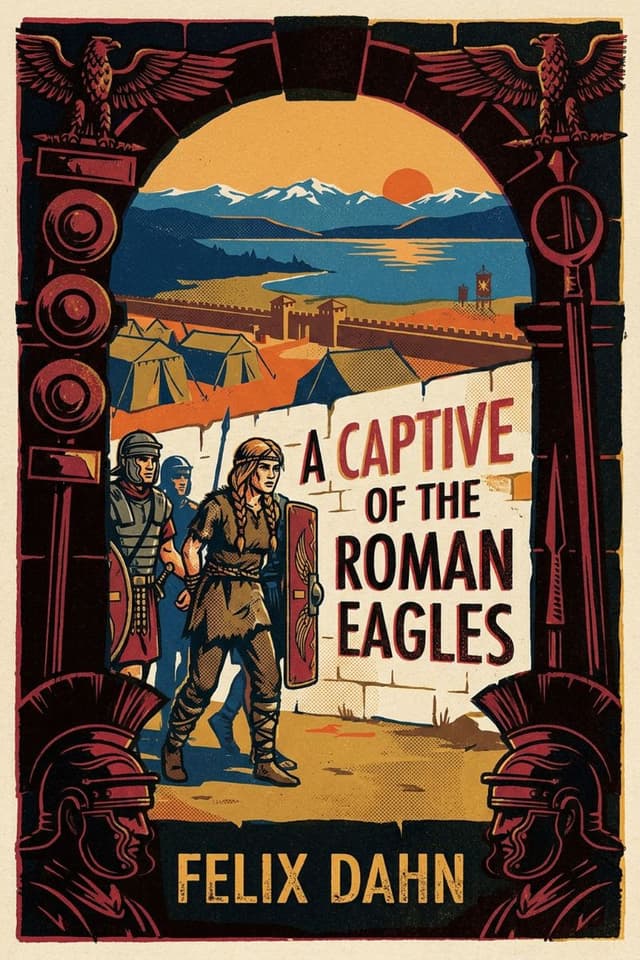
A Captive of the Roman Eagles
Read A Captive of the Roman Eagles by Felix Dahn for free on Novelhalla, and try out our easy-to-read modern edition of this classic book. You can also download the EPUB and read it on any device if you prefer!
The Plot
A Peaceful Lake on the Edge of War
The story opens with a scene any traveler would recognize: the sun setting behind the beeches of Manzell near Friedrichshafen on Lake Constance, with the Alps glowing crimson in the evening light. Then Dahn pulls you back sixteen centuries. In the year 378, the whole northern shore of the "Venetus Lacus" looked somewhat desolate, and often by no means peaceful.
This was the home of the Lentian Alemanni, who lived on the northern and western shores of the lake and had spent that very spring raiding the Roman frontier. Rome wants revenge, and it has a plan. Small Roman columns will close in from several directions at once, and anyone who tries to escape south across the lake by boat will be cut off by the Roman Bodensee Fleet. It's meant to be a quick, clean job of wiping a troublesome people off the map.
Bissula
Living in this threatened corner of the world is Bissula, a young Alemannic girl. She shares her home with her blind old grandmother, Waldrun, and she's watched over by Adalo, a young Alemannic noble who's handsome, proud, and plainly in love with her. He's also a man with bigger ideas than most of his neighbors. Adalo is a supporter of a "Völkerbund," an alliance of the peoples, and he believes the scattered tribes could stand up to Rome if they'd only work together.
Then the Roman eagles arrive, and Bissula's life is torn apart.
Prize of War
Bissula is captured and dragged into the Roman world, and the question of who owns her quickly becomes a fight of its own. One of the men who wants her is Ausonius, the Prefect of Gaul. He's a famous poet, a cultured, clever, slightly vain older man, and he's charmed by the wild northern girl. He even starts writing verses about her. But things don't go his way. Bissula ends up the captive not of Ausonius but of someone else, and to the Prefect's barely hidden fury, the younger man claims her by the rights of war.
So Bissula is a prisoner in an enemy camp, surrounded by soldiers who hate her people. One of them, Herculanus, raises a toast that sums up the mood: "Disgrace and death to the Alemanni!" She has no weapons and no allies, and nobody around her speaks her language in any sense of the word. All she can do is cling to the one name that still means home.
The Rescue
Back on the shores of the lake, Adalo is half mad with grief and suspicion. He even tortures himself with the thought that "Perhaps she went with the Italians willingly... with the clever Ausonius!" But doubt won't stop him. Freeing Bissula from a closely guarded Roman camp looks impossible, and he means to try anyway.
From there the novel turns into a full-blooded adventure, with daring escapes, raids at night, fighting on the lake, burning galleys and desperate chases. As the fighting heats up, the book delivers one twist after another, in the spirit of a swashbuckling cloak-and-dagger romance. Bissula is caught between two worlds and two very different men. One is the refined Roman poet who wants to keep her, and the other is the young warrior who'd risk everything to bring her home. She'll have to decide where she belongs and what freedom is really worth. And the war on Lake Constance is only getting started.
About the Author: Felix Dahn
A Childhood in the Theater
Felix Ludwig Julius Dahn was born in Hamburg, the oldest son of Friedrich and Constanze Dahn, who were well-known actors at the city's theater. The family had both German and French roots. He was born in Hamburg but grew up in Munich, and his poetic talent developed early under the influence of the city's circle of writers. He was a voracious learner and picked up English and French as a boy, then later Italian, Spanish, Portuguese and the Scandinavian languages. His home life wasn't easy, though. In 1850 his parents divorced. Felix moved into a small apartment with his father, while his younger siblings stayed with their mother. He also wrote of a "melancholy" that came over him in early youth and kept returning throughout his life.
Law Professor and Scholar
Dahn studied law and philosophy in Munich and earned his law doctorate in Berlin. After his habilitation he became a lecturer in German law in Munich in 1857. In Munich he was also a member of the poets' society "Das Krokodil." He took a professorship in Würzburg in 1863 and moved to Königsberg in 1872, and later he went on to Breslau. In 1895 he was appointed rector of the University of Breslau. His big scholarly project was Die Könige der Germanen (Germanic Kings), published in 11 parts between 1861 and 1911.
Bestselling Novelist
Dahn didn't stay inside the lecture hall. He became a leading writer of the "Professorenroman," a kind of historical novel by scholars that was briefly popular in the second half of the nineteenth century. His masterpiece was Ein Kampf um Rom (1876), published in English in 1878 as A Struggle for Rome, and it appealed to a huge audience, from teenagers to Pulitzer Prize winners. He followed it with a whole run of shorter books, the Kleine Romane aus der Völkerwanderung (Short Novels of the Migrations), published in 13 parts between 1882 and 1901.
Partnership and Final Years
His second wife was Therese von Droste-Hülshoff (1845-1929), a niece of the celebrated poet Annette von Droste-Hülshoff. The couple worked closely together on their writing, and the poetry volumes in his collected works were written jointly by the two of them. He didn't step back from his official duties until 1910, when he was already 76, and by then his welcoming home in Breslau had become a center of the city's intellectual and artistic life. He died in Breslau on 3 January 1912, at the age of 77.
The Translator: Mary J. Safford
The English version was translated by Mary J. Safford (1842-1916), one of the busiest translators of German historical fiction in her day. She also translated Hungarian author Mór Jókai's The Corsair King, but she was best known for her many translations of Georg Ebers. In her preface to this book she says she hopes that the warm reception her Ebers translations received would carry over to "A Captive of the Roman Eagles."
Fun Facts About the Book
Bissula Was a Real Person
The heroine isn't made up. The real Bissula was an Alemannic woman of the 4th century who was captured by the Romans as a young girl and became the slave of the Roman poet Ausonius, who had taken part in the campaign. Ausonius, a widower of about 60 by then, fell in love with her and freed her. He wrote a poem about her, de Bissula, which he sent to his friend Paulus.
So Was Her Poet
Ausonius was one of the most important men in the Western Empire. Emperor Valentinian I summoned him to tutor his son Gratian, the heir to the throne, and when Valentinian took Gratian on his German campaigns of 368 and 369, Ausonius went along. In his poems he complains with obvious delight that the imperious Bissula "rules her master's house."
Dahn Moved the Calendar
Scholars generally agree that the real Bissula was captured during Valentinian I's German campaign in 368. Dahn moved her story ten years later to 378, a dramatic year when the whole Roman world was shaking. Not everyone has forgiven him for it. One modern reader complained that "the story does not align with the historical facts."
Part of a Series
In Germany, the novel was originally published as Bissula in 1884. It's the second book in Dahn's series Kleine Romane aus der Völkerwanderung, a group of short novels about the age of the great Germanic migrations.
The Chicago Edition
The English translation crossed the Atlantic early. It was published by A.C. McClurg & Co. in Chicago in 1902, subtitled "A Tale of the German Migrations: A.D. 378."
A Modern Opening
Dahn's opening is unusual for a historical novel. He starts in the present day of his own readers, describing what a tourist would see on a summer evening at Friedrichshafen, and only then drops you into the year 378. Before the swords come out, he invites you to stand on the very ground where it all happened.
Themes
Freedom and Captivity
The title tells you where the book's heart is. Bissula's captivity drives everything that happens, but Dahn keeps asking a bigger question: what does it mean to be free? Being well treated in a gilded cage isn't the same thing as liberty, and the book never lets you forget it.
Civilization Versus the Wild
Ausonius stands for everything polished about Rome: poetry, learning, luxury and refined taste. Adalo and the Alemanni stand for loyalty, courage and a fierce attachment to their own land. Dahn plays these two worlds against each other and makes you wonder which one is really the "civilized" one.
Unity of the Peoples
Adalo's dream of uniting the tribes is one of the threads holding the novel together. Divided, the Alemanni are easy prey for Rome's tactic of attacking from several sides at once. Together they might be something to fear. It's a theme Dahn came back to again and again in his fiction.
Love and Possession
Two very different men want Bissula, and they want her in very different ways. The novel looks hard at the gap between loving someone and wanting to own them, and at the gap between admiring a person and actually understanding them.
Empire in Decline
In the background, Rome is overstretched and its soldiers are rushing from one frontier to the next. The sense that the old empire is cracking hangs over every battle.
Historical Context
The year 378 was one of the most dramatic in late Roman history, and Dahn sets his story right in the middle of it. In the East, Gothic tribes, especially the Visigoths, had fled the Huns and found refuge on Roman land, but the Roman governor treated them so badly that they rose up in arms. Valens, Emperor of the East, hoped to handle them alone so he wouldn't have to share the glory with his young nephew Gratianus, ruler of the West, but he still had to ask Gratianus to stand ready with his Gallic legions.
That's where the novel opens: with the Western army caught between two frontiers. As Dahn puts it, the troops were sometimes forced to rush from the Rhine to the Danube to meet the Goths in the East, and then back again to fight the Franks or the Alemanni. The book takes place in the same summer that the Eastern Empire under Valens was about to suffer a catastrophic defeat by the Goths at Adrianople. Knowing that disaster is coming gives the whole story an extra edge.
The Book's Legacy
Dahn will always be best known for A Struggle for Rome, which went on to become a film. He's credited as the writer behind The Last Roman (1968) and Kampf um Rom II - Der Verrat (1969). His smaller novels have had quieter lives, but this one has lasted in an unexpected way: it's become part of the story of how Ausonius has been remembered over the centuries.
Classical scholars have noticed. A review of a recent study of Ausonius in European literature lists Dahn's novel Bissula, which came out in 1884, among the works that kept the Roman poet's memory alive. A 2023 French doctoral thesis by Marie-Françoise Caumont went further and devoted a whole section to Dahn's novel, where Ausonius and Bissula are both historical figures and fictional characters at once.
For modern readers, the book is a chance to step into a corner of history that fiction rarely visits. It's a lakeside frontier at the very end of the Roman age, seen through the eyes of a girl who's mostly remembered through a few lines of a Roman's poetry. Dahn takes that faint trace and gives her a voice, a home, a people and a fight.