Novelhalla
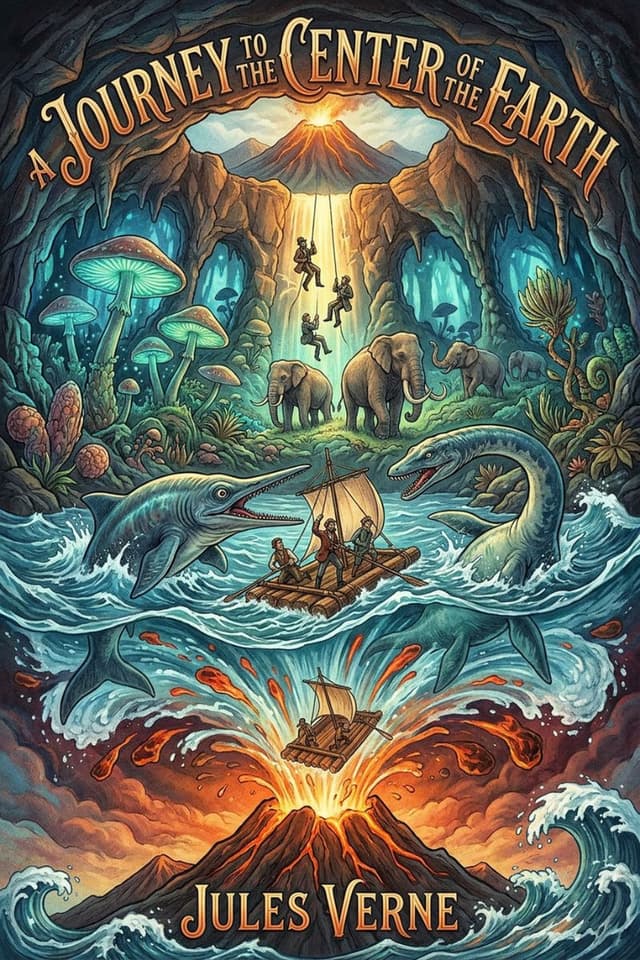
A Journey to the Center of the Earth
Read A Journey to the Center of the Earth by Jules Verne for free on Novelhalla, and try out our easy-to-read modern edition of this classic book. You can also download the EPUB and read it on any device if you prefer!
The Plot
The story begins in Hamburg, Germany, where the eccentric Professor Otto Lidenbrock discovers a coded runic manuscript hidden inside an old Icelandic book. With the help of his nephew Axel, he deciphers a message written by a 16th century alchemist named Arne Saknussemm, claiming to have found a passage to the center of the Earth through an Icelandic volcano.
The impulsive professor immediately drags the reluctant Axel on an expedition to Iceland, leaving behind Axel's sweetheart Gräuben. In Iceland, they hire a stoic and unflappable guide named Hans Bjelke, who proves invaluable throughout their journey.
The three descend into the crater of Snæfellsjökull, following Saknussemm's cryptic instructions. What begins as a claustrophobic crawl through volcanic tunnels gradually opens into something far stranger. They discover vast underground caverns, encounter geological wonders that challenge everything science believes about the Earth's interior, and face life-threatening dangers including cave-ins, getting lost, and a desperate shortage of water.
As they journey deeper, the underground world grows increasingly bizarre and wondrous. The explorers find things that should not exist so far beneath the surface, discoveries that would revolutionize human understanding of natural history and the planet itself.
About the Author: Jules Verne
Early Life
Jules Gabriel Verne was born in 1828 in Nantes, France, a busy port city whose ships and sailors fired his imagination from childhood. His father was a successful lawyer who expected Jules to follow in his footsteps.
Paris and the Theater
Verne moved to Paris ostensibly to study law but spent most of his time writing plays and librettos. He befriended Alexandre Dumas and moved in literary circles, though success remained elusive. He worked as a stockbroker to pay the bills, writing in the early morning hours before work.
The Extraordinary Voyages
In 1862, Verne met publisher Pierre-Jules Hetzel, who recognized his talent and signed him to a long-term contract. Hetzel published "Five Weeks in a Balloon" in 1863, launching Verne's series of "Extraordinary Voyages," which would eventually include over sixty novels.
"Journey to the Center of the Earth" appeared in 1864, followed by "From the Earth to the Moon," "Twenty Thousand Leagues Under the Sea," "Around the World in Eighty Days," and dozens more. Verne became one of the most widely read authors in the world.
Writing Process
Verne was a meticulous researcher who filled his novels with scientific and geographical detail. He maintained extensive files of newspaper clippings and corresponded with scientists. His goal was to make the impossible seem plausible through sheer accumulation of realistic detail.
Later Life
Verne settled in Amiens, where he wrote prolifically, served on the city council, and became increasingly reclusive. In 1886, his mentally ill nephew shot him in the leg, leaving him with a permanent limp. He continued writing until his death in 1905 at age 77.
Fun Facts About the Book
Scientific Accuracy
Verne prided himself on scientific plausibility, but "Journey to the Center of the Earth" required him to ignore what was already known about the planet's interior. Scientists in the 1860s understood that temperatures increased with depth, making a hollow or temperate interior impossible. Verne acknowledged this through Axel's objections, which his uncle simply dismisses.
Hollow Earth Theories
The idea of a hollow or inhabited Earth was taken more seriously in the 19th century than it is today. Various theorists had proposed hollow Earth models, and the concept captured public imagination. Verne tapped into this fascination while maintaining enough scientific skepticism through Axel to have it both ways.
Revisions
Verne revised the novel significantly between its original 1864 publication and later editions. He updated scientific references, expanded certain passages, and refined the prose. Different translations are based on different editions, leading to variations in the text.
The Liddenbrock Sea
Verne invented an underground ocean for the novel, complete with its own ecosystem. This body of water has no basis in geology but creates some of the book's most memorable scenes. The name varies in translations, sometimes called the Lidenbrock Sea, sometimes the Central Sea.
Icelandic Setting
Verne never visited Iceland but researched it thoroughly. His descriptions of the landscape, the people, and the journey to Snæfellsjökull impressed Icelandic readers with their accuracy. The volcano has since become a tourist destination partly due to the novel's fame.
Publication History
The novel was serialized in Hetzel's magazine before appearing as a complete book. Like many 19th century novels, it was written with serialization in mind, featuring cliffhangers and a pace designed to keep readers returning for the next installment.
Translation Challenges
Early English translations took significant liberties with the text, sometimes omitting passages, changing character names, or "improving" Verne's science. Modern translations attempt to restore Verne's original intentions, though debates continue about which French edition should be considered definitive.
Themes
Science and Wonder
The novel celebrates scientific curiosity while acknowledging its limits. Professor Lidenbrock represents the drive to know and explore, even when knowledge conflicts with what exploration reveals. The underground world rewards curiosity with wonders that exceed anything the surface offers.
The Known and Unknown
Verne repeatedly contrasts established scientific knowledge with the mysteries that remain. The journey takes the characters beyond maps and textbooks into territory where observation trumps theory. What they find challenges assumptions about what is possible.
Courage and Fear
Axel's arc traces a journey from fear to bravery. His terror at the expedition gradually gives way to wonder and determination. The novel suggests that fear is natural but should not prevent exploration.
Obsession
Professor Lidenbrock's single-minded pursuit of his goal drives the plot but also endangers everyone. His refusal to turn back, even when prudence demands it, raises questions about where dedication ends and recklessness begins.
Nature's Grandeur
The underground landscapes Verne describes evoke the sublime, a mixture of beauty and terror that dwarfs human concerns. The explorers repeatedly find themselves humbled by the scale and strangeness of what lies beneath the familiar surface world.
The Book's Legacy
"Journey to the Center of the Earth" established Verne as a master of scientific adventure fiction and helped create the genre we now call science fiction. Its influence extends through countless hollow Earth stories, lost world narratives, and tales of scientific exploration.
The novel has been adapted into films, television series, and other media repeatedly, though adaptations often add elements like dinosaur battles that Verne handled more subtly. The 1959 film starring James Mason remains a classic, while newer versions continue to appear.
Verne's vision of adventure through scientific curiosity, of wonders waiting to be discovered by those brave and curious enough to seek them, continues to inspire readers and writers alike.