Novelhalla
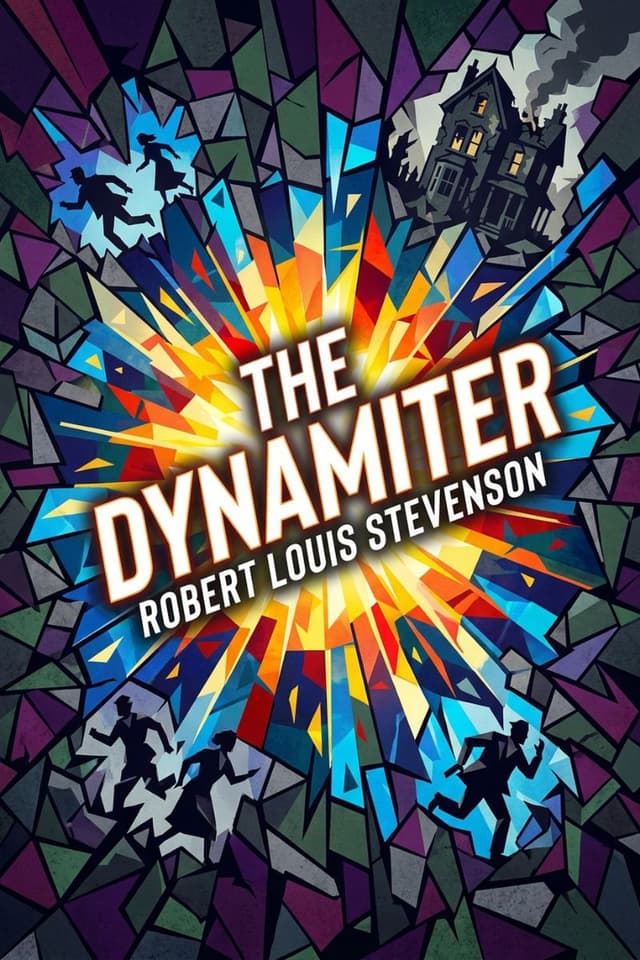
The Dynamiter
Read The Dynamiter by Robert Louis Stevenson for free on Novelhalla, and try out our easy-to-read modern edition of this classic book. You can also download the EPUB and read it on any device if you prefer!
The Plot
The Pact
In a quiet cigar shop on Rupert Street in Soho, three young men sit smoking and lamenting their fortunes. Paul Somerset, Edward Challoner, and Harry Desborough are all broke, all idle, and all bored beyond endurance. The shop is run by a mysterious and dignified figure who calls himself Theophilus Godall, though he carries himself with the bearing of something far grander than a tobacconist.
Somerset spots a notice in the newspaper offering a reward for information about a man seen wearing a sealskin overcoat in the park. He proposes a wager and a challenge: the three of them will go out into London, embrace whatever adventure finds them, and return to the cigar shop to report what happened. The city is vast. Surely something interesting will turn up.
They have no idea what they are walking into.
Challoner's Adventure
Challoner is strolling through a quiet street in Putney when an explosion rocks a nearby house. Smoke pours from the windows. Two men and a young woman come running out. The woman is beautiful, distressed, and in need of help. Challoner, being a gentleman, offers his assistance.
She tells him her name is Miss Fonblanque and spins an extraordinary tale. She has escaped from a sinister sect of Mormons in Utah, a breakaway group called the Destroying Angels. Her parents were murdered. A doctor who once protected her family has invented a potion to restore his own youth so he can marry her himself. She fled across the ocean to England, and now she needs Challoner to deliver money and a letter to her cousin in Glasgow.
Challoner goes. The cousin is not there. The letter, when he reads it, reveals that the whole story was a lie and that he has been used as an unwitting courier for a group of political radicals. The police arrive. Challoner barely escapes, humiliated and considerably wiser about trusting beautiful strangers.
Somerset's Adventure
Somerset's evening takes a different turn. He is accosted on the street by an eccentric elderly woman named Mrs. Luxmore, who sweeps him into her carriage and insists he join her for dinner. She is wealthy, dotty, and the owner of far too many mansions. Her daughter Clara has run away from home to join a radical group, and her rental properties keep attracting the most alarming tenants.
She tells Somerset about one tenant, a foreign gentleman of great charm, who turned out to be the target of assassins. The conspirators, sent to kill him, were so taken with the man's nobility that they could not go through with it. One poisoned himself and the other blew himself up in the pantry. Mrs. Luxmore offers Somerset free use of one of her empty mansions, and he accepts.
In the mansion, Somerset discovers a lodger already in residence, a man named Jones who wears a sealskin overcoat. Jones confides that he is in fact Zero, the infamous dynamiter. He is a terrorist of grand ambitions and absolutely no competence. His bombs fail. His plans collapse. His conspirators lose their nerve. Somerset is horrified but cannot seem to shake the man off, and their entanglement builds toward an explosive conclusion that is both terrifying and absurd.
Desborough's Adventure
Desborough takes lodgings in Bloomsbury, where his rooms overlook those of an alluring young woman who introduces herself as a Cuban refugee hiding from political enemies. She needs his help transporting a brown box to an Irish steamer and then bringing it back. Desborough complies, charmed and confused.
What follows is a mounting series of revelations as the three men's separate adventures begin to converge. The beautiful strangers who have duped and enchanted each of them turn out to be connected in ways none of them expected, and the threads of conspiracy, comedy, and romance all wind back to the same place: that quiet cigar shop in Soho, where Theophilus Godall waits to hear how everything turned out.
About the Authors: Robert Louis Stevenson and Fanny Van de Grift Stevenson
Robert Louis Stevenson
Robert Louis Stevenson was born in Edinburgh in 1850 into a family of lighthouse engineers. He was expected to follow the family profession but showed little interest in engineering and less in the law degree he halfheartedly pursued instead. What he wanted to do was write.
From childhood he suffered from severe respiratory illness that would shape the course of his entire life. He spent years chasing better climates across Europe and America, writing prolifically wherever he landed. In his twenties he mixed in London literary circles, befriending Henry James, Edmund Gosse, and the poet W. E. Henley, who may have served as the model for Long John Silver.
In 1876, at an artists' colony in Grez-sur-Loing, France, he met Fanny Osbourne, an American woman ten years his senior, separated from her husband, with two children in tow. He fell in love. Three years later, against the protests of his family and friends, he crossed the Atlantic to be with her. They married in San Francisco in 1880.
The years that followed brought both extraordinary literary productivity and punishing illness. Stevenson published Treasure Island in 1883, A Child's Garden of Verses and The Dynamiter in 1885, and The Strange Case of Dr. Jekyll and Mr. Hyde and Kidnapped in 1886. Much of this work was written at Bournemouth, where he was often so ill he could barely leave the house.
In 1888 the Stevensons left England for good, sailing the Pacific in search of a climate that might keep him alive. They settled in Samoa, where Stevenson became deeply involved in local politics and was revered by the Samoan people, who called him Tusitala, the Teller of Tales. He died there in December 1894 of a cerebral hemorrhage, at the age of forty-four. Samoan chiefs carried his body to the summit of Mount Vaea, where he is buried.
Fanny Van de Grift Stevenson
Fanny Van de Grift was born in Indianapolis in 1840, the eldest of six children in a family of Dutch and Swedish ancestry. She was not a conventional Victorian woman. She had dark curly hair, a strong temper, and a habit of solving problems directly. She learned to shoot a pistol and roll cigarettes while living in the silver mining camps of Nevada, where she followed her first husband, Samuel Osbourne, in the years after the Civil War.
The marriage was unhappy. Osbourne was unfaithful, and Fanny eventually took her children to Europe, where she studied art at an artists' colony in France. It was there, in 1876, that she met the young Robert Louis Stevenson. She was thirty-five. He was twenty-five. The attraction was immediate and would prove permanent.
After divorcing Osbourne, Fanny married Stevenson in 1880 and became his closest collaborator, fiercest critic, and tireless nurse. She reportedly told him to burn an early draft of Jekyll and Hyde and rewrite it from scratch, though scholars debate the details. What is not in doubt is that she kept him writing through years of illness that might have silenced a less well-supported man.
The Dynamiter was the only book they published together under both their names. Fanny is credited with originating the stories that became its backbone and with writing at least two of the embedded tales herself. After Stevenson's death, she returned to California and spent the rest of her life promoting his work. She died in 1914 in Santa Barbara, and her ashes were carried to Samoa and buried beside her husband on Mount Vaea.
Fun Facts About the Book
A Scheherazade Story
The Dynamiter began as a bedside entertainment. In the winter of 1883, the Stevensons were living in Hyeres on the French Riviera, and Robert Louis was gravely ill with eye disease and other ailments. Confined to a darkened room with bandages over his eyes, unable to read or be read to, he asked Fanny to find some way to keep him entertained. She began going for walks each afternoon and inventing stories to tell him when she returned, playing Scheherazade to his sultan. Those stories, inspired by the dynamite bombings then making headlines, became the seeds of the novel.
The Only Co-Authored Novel
The Dynamiter is the only book the Stevensons published as a true husband-and-wife collaboration. The title page reads "by Robert Louis Stevenson and Fanny Van de Grift Stevenson." Fanny is credited specifically with two of the embedded tales, "The Story of the Destroying Angel" and "The Story of the Fair Cuban," while Robert Louis wrote the framing narrative and other stories, including "Zero's Tale of the Explosive Bomb." Scholars have used stylometric analysis to try to determine exactly who wrote what, and the question remains fascinatingly unresolved.
Ripped from the Headlines
The book was published in April 1885, just weeks after the most dramatic event of the Fenian dynamite campaign: the simultaneous bombing of the Tower of London, Westminster Hall, and the House of Commons on January 24, 1885. The Stevensons had been following the campaign closely. The novel is dedicated to Constables Cole and Cox, two police officers who won the Albert Medal for attempting to carry a live bomb out of Westminster Hall with their bare hands. The dedication treats their courage as the real heroism against which Zero's incompetent terrorism looks all the more ridiculous.
A Sequel to New Arabian Nights
The Dynamiter is formally titled More New Arabian Nights: The Dynamiter and serves as a companion to Stevenson's earlier New Arabian Nights (1882). The figure of Theophilus Godall, the cigar shop owner, is actually Prince Florizel of Bohemia from the earlier book, a dashing royal who lost his throne in a revolution and now lives in quiet exile running a tobacco shop in Soho. Readers who come to The Dynamiter without knowing the earlier work will simply find him an enigmatically gracious shopkeeper. Those who know the backstory will find an extra layer of bittersweet comedy.
Written During a Legendary Streak
The Dynamiter was composed and published during what may be the most astonishing sustained period of creativity in Victorian literature. In 1885 alone, Stevenson published The Dynamiter, A Child's Garden of Verses, and Prince Otto. The following year he produced both Jekyll and Hyde and Kidnapped. All of this was accomplished while he was so ill at Bournemouth that he described himself as living "like a weevil in a biscuit," often bedridden for weeks at a time. Henry James, who visited daily during this period, was both awed and alarmed by his friend's relentless output.
Mormons, Cubans, and Voodoo
The embedded tales in The Dynamiter range wildly in setting and tone. Clara's stories take the reader from the deserts of Utah and the persecution of Mormon separatists to Cuba and the world of Caribbean voodoo. These tales were Fanny's specialty, and they reflect her own adventurous background. A woman who had crossed the Isthmus of Panama with a five-year-old, lived in mining camps, and learned to fire a pistol was well equipped to write about women in desperate circumstances on the edges of civilization.
Influence on Later Literature
Henry James, Stevenson's close friend and frequent visitor at Bournemouth, singled out The Dynamiter as the best part of the New Arabian Nights in an 1887 essay. James was then working on The Princess Casamassima, his own novel about political radicalism and terrorism in London, and scholars have noted the influence. Joseph Conrad's The Secret Agent (1907), another classic novel about incompetent anarchist bombers in London, also owes a clear debt to The Dynamiter's blend of political satire and dark comedy.
The First Dynamite Novel
The Dynamiter is considered the first significant literary response to the Fenian bombing campaign and helped establish what scholars call the "dynamite novel," a genre of fiction dealing with political terrorism, secret conspiracies, and urban violence. The genre flourished through the late Victorian and Edwardian periods, producing works by Conrad, James, G. K. Chesterton, and others. It has obvious resonance with later fiction about terrorism and political violence, making The Dynamiter a surprisingly modern book despite its playful, comedic tone.
Themes
The Comedy of Incompetence
Zero is one of literature's great failures. He has enormous ambitions and absolutely no ability to realize them. His bombs do not go off. His agents desert him. His grand plots collapse into farce. The Stevensons use his incompetence to deflate the romance of political violence, turning the dynamiter from a figure of terror into a figure of fun. The satire cuts deeper than it first appears, suggesting that fanaticism is not just dangerous but fundamentally absurd.
Stories Within Stories
The Dynamiter borrows its structure from the One Thousand and One Nights, with tales nested inside tales and characters who are themselves storytellers. Clara Luxmore is the book's Scheherazade, spinning false identities and invented histories to manipulate the three young men. The novel asks whether there is a meaningful difference between lying and storytelling, and whether a good tale told for selfish reasons is any less captivating for its dishonesty.
The Adventure of Ordinary Life
The three young men make a pact to seek adventure, and London obliges. The novel treats the city as a place of infinite possibility, where an explosion or an eccentric stranger or a mysterious brown box might be waiting around any corner. This vision of London as a kind of urban Arabia, full of marvels for anyone willing to look, connects The Dynamiter to the tradition of urban adventure fiction that would run through Chesterton, Conrad, and beyond.
Women in Control
One of the most striking features of the book is how thoroughly the women dominate the action. Clara Luxmore runs circles around the three men, assuming identities, directing their movements, and using them for her own purposes without their understanding. Mrs. Luxmore manages property and people with cheerful authority. The men, for all their gentlemanly confidence, are dupes. This reversal of expected Victorian gender roles is widely attributed to Fanny's influence on the novel, and the contrast between the resourceful women and the bumbling men gives the book much of its comic energy.
Appearance and Reality
Nobody in The Dynamiter is who they seem. A cigar shop owner is a deposed prince. A beautiful refugee is a revolutionary. A charming lodger is a terrorist. The novel delights in disguise and deception, but it also asks serious questions about how we judge character and whether surfaces can ever be trusted. In a London full of strangers, everyone is performing, and the truth is always one layer deeper than you expect.
The Book's Legacy
The Dynamiter is one of Stevenson's least-known works, overshadowed by Treasure Island, Jekyll and Hyde, and Kidnapped. It has never attracted the wide readership of those books, partly because its structure as a sequence of linked stories lacks the narrative momentum of a conventional novel, and partly because its topical satire of the Fenian bombings has lost some of its immediate charge.
But readers who find their way to it discover a book of real charm and invention. The comedy is sharp, the storytelling is inventive, and the central joke, that political terrorism is best understood as incompetent theater performed by self-important fools, has aged uncomfortably well. The Dynamiter also holds a unique place as a literary collaboration between one of the most famous writers of the nineteenth century and a woman whose contributions to his career have only recently begun to receive serious scholarly attention.
For those interested in the origins of the political thriller, in the literary treatment of terrorism before Conrad, or simply in a funny and fast-moving Victorian adventure with surprisingly modern sensibilities, The Dynamiter rewards the effort.