Novelhalla
The Gods of Mars
Read The Gods of Mars by Edgar Rice Burroughs for free on Novelhalla, and try out our easy-to-read modern edition of this classic book. You can also download the EPUB and read it on any device if you prefer!
The Plot
Return to the Red Planet
For ten agonizing years, John Carter has been stranded on Earth, separated from his beloved Dejah Thoris and the dying world of Mars that he had come to call home. Night after night, the former Confederate soldier stands on a bluff overlooking the Hudson River, arms outstretched toward the red point of light in the sky, willing himself to return.
Finally, the strange power that first transported him to Mars answers his call. Carter awakens on Barsoom once more.
But something is terribly wrong.
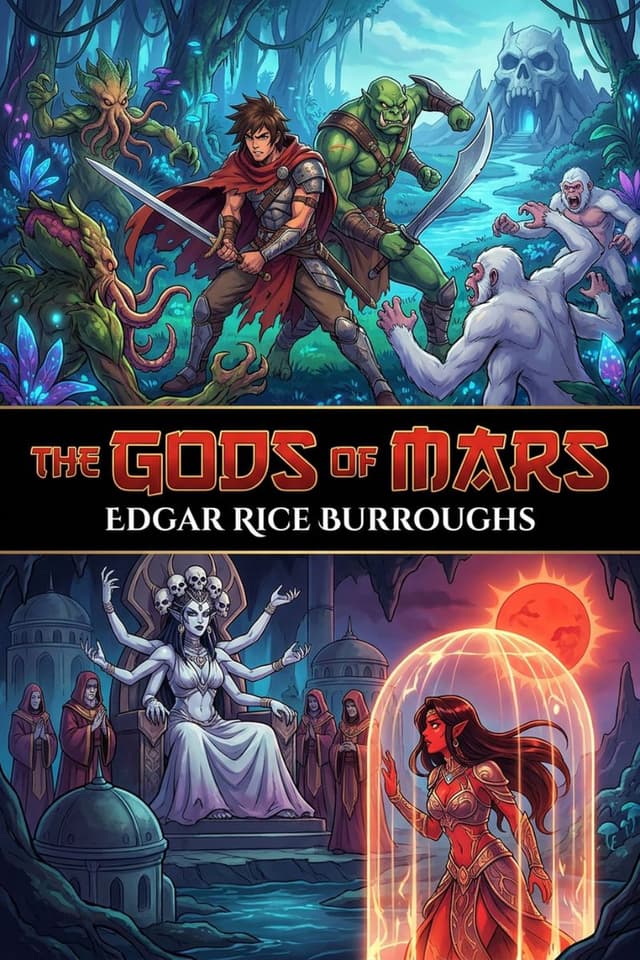
Instead of the ochre deserts and towering cities he remembers, Carter finds himself in a valley of impossible beauty: golden cliffs studded with gems, a pristine sea, lush vegetation. It would be paradise, except for the creatures lurking among the trees. Tall, blue-skinned monstrosities with gaping mouths where their hands should be. Plant Men, the Martians call them. And they are hungry.
The Valley of Death
Carter has materialized in the Valley Dor, at the end of the River Iss. Every Martian knows this place. When they reach the age of one thousand years, the people of Mars undertake a sacred pilgrimage down the river to what they believe is paradise, a heaven where they will spend eternity in peace. It is the foundation of their religion, a journey from which no one has ever returned.
Now Carter understands why.
The Valley Dor is a slaughterhouse. The Plant Men and the great white apes tear the pilgrims apart. Those who survive face something worse: the Holy Therns, a race of white-skinned, bald-headed priests who have maintained this monstrous deception for countless centuries. They enslave the survivors, work them to death, and eat them. The entire Martian religion is a lie designed to deliver a steady supply of victims to these cannibalistic frauds.
As Carter fights for his life against the Plant Men, he discovers he is not alone. Fighting beside him, surrounded by corpses and refusing to die, is his old friend Tars Tarkas, the mighty green Martian warrior. The Jeddak of Thark has taken the pilgrimage himself, hoping to find Carter in the afterlife. Instead, he has found the truth.
Gods Above Gods
Escaping the Therns, Carter and his companions are captured by an even more terrifying force: the Black Pirates of Mars, who call themselves the First Born. These midnight-skinned warriors believe themselves to be the original race of Barsoom, superior to all others. They raid the Therns for slaves and sport, and they worship a living goddess named Issus.
The layers of deception are staggering. The Red and Green Martians believe the Therns are gods. The Therns believe Issus is their goddess. And Issus herself? Carter will discover the truth about her soon enough, when he is dragged before her throne in the underground realm of Omean, hidden beneath Mars's last remaining sea.
In the prisons of Issus, Carter meets a young red Martian warrior of extraordinary skill and courage. The youth's fighting ability matches Carter's own, which seems impossible. Then Carter learns the boy's name: Carthoris. His son. The child Dejah Thoris was carrying when Carter was torn away from Mars ten years ago.
But where is Dejah Thoris? Carter has heard whispers that his princess is somewhere in this nightmare of false gods and cannibal priests. Finding her will require him to tear down the entire rotten structure of Martian religion, exposing truths that have been hidden for ages, and leading an army against enemies who have never known defeat.
A World at War
John Carter is not a man who accepts tyranny. He is not a man who leaves his friends in chains or his wife in the hands of monsters. What begins as one warrior's desperate search for his beloved becomes a revolution that will shake the foundations of Barsoom.
With allies drawn from every race of Mars, enemies who become friends when they learn how thoroughly they have been deceived, and an army of green warriors at his back, Carter launches an assault on the very concept of godhood. The false religion that has fed on Martian blood for millennia is about to face a reckoning.
But the forces arrayed against him are vast, the deceptions run deeper than he imagined, and time is running out. Somewhere in the chaos of collapsing empires and warring fleets, Dejah Thoris waits. Whether Carter can reach her before it is too late, whether anyone can survive the coming cataclysm, remains terrifyingly uncertain.
About the Author: Edgar Rice Burroughs
The Unlikely Storyteller
Edgar Rice Burroughs was born on September 1, 1875, in Chicago, to a prosperous family. Nothing in his first thirty-six years suggested he would become one of the most influential writers of the twentieth century. He seemed, if anything, destined for failure.
Burroughs bounced from school to school, was expelled from Phillips Academy, and failed to gain admission to West Point. He attended the Michigan Military Academy, briefly taught there, then tried his hand at the Army but was discharged after being diagnosed with a heart condition. He worked as a gold miner in Oregon, a cowboy in Idaho, a railroad policeman in Salt Lake City, and a pencil sharpener salesman in Chicago. He failed at business after business.
By 1911, he was thirty-six years old with a wife and two children, working a dreary job and reading pulp magazines to pass the time. He had a revelation: these stories were terrible. He could write something just as bad and get paid for it.
The Birth of Barsoom
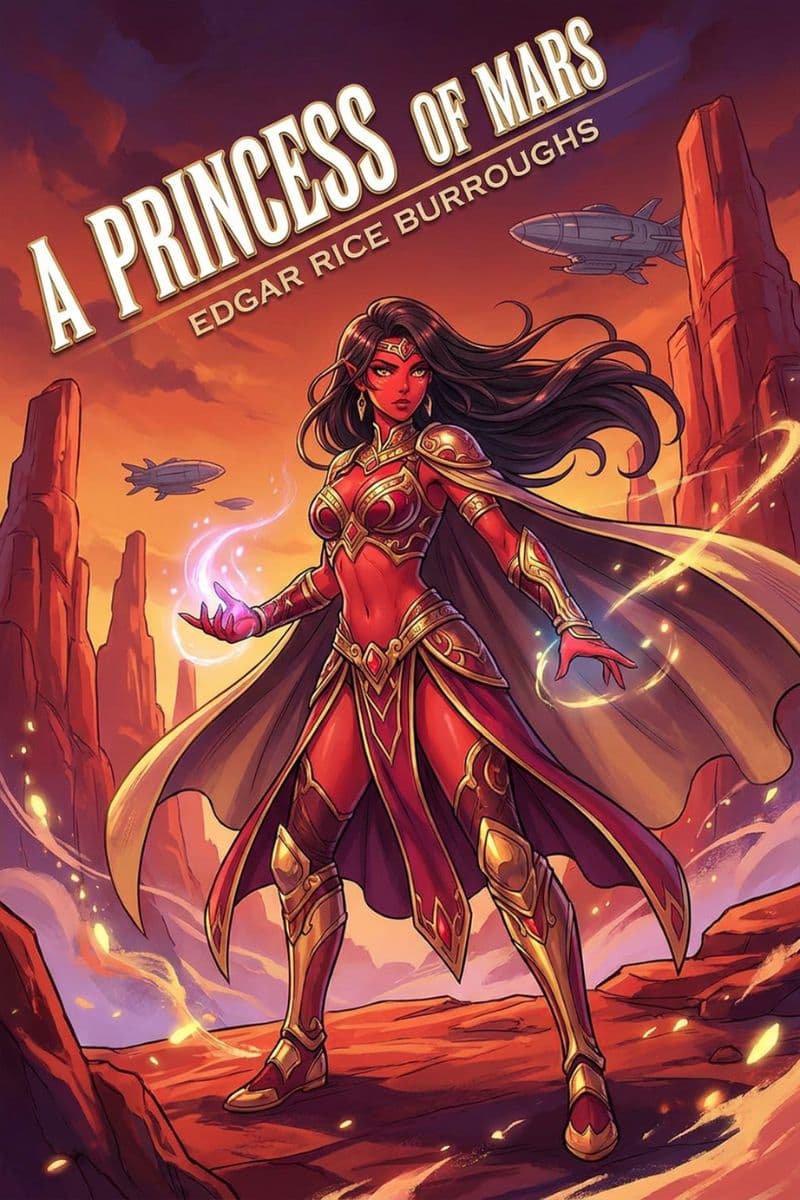
Burroughs wrote his first story, "Under the Moons of Mars," in about two months and sold it to All-Story magazine for $400. He was so embarrassed by the work that he submitted it under the pseudonym "Normal Bean" (the typesetter changed it to "Norman Bean"), meaning to suggest he wasn't crazy. The story introduced John Carter and the dying world of Mars, which Burroughs called Barsoom.
The readers loved it. Within months, Burroughs had written Tarzan of the Apes. He never looked back.
Over the next four decades, Burroughs produced over ninety books: twenty-four Tarzan novels, eleven Barsoom adventures, and dozens of other tales set in hollow earths, lost islands, and alien worlds. He wrote at a furious pace, sometimes keeping a ledger to track his daily word counts. The quality was uneven, but the imagination was boundless.
Building an Empire
Burroughs understood something that most authors of his era did not: a popular character could be exploited across multiple media. He licensed Tarzan for comic strips, radio shows, films, and merchandise. In 1923, he incorporated himself as Edgar Rice Burroughs, Inc., becoming one of the first authors to publish his own books. He bought a ranch in California and named it Tarzana; the community that grew around it still bears that name today.
During World War II, at age sixty-six, Burroughs became the oldest American war correspondent in the Pacific theater, covering the conflict for the Los Angeles Times. He died on March 19, 1950, in Encino, California, having earned more from film rights than any author of his generation.
Fun Facts
The Cliffhanger King
This novel ends on one of the most agonizing cliffhangers in pulp fiction history. Burroughs serialized it in All-Story magazine from January to May 1913, then made readers wait until December 1913 for The Warlord of Mars to continue the story. The entire first trilogy was published within two years, a pace modern fantasy authors might envy.
Layers of Lies
The religious conspiracy in the novel works like nesting dolls. The Red and Green Martians are deceived by the Therns. The Therns are deceived by the First Born. The First Born are deceived by Issus. And Issus herself is revealed to be something far different from what anyone expected. Burroughs was taking aim at organized religion in general, though he wrapped his critique in enough adventure to avoid controversy.
A Diverse Alliance
The novel features one of early science fiction's most diverse heroic teams: John Carter (a white Earthman), Tars Tarkas (a green Martian), Thuvia (a red Martian woman), Xodar (a black Martian), and Carthoris (Carter's half-Earthman, half-Martian son). Carter explicitly comments on how warriors of different races, colors, and religions have united against tyranny.
Scientific Inspiration
Burroughs based his vision of Mars on the astronomical theories of Percival Lowell, who believed the "canals" visible on Mars were evidence of a dying civilization desperately trying to survive on a desiccating world. Though Lowell's theories were already being questioned in 1913, they gave Burroughs the foundation for Barsoom's elaborate canal systems and atmosphere factories.
Ray Bradbury's Favorite
Ray Bradbury called Edgar Rice Burroughs "the most influential writer of our century." Bradbury's own Martian Chronicles owes a debt to Burroughs's vision of Mars, though Bradbury took the planet in a more literary direction. Carl Sagan, James Cameron, and countless other creators have cited the Barsoom books as formative influences.
Tarzan's Twin
Burroughs wrote "Under the Moons of Mars" (later published as A Princess of Mars) and Tarzan of the Apes almost simultaneously in 1911-1912. The two characters became his most enduring creations, with John Carter representing science fiction adventure and Tarzan representing earthbound adventure. Both feature men caught between civilizations.
Still in Print
More than a century after their original publication, the Barsoom books remain in print and continue to inspire adaptations. Disney's 2012 film John Carter drew primarily from the first novel but incorporated elements from this book as well. The commercial failure of that film has not diminished the continued popularity of the original novels.
Themes
The Corruption of Religion
The novel is a sustained attack on religious deception. Each race of Martians has been manipulated by those claiming divine authority, who use faith to enslave and devour believers. The Therns are "holy" cannibals. The First Born worship a goddess who is revealed to be monstrous. Burroughs suggests that any religion that discourages questioning, that punishes those who return with uncomfortable truths, is inherently corrupt.
Hierarchy and Exploitation
Barsoom operates on a brutal hierarchy: the First Born prey on the Therns, who prey on the Red Martians, who war with the Green Martians. Each group believes itself superior. Each is wrong. Carter's coalition proves that cooperation across racial lines defeats the parasitic systems that keep everyone enslaved. The false gods need their victims divided.
The Courage to Tell Truth
One Martian once escaped the Valley Dor and returned to tell his people what he had seen. They executed him for blasphemy. The novel asks what we owe to truth even when truth is dangerous, even when no one wants to hear it. Carter and his allies risk everything to expose lies that have been comfortable for millennia.
Love as Motivation
John Carter's driving force throughout the novel is his love for Dejah Thoris. Everything he does, every battle he fights, every alliance he forges, serves his quest to reunite with his princess. Burroughs understood that the grandest adventures need personal stakes. The fate of a world matters less to readers than the fate of one beloved woman.
The Stranger's Perspective
Carter, as an outsider, can see through the religious deceptions that native Martians accept without question. His Earth perspective allows him to recognize absurdity and cruelty that those raised in the system cannot perceive. The novel suggests that sometimes it takes an outsider to identify what insiders have been conditioned to ignore.
The Book's Legacy
The Gods of Mars solidified the template for planetary romance that would dominate science fiction for decades. The formula Burroughs perfected here, featuring strange worlds with multiple competing civilizations, exotic creatures, beautiful princesses, and sword-wielding heroes, became the foundation for countless imitators and inheritors.
The novel's attack on religious hypocrisy was remarkably bold for 1913. By wrapping his critique in adventure fiction, Burroughs could say things about organized religion that would have been unpublishable in more "serious" literature. The layers of deception, each priesthood exploiting those below while being exploited by those above, remains a powerful image of how power structures perpetuate themselves through faith.
Many readers consider this the best of the Barsoom novels, superior even to A Princess of Mars. The stakes are higher, the world-building richer, the action more spectacular. The four-way aerial battle that climaxes the book, with fleets of Helium, Thark, the Therns, and the First Born all clashing above the dying seas of Mars, remains one of the great set pieces of pulp adventure.
The influence extends far beyond science fiction. Star Wars, Avatar, and virtually every space opera owes something to Burroughs's vision of adventure among alien civilizations. The image of a lone hero fighting against corrupt empires, gathering allies from unexpected places, and triumphing through courage and integrity began here, on the dead sea bottoms of Barsoom, more than a century ago.