Novelhalla
The Adventures of Tom Sawyer
Read The Adventures of Tom Sawyer by Mark Twain for free on Novelhalla, and try out our easy-to-read modern edition of this classic book. You can also download the EPUB and read it on any device if you prefer!
The Plot
The Boy
Tom Sawyer is somewhere around twelve years old and already a menace. He lives with his Aunt Polly in the small Mississippi River town of St. Petersburg, Missouri, along with his goody-two-shoes half-brother Sid, who has never missed an opportunity to get Tom in trouble and never will. Tom skips school, gets into fights, and has a talent for finding exactly the kind of fun that makes adults lose sleep.
He's not a bad kid. He's just a kid who finds the world unbearably boring when it's following the rules.
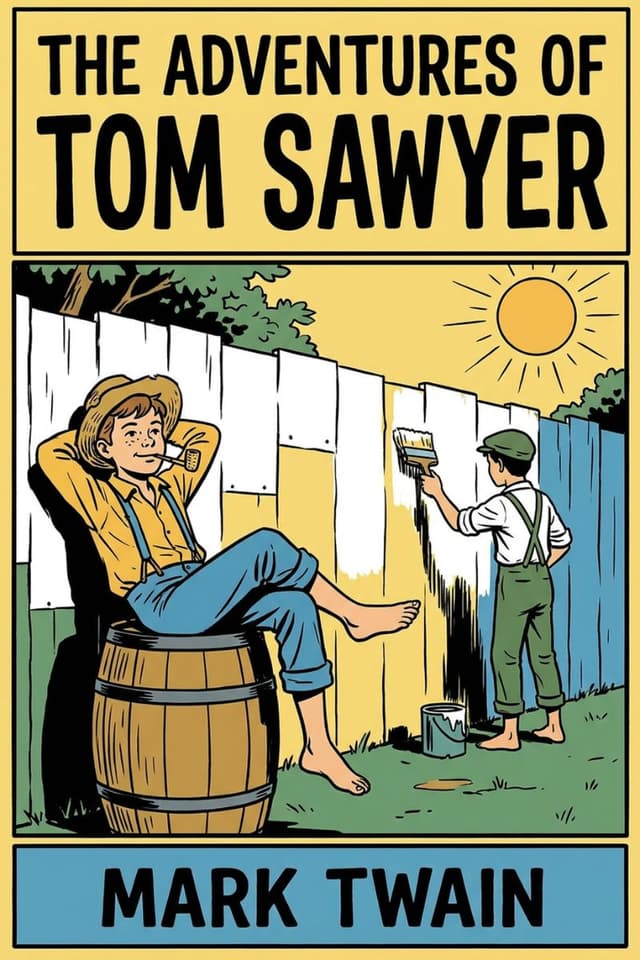
When Aunt Polly catches him sneaking home after a fight, she sentences him to whitewash the fence on a beautiful Saturday morning. What Tom does with that punishment is a masterclass in human psychology. By the time the afternoon rolls around, every boy in the neighborhood has paid Tom for the privilege of doing his chore. He sits in the shade eating an apple, rich in marbles and trinkets and dead rats, having discovered something most adults never figure out: if you want someone to want something, just make it hard to get.
The Girl
Then there's Becky Thatcher, the new girl in town with blue eyes and blonde pigtails, and Tom falls instantly and completely. He shows off, he schemes, he writes "I love you" on his slate and lets her pretend to peek. It's puppy love in the most earnest, ridiculous sense, and Twain plays it with the kind of tenderness that makes you remember what it felt like to be that young and that sure about your feelings.
But Tom has a way of ruining good things. He mentions a previous "engagement" to another girl, and Becky won't speak to him. He is devastated in the way only a twelve-year-old can be devastated, which is to say, completely.
The Graveyard
This is where the book shifts under your feet.
Tom and his best friend Huckleberry Finn sneak into the town graveyard at midnight. Huck is the son of the town drunk, an outcast, the kid every boy envies and every mother forbids. They've come to try a superstitious cure for warts involving a dead cat.
What they witness instead is a murder.
Three men are in the graveyard robbing a grave. There's a fight. A man dies. And the killer, a dangerous figure named Injun Joe, pins the crime on his drunken companion, Muff Potter, who was knocked unconscious and has no idea what happened.
Tom and Huck see everything. They are terrified. They swear a blood oath to never tell a soul.
The Weight of a Secret
The rest of the novel lives under the shadow of that oath. Muff Potter, a harmless drunk, sits in jail awaiting trial for a murder he didn't commit. Tom knows the truth. So does Huck. And Injun Joe walks free through the streets, a man who has already killed once and wouldn't hesitate to kill again.
Tom's guilt eats at him. He sneaks gifts to Muff Potter through the jail window. He can't sleep. He can't shake the feeling that doing the right thing might get him killed.
Meanwhile, Tom's talent for trouble continues. Feeling unloved and unappreciated, he convinces Huck and their friend Joe Harper to run away to an island in the Mississippi and play at being pirates. The town searches for them. The town mourns them. The boys let it happen, watching from their hiding place as the adults who scolded them weep over their supposed deaths.
The boys crash their own funeral. It's one of the most famous entrances in American literature.
The Trial
But the murder won't stay buried. Muff Potter's trial arrives, and the whole town has already convicted him. The evidence seems clear. The witness testimony seems settled.
Then Tom Sawyer takes the stand.
What happens next puts Tom in Injun Joe's crosshairs. And Injun Joe is not the forgiving type.
The Cave
The novel builds toward two converging dangers. There's unfinished business with Injun Joe and a rumored treasure. And there's a school picnic that leads Tom and Becky deep into a vast, pitch-black cave system with miles of winding passages and no one who knows where they are.
Lost in the dark with no food, no light, and no way out, Tom discovers that adventure isn't always a game. Some tunnels don't lead back to daylight. Some corners turn toward things you didn't expect to find.
And somewhere in those caves, Tom is not the only one hiding.
About the Author: Mark Twain
A River Boy
Samuel Langhorne Clemens was born on November 30, 1835, in the tiny town of Florida, Missouri, two weeks after Halley's Comet made its closest approach to Earth. His family moved to Hannibal, Missouri, on the banks of the Mississippi River, when he was four. It was Hannibal, with its bluffs and caves and river traffic, that would become the template for every fictional town he ever wrote.
His father died when Sam was eleven, ending his formal schooling. By twelve, he was apprenticed to a printer, setting type and occasionally sneaking his own sketches into the local paper.
Life on the River
At twenty-one, Clemens talked his way into an apprenticeship with a riverboat pilot named Horace Bixby and spent the next several years learning to read the Mississippi. It was grueling, technical, and thrilling work. A pilot had to memorize every sandbar, snag, and channel shift in over a thousand miles of ever-changing river. It was also the best-paying job he'd ever have and the one that gave him the most pride.
It gave him his pen name, too. "Mark twain" was the leadsman's cry for a river depth of two fathoms, twelve feet, safe water for a steamboat. When he needed a name to write under, he reached back to the river.
The Civil War shut down commercial traffic on the Mississippi in 1861 and ended his piloting career. After a brief, inglorious stint with a Confederate militia unit that disbanded after two weeks, he headed west to Nevada with his brother.
Finding His Voice
Out West, Clemens failed as a silver miner and succeeded as a journalist. Writing for the Virginia City Territorial Enterprise, he first used the name Mark Twain. In San Francisco, he met a volunteer fireman and local character named Tom Sawyer, who loved to tell stories about his boyhood mischief. Twain listened, took notes, and filed the name away.
His breakout came in 1865 with a short story about a jumping frog that ran in newspapers across the country. A lecture tour and a travel book followed. By the time he married Olivia Langdon in 1870 and settled in Hartford, Connecticut, he was becoming famous.
The Great Works
Twain published The Adventures of Tom Sawyer in 1876, drawing heavily on his Hannibal childhood. Eight years later came Adventures of Huckleberry Finn, which Ernest Hemingway would later call the book from which all modern American literature descends. Between and around these came A Connecticut Yankee in King Arthur's Court, The Prince and the Pauper, Life on the Mississippi, and dozens of other works.
He was the highest-paid writer in America. He was also a spectacular failure as a businessman, pouring his fortune into a mechanical typesetter that never worked and other ventures that collapsed. He declared bankruptcy in the 1890s.
The Dark Years
To pay his debts, Twain embarked on a worldwide lecture tour at age sixty. He paid every creditor in full, even though his bankruptcy didn't require it. But the cost was personal. His eldest daughter Susy died of meningitis while he was overseas. His wife Olivia died in 1904. His youngest daughter Jean died of an epileptic seizure on Christmas Eve 1909.
Twain's later writing grew darker, more bitter, more philosophical. The humor was still there, but it sat alongside a deepening pessimism about human nature.
He died on April 21, 1910, one day after Halley's Comet made its closest approach to the sun. He had predicted this. "I came in with Halley's Comet in 1835," he wrote the year before. "It is coming again next year, and I expect to go out with it."
He was right.
Fun Facts About the Book
Twain's First Novel
Tom Sawyer was Mark Twain's first attempt at writing a novel. He'd previously written travel books and sketches, but this was his first go at long-form fiction. He started it in 1873, wrote about a hundred pages, then set it aside. He picked it up again in 1874 and finished the bulk of it in a creative burst, completing revisions in 1875.
The Real Tom Sawyer
Twain named his character after a real person: Tom Sawyer, a volunteer fireman, saloon owner, and local hero in San Francisco. The real Sawyer had rescued ninety people from a burning steamship off the coast of Baja California and was known for telling colorful stories about his boyhood pranks. He and Twain were drinking buddies during Twain's years in San Francisco in the 1860s. Twain later claimed the character was based on three different boys from his childhood, and also once confessed "I am Tom Sawyer!" The real Sawyer was never in doubt about the connection.
Published in England First
Due to concerns about piracy, the novel was first published in London by Chatto and Windus in June 1876, without illustrations. The American edition, published by the American Publishing Company in December 1876, was the first to include True Williams' 160 illustrations, which Twain had personally commissioned.
Twain Thought It Was a Children's Book (Sort Of)
In his preface, Twain wrote that the book was "intended mainly for the entertainment of boys and girls" but hoped adults wouldn't shun it, since "part of my plan has been to try to pleasantly remind adults of what they once were themselves." Critics and readers have debated the intended audience ever since. The book operates on two levels: a rollicking adventure for young readers and a sharper, more satirical commentary on small-town American life for adults.
The Fence Still Gets Whitewashed
In Hannibal, Missouri, there's an actual whitewashed fence near Twain's boyhood home that serves as a tourist attraction. Every year, the town holds a fence-painting competition during its Tom Sawyer Days festival. Tom's scheme to get other boys to paint for him has become one of the most recognized scenes in American literature, and a shorthand for the art of making work look like play.
A Book That Got Banned
Tom Sawyer was one of the first books banned from the Brooklyn Public Library in 1876, the same year it was published. The librarians called it unsuitable for young readers. Twain responded with characteristic dryness, noting that the controversy would probably just sell more copies. He was right about that, too.
Themes
The Invention of Childhood
Tom Sawyer is one of the first American novels to take childhood seriously on its own terms. Tom's world isn't a miniature version of the adult world. It has its own logic, its own currency (dead cats, marbles, pulled teeth), its own codes of honor. Twain treats boyhood not as a phase to be endured but as a complete and vivid way of being alive.
Rules and Rebellion
Tom lives in a world of rules, set by Aunt Polly, the schoolmaster, the church, the whole machinery of respectable society. He breaks every one of them, not out of malice but out of a deep and instinctive resistance to being boxed in. The novel asks whether Tom's rebellion is a problem to be corrected or the healthiest thing about him.
The Cost of Doing Right
The murder in the graveyard transforms the novel from a comedy into something weightier. Tom knows the truth about an innocent man in jail. Speaking up could save a life. Staying silent keeps him safe. The tension between conscience and self-preservation runs through the second half of the book, and Twain doesn't make the choice easy or simple.
Respectability vs. Freedom
Tom wants the adventures of Huckleberry Finn's life, the freedom from school and church and clean clothes. But he also wants the applause. He wants to be the pirate and the hero. Huck, by contrast, doesn't care what anyone thinks. The novel draws a quiet line between Tom's performative rebellion and Huck's genuine outsider status, a distinction Twain would explore much more deeply in the sequel.
Superstition and Fear
The children's world in Tom Sawyer runs on superstition. Dead cats cure warts. Spunk-water fixes everything. Treasure is buried where ghosts walk at midnight. Twain plays these beliefs for comedy, but he also shows how superstition and real fear blur together, especially when the dangers stop being imaginary.
The Book's Legacy
Tom Sawyer changed what American fiction could be. Before Twain, most novels about children were moral instruction manuals, stories where good boys were rewarded and bad boys got what they deserved. Twain threw that out. He wrote a boy who lied, stole, skipped school, and manipulated everyone around him, and made readers love him for it.
The novel's portrait of small-town Mississippi River life in the years before the Civil War became one of the defining images of American childhood, so vivid and so deeply felt that it shaped how Americans understood their own past.
Tom Sawyer spawned a direct sequel in Adventures of Huckleberry Finn, widely considered one of the greatest American novels ever written, along with two lesser follow-ups, Tom Sawyer Abroad and Tom Sawyer, Detective. The character has been adapted into dozens of films, television shows, musicals, and stage productions across the world.
The whitewashing scene alone has entered the language as a metaphor. The name "Tom Sawyer" has become shorthand for a particular kind of American boyhood: scrappy, clever, reckless, and fundamentally good-hearted underneath all the trouble.
Hannibal, Missouri, still draws visitors from around the world who come to see the caves, the river, and the fence, all because a man who grew up there decided to write down what it felt like to be a boy in a small town on the Mississippi, back when the world was wide open and every day held the possibility of something dangerous and wonderful.