Novelhalla
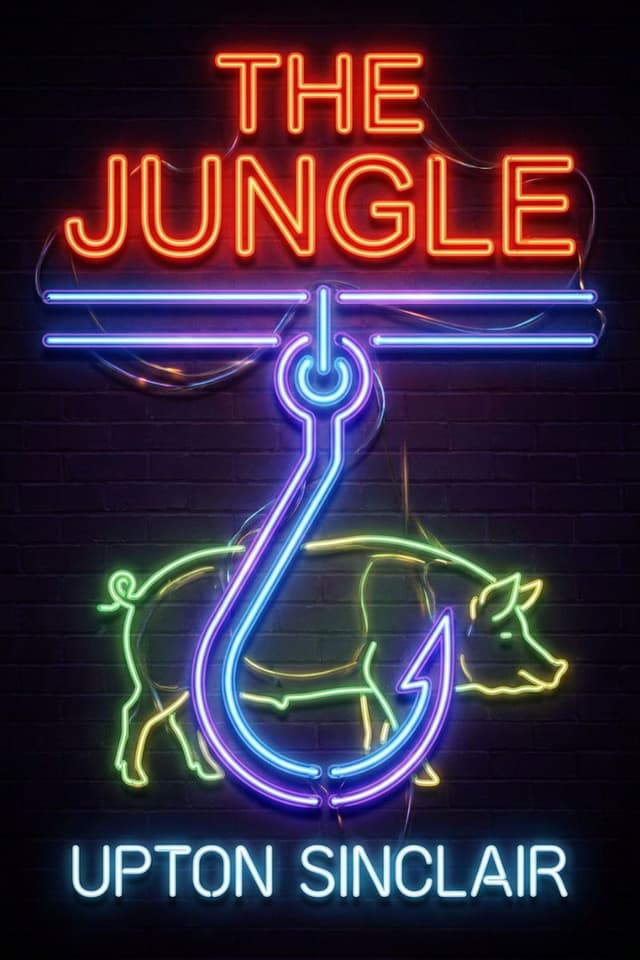
The Jungle
Read The Jungle by Upton Sinclair for free on Novelhalla, and try out our easy-to-read modern edition of this classic book. You can also download the EPUB and read it on any device if you prefer!
The Plot
The Wedding
The story opens with a party. Jurgis Rudkus and Ona Lukoszaite are celebrating their wedding in a bar in Packingtown, Chicago. They're young, they're in love, and they've just arrived from Lithuania with an extended family full of hope and absolutely no idea what's coming.
The wedding feast is loud and joyous and traditional. There's music and dancing and an enormous spread of food. There's also the small problem that many of the guests leave without contributing money to help cover the cost, which is not how things work in Lithuania. Jurgis and Ona are already in debt before their married life properly begins.
But Jurgis isn't worried. He's young and enormously strong and willing to do anything. His answer to every problem is the same: "I will work harder."
It is the most heartbreaking sentence in American literature.
Packingtown
The family has come to Chicago chasing the American Dream. What they find is Packingtown, a neighborhood built around the Union Stock Yards, where hundreds of thousands of animals are slaughtered every day and the air itself stinks of blood and rendering fat.
Jurgis gets a job at a slaughterhouse. Ona's cousin Marija finds work in a cannery. Jurgis's elderly father, Dede Antanas, is turned away again and again because he's too old, until he finally lands a job by agreeing to pay a third of his wages as a bribe. The family decides to buy a house. They sign papers they don't fully understand. The house is a trap, rigged with hidden fees and escalating costs designed to bleed them dry.
The work is brutal. The plants are dark, freezing or boiling depending on the season, and staggeringly dangerous. Men fall into rendering vats. Workers lose fingers, hands, entire limbs to the machinery. The speed of the lines never slows. If you get hurt, you get replaced. If you complain, you get fired.
And then there's what goes into the meat.
The Descent
What follows is one of the most relentless descents in fiction. Every time the family claws its way to something resembling stability, another blow lands. Wages are cut. Workers are laid off for weeks at a time. Children who should be in school are sent to work. The elderly are ground down until they break.
Jurgis works harder. He always works harder. It doesn't matter.
The system isn't broken. It's working exactly as designed. The landlords, the bosses, the politicians, the police: they're all connected, all feeding off the same desperate immigrant labor force. The housing scam, the wage theft, the unsafe conditions, the bribery, the corruption at every level of city government: it's not a series of unlucky breaks. It's a machine, and families like Jurgis's are the fuel.
What the Machine Does to People
The middle chapters of this book are devastating. Sinclair doesn't flinch. He follows every member of this family through every indignity, every cruelty, every moment where hope gets a little smaller.
Jurgis's father takes a job that requires him to stand in chemicals all day. Ona is fragile and the factory is destroying her health. The children scavenge for scraps. The winter is merciless. The bills never stop.
And then things get worse.
Something happens to Ona. Something she can't tell Jurgis about, something connected to her boss, a man with power over her job and her family's survival. When Jurgis finds out, his reaction is immediate and violent. And the consequences of that violence send everything spiraling into a darkness the family cannot escape.
What happens next, the losses that pile up, the things that are taken from Jurgis one by one: they are the kind of thing that makes you put the book down and stare at the wall. Sinclair was not interested in being gentle with his readers.
The Bottom
Jurgis hits bottom. Then he discovers there are levels below bottom.
He passes through the criminal underworld of Chicago, through political corruption, through the machinery of a city that runs on graft and exploitation. He sees the system from every angle: as a worker, as a prisoner, as a beggar, as a strikebreaker, as a cog in a political machine. None of it offers a way out. Every door opens onto another room in the same building.
The question the book keeps asking, louder and louder, is simple: what happens to a good man in a system that punishes goodness? What happens when working harder doesn't work? What happens when the rules are written by the people profiting from your suffering?
Jurgis is about to find out if there's an answer. And the answer, when it comes, will change how he sees everything.
About the Author: Upton Sinclair
A Childhood Between Worlds
Upton Beall Sinclair Jr. was born on September 20, 1878, in Baltimore, Maryland. His childhood was defined by contrast. His father was a liquor salesman who struggled with poverty and alcoholism. His mother came from a wealthier family. Young Upton bounced between both worlds, sleeping on sofas one week and visiting prosperous relatives the next.
The experience left a mark. His father's drinking made him a lifelong temperance advocate. The gap between rich and poor made him a lifelong socialist. He taught himself to read at five and was writing for publication by his teens.
The Young Writer
Sinclair entered the College of the City of New York at fourteen, supporting himself by writing adventure stories and jokes for pulp magazines. He moved on to Columbia University to study law but found himself drawn to literature and radical politics instead. He published his first novel in 1901, but early works didn't sell.
He was idealistic, intense, and perpetually broke. He married Meta Fuller in 1900, and the marriage was troubled from the start. He was the kind of man who would pour every dollar he earned into a political cause and leave his family to figure out dinner.
The Seven Weeks That Changed America
In 1904, the socialist newspaper Appeal to Reason commissioned Sinclair to write about the meatpacking industry. He spent seven weeks working undercover in the slaughterhouses of Chicago's Union Stock Yards, observing everything: the labor conditions, the living conditions, the processing practices, and the corruption that kept the whole system running.
He wrote The Jungle in a fever. The novel was serialized in Appeal to Reason in 1905 and published as a book by Doubleday in 1906. It sold 25,000 copies in its first six weeks. The public reaction was enormous, though not in the way Sinclair intended. Readers were horrified by the descriptions of what went into their food. The exploitation of the workers, which was the whole point of the book, largely took a back seat.
Sinclair's famous response: "I aimed at the public's heart, and by accident I hit it in the stomach."
The Activist
The Jungle made Sinclair famous and gave him money for the first time. He used it to found Helicon Hall, a utopian writers' commune in New Jersey. It burned down within a year.
He divorced Meta in 1913 and married Mary Craig Kimbrough the same year. They moved to California, where Sinclair threw himself into politics. He ran for Congress on the Socialist ticket, then for Senate, then for governor of California three times. His 1934 gubernatorial campaign, running as a Democrat on his "End Poverty in California" platform, came remarkably close to succeeding before being crushed by one of the most vicious propaganda campaigns in American political history, including the first-ever political attack ads, produced by Hollywood studios.
Later Years
Sinclair never stopped writing. He produced nearly one hundred books across every genre. His eleven-volume Lanny Budd series, fictional spy novels set against the backdrop of world events from 1913 to 1949, won him the 1943 Pulitzer Prize for Fiction for Dragon's Teeth, a novel about the rise of Nazism.
In 1967, when Sinclair was eighty-nine years old, President Lyndon Johnson invited him to the White House for the signing of the Wholesome Meat Act. Sixty-one years after The Jungle, the work was still rippling outward.
Sinclair died on November 25, 1968, at age ninety. He had given most of his earnings to socialist and reform causes over the course of his life.
Fun Facts About the Book
Sinclair Went Undercover
Sinclair spent seven weeks working incognito in the Chicago stockyards, gathering firsthand material for the novel. He walked the killing floors, talked to workers, and observed the processing operations up close. The details in the book aren't invented. They're reported.
It Changed the Law
The Jungle's descriptions of the meatpacking industry were so revolting that President Theodore Roosevelt ordered an investigation. When government inspectors confirmed much of what Sinclair had described, Congress passed the Pure Food and Drug Act and the Meat Inspection Act, both in 1906. The legislation led to the creation of what would eventually become the FDA.
Roosevelt Read It and Threw His Sausages Out the Window
After reading The Jungle, Roosevelt was reportedly eating breakfast sausages when the descriptions came back to him. According to a popular (and possibly embellished) account, he threw his sausages out the White House window and immediately sent investigators to Chicago. The meatpacking companies, tipped off about the investigation, had their workers deep-clean the plants beforehand. The investigators were still disgusted.
The Heart vs. The Stomach
Sinclair wrote the book to expose the exploitation of immigrant workers and to promote socialism. The public fixated instead on food safety. The workers' rights issues that Sinclair cared most about took decades longer to address. His frustration about this misfire followed him for the rest of his life.
Jack London's Review
Writer Jack London reviewed The Jungle and called it "the Uncle Tom's Cabin of wage slavery," comparing it to the novel that had helped spark the abolitionist movement. It was the highest praise a socially conscious novel could receive, and the comparison stuck.
Eight Rejections Before Doubleday
The novel was serialized successfully in Appeal to Reason, but book publishers were terrified of it. Multiple houses turned it down. Sinclair was preparing to self-publish when Doubleday finally took the risk. They sent investigators to Chicago to verify Sinclair's claims before agreeing to publish, a fact-checking process that only strengthened the book's credibility.
It Has Never Gone Out of Print
Published in 1906, The Jungle has been continuously in print for over a century. It has been translated into dozens of languages and remains one of the most widely assigned novels in American high schools and universities.
Themes
The American Dream as a Trap
Jurgis and his family come to America believing in the promise. Work hard, play by the rules, and you'll get ahead. The novel systematically dismantles this belief. Every institution the family encounters, from real estate to employment to the legal system, is designed to extract value from them, not to help them build a life.
The Human Cost of Industry
The meatpacking plants don't just process animals. They process people. Workers are treated as interchangeable, disposable parts in a machine that values efficiency over human life. When a worker is used up, another immigrant steps off the train to replace them. The novel insists that you see the people inside the machine and recognize what the machine does to them.
Corruption as a System
The corruption in The Jungle isn't a few bad actors. It's the entire structure. Landlords, factory owners, politicians, police, and judges all operate within a web of mutual benefit that depends on keeping workers powerless. The system doesn't need to be reformed. From Sinclair's perspective, it needs to be replaced.
The Destruction of the Family
The family is the unit of meaning in the novel, and watching it get dismantled is the book's most powerful weapon. Every loss that Jurgis suffers is a loss of connection, of the people who give his struggle a reason. The novel argues that a system that destroys families in the name of profit has forfeited any claim to legitimacy.
The Power of Solidarity
The final section of the novel offers a counterpoint to everything that has come before. Sinclair's answer to the crushing individualism that destroys Jurgis is collective action. Whether or not you find the ending convincing, the novel's argument is clear: alone, you are fuel for the machine. Together, you might be something else entirely.
Historical Context
Chicago at the Turn of the Century
The Chicago that Jurgis and his family enter was one of the fastest-growing cities in the world. Between 1880 and 1910, millions of immigrants poured in from Eastern and Southern Europe, drawn by the promise of industrial jobs. The meatpacking industry was the city's economic engine, processing millions of animals per year in a complex of slaughterhouses and packing plants known as the Union Stock Yards.
The conditions Sinclair described were real. Workers labored in unheated or overheated buildings, handled toxic chemicals without protection, and faced speeds and quotas that made injuries routine. Housing in Packingtown was overcrowded, poorly built, and controlled by landlords with no incentive to maintain it. Political bosses ran the neighborhoods, trading favors for votes, and the police served whoever was paying them.
The Progressive Era
The Jungle arrived at a moment when America was beginning to grapple with the consequences of unregulated industrialization. A generation of journalists and writers, known as muckrakers, were exposing corruption in business and government. Sinclair's novel was the most explosive entry in this tradition, and its impact on federal legislation was immediate and lasting.
The Book's Legacy
The Jungle is one of the most consequential novels ever published in America. It didn't just change the literary conversation. It changed the law. The Pure Food and Drug Act and the Meat Inspection Act, both signed in 1906, were direct results of the public outrage the book generated. The regulatory framework those laws created evolved into the Food and Drug Administration, an agency that affects the daily life of every American.
Beyond its legislative impact, The Jungle established the template for a particular kind of American novel: the work of fiction that functions as investigative journalism, that uses story and character to make systemic injustice personal and impossible to ignore. Its influence runs through John Steinbeck's The Grapes of Wrath, through Rachel Carson's Silent Spring, through every piece of writing that has tried to make readers care about people they've been trained to overlook.
The novel also occupies an unusual position in literary history. It is widely read but not always admired for its craft. Critics have noted that the final chapters, where Sinclair's socialist message takes center stage, are weaker than the devastating early sections. Sinclair was a better reporter than he was a novelist, and the book's power comes more from the force of its subject matter than from artistic subtlety.
None of which has stopped it from mattering. Over a century after publication, The Jungle remains a gut-punch of a book, a story that makes you angry in exactly the way its author intended, even if what you're angry about isn't quite what he had in mind.