Novelhalla
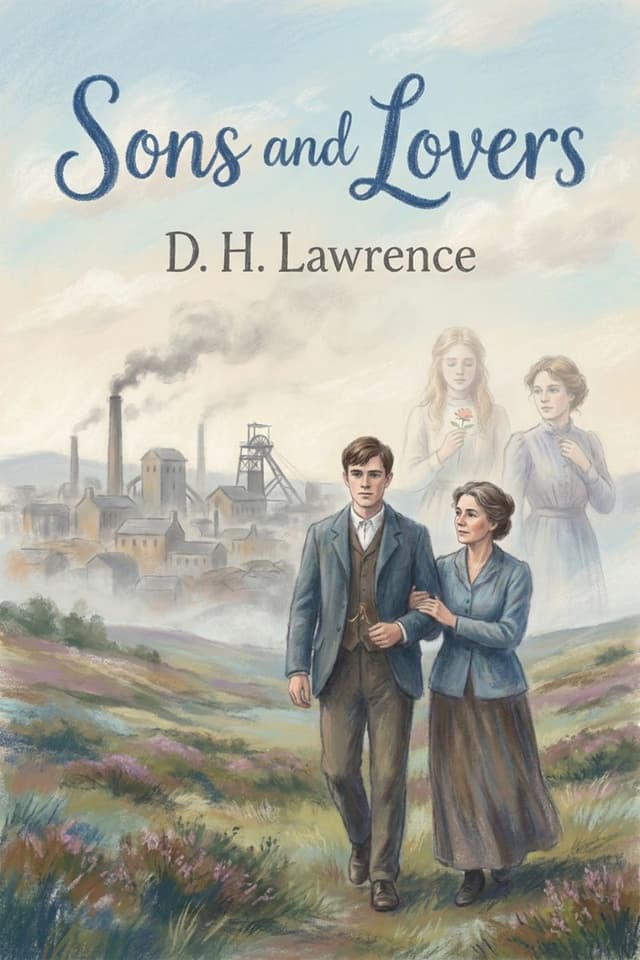
Sons and Lovers
Read Sons and Lovers by D. H. Lawrence for free on Novelhalla, and try out our easy-to-read modern edition of this classic book. You can also download the EPUB and read it on any device if you prefer!
The Plot
Sons and Lovers is a novel about the suffocating grip of family love, set in the coal-mining communities of Nottinghamshire, England, at the turn of the twentieth century. It traces two generations of the Morel family, but its heart belongs to the second son, Paul, who must find a way to become his own man while bound to a mother who needs him too much.
A Mismatched Marriage
Gertrude Coppard comes from a respectable family with intellectual aspirations. At a Christmas dance, she meets Walter Morel, a coal miner with a warm laugh and an easy charm. She is drawn to his vitality, his physical presence, the way he seems so alive. They marry quickly, swept up in passion.
The disillusionment comes fast. Gertrude discovers that Walter lied about owning their house, that he earns less than she believed, that he drinks away too much of what he does earn. She finds herself trapped in a mining village among women she considers beneath her, married to a man she can no longer respect. The couple argue bitterly. Walter retreats to the pub; Gertrude retreats into her children.
She has four: William, Annie, Paul, and Arthur. But it is her sons who become the center of her emotional life. She pours into them all the ambition and feeling she cannot give her husband. She will make sure they rise above their father's world. They will be educated, refined, successful. They will not go down the pit.
William and Paul
William, the eldest son, is everything Gertrude hopes for. Handsome, charming, ambitious, he adores his mother with an intensity that sometimes disturbs her. When he is offered a position in London, she is proud but devastated. He is leaving her.
In London, William rises quickly. He becomes engaged to a fashionable young woman named Lily, whom he brings home to meet the family. Gertrude sees at once that Lily is shallow and vain, utterly wrong for her brilliant son. William himself seems to know it, but he cannot break free.
Paul, the second son, is quieter than William, more sensitive, more artistic. He is sickly as a child, often ill with respiratory ailments. He watches his parents' battles and silently takes his mother's side. When he recovers from a serious bout of pneumonia, nursed devotedly by Gertrude, the bond between them deepens into something that will shape the rest of his life.
Paul finds work at a factory that makes surgical appliances, but his real passion is painting. He spends his evenings sketching and his earnings go to his mother. They take long walks together, discuss art and ideas, share an intimacy that is more like courtship than motherhood.
Miriam
At Willey Farm, not far from the Morel home, Paul meets Miriam Leivers, a farmer's daughter who is intense, spiritual, and hungry for knowledge. She is everything the mining village is not. She wants to learn, to think, to experience beauty. Paul begins teaching her French. They take long walks through the countryside, talking about books and poetry and the meaning of life.
Their connection is deep but troubled. Miriam approaches everything with a kind of religious intensity that both attracts and repels Paul. She seems to want his soul more than his body. When they are together, he feels understood in ways no one else understands him. But he also feels suffocated, pulled into her gravity.
And there is his mother. Gertrude hates Miriam with a ferocity that surprises even herself. She sees the girl as a rival, a threat to her hold on Paul. She criticizes Miriam constantly, mocks her spirituality, accuses her of draining Paul's vitality. Paul, caught between the two women, cannot commit to either.
Clara
Through Miriam, Paul meets Clara Dawes, a woman several years older who is separated from her husband, Baxter. Clara is everything Miriam is not: sensual, worldly, politically aware. She is involved in the suffragette movement and has opinions that shock provincial society.
Paul is drawn to Clara's physicality in a way he has never been drawn to Miriam. Their relationship becomes passionate, but it too runs into obstacles. Clara cannot fully give herself while still legally bound to Baxter. Paul cannot fully give himself while still emotionally bound to his mother.
The tensions between Paul and Baxter Dawes eventually explode into violence. And through it all, Gertrude Morel watches, waits, and keeps her hold on her son.
The Central Struggle
The novel builds toward a crisis that will force Paul to confront the impossible situation at the center of his life. He loves his mother too much to leave her. But as long as she remains the strongest force in his world, he cannot truly love anyone else. Lawrence called it "the tragedy of thousands of young men in England": sons who are urged into life by their mothers' love, only to find that same love makes it impossible to become fully alive.
The book does not offer easy answers. Paul must find his own way forward, through grief and confusion and the wreckage of relationships he has not been able to sustain. The ending is deliberately ambiguous, leaving readers to decide whether he will sink into darkness or turn toward the light.
About the Author: D.H. Lawrence
Eastwood
David Herbert Lawrence was born on September 11, 1885, in Eastwood, a coal-mining village in Nottinghamshire, England. He was the fourth of five children born to Arthur Lawrence, a miner who had worked underground since the age of ten, and Lydia Beardsall, a former schoolteacher from a middle-class family who felt she had married beneath her.
The parallels to Sons and Lovers are immediately apparent. Lawrence's parents were mismatched in education, temperament, and aspiration. His father was a hard-drinking man who spoke in dialect and came home blackened with coal dust. His mother was refined, religious, and determined that her children would escape the mines. The household was marked by bitter arguments, and young Bert (as Lawrence was called) sided firmly with his mother.
Lawrence grew up in the shadow of the collieries, but he also roamed the remaining patches of countryside and the edges of Sherwood Forest, developing a lifelong love of the natural world. He was a sickly child who preferred books to roughhousing, and his mother encouraged his intellectual ambitions.
Education and Jessie Chambers
Lawrence won a scholarship to Nottingham High School in 1898. After leaving school, he worked briefly as a clerk at a surgical appliances factory (as Paul does in the novel), but a severe bout of pneumonia forced him to quit. During his recovery, he began visiting Haggs Farm, where the Chambers family lived. There he met Jessie Chambers, the daughter of the house, who would become his closest intellectual companion, his first serious love, and the model for Miriam Leivers.
Jessie encouraged Lawrence's writing and helped him develop his literary ambitions. Their relationship was intense but troubled. Lawrence was drawn to her mind and her sensitivity, but he was also held back by something he could not name. His mother disapproved of Jessie, and Lawrence could not break free of his mother's influence.
Lawrence trained as a teacher at University College, Nottingham, and took a position at a school in Croydon, south of London. Jessie submitted some of his poems to Ford Madox Ford at The English Review, launching Lawrence's literary career. His first novel, The White Peacock, was published in 1911.
His Mother's Death and Frieda
In December 1910, Lawrence's mother died of cancer. He had been extraordinarily close to her, and her death devastated him. According to some accounts, he gave her an overdose of sleeping pills to hasten the end of her suffering. This period of grief became the catalyst for Sons and Lovers.
In early 1912, Lawrence met Frieda von Richthofen Weekley, the wife of one of his former professors at Nottingham. Frieda was German, aristocratic, unconventional, and six years older than Lawrence. She was also married with three children. Within weeks, they had fallen in love. Within months, they had eloped to Germany.
Frieda transformed Lawrence's life and his writing. She read the drafts of what was then called "Paul Morel" and helped him revise it into the novel we know. She brought a frankness about sexuality and emotion that freed Lawrence from his earlier inhibitions. She also ended his friendship with Jessie Chambers, who was deeply hurt by her portrayal in the finished novel.
Controversy and Exile
Lawrence and Frieda married in 1914, after her divorce. The outbreak of World War I made their situation difficult: she was German, he was declared unfit for military service, and both were suspected of disloyalty. They lived in poverty, moving frequently, and Lawrence's next novel, The Rainbow, was prosecuted for obscenity in 1915 and all copies ordered destroyed.
After the war, Lawrence left England and rarely returned. He and Frieda wandered through Italy, Australia, New Mexico, and Mexico, always seeking a place where they might establish a utopian community of like-minded souls. Lawrence continued to write prolifically, producing novels, stories, poems, essays, and travel books.
His most notorious work, Lady Chatterley's Lover, was published privately in 1928 and immediately banned for its explicit treatment of sexuality. The legal battles over the book continued long after Lawrence's death.
Final Years
Lawrence suffered from tuberculosis for much of his adult life, though he refused to acknowledge it. By the late 1920s, his health was failing rapidly. He died on March 2, 1930, in Vence, France, at the age of forty-four.
His reputation has grown steadily since his death. Once dismissed as a pornographer or a crank, he is now recognized as one of the most important English novelists of the twentieth century. His frank exploration of sexuality, class, and the tensions between civilization and instinct influenced generations of writers who came after him.
Fun Facts About the Book
Almost Completely Autobiographical
Sons and Lovers is one of the most autobiographical novels in English literature. The Morel family mirrors the Lawrence family in nearly every particular. Bestwood is Eastwood. Walter Morel is Arthur Lawrence. Gertrude Morel is Lydia Lawrence. Paul Morel is Lawrence himself. Even minor details, like the surgical appliance factory where Paul works, came directly from Lawrence's life.
Four Drafts and a Name Change
Lawrence rewrote the novel four times before he was satisfied. The earlier versions were titled "Paul Morel." It was only in the final draft, shaped partly by Frieda's suggestions, that Lawrence changed the title to the more thematic "Sons and Lovers" and refocused the narrative on the relationship between mothers and sons.
Jessie Chambers Was Devastated
Miriam Leivers is closely based on Jessie Chambers, Lawrence's childhood friend and first love. Lawrence showed her drafts of the novel and asked for her comments, which she provided extensively. But she was deeply wounded by the final portrayal, which she felt unfairly blamed her for the failure of their relationship. She never spoke to Lawrence again after reading the published book. Years later, she wrote her own memoir, D.H. Lawrence: A Personal Record, to tell her side of the story.
Censored Before Publication
Lawrence's editor, Edward Garnett, cut approximately ten percent of the manuscript before publication to avoid censorship problems. The deleted passages included material about William and more explicit treatment of sexuality. A complete, unexpurgated edition was not published until 1992, when Cambridge University Press restored all the cuts.
The Publisher Was Shocked
When Lawrence submitted an earlier draft to the publisher William Heinemann, the response was scandalized. Heinemann himself wrote that the "degradation of the mother" depicted in the novel was "almost inconceivable." This reaction spurred Lawrence to defend his work and revise it one more time.
Freudian Readings
Sons and Lovers was published the same year that Freud's theories began reaching English readers through translations. Critics immediately seized on the novel as an illustration of the Oedipus complex, the theory that sons are unconsciously attracted to their mothers and hostile toward their fathers. Lawrence himself had mixed feelings about Freudian readings, but the psychological framework has shaped interpretation of the novel ever since.
The 1960 Film Won an Oscar
Sons and Lovers was adapted into a film in 1960, directed by Jack Cardiff and starring Trevor Howard, Wendy Hiller, Dean Stockwell, and Mary Ure. The film won the Academy Award for Best Cinematography (Black and White) and received nominations for Best Picture, Best Director, Best Actor, and Best Actress.
Lawrence Called It a Great Tragedy
In a letter to his editor, Lawrence described the novel's central idea: a woman of character marries beneath her, finds no satisfaction in her marriage, and turns to her sons as substitutes for a lover. The sons are "urged into life" by their mother's love, but when they try to love other women, they cannot. "Their mother is the strongest power in their lives, and holds them." Lawrence called this "the tragedy of thousands of young men in England."
He Later Regretted His Treatment of His Father
After his mother's death and his marriage to Frieda, Lawrence came to see his father in a more sympathetic light. He acknowledged that the novel had been unfair to Walter Morel, portraying him as purely brutal when in fact Arthur Lawrence had warmth and vitality that his son had failed to appreciate. This more balanced view of working-class masculinity would inform Lawrence's later work.
Themes
The Oedipal Bond
The central theme of Sons and Lovers is the intense, almost romantic attachment between mother and son. Gertrude Morel, disappointed in her marriage, transfers her emotional needs to her children, particularly William and then Paul. This love nurtures them but also imprisons them. Paul cannot fully commit to Miriam or Clara because his mother remains the strongest force in his emotional life. Lawrence explores how love that should liberate can instead suffocate.
Class and Aspiration
The novel vividly depicts the class tensions of industrial England. Gertrude considers herself superior to her miner husband and the working-class community where she lives. She is determined that her sons will rise above this world through education and respectable employment. But the novel also shows the cost of this aspiration: the contempt for Walter Morel diminishes him, and the drive to escape the mines comes with its own forms of alienation.
Industrialism and Nature
Lawrence contrasts the grim, coal-blackened landscape of the mining towns with the beauty of the surrounding countryside. Characters find freedom and renewal in nature; they feel trapped and diminished in industrial settings. Paul's artistic sensibility is nourished by the natural world and stifled by the factory. The theme reflects Lawrence's lifelong belief that modern industrial civilization was destroying something essential in human beings.
Sexuality and Spirituality
Paul's relationships with Miriam and Clara represent two different modes of love. Miriam offers spiritual and intellectual connection but holds back physically, approaching sexuality with fear and reluctance. Clara offers passionate physical connection but cannot provide the deeper intimacy Paul craves. Neither woman can give him what he needs, in part because he does not fully know what he needs, and in part because his mother's hold prevents him from giving himself completely to anyone.
The Artist's Development
Sons and Lovers is a Bildungsroman, a novel of education and growth. We watch Paul develop from a sickly child into a young man with artistic ambitions. His painting represents his attempt to create meaning and beauty in a world that often seems ugly and confining. But his artistic development is stunted by the same emotional conflicts that prevent him from forming healthy relationships.
Marriage and Its Discontents
The Morel marriage is a disaster from which all the novel's conflicts flow. Lawrence shows how incompatibility, resentment, and disappointed expectations can poison a household. The children take sides, the husband retreats into drink, the wife retreats into her sons. The novel suggests that marriage based on physical attraction alone, without shared values and mutual respect, is doomed to misery.
Death and Grief
Death shadows the novel. The loss of a child devastates Gertrude. The slow decline of a mother transforms Paul. Lawrence wrote the book in the immediate aftermath of his own mother's death, and his grief permeates the narrative. The novel asks how we go on living after losing the person who has been the center of our world.
The Book's Legacy
Sons and Lovers established Lawrence as a major literary figure and remains one of the most important novels of the twentieth century. It was groundbreaking in its psychological depth, its frank treatment of sexuality, and its sympathetic portrayal of working-class life.
The novel pioneered a new kind of autobiographical fiction, using the author's own experience as raw material for art while transforming it into something universal. Lawrence's willingness to expose his own family dynamics, including his complicated feelings about his parents and his romantic failures, opened doors for later writers.
Sons and Lovers also brought the English Midlands into literature in a way that had never been done before. Lawrence made the mining communities, with their specific dialects, customs, and landscapes, as vivid and significant as any setting in fiction. He showed that the lives of ordinary working people contained drama, tragedy, and poetry.
The novel's exploration of the mother-son relationship anticipated and paralleled Freudian psychology, making it a touchstone for psychoanalytic literary criticism. Generations of readers have seen in Paul Morel's struggles a mirror of their own difficulties in separating from family and forming adult relationships.
Lawrence's later work would be more experimental and more controversial, but many readers consider Sons and Lovers his finest achievement. It combines the psychological insight of his mature work with a narrative accessibility that his later novels sometimes lack. The portrait of Gertrude Morel is one of the most complex and memorable mothers in English fiction.
The novel has been adapted multiple times for film and television. It continues to be widely read and taught, speaking to anyone who has ever felt torn between family loyalty and personal freedom, between the love that shapes us and the need to become ourselves.