Novelhalla
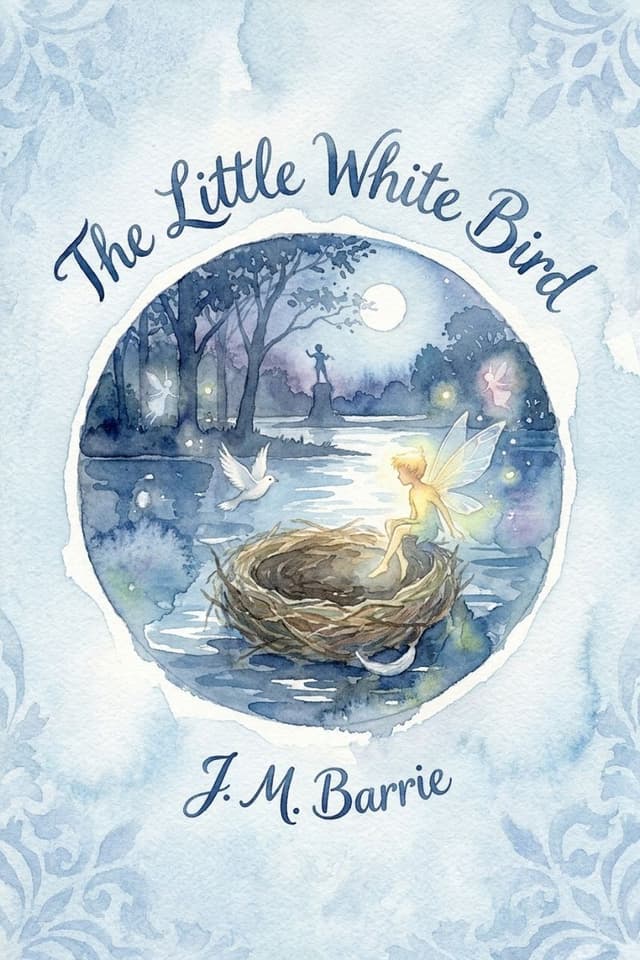
The Little White Bird
Read The Little White Bird by J. M. Barrie for free on Novelhalla, and try out our easy-to-read modern edition of this classic book. You can also download the EPUB and read it on any device if you prefer!
The Plot
A Bachelor, a Dog, and a Window
Captain W. is a retired officer living comfortably and alone in London. He has money, a club, a set of rooms, and Porthos, an enormous St Bernard who takes up most of the furniture and all of the affection going spare. What he doesn't have is a wife, a child, or any real reason to leave the house except to walk the dog. He's funny about this. He's funny about everything, in the way people are when the alternative is being honest.
From his club window he watches a young nursery governess called Mary hurry past on her errands. She's poor and cheerful and hopelessly in love with a painter who can't afford her. The Captain tells himself he finds her ridiculous. He then proceeds to think about her more or less constantly, and to interfere in her life in the most roundabout way imaginable: anonymous gifts, secret money, small mercies arranged so carefully that nobody could ever trace them back to him.
The Son Who Doesn't Exist
The trouble with charity conducted in disguise is that eventually somebody asks you a direct question. Cornered in conversation and unwilling to admit what he's been doing, the Captain invents a son. He names him Timothy. It's meant to be a throwaway lie to cover an awkward moment.
It doesn't stay throwaway. Timothy acquires clothes, habits, a personality, a place in the Captain's daily thoughts. He becomes a boy the Captain can love out loud, safely, because he isn't real. And because he isn't real, he can be used. The Captain works out exactly what he wants from the fiction of Timothy, and it involves a real child, and it involves telling more lies to get there.
Mary's boy is called David. By the time the Captain is walking him through Kensington Gardens, holding his hand and buying him buns and inventing worlds for him, it's genuinely unclear who's the child in the arrangement.
The Gardens After Six
David wants stories, and the Captain has one. It concerns a boy named Peter Pan, whose age is a week and always will be.
Peter began as an ordinary infant in an ordinary London nursery, but he overheard some talk about the man he would one day grow into and didn't care for the sound of it. So he did what any baby would do if it still remembered being a bird. He went to the window, and he flew.
He landed in Kensington Gardens, where all the babies in London come from, and where after Lock-Out Time the gates shut and the ordinary rules stop applying. The birds took him in. An elderly crow named Solomon Caw looked him over and delivered a diagnosis nobody had prepared him for: he isn't a bird any more, and he isn't quite a boy either. He's a Betwixt-and-Between.
Solomon says it kindly enough. But the moment Peter learns he can't fly, he can't fly, and the island in the middle of the Serpentine becomes an island in the way islands really are. He's a week old, he's marooned, and the only ferry service available is one he'll have to commission from thrushes.
The Girl Who Stayed Too Late
Maimie Mannering is four, and considerably better informed about the world than Peter is. She sneaks into the Gardens to see the fairy ball, which is a wonderful idea right up until the gates close behind her and the temperature drops and the fairies notice her watching.
What Peter and Maimie make of each other is the warmest thing in the book and the saddest. He proposes marriage, for reasons involving her coat. She has a mother at home who will be frantic by morning. Peter has been told what happens to boys who go back to windows, and he's told Maimie too, and neither of them wants to be the one to say it out loud.
There's also the matter of what Peter does in the Gardens at night when nobody's around. Barrie mentions it almost in passing, in one short sentence, and then moves briskly on, and you will not move briskly on. That sentence is the reason people call this book a children's story with something wrong underneath it.
Back in the World
The Peter Pan story is a story David is being told, and the man telling it has his own night to get through. There's an evening when David is allowed to stay over. There's a growing question of who this boy actually belongs to, and how much of a mother's son a stranger can borrow before somebody has to say something. And there's a manuscript the Captain has been quietly writing all along, about a woman and her children, which he'll eventually have to hand over to the one person who'd know exactly what it means.
Whether he does, and what she makes of it, is the last thing the book tells you.
About the Author: J. M. Barrie
Kirriemuir
James Matthew Barrie was born in 1860 in Kirriemuir, a weaving town in Angus, Scotland, one of ten children in a family that was poor, ambitious, and rigorously Presbyterian. His father was a handloom weaver. His mother, Margaret Ogilvy, was the emotional centre of the house and later of Barrie's writing.
When Barrie was six, his older brother David died in a skating accident, two days short of his fourteenth birthday. Their mother never recovered. Family accounts describe Barrie trying to fill the gap by wearing David's clothes and imitating his whistle so his mother might mistake him for the son she'd lost. He also absorbed something she said in her grief, which was that at least David would never grow up. It's not hard to see where he put that.
London
Barrie studied at the University of Edinburgh, worked as a journalist in Nottingham, and moved to London in 1884, where he turned his Kirriemuir childhood into sketches and then into books: Auld Licht Idylls, A Window in Thrums, The Little Minister. He then moved into theatre and turned out to be extremely good at it. Quality Street and The Admirable Crichton both landed in the early 1900s and made him rich.
In 1894 he married the actress Mary Ansell. The marriage produced no children and, by most accounts, not much happiness. It produced Porthos, a St Bernard bought on their Swiss honeymoon, who is in this book almost undisguised.
The Davies Boys
Walking Porthos in Kensington Gardens in the late 1890s, Barrie fell in with the young sons of Arthur and Sylvia Llewelyn Davies. Sylvia was the daughter of the artist George du Maurier and the aunt of a then-unborn Daphne. Barrie attached himself to the family with an intensity that people at the time found odd and people now find harder to categorise. He invented stories for the boys. He photographed them constantly. He drifted further from his wife, who divorced him in 1909.
Arthur Llewelyn Davies died in 1907. Sylvia died in 1910. Barrie became one of the boys' guardians and supported them for the rest of his life.
Later Years
The 1904 stage play made Peter Pan a permanent fixture of world culture and Barrie a very wealthy man. He was made a baronet in 1913, received the Order of Merit in 1922, and became Chancellor of the University of Edinburgh in 1930. He kept writing plays, including Dear Brutus and Mary Rose, both of them circling the same obsessions as always: lost children, second chances, the door back into a life you didn't get.
The losses kept coming. George Llewelyn Davies was killed in Flanders in 1915. Michael, the boy Barrie loved most, drowned at Oxford in 1921, a month short of twenty-one. Barrie died of pneumonia in London in 1937, aged 77, and was buried in Kirriemuir beside his parents and the brother whose death started all of it.
Fun Facts About the Book
Peter Pan's First Appearance
This is where Peter Pan begins. Not the play, not the boy in green, not Neverland. Here, in a 1902 novel written for adults, as a seven-day-old infant living rough in a London park. Everything the world knows about the character came afterwards, out of a side story in a book about a lonely bachelor.
It Was a Book Inside a Book
The Peter Pan material started as a single chapter and kept growing while Barrie worked on the manuscript, until it had swollen into a hundred-page story stitched into the middle of a completely different novel. Barrie spent four years on it.
It Got Filleted Four Years Later
After the play was a smash, Barrie's publishers simply lifted chapters 13 to 18 out of the book, tidied the seams so they'd read on their own, and reissued them in 1906 as a standalone children's title illustrated by Arthur Rackham. Millions of people have read those chapters without knowing there was a whole novel wrapped around them.
It Came Out in a Magazine First
Scribner's ran it serially in Scribner's Magazine from August to November 1902, with book publication in both Britain and America that November.
The First Edition Came With a Map
Buyers in 1902 got a fold-out map of Kensington Gardens bound in near the title page, so they could follow the geography of the fairy business against the real park.
Porthos Was Real, and He Became Nana
The huge St Bernard who steals scenes here was Barrie's actual dog. Two years later he'd be reincarnated as Nana, the Darling family's canine nursemaid, though Barrie switched the breed to a Newfoundland for the stage.
Maimie Is a First Draft of Wendy
The little girl who gets locked in the Gardens is the direct ancestor of Wendy Darling. Same curiosity about fairies, same instinct to mother a boy who doesn't have one, same impossible choice between him and home.
The Two Peters Don't Match
This Peter is a week old and will never have a birthday. The later Peter has baby teeth and is roughly school age. The stories are often called a prequel to the play, but they genuinely can't both be true, and Barrie never tried to reconcile them.
The Statue That Appeared Overnight
In 1912 Barrie paid for a bronze Peter Pan by Sir George Frampton and had it installed in Kensington Gardens overnight on 30 April, without ceremony, so that children would find it in the morning and assume the fairies had done it. He put a notice in The Times announcing a May Day surprise by the Serpentine. He picked the exact spot where Peter lands in this book. He was also privately unimpressed with the result, grumbling that Frampton hadn't captured the devil in Peter.
Mary Has Barrie's Wife's Name and Somebody Else's Life
David's mother is called Mary A., which was Barrie's wife's name before marriage. Biographers agree the character is modelled on Sylvia Llewelyn Davies instead. Barrie's own biographer-filmmaker Andrew Birkin described the narrator flatly as Barrie thinly disguised, which makes the whole thing an unusually public piece of private business.
Themes
Wanting to Be a Father
The engine of the book is a man who has decided he'll never have a child and cannot stop arranging his life around one anyway. The Captain's fake son, his secret charity, his campaign for David's affection, all of it is one appetite in different costumes. Barrie writes it with real tenderness and never quite lets you feel comfortable about it.
Betwixt and Between
Solomon's word for Peter is the book's word for everybody in it. Peter is neither bird nor boy. The Captain is neither family nor stranger, neither young nor properly grown, neither the father nor nothing. Barrie's interest is in people who fall between the available categories and then have to live somewhere.
Make-Believe as a Weapon
Imagination in this book isn't only lovely. It's how the Captain manipulates people. It's how Peter avoids a fact he can't survive knowing. Barrie was the great advocate for pretending, and he's remarkably clear-eyed here about what pretending costs and what it can be used to do.
Mothers and Windows
Windows are how you leave and how you come back, and Barrie makes them carry an almost unbearable weight. Behind every flight in this book is a woman in a room, waiting or not waiting. The whole Peter Pan mythology grows out of a single question about what a mother does after the boy has gone.
Money, Quietly
The Captain has money. Mary and her painter don't. Barrie is exact about what that difference means: which sacrifices are visible, which are humiliating, what it does to a marriage when the rent is uncertain. The charity in the book is always secret partly out of kindness and partly because being helped in public is its own injury.
Growing Up as Something That Happens to You
Peter's entire existence starts with a baby overhearing a description of the adult he'll become and deciding no. Barrie treats adulthood less as an achievement than as a thing done to children while they're not looking, and the whole book vibrates with the wish to have got out in time.
Loneliness Dressed as Comedy
The narrator is very funny. He's funny about his club, his dog, his neighbours, his own dignity. He is funny in the specific way of a man who has organised his entire personality around not being asked how he's doing. Reading past the jokes is most of the experience.
The Book's Legacy
Everything came from here. The 1904 play Peter Pan, or The Boy Who Wouldn't Grow Up added Wendy, Hook, Tinker Bell and Neverland and became one of the most performed works in the English language. The 1911 novel Peter and Wendy followed. Then the 1906 extraction with Rackham's illustrations, then a century of films, ballets, pantomimes and cartoons, none of which would exist if a lonely narrator in an adult novel hadn't started telling a small boy about a baby who flew out of a window.
In 1929 Barrie gave the Peter Pan copyright to Great Ormond Street Hospital for Children in London, and confirmed it in his will. Nearly a century on, the hospital still benefits every time the play is staged, which may be the single most successful act of literary philanthropy on record.
The statue still stands by the Long Water, on the spot Barrie chose, and children still climb the mice and rabbits around its base.
The book itself has had a stranger afterlife. It's been read as a masterpiece of whimsy and as something considerably darker, and the Barrie scholar Peter Hollindale's assessment is that modern readers can find hints of all sorts of abnormality in it while the thing itself stays oddly innocent and asexual. Andrew Birkin's J. M. Barrie and the Lost Boys and the 1978 BBC dramatisation drawn from it made the real story behind the fiction widely known, and the 2004 film Finding Neverland introduced it to a much larger audience in a considerably softer form.
What survives best is the tone. Nobody else writes like this: a comic novel about a man's social embarrassments that keeps opening trapdoors into grief, then handing you a fairy and asking you to believe. It's a book about the things adults can't say, told through a story invented for a child so that the adult can say them anyway.