Novelhalla
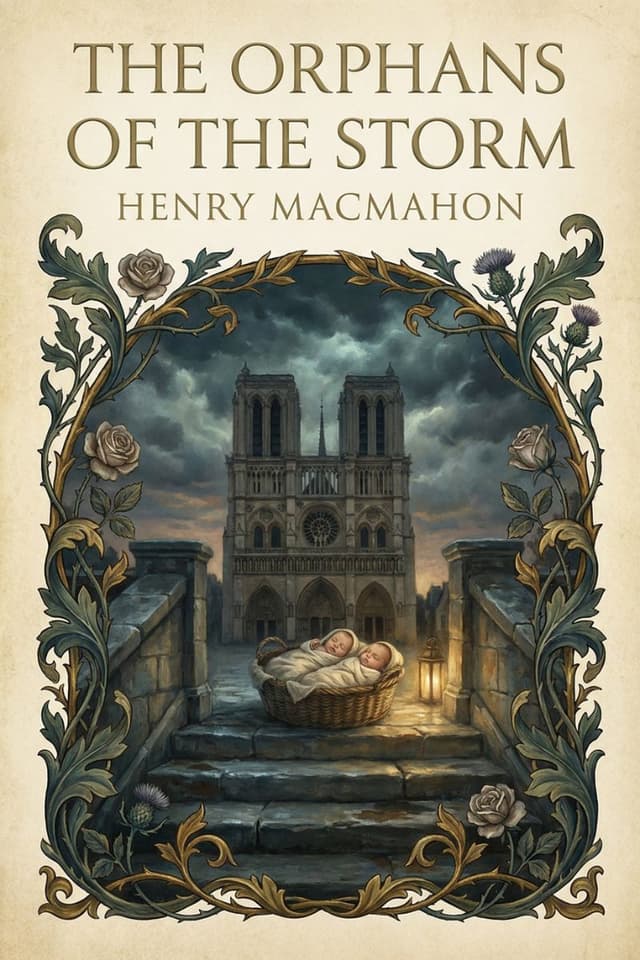
The Orphans of the Storm
Read The Orphans of the Storm by Henry MacMahon for free on Novelhalla, and try out our easy-to-read modern edition of this classic book. You can also download the EPUB and read it on any device if you prefer!
The Plot
Two Sisters, One Promise
France, 1789. Henriette and Louise Girard are as close as two sisters can be, even though they aren't actually related by blood. Both were foundlings, abandoned as infants on the steps of Notre Dame and raised together by a kind Norman family. When the plague killed their adoptive parents and stole Louise's eyesight, Henriette became everything to her: mother, protector, best friend.
A country doctor has given them a fragile thread of hope. There are surgeons in Paris, he says, men skilled enough to restore Louise's sight. It's all Henriette needs to hear. She'll take her sister to the capital. She'll find the cure. She'll fix everything.
But Louise has a condition. She knows what will happen in Paris. Her beautiful sister will meet someone, fall in love, and leave her behind. So Henriette makes a vow: she will never marry until Louise can see her husband's face and approve of him herself.
They set out for Paris with nothing but each other and a cousin's address.
The City of Wolves
Paris in 1789 is no place for two young women alone, and the city wastes no time proving it.
On the road, a nobleman named the Marquis de Praille spots Henriette from his gilded carriage. He is the kind of aristocrat who beats his servants for sport and asks whether his horses were injured after his coach has run down a pedestrian. He takes one look at Henriette and decides he must have her.
The sisters arrive at the coach house after dark. Their cousin Martin never appears. Instead, men in the shadows grab Henriette, throw a cloth over her face, and drag her into a waiting carriage. Louise, blind and helpless, is left standing alone in a city of a million strangers.
What follows happens fast and in two directions at once. Henriette is carried half-conscious to the Marquis's estate, where a decadent party is already underway. Louise, stumbling through the dark streets, nearly walks off a pier into the Seine before being caught at the last second by a hunchbacked scissors-grinder named Pierre Frochard.
Pierre is gentle and kind. His family is not.
Separated
From this point, the sisters' lives split into parallel nightmares.
Henriette is rescued from the Marquis by the Chevalier de Vaudrey, a young nobleman who is everything de Praille is not: honorable, brave, and genuinely troubled by the suffering of ordinary people. He fights a duel for her, spirits her away, and sets her up safely while she searches for Louise. They fall in love almost immediately, but Henriette won't hear of marriage. Not until she finds her sister.
Louise's situation is far worse. Pierre's mother, the monstrous old hag known as Mother Frochard, sees the blind girl as a business opportunity. She forces Louise into the streets to beg and sing for coins, keeping her prisoner in a cellar crawling with rats. When Louise resists, the old woman starves her into compliance. Pierre wants to help but is himself bullied and beaten by his mother and his brutal older brother Jacques.
Meanwhile, history is moving. The streets are full of hungry people. A lawyer named Danton is making speeches about tyranny. A quieter, colder man named Robespierre is taking notes. The aristocrats feast behind their gates and pretend nothing is changing.
Tangled Fates
The story braids the sisters' fates with the upheaval of a revolution in ways that seem almost cruel.
The Chevalier's family turns out to be deeply entangled in Louise's own hidden past. There is a secret about Louise's true parentage, one that connects her to the very aristocratic world that is tearing France apart. The people who could reunite the sisters are often the same people whose power and privilege are about to be violently stripped away.
Henriette searches Paris desperately. The Chevalier uses every connection he has. At one point, Henriette is close enough to hear Louise's voice singing in the street below her window. She screams her sister's name. And the moment of reunion is ripped away.
Every time the sisters nearly find each other, something intervenes. Aristocratic politics. Arrests. The accelerating chaos of a society coming apart at the seams. Danton, who owes Henriette a debt after she sheltered him from royalist assassins, becomes a powerful ally. But Robespierre is watching, and he does not forget who befriended whom.
The Storm Breaks
The French Revolution arrives not as an idea but as a flood.
The Bastille falls. The aristocrats scatter or die. The king's power crumbles. And the new order that replaces it proves just as hungry for blood as the old one. Robespierre's Committee of Public Safety sends hundreds to the guillotine, and the definition of "enemy of the people" expands daily. Being an aristocrat is a death sentence. Harboring one is just as bad.
The Chevalier de Vaudrey, despite every danger, returns to Paris for Henriette. It's the bravest and possibly the stupidest thing he could do. When he's discovered, both he and Henriette are condemned to the guillotine.
Louise is still in the Frochards' cellar. Pierre Frochard, the gentle hunchback who has loved her from the moment he saved her life, finally reaches the breaking point. His brother Jacques wants Louise for himself. And what follows between the two brothers involves a knife and a decision that Pierre has been too afraid to make until now.
The novel hurtles toward a climax where every thread converges: the guillotine blade, a desperate ride through the streets, a pardon that may arrive too late, and the question of whether two orphan girls from Normandy can survive a storm that is swallowing an entire nation.
About the Author: Henry MacMahon
The Novelizer
Very little is known about Henry MacMahon's personal life, which is fitting for a writer whose most famous work is itself an adaptation. MacMahon was an American writer active in the early 1920s who specialized in the then-common art of the "novelization," transforming motion pictures into prose fiction for readers who wanted to experience the story beyond the theater.
The Griffith Connection
In 1922, Grosset and Dunlap published MacMahon's novelization of D.W. Griffith's epic silent film, released the previous year. The book was marketed as "A Complete Novel from D.W. Griffith's Motion Picture Epic on the Immortal Theme of The Two Orphans" and was illustrated with stills from the film starring Lillian and Dorothy Gish. MacMahon's contribution was to translate the visual spectacle of Griffith's silent film into narrative prose, adding interior monologue, historical commentary, and descriptive flourishes that the silent medium couldn't deliver.
A Writer in the Shadows
The novelization was a peculiar literary form, prestigious enough to warrant publication by major houses but rarely earning its authors much individual fame. MacMahon's name appeared on the cover, but D.W. Griffith's was the one people remembered. The book served its purpose: it extended the life of the film, reached audiences in towns without movie theaters, and gave fans a way to revisit the story at home. MacMahon did the work with genuine skill, bringing a florid, emotional style to the material that suited its melodramatic soul.
Fun Facts About the Book
It's Based on a Play That Was Based on a Film That Was Based on a Play
The layers of adaptation here are remarkable. MacMahon's 1922 novel is a novelization of D.W. Griffith's 1921 silent film, which was itself an adaptation of a wildly popular 1874 French stage melodrama called Les Deux Orphelines by Adolphe d'Ennery and Eugène Cormon. That play had already been adapted for the American stage, filmed at least twice before Griffith got to it, and performed hundreds of times across decades. By the time MacMahon put pen to paper, the story had been traveling through different media for nearly fifty years.
The Gish Sisters Played Sisters
The film that inspired the novel starred real-life sisters Lillian and Dorothy Gish as the fictional sisters Henriette and Louise. It was their final film together with Griffith, and Dorothy, known primarily as a comedienne, surprised audiences with her dramatic portrayal of the blind Louise. The casting gives the emotional core of the story an extra layer of real-world resonance.
Danton as "The Abraham Lincoln of France"
Griffith's film, and by extension MacMahon's novel, presents the revolutionary leader Georges Danton in heroic terms, essentially casting him as the moral center of the French Revolution. Griffith's title cards in the film literally called Danton "the Abraham Lincoln of France." This is, to put it gently, a creative interpretation of history, but it makes for a compelling character in the novel.
A Warning About Bolshevism
Griffith made the film in 1921, just a few years after the Russian Revolution, and he was not subtle about the parallels he wanted audiences to draw. The novel carries forward Griffith's political messaging: the French Revolution was justified, but the mob violence and radical overreach that followed were warnings about what happens when legitimate grievances become tyranny. MacMahon dutifully incorporated these contemporary anxieties into his prose.
The Brooklyn Theater Fire Connection
The original stage play, The Two Orphans, has a dark piece of history attached to it. On December 5, 1876, during a performance at the Brooklyn Theatre in New York, a catastrophic fire broke out that killed nearly 300 people. Actress Kate Claxton, who was performing as Louise that night, survived and continued playing the role for decades afterward. She eventually purchased the performance rights to the play.
Thomas Jefferson Makes a Cameo
Both the film and the novel feature a brief appearance by Thomas Jefferson, who was indeed serving as American ambassador to France in 1789 and witnessed the early stages of the Revolution firsthand. In the story, Jefferson and the Marquis de Lafayette appear as figures in the background of the revolutionary ferment, lending historical weight to the fictional drama.
Themes
The Bond Between Sisters
At its heart, this is a story about two women who refuse to let the world separate them. Every obstacle the plot throws at Henriette and Louise, including kidnapping, imprisonment, blindness, revolution, and the guillotine itself, is ultimately a test of whether their bond can survive forces far larger than either of them. Henriette's vow never to marry until Louise can see is the engine that drives everything forward.
Class and Cruelty
The novel paints pre-revolutionary France as a society where the rich have literally stopped seeing the poor as human. The Marquis de Praille is the extreme example, but the entire aristocratic world is implicated. The contrast between the lavish parties inside the gates and the starving beggars outside them isn't subtle, and it isn't meant to be. When the revolution comes, the novel wants you to understand why.
Revolution and Its Betrayals
The storm of the title isn't just the Revolution itself but what the Revolution becomes. The novel shows how justified rage can curdle into something just as monstrous as the tyranny it replaced. Robespierre's Reign of Terror condemns the innocent alongside the guilty, and the people who fought for liberty find themselves building new prisons. The Chevalier de Vaudrey, a nobleman who genuinely cared about the common people, is sentenced to die precisely because of the class he was born into.
The Invisible and the Overlooked
Louise's blindness is the novel's central metaphor. She can't see the world, but the world also can't see her. She's invisible to the aristocrats who abduct her sister, invisible to the Frochard family except as a source of income, and invisible to her own birth mother who passes her on the street without recognition. The novel is full of people who are overlooked, dismissed, or rendered powerless by systems that treat them as less than human.
The Book's Legacy
The story of the two orphans has proven remarkably durable across more than a century and a half of retellings. What began as a French stage melodrama in 1874 became one of the most performed plays of the late nineteenth century, was filmed at least five times in different countries, and inspired adaptations in languages from Bengali to Italian to Turkish.
MacMahon's novelization captured a particular moment in that long history, preserving the emotional sweep of Griffith's silent epic in a form that audiences could read and reread. The novel carries the marks of its era, including the florid prose, the political anxieties about Bolshevism, and the melodramatic sensibility, but the core story of two sisters separated by cruelty and reunited by love remains genuinely moving.
Griffith's film itself, despite being a commercial disappointment at the time, is now considered one of the landmark works of silent cinema. It was the last great collaboration between Griffith and Lillian Gish, and its influence on cinematic technique, particularly its cross-cutting between parallel storylines to build suspense, was studied and admired by filmmakers around the world, including the Soviet directors Sergei Eisenstein and Vsevolod Pudovkin, who found in Griffith's work the foundations of their own revolutionary cinema.
The story endures because it taps into something timeless: the fear of being separated from the people we love, the hope that love can survive even the worst the world can throw at it, and the uncomfortable truth that revolutions fought for justice can become their own kind of tyranny.