Novelhalla
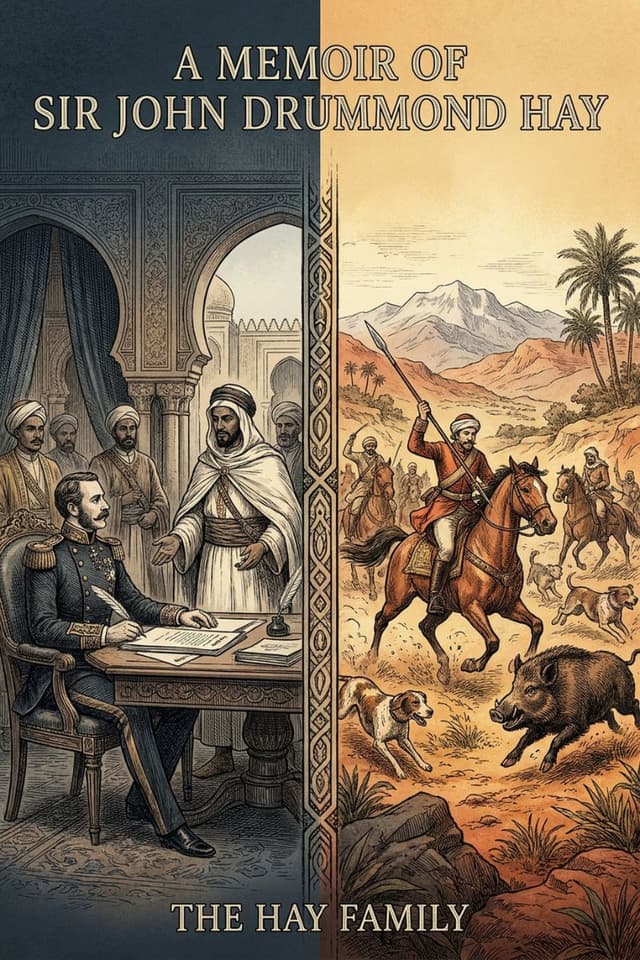
A Memoir of Sir John Drummond Hay
Read A Memoir of Sir John Drummond Hay by The Hay Family for free on Novelhalla, and try out our easy-to-read modern edition of this classic book. You can also download the EPUB and read it on any device if you prefer!
The Plot
The Boy from Valenciennes
He is born in 1816 in occupied France, the son of a British army officer. Before he turns ten, he is sitting on Walter Scott's knee at the family home in Edinburgh, listening to stories from the most famous writer alive. He walks to school through the cold Scottish mornings, sharing his bread roll with a harmless local eccentric known as "daft Jamie," who one day simply vanishes. The boy later learns Jamie was one of the first victims of Burke and Hare, the notorious body snatchers who sold corpses for medical dissection.
He is, by his own cheerful admission, the worst student in his class. When a judge stops him on the street and asks his rank, he hangs his head. Dead last, he confesses. The judge tells him that's exactly where he was, too, and look how things turned out. The boy runs home to tell his mother the good news. She is not impressed.
This is John Drummond Hay, and nothing about his early life suggests the extraordinary career that is coming.
Constantinople
At twenty-four, he lands a junior diplomatic post at the British Embassy in Constantinople, where the Ottoman Empire is creaking and the Great Powers are circling. He serves under two of the most formidable British ambassadors of the age and gets a crash course in the kind of diplomacy that runs on personal relationships, sharp instincts, and the ability to read a room in multiple languages.
He picks up Turkish and Arabic to go with his French, Italian, and Spanish. He learns how power actually works in places where the rules are unwritten and the stakes are life and death. It is an education no school could have given him.
Morocco
Then his father, serving as Consul General in Tangier, needs help. Young Drummond Hay is sent to assist, and within months he has so impressed everyone that he is appointed to replace his superior. He is twenty-eight years old. He will not leave Morocco for forty years.
What follows is one of the most remarkable diplomatic careers of the nineteenth century, lived out in a country that most Europeans barely understand. Morocco in the 1840s is a world unto itself. The Sultan rules from ancient cities like Marrakesh and Fez, but his authority frays at the edges, where mountain tribes answer to no one. Pirates operate from the Rif coast. Religious fanaticism runs hot. The roads between cities are dangerous. The politics are layered with tribal loyalties, religious authority, and the constant pressure of European powers looking for any foothold they can find.
Drummond Hay throws himself into all of it. He rides out to meet tribal chiefs. He speaks to Moors of every class in their own language. He hunts wild boar on horseback through the forests outside Tangier. He negotiates with sultans, mediates between warring factions, and personally intervenes to shut down piracy along the coast.
The Sentinel of the Straits
The Sultan offers to hand him control of Morocco's entire foreign policy. A wealthy Moroccan entrusts him with a fortune in gold, no receipt, no witnesses, simply because he trusts the Englishman's word. When Spain declares war on Morocco in 1859, every other foreign diplomat flees Tangier. Drummond Hay stays. Spanish friars beg him to protect their church from the fury of angry Moroccan mobs. He does.
He negotiates the commercial treaty that opens Morocco to trade, a document so significant that old Morocco hands call it the country's Magna Carta. He leads expeditions to the Atlas Mountains, where the snow-capped peaks have barely been seen by European eyes. He bluntly tells the Sultan to his face that his government is corrupt and his people are suffering, in language so direct it would end most diplomatic careers. Instead, it deepens the Sultan's respect.
Through it all, he fights a quiet, relentless campaign to keep France and every other European power from gaining a foothold in Morocco. "As a sentinel of the Straits," he writes near the end of his service, "I fire my gun, as a warning, when I know of a move to obtain that object."
The Unfinished Story
In 1886, he retires, though he keeps coming back to the country that has consumed his life. He begins writing his memoirs at the urging of friends, but an eye injury slows him down. He dictates stories to his daughter. He plans to resume writing when his sight improves. Then illness strikes, and influenza carries him off in 1893.
His two daughters are left with scattered notebooks, half-finished chapters, bundles of letters to his mother and sister, and the task of stitching their father's extraordinary life into a single book. What they produce is part biography, part adventure story, part love letter to a country and a career that don't exist anymore.
About the Authors
A Family Production
This memoir has no single author. It was assembled by Sir John's two daughters, Louisa Annette Edla Drummond-Hay Brooks and Alice Emily Drummond-Hay, from their father's journals, letters, half-written recollections, and their own memories. Sir Francis de Winton, a military man who had served alongside Drummond Hay in Morocco, wrote the introduction.
The daughters are candid about their limitations. They couldn't use official government documents. Their father died before finishing the work. They had to piece together a forty-year diplomatic career from private letters, most of them addressed to his mother and eldest sister. The result has the slightly uneven texture of a scrapbook assembled with love and care, full of vivid firsthand detail in some places and quiet gaps in others.
Sir John Drummond Hay
The subject himself was born in Valenciennes, France, in 1816, educated at Edinburgh Academy and Charterhouse, and entered the diplomatic service in his twenties. He served in Constantinople before being posted to Morocco, where he spent the rest of his professional life. He spoke Turkish, Arabic, French, Italian, and Spanish with fluency. He married twice, first Sarah Laura Livingston in 1838, and after her death, Annette Cazytensen of Copenhagen. He was an avid sportsman, a gifted storyteller, and by all accounts a man of extraordinary personal courage. He died at Wedderburn Castle in Scotland in 1893.
Fun Facts About the Book
Sitting on Walter Scott's Knee
As a young boy in Edinburgh, Drummond Hay knew Sir Walter Scott personally. Scott was a friend of the family and visited their home regularly. Young John sat on the great novelist's knee and listened to his stories. He even visited Abbotsford, where Scott instructed his enormous deerhound, Maida, to look after the boy. The dog let him ride on her back.
The Burke and Hare Connection
In one of the memoir's most chilling asides, Drummond Hay recalls a man he used to see on his walk to school in Edinburgh, a local figure known as "daft Jamie," with whom he shared his breakfast bread. Jamie disappeared one day. Drummond Hay later learned he had been murdered by Burke and Hare, the infamous killers who sold bodies to a surgeon for dissection. It is a casually horrifying detail dropped into an otherwise sunny account of childhood.
The Fortune Teller
Before his diplomatic career began, a Moroccan servant offered to take young Drummond Hay to a fortune teller who had never been wrong about anyone she'd seen. Whether the prediction came true, and what exactly it foretold, is one of the book's many tantalizing threads.
Pigsticking in Morocco
Drummond Hay didn't just practice diplomacy in Morocco. He essentially established organized sport hunting outside Tangier, introducing pigsticking (boar hunting on horseback with lances) to North Africa. The Sultan allocated ground for it, and under Drummond Hay's supervision, the hunts became legendary social events attended by Europeans and Moroccans alike.
His Own Earlier Book
Before his daughters assembled this memoir, Drummond Hay had already published "Western Barbary," an account of his early travels into the Moroccan interior. Written with what his daughters describe as the vigor and freshness of youth, it was well received and remains an early piece of European travel writing about Morocco's wild interior.
Schoolmates with Thackeray (Almost)
At Charterhouse, Drummond Hay just missed overlapping with William Makepeace Thackeray, who had either just left or was about to leave. He did attend alongside the future war hero Henry Havelock and the illustrator John Leech, as well as the publisher John Murray.
Themes
The Power of Personal Character
This is, at its heart, a book about what one person can accomplish through sheer force of personality. Drummond Hay had no army behind him, no great wealth, no overwhelming national power to project. What he had was fluency in Arabic, physical courage, a talent for building trust, and a stubbornness that wouldn't quit. In a country where most European diplomats were ignored or tolerated, he became the most powerful foreigner in the kingdom.
A Vanished World
The Morocco described in these pages no longer exists, and didn't exist much longer after Drummond Hay left it. Within two decades of his retirement, European powers would carve up the country. The book captures a moment when Morocco was still independent, still mysterious to most Europeans, and still governed by its own ancient rhythms. It is a portrait of a world on the edge of disappearing.
The Diplomat as Adventurer
Modern diplomacy is bureaucratic, cautious, and committee-driven. Drummond Hay's diplomacy involved riding horseback through bandit country, personally shutting down pirate operations, hunting wild boar with tribal chiefs, and telling a sultan his government was rotten. The memoir is a reminder that there was a time when a single representative, thousands of miles from home, had to make consequential decisions entirely on his own judgment.
Fathers and Daughters
There is something quietly moving about the structure of this book. A father who ran out of time to tell his own story, and two daughters who pieced it together from fragments, writing with obvious pride and love but also with the careful restraint of women who know they can't fully capture what they witnessed. The gaps in the narrative are almost as eloquent as the stories themselves.
The Book's Legacy
This memoir is not famous. It was published in 1896, sold modestly, and has lived in relative obscurity ever since. But for anyone interested in nineteenth-century Morocco, British imperial diplomacy, or simply the kind of life that doesn't get lived anymore, it is a remarkable document.
Drummond Hay himself occupies a strange place in history. He was one of the most influential figures in nineteenth-century Morocco, more trusted than any other European who ever served there. The Oxford Dictionary of National Biography gives him an entry. Khalid Ben-Srhir wrote an entire academic study of his embassy. But outside specialist circles, he is largely forgotten.
The book survives because of Project Gutenberg, which makes it freely available, and because the stories in it are simply too good to vanish entirely. A boy who shared bread with a Burke and Hare victim, who rode Walter Scott's dog, who grew up to become the most powerful man in Morocco after the Sultan. You could not invent this life. You can only read it.