Novelhalla
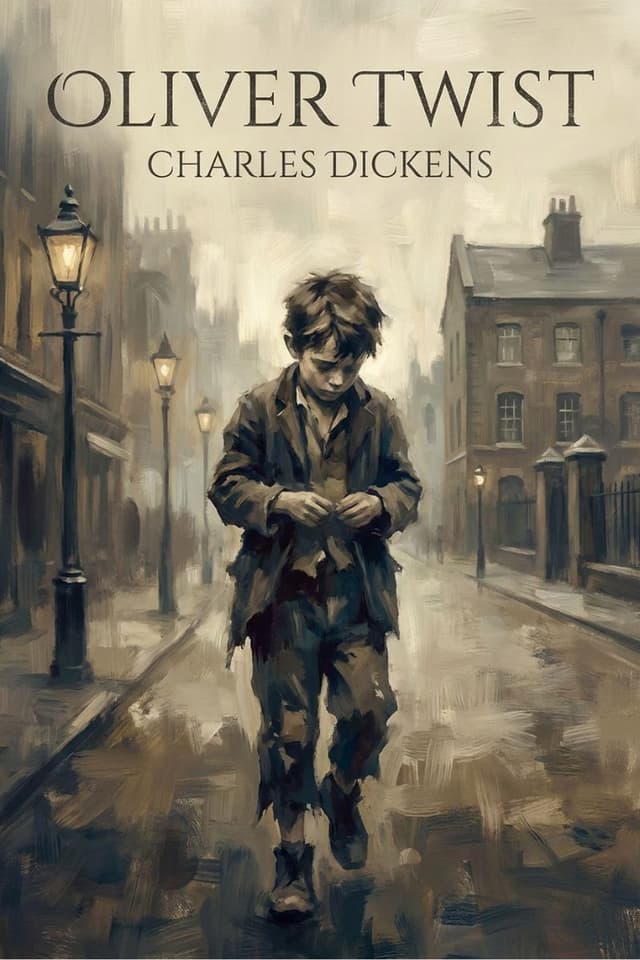
Oliver Twist
Read Oliver Twist by Charles Dickens for free on Novelhalla, and try out our easy-to-read modern edition of this classic book. You can also download the EPUB and read it on any device if you prefer!
The Plot
The Workhouse
A woman stumbles into a workhouse, gives birth to a boy, and dies. No one knows who she was. No ring on her finger. No name. The baby is given one by the parish beadle, Mr. Bumble, who names his charges alphabetically. This one gets Twist.
Oliver grows up in the care of the parish, which is to say he grows up hungry, neglected, and unloved. He's farmed out to a woman who pockets the money meant for the children and feeds them as little as possible. When he's old enough, he's sent back to the workhouse to pick oakum alongside the adult paupers. The boys are fed so little they're wasting away.
One night, desperate with hunger, Oliver does the unthinkable. He walks up to the master after supper, bowl in hand, and asks for more.
The reaction is instant and absurd. You'd think he'd set the building on fire. The board is convened. Oliver is declared a menace. He is offered to anyone willing to take him off the parish's hands. He ends up apprenticed to Mr. Sowerberry, the local undertaker, who uses the boy's sad face as a prop at children's funerals.
The Road to London
After being savagely beaten by an older apprentice and finding no one willing to defend him, Oliver runs away. He walks for seven days toward London, sleeping in fields, begging for scraps, barely surviving. On the outskirts of the city, he meets a boy his own age who is unlike anyone he's ever encountered.
Jack Dawkins, better known as the Artful Dodger, is sharp, confident, and oddly generous. He buys Oliver a meal and offers him a place to stay. Oliver, who has never in his life been shown casual kindness by a stranger, follows him gratefully into the tangled streets of London.
The Dodger leads him to a filthy room where an old man is cooking sausages over a fire while a group of boys smoke pipes and drink gin. The old man is Fagin. He seems friendly. The boys seem happy. Oliver has no idea what he's walked into.
Fagin's World
Fagin runs a gang of child pickpockets. The boys go out each day and bring back wallets, handkerchiefs, and whatever else their quick fingers can lift. Fagin fences the goods and keeps the profits. He plays games with the boys to sharpen their skills, making a show of hiding treasures in his pockets for them to steal. Oliver thinks it's all great fun. He doesn't understand.
Not until he goes out "to work" with the Dodger and another boy named Charley Bates, and watches in horror as they pick the pocket of an elderly gentleman at a bookstall. Oliver freezes. The gentleman turns. And it's Oliver, standing there looking guilty, who gets chased and caught.
The gentleman is Mr. Brownlow. And despite every appearance, he looks at this terrified, half-starved child and sees something that stops him. Oliver faints in the courtroom. A witness clears him. And Brownlow, moved by something he can't quite explain, takes Oliver home.
A Taste of Safety
For a brief, shining stretch, Oliver lives in Brownlow's comfortable house. He is fed. He is clothed. The housekeeper, Mrs. Bedwin, fusses over him. Brownlow is struck by a resemblance between Oliver and a portrait of a young woman hanging in his home, though he can't quite place why.
It won't last. Fagin is furious that Oliver has escaped, terrified the boy might tell what he knows. He enlists Nancy, a young woman who has been part of his operation since she was a child, and her brutal lover, Bill Sikes, to get Oliver back. They find him on an errand for Brownlow, pretend to be his family, and drag him back into the underworld.
Oliver is stripped of his new clothes and dressed in rags again. Everything Brownlow gave him is taken. And now Fagin has plans for the boy.
The Housebreaker
Bill Sikes needs a small child for a job. He's planning to rob a country house, and he needs someone tiny enough to fit through a window and unlock the door from inside. Fagin volunteers Oliver. Sikes makes it clear that if Oliver hesitates, he'll kill him.
Oliver is dragged through the dark to a house outside London. Sikes shoves him through a tiny window. Oliver intends to run upstairs and warn the family. But the residents are already awake. A shot rings out. Oliver is hit in the arm. Sikes hauls him back through the window and flees with him, then abandons the bleeding boy in a ditch.
When Oliver wakes, he crawls back to the house and collapses at the door. The people inside, instead of turning him over to the law, take him in and nurse him back to health. The house belongs to Mrs. Maylie and her young ward, Rose. They see what Brownlow saw: a child in need of help, not a criminal.
The Conspiracy
But there is someone else who has an interest in Oliver, someone operating in the shadows. A man who goes by the name Monks has been meeting with Fagin, paying him handsomely to keep Oliver trapped in a life of crime. Monks knows something about Oliver's past, something dangerous. He's determined to make sure the boy's true identity stays buried forever.
Monks bribes the workhouse officials. He destroys evidence. He is desperate, vicious, and afraid of something Oliver doesn't even know exists: a secret about his birth, his parents, and an inheritance that could change everything.
Nancy, who helped kidnap Oliver, begins to feel the weight of what she's done. She overhears Monks and Fagin plotting, and what she learns shakes her to the core. For the first time in her life, she considers betraying the people who raised her. It's the most dangerous thing she could possibly do.
The Bridge
Nancy makes contact with Rose Maylie and, through her, with Mr. Brownlow. On London Bridge, in secret, late at night, she tells them everything she knows about Monks and the conspiracy against Oliver. She begs them to protect the boy. But she refuses to leave Sikes, refuses to save herself. She has been with him since she was a girl. She can't imagine another life, even though this one is killing her.
Fagin, suspicious, sends a spy to follow her. The spy sees everything. And Fagin, with calculated malice, tells Sikes what Nancy has done, twisting the story just enough to make it sound like she's betrayed him personally.
What happens next is the darkest passage Dickens ever wrote. And it sets in motion a chain of events that will bring down Fagin's entire empire, expose the conspiracy against Oliver, and force every secret in this story into the light.
The question is whether Oliver will learn who he really is before the people trying to destroy him finish the job. And whether anyone who tries to help him will survive the attempt.
About the Author: Charles Dickens
The Boy in the Blacking Factory
Charles Dickens was born in 1812 in Portsmouth, the second of eight children. His father, John Dickens, was a naval clerk with a talent for living beyond his means. When Charles was twelve, his father was sent to debtors' prison, and the boy was pulled out of school and put to work in a boot-blacking factory, pasting labels on bottles of shoe polish in a rat-infested warehouse by the Thames.
The experience lasted only a few months, but it marked Dickens for life. The shame, the fear, the sense of being abandoned by the adults who should have protected him: these feelings powered nearly everything he wrote. He never fully told anyone about it until near the end of his life, but it runs like an electric current through his fiction. Every abandoned child, every workhouse, every cruel institution in his novels carries the charge of that warehouse.
The Rise
Dickens educated himself, became a court reporter, then a journalist, and by his mid-twenties was the most famous writer in England. The Pickwick Papers, published in serial installments in 1836, made him a sensation. Oliver Twist followed almost immediately, appearing in monthly installments beginning in February 1837 when Dickens was just twenty-five years old. He was simultaneously editing a literary magazine, finishing Pickwick, and starting a new novel. The pace was extraordinary, and he would maintain it for the rest of his life.
The Phenomenon
Over the next three decades, Dickens produced an astonishing body of work: David Copperfield, Bleak House, Great Expectations, A Tale of Two Cities, A Christmas Carol, and many more. He was not just a bestselling novelist. He was a cultural force. He gave wildly popular public readings that drew enormous crowds. He campaigned for social reform. He edited magazines. He staged amateur theatricals. He walked the streets of London for hours at night, feeding his insatiable curiosity about the city and its people.
The Man
Dickens was brilliant, generous, restless, and often difficult. He fathered ten children with his wife Catherine, then left her in 1858 for a young actress named Ellen Ternan, handling the separation with a cruelty that shocked his friends. He drove himself relentlessly, and the punishing schedule of reading tours in his final years broke his health. He died of a stroke on June 9, 1870, at age fifty-eight, leaving his final novel, The Mystery of Edwin Drood, unfinished.
He was buried in Westminster Abbey, despite having asked for a simple, private funeral. The public would not allow it. For three days, mourners filed past his grave. He belonged, by then, not just to English literature but to the world.
Fun Facts About the Book
The First Child Hero
Oliver Twist was the first novel in English literature to make a child its protagonist. Before Dickens, children in novels were minor characters or plot devices. By putting a hungry, frightened boy at the center of the story and asking readers to see the world through his eyes, Dickens invented something new. Every orphan hero in fiction since, from Huck Finn to Harry Potter, owes a debt to Oliver.
Written at a Superhuman Pace
Dickens was twenty-five when he started Oliver Twist, and he was writing it simultaneously with The Pickwick Papers while editing Bentley's Miscellany, the magazine in which Oliver appeared as a serial. He produced two or three chapters a month, each accompanied by an illustration from George Cruikshank. The first installment was so popular that the issue had to be reprinted with an additional thousand copies.
The Real Fagin
Dickens originally named the character "Bob Fagin," the full name of a boy he'd worked alongside in the blacking factory. The real Bob Fagin had been kind to young Charles, once caring for him when he fell ill at work. Why Dickens gave his name to a villain who corrupts children remains one of the stranger puzzles of his biography. He later shortened it to just "Fagin."
The Poor Law Attack
Oliver Twist was deliberately written as an attack on the Poor Law Amendment Act of 1834, which created the workhouse system that Dickens portrays with such fury. The law was designed to make poverty so miserable that people would do anything to avoid seeking public assistance. Dickens thought it was monstrous, and he used Oliver's story to show the human cost of treating the poor as a problem to be managed rather than people to be helped. He was still attacking the same law in his last completed novel, Our Mutual Friend, thirty years later.
The Illustrator's Claim
George Cruikshank, who provided the iconic illustrations for the serial, claimed after Dickens's death that he, not Dickens, had invented the story and characters of Oliver Twist. The claim was widely dismissed, but it speaks to how closely the two men collaborated and how inseparable the images became from the text. Cruikshank's etchings of Fagin's den, the workhouse, and the London streets remain some of the most recognizable illustrations in English literature.
Dickens the Performer
In his later years, Dickens performed dramatic readings of his novels to enormous audiences. His reading of the scene in which Nancy is murdered became so famous, and so physically intense, that his doctors begged him to stop performing it. He refused. Witnesses reported that audience members fainted and that Dickens himself was visibly shattered after each performance. It is widely believed that the strain of these readings contributed to his early death.
The Controversy Over Fagin
Dickens's portrayal of Fagin as a Jewish villain drew criticism even during his lifetime. A Jewish woman named Eliza Davis wrote to him in 1863, pointing out how harmful the characterization was. Dickens took the criticism seriously and, in his later novel Our Mutual Friend, created the character of Mr. Riah, a kind and dignified Jewish man, as a form of amends. He also revised later editions of Oliver Twist to remove some of the more pointed references to Fagin's Jewishness.
Themes
Poverty and the Systems That Sustain It
Dickens doesn't simply show poor people suffering. He shows the institutions that are supposed to help them, the workhouses, the parish boards, the magistrates, actively making things worse. The adults who control Oliver's fate are not merely indifferent. They are self-serving, pompous, and sometimes deliberately cruel. The novel argues that poverty in Victorian England is not a natural disaster. It is a system, maintained by people who benefit from it.
Innocence Under Siege
Oliver is almost impossibly good. He moves through a world of thieves, murderers, and corrupt officials without being corrupted himself. This has frustrated some readers, who find him too passive or too saintly. But that's the point. Dickens is testing a proposition: can genuine innocence survive the worst that the world can throw at it? And if it can, what does that say about the people who tried to destroy it?
The Criminal Underworld as a Dark Family
Fagin's gang is, in its twisted way, a family. He provides food, shelter, and companionship to children the rest of society has thrown away. The boys call him "the old gentleman." They have inside jokes and shared rituals. The horror of Fagin's operation is not that he preys on strangers but that he preys on the very children who depend on him, turning their need for belonging into a tool for exploitation.
Nancy and the Cost of Loyalty
Nancy is the most complex character in the novel. She was recruited into Fagin's world as a small child. She has done terrible things. She is also capable of extraordinary compassion and courage. When she finally acts to save Oliver, she does so knowing what it will cost her. Her refusal to abandon Sikes, even when escape is offered, is heartbreaking and complicated. Dickens uses her to ask whether someone shaped by cruelty can still choose goodness, and what price that choice demands.
Identity and Inheritance
Oliver doesn't know who he is. The entire machinery of the plot, Monks's conspiracy, Fagin's schemes, the destruction of evidence, is designed to keep him from finding out. The novel suggests that identity is not just a matter of knowing your parents' names. It's about whether the world will allow you to become who you were meant to be, or whether it will crush that possibility before you ever get the chance.
The Book's Legacy
Oliver Twist made Dickens into something more than a popular novelist. It made him a social crusader. The novel's depiction of workhouse conditions, child exploitation, and the criminal underworld shocked Victorian England into confronting realities it preferred to ignore. The phrase "Please, sir, I want some more" became one of the most quoted lines in English literature, a distillation of every hungry child's plea that has ever been ignored by the people in charge.
The novel has been adapted more times than almost any other work of fiction. David Lean's 1948 film is a masterpiece of British cinema. Lionel Bart's 1960 musical Oliver! transformed the story into a beloved stage and screen spectacle, winning the Academy Award for Best Picture in 1968. There have been animated versions, television adaptations, modern retellings, and countless stage productions around the world.
Dickens's portrayal of Fagin has been the subject of ongoing critical debate, particularly regarding its antisemitic dimensions. Modern readers and scholars continue to wrestle with how to engage honestly with both the novel's extraordinary power and its significant flaws.
What endures most is the image of the child. Small, alone, hungry, surrounded by people who want to use him, and somehow, against all odds, still hoping for something better. Dickens saw that child in the blacking factory mirror when he was twelve years old. He spent the rest of his life making sure the world could see him too.