Novelhalla
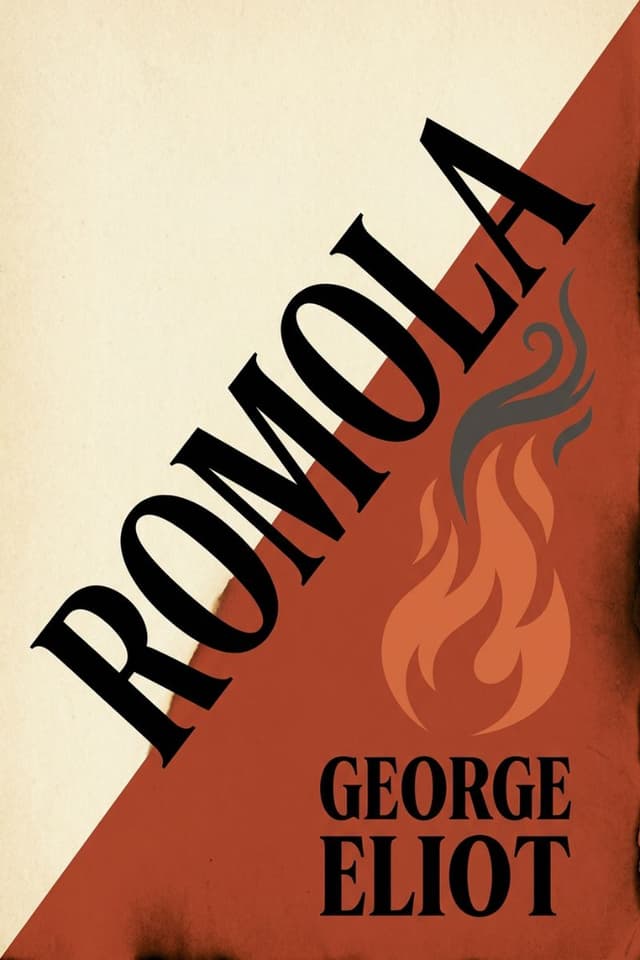
Romola
Read Romola by George Eliot for free on Novelhalla, and try out our easy-to-read modern edition of this classic book. You can also download the EPUB and read it on any device if you prefer!
The Plot
The Stranger
Florence, 1492. Lorenzo de' Medici is dead, and the most powerful city in Italy doesn't know what it is anymore. Into this chaos walks a stranger.
Tito Melema washes ashore with nothing but his good looks, a quick mind, and a pouch of rare jewels. He's Greek, educated, charming in that way that makes everyone want to help him. Within weeks he's selling gems, making connections, and sliding into the intellectual circles of the city like he was born to them. The barber's shop where the scholars and wits gather becomes his stage. Everyone likes Tito. Everyone trusts Tito.
There's just one problem. Those jewels don't belong to him.
They belong to Baldassarre Calvo, the old scholar who raised Tito like a son, who gave him everything, and who may right now be a slave in Turkish hands, waiting to be ransomed. Tito knows this. He thinks about it. And then he decides not to think about it anymore.
The Scholar's Daughter
Through his new connections, Tito meets Bardo de' Bardi, a blind antiquarian consumed by his library and his scholarship. Bardo's world is narrow but deep, and it runs entirely through his daughter. Romola is brilliant, devoted, and utterly sheltered. She reads to her father. She assists his research. She has never had contact with a mind that could stir her larger nature into life.
Tito stirs it. He's well-traveled, well-read, and he looks at her like she matters beyond her usefulness. She falls for him completely. Her dying brother Dino, now a Dominican friar, warns her on his deathbed against the marriage. He's seen a vision. Something terrible. Romola dismisses it as religious fever.
She marries Tito.
The Mask Slips
Marriage to Tito is warm at first and then, gradually, strange. He is evasive about small things. He talks about leaving Florence. He doesn't want the responsibilities Bardo's legacy will demand. And there's the matter of Tessa, a sweet, simple peasant girl Tito met at a carnival. He let her believe a mock wedding ceremony was real. She thinks she's his wife. She's keeping it secret, just as he told her to.
Then Bardo dies, and things accelerate. Tito secretly sells Bardo's library, the collection Romola's father spent his life assembling, the one thing Romola was entrusted to protect. When she discovers what he's done, something breaks between them that can never be repaired.
She tries to leave Florence. She packs a disguise and heads for the gates. But on the road outside the city, she encounters the one man powerful enough to turn her around: Girolamo Savonarola.
The Preacher
Savonarola is the other great force in this story. He's a Dominican friar whose fiery sermons have seized the imagination of Florence. He preaches repentance, reform, the wrath of God descending on a corrupt city. He is electrifying and terrifying and possibly a prophet. Half of Florence worships him. The other half wants him dead.
He tells Romola she cannot run. Her duty is in Florence, to her marriage, to the suffering people around her. And Romola listens. She goes back. She throws herself into caring for the sick and the starving as famine and plague tear through the city. She finds purpose in suffering that her marriage never gave her.
But Savonarola is also a man with his own ambitions and his own blind spots. And as his power grows, Romola will have to decide how far faith can take her before it becomes another kind of obedience.
The Reckoning
Meanwhile, Tito is playing every side. He works for the new government. He works against it. He feeds information to whoever will pay. He wears a coat of chain mail beneath his clothes because there is someone in Florence who wants him dead.
That someone is Baldassarre.
The old man escaped slavery. He made it to Florence. He found Tito in a crowd and reached for him, and Tito looked into the face of the father who raised him and called him a madman. Baldassarre is frail, his memory failing, but his fury is not. He haunts the edges of the story like a ghost who refuses to stay buried.
Romola's world keeps fracturing. Her husband's secret family. His betrayals, political and personal. Her godfather imprisoned by the very government she tried to believe in. And Savonarola, who once seemed like a compass pointing toward truth, turning out to have his own complicated relationship with power.
The threads are all pulling tight. Tito's enemies are closing in. Baldassarre's patience is running out. Florence is tearing itself apart. And Romola is standing in the middle of it all, trying to answer a question that has no easy answer: where does the duty of obedience end, and where does the duty of resistance begin?
About the Author: George Eliot
Early Life
George Eliot was the pen name of Mary Ann Evans, born in 1819 in Warwickshire, England. She was the daughter of an estate manager and grew up in the rural countryside that would inspire her greatest novels. She was educated at boarding schools where she developed a passionate religious devotion and a gift for languages, learning French, Italian, German, and later Greek and Latin.
Intellectual Awakening
In her twenties, Evans underwent a dramatic loss of Christian faith that estranged her from her father and set the course of her intellectual life. She moved to London, became a subeditor at the prestigious Westminster Review, and entered the radical intellectual circles of the day. She translated major works of German theology and philosophy, establishing herself as one of the most formidable minds in Victorian intellectual life before she ever wrote a word of fiction.
Love and Scandal
In 1854, Evans made a decision that would define her life: she began living openly with George Henry Lewes, a brilliant writer and philosopher who was separated from his wife but legally unable to divorce. Victorian society was scandalized. Evans's own family shunned her. But the relationship endured for twenty-four years, and it was Lewes who encouraged her to try writing fiction, a suggestion that would change the course of English literature.
The Novelist
Writing under the name George Eliot (George for Lewes, Eliot because it was "a good mouth-filling, easily pronounced word"), she published her first story in 1857. Adam Bede followed in 1859 and was an instant sensation. The Mill on the Floss, Silas Marner, Romola, Felix Holt, Middlemarch, and Daniel Deronda followed over the next seventeen years. She was recognized in her lifetime as one of the greatest novelists writing in English, known for her psychological depth, her moral seriousness, and her unsentimental compassion for ordinary human life.
Final Years
Lewes died in 1878, devastating Eliot. In 1880, she married John Walter Cross, a friend twenty years her junior. She died in December of that year at age sixty-one. Because of her unconventional life and her rejection of Christian orthodoxy, she was not buried in Westminster Abbey, but was laid to rest in Highgate Cemetery beside Lewes. A memorial stone was placed in Poets' Corner a century later.
Fun Facts About the Book
"Written with My Best Blood"
Eliot herself described the labor of writing Romola in dramatic terms, saying she could "swear by every sentence as having been written with my best blood, such as it is, and with the most ardent care for veracity of which my nature is capable." She spent eighteen months just on research and contemplation before beginning to write, including multiple trips to Florence.
Trollope's Warning
Anthony Trollope, after reading the first installment, marveled at the work Eliot must have "endured in getting up the work" but also gently warned her not to "fire too much over the heads of her readers." It was a prophetic comment. The novel was a critical success and a commercial disappointment, and readers have been divided on it ever since.
The Most Expensive Novel of Its Era
Smith, Elder & Co. paid Eliot a reported 7,000 pounds for Romola, a staggering sum that made it one of the most expensive novel purchases of the Victorian period. The publisher was reportedly less than satisfied with the return on investment.
Her Only Novel Set Outside England
Romola is the only one of Eliot's seven novels set outside nineteenth-century England. It was a bold creative gamble, abandoning the Warwickshire countryside she knew intimately for a foreign city four centuries in the past. Some critics see this as the novel's weakness. Others see it as proof of the extraordinary range of her ambition.
Real People in the Pages
The novel weaves fictional characters alongside real historical figures. Niccolo Machiavelli appears as a young man, bantering in the barber's shop. Savonarola is a fully developed character whose rise and fall structures the entire story. Even Piero di Cosimo, the eccentric Renaissance painter, makes vivid appearances. Eliot's research was so thorough that scholars have used the novel as a guide to Florentine topography.
A Mirror for Victorian England
Scholars have long noted that Eliot's Florence is really a stand-in for her own troubled times. As one critic put it, the city was "philosophically confused, morally uncertain, and culturally uprooted," making it "a prototype of the upheaval of nineteenth-century England." The religious and political chaos of 1490s Florence let Eliot explore the anxieties of her own era at a safe historical distance.
The Silent Film
In 1924, the novel was adapted into a lavish silent film starring Lillian Gish as Romola, William Powell as Tito, and Ronald Colman in a supporting role. The production featured meticulous recreations of fifteenth-century Florence. It remains the only major screen adaptation of the novel.
Themes
The Anatomy of a Villain
Tito Melema is one of the most psychologically complex villains in Victorian fiction. He doesn't start out evil. He starts out selfish in small, understandable ways, and Eliot traces each moral compromise with devastating precision. Every bad decision makes the next one easier. Every betrayal requires a slightly thicker layer of charm to cover it. The novel asks not "how could someone do such things?" but "how does anyone become the kind of person who does such things?" The answer is: one small choice at a time.
Obedience and Resistance
The central question of the novel, the one Eliot returns to again and again, is where the duty of obedience ends and the duty of resistance begins. Romola is told to obey her husband. She's told to obey the church. She's told to obey the state. At what point does compliance become complicity? It's a question that felt urgent in the 1490s, urgent in the 1860s, and urgent now.
The Uses of Religion
The novel takes a complicated, deeply honest look at religious faith. Savonarola is neither hero nor fraud but something more interesting: a genuinely inspired man whose inspiration becomes entangled with ambition. Romola's own spiritual journey moves from secular scholarship through religious devotion to something Eliot valued most: a humanism grounded not in doctrine but in compassion.
The Cost of Charm
Tito's beauty and intelligence open every door in Florence. People want to trust him because he's pleasant to be around. The novel is a study in how dangerous it is to confuse likability with goodness, and how easily a society rewards surface over substance.
Women and Power
Romola has no money of her own, no legal standing, no profession. She is brilliant and well-educated, and none of it gives her any real autonomy. The novel quietly and relentlessly shows how the structures around women force them into dependence, and how much courage it takes to resist within a system designed to make resistance look like failure.
Side Characters
Baldassarre Calvo
The old man who raised Tito, betrayed by the boy he treated as a son, stripped of everything, and driven by a fury that outlasts his failing body and fading mind. Baldassarre is one of the most haunting figures in the novel, a walking embodiment of the consequences Tito is trying to outrun.
Tessa
Simple, trusting, and utterly at Tito's mercy, Tessa believes she is married to the most wonderful man in the world. She keeps his secret. She raises his children. She has no idea what he really is. Her innocence is both touching and a kind of indictment of the world that allows men like Tito to operate unchecked.
Savonarola
He could carry his own novel. The fiery Dominican preacher who seizes control of Florence's conscience is drawn with astonishing nuance. He believes he speaks for God. He might be right. He also might be a man intoxicated by the sound of his own voice. Eliot refuses to let the reader settle on a simple answer.
The Book's Legacy
Romola has always been the George Eliot novel that people argue about. It was praised by Henry James and admired by critics who called it one of her greatest achievements, but it was never a popular success. Readers who expected another Warwickshire novel found themselves in Renaissance Florence, struggling through dense historical detail before the story seized them.
Those who push through tend to be rewarded. The character of Tito Melema is widely regarded as one of the finest portraits of moral disintegration in English fiction, a villain who is all the more terrifying for being so recognizably human. The George Eliot Fellowship has described him as "a figure of Shakespearean dimensions who can smile, and smile, yet be a villain."
The novel occupies a crucial position in Eliot's career, bridging the regional charm of her early work and the sweeping ambition of Middlemarch and Daniel Deronda. It was the book where she proved she could think on the largest possible scale, even if the proof came at a cost.
The Observer named Romola one of the ten best historical novels of all time, and for readers willing to meet it on its own terms, it remains one of the most intellectually ambitious and morally searching novels of the Victorian era.