Novelhalla
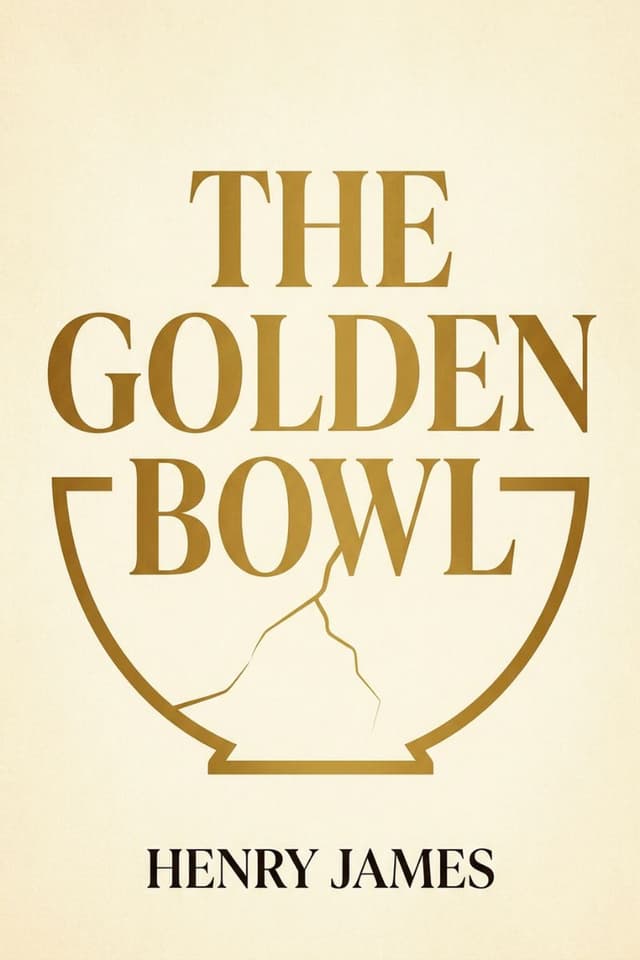
The Golden Bowl
Read The Golden Bowl by Henry James for free on Novelhalla, and try out our easy-to-read modern edition of this classic book. You can also download the EPUB and read it on any device if you prefer!
The Plot
A Perfect Arrangement
On the surface, everything looks ideal. Adam Verver is a fabulously wealthy American art collector living in London with his daughter Maggie, the two of them so close, so content in each other's company, that the rest of the world barely gets a look in. Maggie is about to marry Prince Amerigo, a charming, impoverished Italian nobleman of ancient lineage. He gets money. She gets a title. Everyone gets what they want.
Except that just days before the wedding, Amerigo meets privately with Charlotte Stant, a beautiful, sharp-witted American woman he once loved deeply in Rome. They were too poor to marry then. So they didn't. He's marrying Maggie now. Charlotte is one of Maggie's closest friends.
The two of them go shopping together for a wedding gift. They end up in a small antique shop, considering a gilded crystal bowl. Charlotte wants it. The prince notices something and refuses, quietly, firmly. There is a crack in it. Nearly invisible, but there.
They don't buy the bowl. They go their separate ways.
The Arrangement Expands
After the wedding, Maggie grows increasingly preoccupied with her father. She feels guilty for leaving him alone. She still spends most of her time with him, the two of them moving through their grand social world like a self-contained unit. The Prince is technically part of the family now, but Maggie barely seems to notice.
Her solution: her father should remarry. And the ideal candidate? Charlotte Stant, her dear friend, who is poor and unmarried and would certainly appreciate security.
Adam proposes. Charlotte accepts. Suddenly the four of them are bound together in a tight, glittering knot: two couples, two marriages, one enormous house, one social world. Maggie and Adam as close as ever. The Prince and Charlotte thrown together constantly, left to fill the hours while their respective spouses attend to each other.
Charlotte and Amerigo had a history. Now they have proximity. And endless, unsupervised time.
The Bowl Returns
Maggie begins to sense that something is wrong. She can't name it, can't see it clearly, but it's there, a pressure behind the surface of her perfect life. She goes shopping for a birthday gift for her father and wanders into an antique shop. The shopkeeper shows her something beautiful. A gilded crystal bowl.
She buys it.
Later, the shopkeeper comes to her home to confess that he overcharged her, that there is a flaw in the piece she couldn't see. While he's there, he notices photographs on display. He recognizes two of the faces. He was there, he says, years ago, when a young man and a young woman came into his shop together speaking Italian. They stood over this very bowl. They spoke of giving gifts to each other. He points at the photographs.
The young man was her husband. The young woman was Charlotte.
Maggie now knows what she didn't know before. The question is what she does with it, and whether the bowl, the marriage, and the arrangement she built so carefully can survive the crack running through all of it.
About the Author: Henry James
A Family of Extraordinary People
Henry James was born in New York City in 1843 into one of the most intellectually charged families in America. His father was a philosopher and theologian who counted Emerson and Thoreau among his friends. His older brother William would become one of the most important psychologists and philosophers of the 19th century. His sister Alice would become famous as a diarist. Henry, surrounded by all this brilliance, became an observer. A watcher. It may be the most significant thing about him.
He attended Harvard Law School briefly before deciding that the law was not for him and literature was.
The American in Europe
James spent much of his twenties moving between the United States and Europe, writing criticism and short fiction for magazines like The Atlantic Monthly, absorbing the literary culture of Paris and London, making friends with Turgenev, Flaubert, and George Eliot. By 1875 he had made his decision: he left America permanently and settled in England.
His great subject, at least in his early career, was the encounter between the New World and the Old. Americans abroad: innocent, open, often naive, colliding with the more stratified, corrupt, and seductive culture of Europe. Daisy Miller (1879) and The Portrait of a Lady (1881) established him as a major figure on both sides of the Atlantic.
The Difficult Middle Years
In the 1890s, James made a disastrous attempt to become a playwright. He worked for years on stage productions, only to be booed at the opening night of his most ambitious effort in 1895. He retreated, shaken, back to fiction.
The failure seemed to transform him. His prose became denser, more oblique, more inward. He stopped telling readers what was happening and started making them feel their way toward it. Critics called it his "late style." Some found it intoxicating. Others found it impossible. Most agreed they'd never read anything quite like it.
The Final Phase
The years from 1902 to 1904 produced what many consider the three greatest novels of his career: The Wings of the Dove, The Ambassadors, and The Golden Bowl. James himself considered The Golden Bowl his best and most finished work.
He was devoted to England in his later years, living in Lamb House in Rye, Sussex, dictating his novels to a secretary because his hands had given out. In 1915, outraged by American neutrality in World War I, he renounced his American citizenship and became a British subject. He died in London in February 1916. He was 72.
The Private Life
James never married. He was intensely, perhaps exclusively close to a small circle of people, including his cousin Mary "Minny" Temple, whose death at 24 devastated him and whose image appears across his fiction in the form of doomed young American women. His letters to certain younger men were intense to the point of being quasierotic. Whether James lived his private life or only imagined it is a question his biographers have never fully resolved, by his own design. He burned thousands of letters before he died.
Fun Facts About the Book
James Thought This Was His Best
James wasn't shy about his feelings. He described The Golden Bowl to his publisher as "distinctly the most done of my productions, the most composed and constructed and completed." He called it the solidest thing he had ever written. For a man known for perfectionism and self-doubt, this was a remarkable statement.
Dictated, Not Written
By the time James wrote The Golden Bowl, his hands had deteriorated to the point that he could no longer type. He dictated the entire novel to his secretary, Theodora Bosanquet. Some critics believe this explains the novel's unusually long, circling, clause-within-clause sentences: James was essentially talking the book into existence, and the prose has the rhythm of someone thinking out loud very carefully.
The Title Comes from the Bible
The golden bowl of the title is drawn from Ecclesiastes: "Or ever the silver cord be loosed, or the golden bowl be broken." In context it's a meditation on mortality and the vanity of earthly things. James takes this image of beautiful, irreparably broken things and makes it the central symbol of his novel about marriages that look perfect from the outside.
The Novel Is Split in Two
The book is divided into two halves with separate titles: "The Prince" and "The Princess." The first half follows events primarily through Amerigo's perspective. The second shifts entirely to Maggie's. The effect is disorienting in the best possible way. The reader sees the same situation from two completely different vantage points and realizes how much each character is hiding, even from themselves.
The Merchant Ivory Adaptation
In 2000, Merchant Ivory Productions released a film adaptation directed by James Ivory, starring Uma Thurman as Charlotte, Kate Beckinsale as Maggie, Jeremy Northam as the Prince, and Nick Nolte as Adam Verver. It's a handsome, slow, attentive film, though critics noted that the movie softened some of the novel's moral complexity, particularly around Charlotte.
A BBC Production Came First
In 1972, the BBC produced a six-hour televised adaptation with a screenplay by Jack Pulman. It's considered a gold standard of James adaptations, praised for capturing the novel's atmosphere of suppressed feeling and social performance. Cyril Cusack played the narrator, commenting on events in the style of James himself.
Iris Murdoch Was a Fan
Some critics believe The Golden Bowl was a direct influence on Iris Murdoch's novel A Severed Head. Murdoch was known to be a devoted reader of James, and the structural similarities between the two books, their shared interest in the secret lives of interconnected couples, are hard to ignore.
A Landmark of Modernist Fiction
The Golden Bowl is frequently cited as one of the earliest and most sophisticated examples of stream-of-consciousness narrative technique in English fiction. James doesn't just report what characters think. He tracks the texture of thinking: the hesitations, the things unsaid, the slow dawning of terrible understanding. Writers like James Joyce and Virginia Woolf were paying close attention.
Themes
What We Choose Not to Know
The novel is full of people who sense the truth and decide not to look directly at it. Adam Verver may know more than he lets on. Maggie knows something is wrong long before she can admit what it is. The Prince and Charlotte know that what they are doing is dangerous and do it anyway. James builds an entire world out of deliberate not-knowing, suggesting that social life depends on a shared agreement to leave certain things unexamined. The golden bowl itself is a symbol of this: beautiful, gilded, and cracked in a way that only shows up in the right light.
The Transactional Nature of Marriage
Every marriage in this novel is also, at some level, a deal. The Prince has a title and no money. The Ververs have money and no title. Charlotte has charm and intelligence and no security. Adam has everything material and wants his daughter happy. James doesn't present this cynically, exactly, but he doesn't let anyone off the hook either. The question of what people owe each other when they've entered into these arrangements runs through every scene.
Power and Silence
Nobody in this novel has a direct confrontation. Nobody says what they mean. Power is exercised through implication, through the arrangement of social situations, through what is left conspicuously unsaid. When Maggie finally begins to understand her situation, she doesn't rage. She begins to maneuver. The novel becomes a story about a woman who discovers she is capable of a kind of cold, controlled intelligence she didn't know she possessed.
Americans and Europeans
James's lifelong subject, stripped down to four people. Adam and Maggie are Americans: wealthy, confident, essentially innocent, with a directness of feeling and a belief that things can be fixed. The Prince is European: older in his bones, aware of corruption as simply a fact of life, more at ease with moral compromise. Charlotte exists somewhere between them. The novel watches these temperaments collide in slow motion, in drawing rooms, in carefully managed silences.
The Parent and the Child
The most unusual relationship in the book isn't between the spouses. It's between Maggie and her father. Their closeness, which they both consider perfectly natural and proper, is what creates the vacuum that makes everything else possible. The novel asks, with real delicacy, whether a love that intense, even between parent and child, carries its own distortions.
Beautiful Things and What They Cost
Adam Verver collects art. He also, the novel implies, collects people. He acquired the Prince for Maggie the way he might acquire a masterpiece for a museum, with taste and money and certainty of value. The novel never lets this metaphor go. Charlotte is also acquired, in a sense. The golden bowl itself is an object, purchased, flawed, eventually broken. James keeps asking: what does it mean to treat people as beautiful, possessible things?
The Book's Legacy
The Golden Bowl is widely considered one of the most demanding novels in the English language and one of the most rewarding. James himself believed it was his greatest achievement. The critical consensus since his death has largely agreed, though not without dissent: Virginia Woolf found his late work too mannered; Rebecca West said winter had fallen on his genius. Colm Toibin called it his best.
The novel's influence on subsequent fiction is enormous. Its technique of rendering consciousness from the inside, of making the reader feel the uncertainty and incompleteness of perception, anticipates the stream-of-consciousness innovations of Joyce and Woolf. Its treatment of marriage as a social performance concealing private devastation connects directly to writers like Iris Murdoch and countless novels of domestic life that followed.
The two adaptations, the BBC's 1972 miniseries and the 2000 Merchant Ivory film, brought the story to broader audiences. The film in particular sparked renewed interest, though readers tend to feel the novel's true experience cannot be replicated on screen: so much of what James does happens in the gap between what characters say and what they mean, and that gap lives in prose, not dialogue.
For readers willing to meet it on its own terms, The Golden Bowl offers something rare: a novel that gets more complex the more you understand it, where rereading reveals not just new details but entirely new interpretations of scenes you thought you'd understood. The crack in the bowl is always there. You just have to learn to see it.