Novelhalla
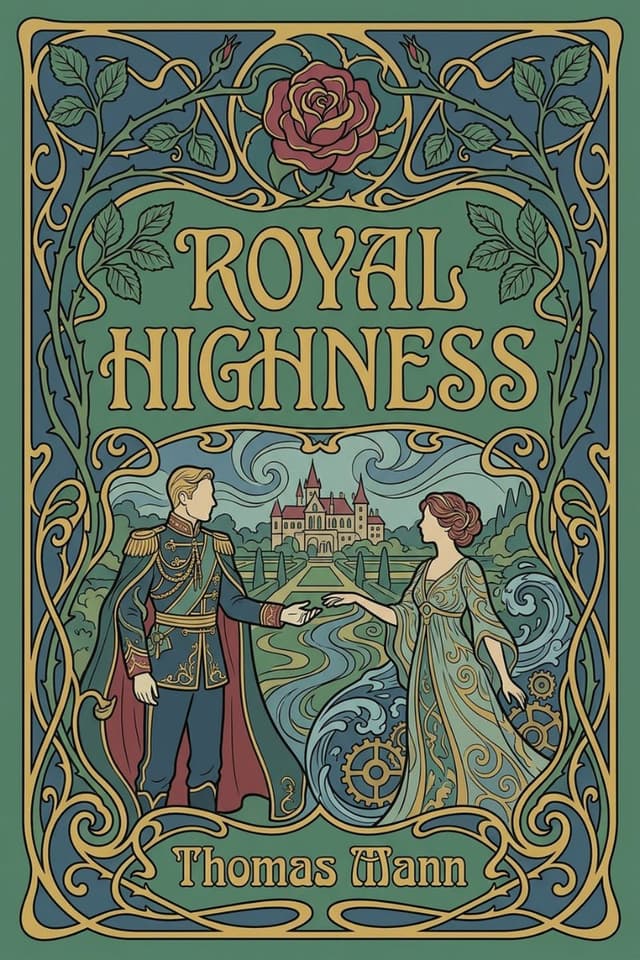
Royal Highness
Read Royal Highness by Thomas Mann for free on Novelhalla, and try out our easy-to-read modern edition of this classic book. You can also download the EPUB and read it on any device if you prefer!
The Plot
Seventy-Two Guns and One Bad Minute
A grand duchy somewhere in Germany, small enough to cross in an afternoon, fires seventy-two rounds from the citadel to announce that the Grand Duchess has produced a second son. The fire brigade joins in with the town's salute guns, badly, to the great amusement of everyone watching. Bells ring. That night the whole capital lights itself up without anybody ordering it to.
Upstairs in the ancestral castle, the Minister of State is performing the small legal formality of confirming with his own eyes that the baby is a boy. He confirms it. Then the midwife keeps looking at him, and looking down at the child, and looking back at him, until he understands that she's steering his eyes somewhere. He looks. He examines the child's left hand for two or three minutes, and then asks whether the Grand Duke has seen it yet.
He hasn't. He will, within a quarter of an hour, and he will not take it well. A prince with one hand, he says, pacing the library, furious at nobody in particular, because a misfortune with nobody to blame is the worst kind there is. And his minister, who is a subtler man than he looks, points out that this is very interesting phrasing, because there's a prophecy attached to this house, handed down for centuries, from an old woman who drew her stick through the sand and said that a prince with one hand would give the country more than all the rest could give it with two.
The Boy in the Silver Hall
The child is christened Klaus Heinrich. He grows up as a spectacle.
He learns early that his job is to be looked at. His mother's beauty is famous, practised, and administered in careful doses; her tenderness comes out mainly at concerts, where the audience can be moved by it. His father greets people from behind an invisible wall of etiquette and looks helpless the instant anybody speaks to him first. His older brother Albrecht, the heir, is delicate, cold, and mortified by absolutely everything, and has already looked death in the face once, which has made him proud and unreachable. Only his younger sister Ditlinde is a real companion, and only when the two of them can escape into the disused parts of the old castle to go rummaging through rooms full of rusted muskets and discarded thrones.
At thirteen, standing alone in the freezing Silver Hall where his father receives deputations, Klaus Heinrich looks around at the torn silk and the symmetrical candles and the useless table in the middle, and finally understands what he is. He puts his face in his hands, both hands, including the small brown wrinkled one, and cries.
He gets better at it after that. He learns to keep the left hand in a coat pocket, or behind his hip, or tucked into the breast of his jacket. He learns to make conversation that gives nothing away. What he never quite loses is the curiosity, the itch to know what people are actually like when they aren't arranging their faces for him.
The Man Who Won't Let Him Confide
Then Raoul Ueberbein arrives, a young teacher with a green complexion, a red beard, and a foundling's history. He is the only person in the boy's life who takes liberties with him, and the friendship they build is the strangest thing in the novel.
Because Ueberbein won't let him be human. No confidences, he says. Not that he doesn't know Klaus Heinrich has things he wants to say. He simply refuses to hear them, on the grounds that a prince has no right to intimacy, that Klaus Heinrich is not a person but a concept, a frame, an emblem, and that formality and intimacy are absolutely mutually exclusive. Ueberbein believes this fiercely, out of a strange inverted pride, and he intends to hold his pupil to it.
Klaus Heinrich accepts the doctrine because it's the only explanation of himself he's ever been offered.
A Bankrupt Fairy Tale
The old Grand Duke dies. Albrecht takes the throne, hates every second of being seen, and eventually asks his younger brother to do the appearing for him. Klaus Heinrich is promoted, given a title, and handed the entire ceremonial life of the country.
So that's what he does. Dinners, gymnastic displays, fishing festivals, horse races, hospital openings, red carpet, upturned faces, a few technical remarks memorised beforehand, the left hand hidden. Everyone is satisfied. He goes home empty.
And the country is broke. Not struggling, broke. The forests have been stripped and sold off for generations, the railways lose money, the debt is thirty million pounds, and the Diet keeps voting new taxes on a people too poor to pay them. What is needed, the ministers admit privately, is a miracle.
The Americans at Delphinenort
The miracle checks into the best hotel with a doctor, two secretaries, a butler who assembles the exercise bicycle himself, and a collie.
Samuel Spoelmann is one of the richest men alive, made in gold and oil and steel and railways, a small red-faced invalid with a kidney complaint who has come to this obscure spa for the lithium water and has decided he likes it. He buys the crumbling baroque schloss rotting in the public gardens, restores it at a cost nobody can quite believe, and moves in.
With him comes his daughter Imma, who is the most interesting person to enter this country in a hundred years. She's dark, tiny, sharp-tongued, and studies algebra for pleasure, turning up at university lectures on the theory of numbers to sit among the students and scribble notes. She finds the local reverence for royalty ridiculous and says so. Her companion is a countess who is not entirely sane, and her dog is a nervous wreck.
Klaus Heinrich has spent his entire life being looked at by people who lower their eyes. Imma Spoelmann looks straight back at him, and asks him what exactly he thinks he does all day.
What the People Start Saying
He begins finding reasons to visit. She keeps refusing to make it easy for him. He rides badly and she notices; he says something formal and she takes it apart; he tries to explain his exalted calling and she asks whether it is anything at all.
Meanwhile something starts moving underneath. Somebody in the town remembers the old prophecy about the one-handed prince, and then everybody remembers it, and the thing the whole court has spent twenty years politely refusing to see is suddenly the most discussed feature in the grand duchy. The people put two and two together the way people always do when they want a story to come out right.
And in one of the courtyards of the old castle there stands a rose bush. It has stood there for ages, tended by a porter, in snow and rain and sun. It bears magnificent dark red roses, and those roses have no proper scent. They smell faintly, unmistakably, of decay. Tourists come to check with their own noses. There's an old belief in the town that one day, on some occasion of great public happiness, the bush will finally bloom sweet.
Nobody has ever expected to be alive to smell it.
About the Author: Thomas Mann
Lübeck
Paul Thomas Mann was born on 6 June 1875 in Lübeck, the old Hanseatic port on the Baltic, the second son of a grain merchant who was also a senator of the city. His mother, Julia, had been born in Brazil to a German father and a Brazilian mother, and brought music and a warmer southern temperament into a very northern, very correct household.
His father died in 1891 and left instructions that the family firm be liquidated. The Manns' hundred-year position in Lübeck ended, the widow moved to Munich, and Thomas followed. He worked briefly for a fire insurance company, wrote for the satirical magazine Simplicissimus, and studied a scattering of subjects with no serious intention of finishing anything.
Buddenbrooks and After
He was twenty-six when Buddenbrooks appeared in 1901, a huge novel about the decline of a Lübeck merchant family across four generations, drawn so directly from his own that people back home worked out who was who. It made him famous.
Then he spent years struggling to follow it. This book, his second novel, took from the summer of 1906 to February 1909 and came out of a very specific piece of his own life. In 1904 he had fallen for Katia Pringsheim, the only daughter among five children of an enormously wealthy Munich family. Her father held the chair of mathematics at the university. Katia was studying mathematics and physics herself, which very few women in Germany were doing at the time, and when Mann proposed she asked for six months to think it over. She said yes, and they married on 11 February 1905.
The Long Career
Six children followed, several of whom became writers and public figures in their own right. So did the books that made him one of the central novelists of the century: Death in Venice in 1912, The Magic Mountain in 1924, the Joseph tetralogy, Doctor Faustus. He won the Nobel Prize in Literature in 1929.
Exile
He was lecturing abroad in 1933 when the Nazis took power and his children warned him not to come home. He never lived in Germany again. His citizenship was stripped, his house seized, his books burned. He took Czechoslovak citizenship, then moved to the United States, where he taught at Princeton, worked for the Library of Congress, settled in California, became an American citizen in 1944, and broadcast anti-Nazi radio addresses to Germany throughout the war.
He returned to Europe in 1952, uneasy in the political climate of both his countries, and died in Zurich on 12 August 1955 at eighty.
Fun Facts About the Book
It's His Own Courtship in Costume
The whole thing is a transposition of Mann's pursuit of Katia Pringsheim. A young man from a formal, hemmed-in world, a brilliant and skeptical girl from an immensely rich family, a courtship conducted mostly through argument. Imma studies algebra because Katia studied mathematics. The mathematician father becomes an American billionaire. Mann barely bothered to hide it.
The Prince's Name Went to His Son
Mann's second child was born in November 1906, right as the novel was getting under way, and was christened Klaus Heinrich Thomas Mann. He grew up to be the novelist Klaus Mann.
Imma's Ancestry Is Mann's Own
Imma Spoelmann is repeatedly described in the book as a quintroon, with a South American grandmother, which is exactly the sort of mixed inheritance Mann carried from his Brazilian-born mother. He gave his heroine his own outsider blood and then made it the thing that unsettles an entire court.
Readers Recognized the Arm
Kaiser Wilhelm II had a withered left arm from a birth injury and spent his life arranging himself so that photographs would hide it. Nobody in 1909 needed that pointed out. Samuel Spoelmann's rescue of a bankrupt state with an enormous private loan was also read against J.P. Morgan, who had done something not unlike it for the United States Treasury.
Mann's Own Description of It
He said he was trying to lighten the heavy naturalism he'd inherited from the nineteenth century into something at once intellectual and symbolic, "a transparency for ideas to shine through." It's the closest thing to a fairy tale he ever wrote, and the chapter titles read like one.
The Public Loved It, the Critics Didn't
It ran first in the magazine Die Neue Rundschau and was received with enthusiasm by ordinary readers. Reviewers were much more divided, and a certain condescension toward it has never entirely gone away. It's still routinely described as slight, usually by people comparing it to books Mann hadn't written yet.
The English Translation Had Terrible Timing
A. Cecil Curtis's translation was published by Knopf in 1916, which was not a promising year to bring out a warm, affectionate comedy about German court life for an English-speaking audience.
The Film Was a Family Affair
A West German film version appeared in 1953 with Dieter Borsche and Ruth Leuwerik. One of the credited screenwriters was Erika Mann, the author's eldest daughter.
Themes
Representing Versus Being
This is the engine of the book, and Ueberbein states it flatly: you are not a person, you are a form. Klaus Heinrich's entire existence is a performance of a symbol, and Mann means it to stand for more than monarchy. He was writing about himself, about the artist, about anyone whose public function eats the private person. The question the novel keeps circling is whether a life made entirely of representation is a calling or a slow disappearance.
The Defect That Makes the Man
The hand is a deformity, a shame, a thing to be hidden, and also the mark that singles him out and, according to a prophecy nobody took seriously, the source of everything good that might happen to this country. Mann was permanently fascinated by the idea that the flaw and the distinction are the same feature. Doctor Sammet says it out loud in the first chapter: a man with one more reason than everyone else to exert himself is at an advantage, not a disadvantage.
Old Europe Meets the New Money
A dynasty that thinks credit is undignified, that regards its land as sacred and its debts as unmentionable, meets a man who made his fortune in gold, oil, steel, and railroads and can settle the national debt out of pocket. The novel is genuinely torn about this. It laughs at the court's precious uselessness and also mourns it a little.
Loneliness
Not metaphorical loneliness. Actual, structural, engineered loneliness. Klaus Heinrich cannot be spoken to first. He cannot receive a confidence. Crowds gather to look at him and he goes home to empty rooms. The most affecting scenes in the book are the small breaches in the wall: a lost veteran in a corridor, a schoolteacher's ordinary conversation, a girl who argues with him.
What Happiness Costs
The country needs money. The prince needs a life. There's a solution available that answers both, and the book is honest enough to sit inside the discomfort of that, to ask whether a marriage that saves a state can also be a real one, and whether anyone involved would be able to tell the difference.
Duty as a Form of Vanity
Mann is quietly merciless about how flattering self-sacrifice can feel. The Grand Duchess's tenderness is real and also staged. Ueberbein's ferocious asceticism is real and also a way of being superior to everyone. Nobody in this book renounces anything without getting something back for it.
The Book's Legacy
This is the least read of Mann's major novels, and the one most likely to surprise people who come to it after the famous ones. It's warm. It's funny. It has a plot that moves. There's no tuberculosis sanatorium, no plague-stricken Venice, no pact with the devil. Mann wrote it in his early thirties, newly married and reasonably happy, and it shows.
Critics have been condescending about it for over a century, and readers keep quietly loving it anyway. The German writer who ends up on university syllabi is the author of the long difficult masterpieces; the one who wrote a comedy about a lonely prince and a girl who does algebra tends to get a footnote. But the fairy-tale register he opens up here never left him. It comes back in The Holy Sinner and again in Felix Krull, the last thing he was working on when he died.
It's also a strange time capsule. Mann was writing in 1908 about a tiny German court, its rituals, its debts, its absurd dignity, its one-handed prince who so resembled the actual Kaiser. Within a decade every one of those courts was gone, swept off the board by a war Mann initially supported and spent the rest of his life reckoning with. What reads as gentle satire now reads as an elegy nobody knew they were writing.
And for anyone who has ever had a public role that ate their private life, the book still lands hard. Klaus Heinrich standing at the window, smiling down at a market square full of upturned faces, hiding his hand, saying the correct thing, is a portrait of something a lot of people recognise from the inside.