Novelhalla
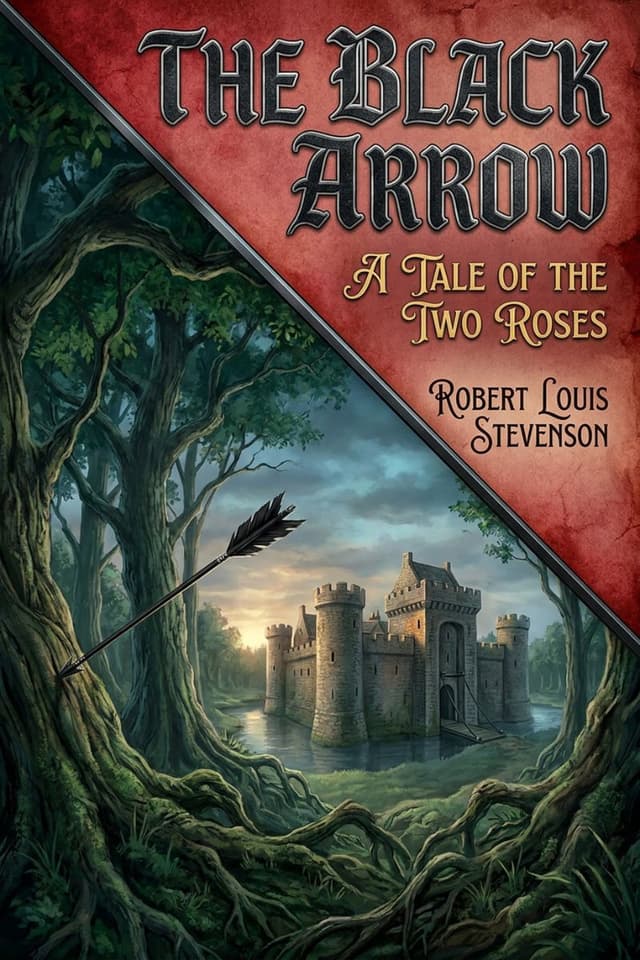
The Black Arrow: A Tale of the Two Roses
Read The Black Arrow: A Tale of the Two Roses by Robert Louis Stevenson for free on Novelhalla, and try out our easy-to-read modern edition of this classic book. You can also download the EPUB and read it on any device if you prefer!
The Plot
The Black Arrow is set during the Wars of the Roses, the bloody civil conflict between the houses of Lancaster and York that tore England apart in the fifteenth century. The story takes place around 1461, during one of the war's most violent phases.
Dick Shelton's World
Richard "Dick" Shelton is a young man raised as the ward of Sir Daniel Brackley, a cunning and unscrupulous knight who switches his allegiance between York and Lancaster depending on which side seems to be winning. Sir Daniel runs his estates with an iron fist, extorting money from peasants and eliminating anyone who gets in his way.
The story opens at Tunstall Moat House when the bell rings to summon soldiers for battle. Almost immediately, one of Sir Daniel's men is struck down by a black arrow, a mysterious weapon used by a band of outlaws calling themselves the fellowship of the Black Arrow. Attached to the arrow is a threatening note signed by "John Amend-All," promising vengeance against Sir Daniel and his cronies for their crimes against the common people.
The Journey and the Discovery
Dick is sent on an errand and encounters a young companion named John Matcham, whom he befriends during their dangerous journey through the forest. Together they stumble upon a camp of the Black Arrow outlaws and overhear their leader, Ellis Duckworth, accusing Sir Daniel of murdering Dick's own father, Sir Harry Shelton.
Dick and Matcham are discovered by Sir Daniel himself, who is traveling in disguise as a leper to avoid the outlaws. When they reach Tunstall Moat House, Dick confronts his guardian about the accusations. Sir Daniel swears his innocence, but the guilty behavior of Sir Oliver Oates, a corrupt parson in Sir Daniel's service, confirms Dick's worst suspicions.
Dick also discovers something else: his companion John Matcham is actually Joanna Sedley, a young heiress in disguise. Sir Daniel has kidnapped her and plans to control her fortune by forcing her into marriage. Despite the brevity of their acquaintance, Dick falls in love with her.
About the Author: Robert Louis Stevenson
Early Life
Robert Louis Balfour Stevenson was born on November 13, 1850, in Edinburgh, Scotland. He was the only child of Thomas Stevenson, a prosperous civil engineer who specialized in designing lighthouses, and Margaret Isabella Balfour, daughter of a minister. The Stevensons were part of the famous "Lighthouse Stevensons," an engineering dynasty that built most of Scotland's coastal lighthouses.
A Sickly Childhood
From infancy, Stevenson suffered from serious respiratory problems that would plague him his entire life, likely tuberculosis. His frequent illnesses confined him to bed for long stretches, where his nurse Alison Cunningham entertained him with vivid stories of Scottish history, religious tales, and local legends. This bedridden childhood both tormented him and nurtured his imagination. He would later dedicate A Child's Garden of Verses to his beloved nurse.
Rebellion and Education
Stevenson attended Edinburgh University, where his family expected him to follow the engineering profession. He had no interest whatsoever in lighthouses or construction. After confessing this to his disappointed father, a compromise was reached: he would study law instead. Stevenson proved equally disinterested in legal studies, attending classes irregularly while cultivating a bohemian lifestyle complete with long hair and velvet jackets. He explored Edinburgh's seedier neighborhoods and questioned the strict Presbyterian faith of his upbringing, causing considerable family tension.
He passed his bar examination in 1875 but never practiced law. By then, he had openly declared his intention to become a writer.
Love and Adventure
In 1876, while visiting an artists' colony in France, Stevenson met Fanny Van de Grift Osbourne, an American woman eleven years his senior who was separated from her husband and traveling with her two children. Despite the age difference and her complicated situation, they fell in love.
When Fanny returned to California in 1878, Stevenson received a mysterious telegram from her and immediately set off to join her. The journey nearly killed him. He crossed the Atlantic in steerage and then traveled across America by emigrant train, arriving sick, starving, and impoverished. After Fanny obtained her divorce, they married in 1880.
The Great Works
Stevenson's writing career flourished despite his constant health struggles. His first novel, Treasure Island, began as an entertainment for his twelve-year-old stepson Lloyd Osbourne and was serialized in Young Folks magazine in 1881-82. It became a sensation. The Black Arrow followed in the same magazine in 1883.
In 1886, Stevenson published The Strange Case of Dr Jekyll and Mr Hyde, which he reportedly wrote in a feverish burst after the story came to him in a nightmare. That same year saw the publication of Kidnapped. These works established him as one of the most popular and respected writers of his generation.
The South Seas
Seeking a climate that might ease his tuberculosis, Stevenson and his family embarked on a series of voyages through the Pacific in 1888. He fell in love with the islands and in 1890 purchased an estate called Vailima in Samoa, where he would spend his final years.
The Samoan people adopted him, calling him "Tusitala" (Teller of Tales). He became deeply involved in local politics and championed the rights of islanders against European colonial powers. He continued writing prolifically, including the novels The Master of Ballantrae and the unfinished Weir of Hermiston, which many consider his finest work.
Death
On December 3, 1894, at age 44, Stevenson suffered a sudden brain hemorrhage while helping his wife prepare dinner. He died within hours. The Samoan people carried his body to the top of Mount Vaea, where he was buried according to his wishes. His epitaph comes from his own poem "Requiem": "Under the wide and starry sky, / Dig the grave and let me lie."
Fun Facts About the Book
"Tushery"
Stevenson himself was the book's harshest critic. He coined the term "tushery" specifically to describe his use of archaic medieval language in The Black Arrow, referring to affected old-fashioned expressions like "tush" (an exclamation of impatience). In a letter to a friend, he wrote: "And every tusher tushes me so free, that may I be tushed if the whole thing is worth a tush."
His Wife Refused to Read It
Stevenson dedicated the book to his wife Fanny as "the Critic on the Hearth," a playful jab at the fact that she disapproved of the project so strongly that she refused to read even a single page. In the dedication, he notes with dry humor that this is "the only book of mine that you have never read, and never will read."
Written in Two Months
While Treasure Island took considerable time to develop, Stevenson wrote The Black Arrow rapidly, completing it in about two months while living in Hyères, France, despite being ill with influenza through much of the writing process.
The Paston Letters
Stevenson drew heavily on the Paston Letters for historical detail. These were a collection of correspondence from a Norfolk family during the Wars of the Roses, providing a vivid firsthand account of daily life during the period. Stevenson had loved them since childhood.
Serialized Under a Pseudonym
Like Treasure Island before it, The Black Arrow was published under the pseudonym "Captain George North" in Young Folks magazine. The serial ran from June to October 1883, appearing in seventeen weekly installments. It was not published as a complete novel until 1888.
Historical Liberties
Stevenson cheerfully admitted to playing fast and loose with history. He made Richard of Gloucester (the future Richard III) considerably older than he actually was in 1461, and invented an entirely fictional battle for the novel's climax. In footnotes to later editions, he acknowledged these anachronisms without apology.
Popular with Young Readers
Despite Stevenson's own low opinion of the book, The Black Arrow was hugely popular with its target audience. Young readers loved its action, intrigue, and adventure. It became successful enough as a newspaper serial in America that it spawned numerous high school theatrical adaptations.
Influenced Superhero Fiction
Some literary historians argue that The Black Arrow, with its masked avenger figure and band of vigilantes pursuing justice against corrupt authorities, helped establish conventions that would later appear in superhero fiction. The fellowship of the Black Arrow, operating outside the law to punish evildoers, anticipates later costumed avenger narratives.
"Great Sport"
Despite his self-criticism, Stevenson also expressed genuine enjoyment in writing the book. "It's great sport to write tushery," he told his friend Sidney Colvin. He was particularly pleased with his portrayal of Richard of Gloucester and hoped to write about the character again someday.
Word Count
The Black Arrow consists of approximately 80,000 words, making it a relatively quick read compared to many Victorian novels.
Themes
Loyalty and Betrayal
The novel is saturated with questions of loyalty. Dick must navigate a world where allegiances shift constantly, where his own guardian is revealed as his father's murderer, and where the great lords switch sides between Lancaster and York as it suits them. The contrast between Sir Daniel's faithlessness and the loyalty of characters like Lawless drives much of the moral weight of the story.
Coming of Age
Dick begins the novel as a naive young man, content to follow Sir Daniel's orders without questioning them. Through the course of the story, he must learn to think for himself, choose his own allegiances, and take responsibility for his actions. His journey from ward to independent knight mirrors the classic coming-of-age arc.
Class and Justice
The Black Arrow fellowship represents common people seeking justice against nobles who abuse their power. Ellis Duckworth and his men target Sir Daniel not for political reasons but because of his crimes against ordinary folk. The novel suggests that true justice sometimes requires operating outside corrupt official systems.
The Futility of Civil War
The Wars of the Roses provide more than just a colorful backdrop. Stevenson depicts a society tearing itself apart, where the constant switching of sides reveals the arbitrariness of the conflict. Dick's eventual decision to retire from warfare rather than continue fighting suggests skepticism about the value of such bloodshed.
Appearance vs. Reality
Disguises and hidden identities pervade the novel. Joanna poses as a boy. Sir Daniel travels disguised as a leper. The Black Arrow operates from hidden forest camps. Dick himself must don various disguises during his adventures. Nothing and no one is quite what they appear to be.
The Book's Legacy
The Black Arrow has always lived in the shadow of Treasure Island and Dr Jekyll and Mr Hyde, and Stevenson's own dismissive comments about it have not helped its reputation. Critics have generally treated it as minor Stevenson, a piece of commercial hackwork dashed off for a children's magazine.
Yet the novel has never gone out of print and has been adapted numerous times for film and television, including a 1948 film starring Louis Hayward and a 1985 Disney television movie with Oliver Reed. Some modern critics have argued for a reappraisal, noting that the novel's psychological complexity, particularly in its portrayal of Dick's moral awakening and the ambiguous figure of Richard of Gloucester, deserves more attention than it has received.
The book remains an entertaining example of Victorian adventure fiction and a window into how nineteenth-century readers imagined the medieval past.