Novelhalla
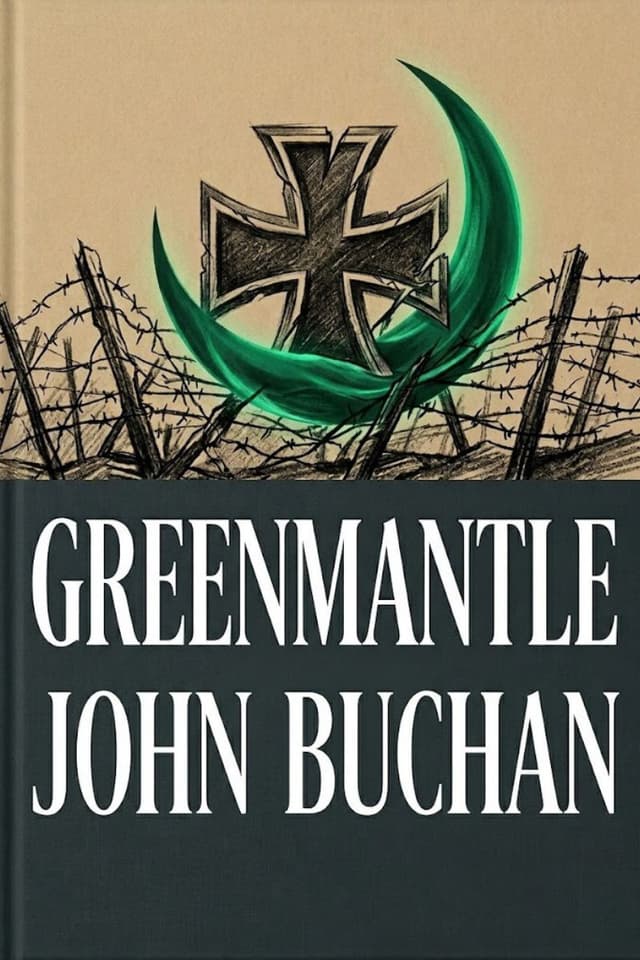
Greenmantle
Read Greenmantle by John Buchan for free on Novelhalla, and try out our easy-to-read modern edition of this classic book. You can also download the EPUB and read it on any device if you prefer!
The Plot
Richard Hannay is recovering from wounds received at the Battle of Loos in late 1915 when he receives an urgent summons to the Foreign Office. Sir Walter Bullivant, a senior intelligence officer, reveals a troubling mystery: something is stirring in the Muslim world, a secret weapon the Germans plan to use to ignite a holy war that could sweep from Turkey through Persia to the borders of India.
The only clue comes from a dying British agent who staggered into camp with ten bullet holes in him, clutching a scrap of paper with three cryptic words: "Kasredin," "cancer," and "v. I." That agent was Sir Walter's own son.
The Mission
Hannay agrees to take on the impossible mission of discovering what the Germans are planning. He recruits three companions: Sandy Arbuthnot, a brilliant adventurer who speaks countless languages and has blood-brotherhood with half the tribes of the East; Peter Pienaar, a tough old Boer hunter and scout from South Africa; and John S. Blenkiron, a wealthy American with a bad stomach, a talent for playing Patience, and a burning hatred of the Kaiser.
The four agree to travel separately through enemy territory and meet in Constantinople at a seedy establishment called the Garden-House of Suliman the Red. From there, they will try to unravel the mystery before the Germans can unleash their plot.
The Journey
Hannay travels through Germany posing as a Boer rebel who hates the British. Along the way he encounters the terrifying Colonel Ulric von Stumm, a giant of a man with a brutal streak and a suspicious mind. Stumm takes an interest in Hannay but also distrusts him, making for a dangerous game of cat and mouse.
The companions must navigate checkpoints, endure interrogations, and narrowly avoid exposure at every turn as they make their way toward Constantinople. What they discover there about the meaning of "Dolorosa Doyle Greenmantle" will lead them into one of the great battles of the war.
About the Author: John Buchan
Early Life
John Buchan was born in Perth, Scotland, in 1875, the son of a Free Church of Scotland minister. He grew up in a devout household with a love of books, stories, and the Scottish countryside. He proved to be a brilliant student, winning scholarships to the University of Glasgow and then to Oxford, where he began publishing stories and won the Newdigate Prize for poetry.
South Africa and Early Career
After Oxford, Buchan worked as a barrister and then went to South Africa to help with reconstruction after the Boer War. He served on Lord Milner's staff, gaining experience in administration and developing a fascination with Africa that would appear throughout his fiction. He returned to England and worked as a publisher while writing prolifically on the side.
The War Years
When World War One began, Buchan was initially rejected for military service due to poor health. He worked as a war correspondent for The Times and wrote a massive multi-volume history of the war as it unfolded. In 1915 he published The Thirty-Nine Steps, introducing Richard Hannay and creating one of the first modern thrillers. Greenmantle followed in 1916. That same year, Buchan joined the intelligence department of the Foreign Office and later became Director of Information, essentially running British propaganda.
Later Life and Legacy
After the war, Buchan continued writing novels while pursuing a political career. He served in Parliament and was eventually created Baron Tweedsmuir. In 1935 he was appointed Governor General of Canada, a post he held with distinction until his death in 1940.
Buchan wrote over a hundred books, including novels, biographies, and histories. His Richard Hannay thrillers influenced generations of spy fiction writers, from Eric Ambler to Ian Fleming to John le Carre.
Fun Facts About the Book
Written During the War
Buchan wrote Greenmantle in 1916 while working for the Foreign Office, drawing on current events and genuine anxieties about German plots in the Middle East. The book was serialized in a magazine before being published as a novel. He wrote it in scraps of time between his official duties, sometimes scribbling scenes during train journeys.
The Fear Was Real
The threat of a German-inspired jihad was a genuine concern in British intelligence circles. The Kaiser had encouraged the Ottoman Sultan to declare holy war against the Allies in 1914. British officials worried constantly about uprisings in Egypt, India, and elsewhere. Buchan's fiction reflected real strategic nightmares of the time.
Sandy Arbuthnot's Inspiration
The character of Sandy Arbuthnot was based partly on Buchan's friend Aubrey Herbert, a brilliant and eccentric diplomat who spoke numerous languages and had extensive contacts throughout the Middle East. Herbert was twice offered the throne of Albania. Some readers have also seen touches of T.E. Lawrence in Sandy, though Lawrence's famous exploits came after the book was written.
Real History Woven In
The novel builds toward the Battle of Erzerum, which actually happened in February 1916 when Russian forces captured the fortified Ottoman city in a surprise winter offensive. Buchan wove his fictional plot into real historical events with considerable skill.
Hitchcock Wanted to Film It
Alfred Hitchcock, who directed the famous 1935 film of The Thirty-Nine Steps, always wanted to adapt Greenmantle. He envisioned Cary Grant and Ingrid Bergman in the lead roles. However, the Buchan estate asked for too much money, and the film was never made. Greenmantle has still never received a major film adaptation.
Pulled from the Radio
When the BBC scheduled a radio adaptation of Greenmantle as a Classic Serial in 2005, they pulled it from the schedule following the July 7 London bombings. The story's themes of Islamic holy war and terrorism were considered too sensitive in the immediate aftermath.
A Sequel to a Classic
Greenmantle is the second of five novels featuring Richard Hannay. The first, The Thirty-Nine Steps, had been a sensation the year before. Many readers consider Greenmantle the best of the series, with a larger scope and more memorable supporting characters than its predecessor.
The Title Character Barely Appears
Despite giving the book its name, Greenmantle himself is more of a looming presence than an active character. The mystery of who or what Greenmantle is drives much of the plot, but the answer is more complicated than simply finding one person.
Themes
The Great Game
The novel is steeped in the tradition of imperial espionage, the shadow war between great powers for influence over strategic regions. Buchan presents the Middle East as a chessboard where Germany and Britain maneuver for advantage, with millions of lives hanging on the outcome.
Faith as a Weapon
The plot centers on the power of religious belief to move masses of people. The Germans in the novel seek to harness Islam as a tool of war, raising questions about the manipulation of faith for political ends that remain uncomfortably relevant today.
Duty and Sacrifice
Hannay and his companions accept a mission they know may kill them because they believe in something larger than themselves. The novel takes duty seriously without being preachy about it, showing both the nobility and the cost of service.
East and West
Buchan was genuinely fascinated by the cultures of the Middle East and Central Asia, even if his perspective was shaped by the attitudes of his time. The novel grapples with Western attempts to understand and influence the East, with Sandy Arbuthnot representing the possibility of genuine cross-cultural connection.
Brotherhood
The bond between Hannay, Sandy, Peter, and Blenkiron is central to the story. They are very different men thrown together by circumstance who become true comrades. Buchan suggests that such friendships, forged under pressure, represent something essential about human nature.
The Book's Legacy
Greenmantle helped establish the modern spy thriller as a genre. Its combination of exotic locations, high stakes, disguises, and a ticking clock influenced countless later writers. The novel showed that adventure fiction could engage with real geopolitical concerns while still delivering excitement.
The book's portrayal of Islam and the Middle East reflects the prejudices of its era, which can make it uncomfortable reading today. But Buchan was more nuanced than many of his contemporaries, and his villains are Germans rather than Muslims. The novel remains a fascinating artifact of how Britain saw itself and its empire during the Great War.
Richard Hannay would return in three more novels: Mr Standfast, The Three Hostages, and The Island of Sheep. But many readers consider Greenmantle the high point of the series, a genuinely gripping adventure that captures a particular moment in history when the old world was falling apart and anything seemed possible.