Novelhalla
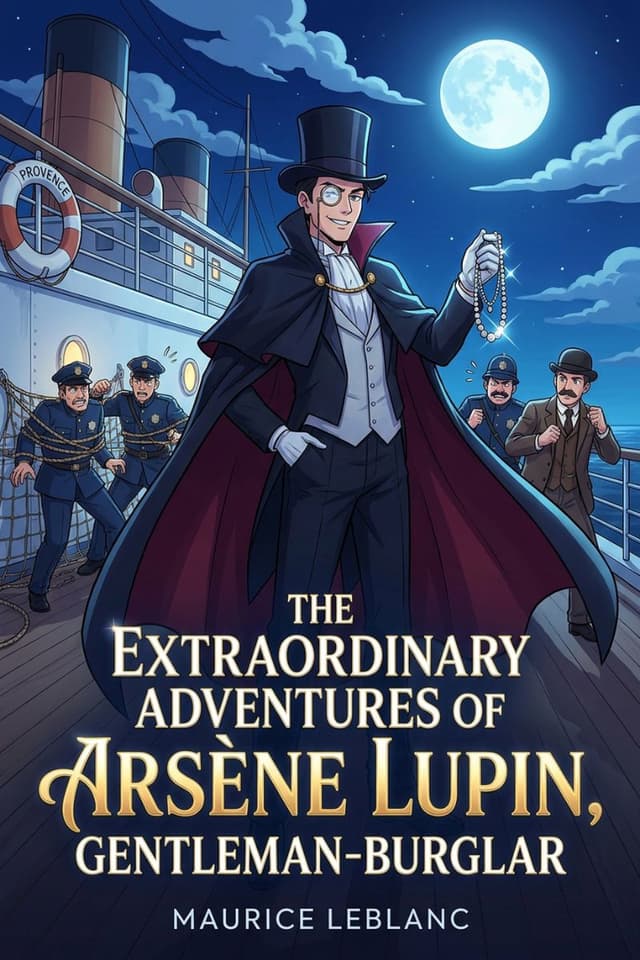
The Extraordinary Adventures of Arsène Lupin
Read The Extraordinary Adventures of Arsène Lupin by Maurice Leblanc for free on Novelhalla, and try out our easy-to-read modern edition of this classic book. You can also download the EPUB and read it on any device if you prefer!
The Plot
The Man on the Ship
Somewhere aboard a transatlantic steamer bound for France, there is a thief. Everyone knows this because the ship received a telegram: Arsene Lupin is traveling under a false name. A partial description is circulated. A first initial of the alias is known. And now every passenger in first class is staring at every other passenger in first class, trying to figure out which of these perfectly respectable gentlemen is actually the most famous criminal in France.
The charming Bernard d'Andrezy takes the lead in the investigation. He's helpful, personable, reassuring. He also happens to be spending a suspicious amount of time with a certain Miss Nelly. When jewels go missing, the suspects narrow. When Inspector Ganimard is waiting at the dock, the truth becomes clear. But what happens to the evidence is another matter entirely, and it has nothing to do with the police.
This is your introduction to Arsene Lupin. Get comfortable. He's just getting started.
The Thief Who Writes Letters
From his prison cell in La Sante, Lupin sends a letter to Baron Cahorn. The letter is polite, detailed, and devastating. It lists the baron's most valuable possessions by name and location, including works of art no outsider should know about. It names a date. It makes a request: pack the items up and send them over. If the baron declines, Lupin will come collect them himself.
The baron, understandably panicked, hires Inspector Ganimard and two officers to guard the castle on the appointed night. The castle sits on a cliff surrounded by water. There is no way in.
Everything is stolen anyway.
How Lupin managed it from inside a locked prison cell is a question that haunts Ganimard for the rest of the story. It should be said that the answer is both completely logical and absolutely infuriating.
The Escape
Lupin announces he will not attend his own trial. The authorities, determined to prove him wrong, watch him like hawks. They allow a planned escape to proceed, secretly following him, hoping to round up his accomplices. Lupin goes out for a meal and calmly returns to prison, having known he was being followed the entire time.
At the trial, Ganimard becomes convinced the man in the dock is not Lupin at all but a substitute. The substitute is released. Ganimard follows him. The confrontation that follows requires a very specific understanding of what diet, drug injections, and sheer nerve can accomplish when applied with theatrical precision.
Nine Stories, One Criminal Genius
The collection is nine stories, and each one operates on the same wicked principle: Lupin tells you what he's going to do, and you still can't stop him.
He robs a train compartment in pitch darkness under circumstances that seem physically impossible. He solves the mystery of Marie Antoinette's necklace while simultaneously stealing it. He insinuates himself into a wealthy woman's household for months, waiting for a safe that may or may not contain a fortune. He makes a priceless black pearl vanish from a locked room full of witnesses.
And in the final story, a certain famous English detective arrives in France to match wits with Lupin. He is brilliant, methodical, and supremely confident. He is also, it must be noted, just a little bit too late.
About the Author: Maurice Leblanc
Early Life
Maurice Leblanc was born in 1864 in Rouen, Normandy, the son of a wealthy ship-owner. He was delivered by Achille Flaubert, brother of the novelist Gustave Flaubert, and as a teenager he frequently encountered both Flaubert and Guy de Maupassant. His younger sister Georgette became a celebrated opera soprano and actress, and for years was the romantic partner of the Belgian playwright Maurice Maeterlinck.
When the Franco-Prussian War broke out in 1870, the six-year-old Maurice was sent to Scotland for safety. He returned to complete his education at the Lycee Corneille in Rouen, then briefly worked at his father's card factory before heading to Paris in 1888 to pursue writing. He studied law along the way but abandoned it as quickly as possible.
The Struggling Novelist
Leblanc's early career was a study in critical praise and commercial indifference. He published his first novel, Une Femme, in 1893, a psychological study influenced by Flaubert and Maupassant. Critics liked his work. Readers mostly didn't find it. For over a decade, he wrote novels and short stories for French periodicals, earning a reputation as a skilled but unremarkable literary writer.
He was, by his own admission, nobody particularly special.
The Commission That Changed Everything
In 1905, Pierre Lafitte, publisher of the new magazine Je sais tout, asked Leblanc to write a crime story. Lafitte wanted a French answer to Sherlock Holmes, something that would keep readers buying the magazine month after month. Leblanc, then in his forties and still waiting for a breakthrough, created Arsene Lupin.
The first story, "The Arrest of Arsene Lupin," was published on July 15, 1905. It was an instant sensation. By 1907, the stories had been collected into a book, and Leblanc's life was permanently transformed. He would go on to write seventeen novels and thirty-nine novellas featuring the character, essentially devoting the rest of his career to Lupin.
The Reluctant Creator
Like Arthur Conan Doyle with Sherlock Holmes, Leblanc came to resent his creation's dominance over his career. He tried to kill Lupin off in the 1910 novel 813, only to resurrect him. He created other characters, including the detective Jim Barnett, but eventually merged them with Lupin when the public refused to care about anyone else.
In 1918, Leblanc bought a half-timbered house in Etretat, on the Normandy coast, which he named Clos Lupin. He wrote there for two decades. When the threat of Nazi Germany loomed, he fled to Perpignan in the south, where he died of pneumonia in November 1941, just two weeks after the death of his sister Georgette. He was seventy-six.
Fun Facts About the Book
The Real-Life Gentleman Burglar
Lupin may have been partly inspired by Marius Jacob, a real French anarchist thief whose sensational trial made headlines in March 1905, just months before Lupin's first appearance. Jacob led a gang called "The Workers of the Night," committed roughly 150 burglaries targeting only the wealthy, left mocking notes at crime scenes, and redistributed his proceeds to the poor. Leblanc always denied the connection, but the parallels are hard to ignore.
The Sherlock Holmes Lawsuit
In the final story of this collection, Lupin faces off against "Sherlock Holmes" by name. Arthur Conan Doyle's lawyers objected, and in all subsequent printings and future stories, the character was renamed "Herlock Sholmes," with Dr. Watson becoming "Wilson." The barely disguised parody became a running feature of the series, with Lupin consistently outwitting his English rival.
Written on Assignment
Leblanc didn't create Lupin out of artistic passion. He was commissioned by a magazine editor who wanted a recurring character to drive subscriptions. The assignment was essentially commercial hackwork, and the character Leblanc created on demand became the defining work of his life. There's a certain Lupin-like irony in that.
France's Answer to Holmes
In French-speaking countries, Arsene Lupin has enjoyed a popularity comparable to Sherlock Holmes in the English-speaking world. The two characters were created within a few years of each other and have been linked in the public imagination ever since. But where Holmes represents the triumph of order and deduction, Lupin represents the triumph of charm, nerve, and the willingness to break every rule in the book.
The Narrator Trick
Several of the stories are narrated by a character who claims to know Lupin personally, blurring the line between fiction and memoir. The narrator of "The Seven of Hearts" presents himself as a real person who became entangled in Lupin's schemes. This metafictional playfulness was unusual for the era and gave the stories an intimacy that a more traditional third-person approach wouldn't have achieved.
Etretat
The Normandy coastal town of Etretat, where Leblanc lived and wrote, became deeply woven into the Lupin stories. In later novels, the town's famous chalk cliffs and natural arches conceal secret passages and ancient treasure vaults. Today, Leblanc's house is the Clos Lupin Museum, and Etretat is a pilgrimage site for Lupin fans who come to walk the same landscapes that Leblanc transformed into his character's playground.
Themes
The Thief as Hero
The most radical thing about these stories is their moral alignment. The reader is not rooting for the detective. The reader is rooting for the criminal. Lupin steals from the wealthy, humiliates the powerful, and does it all with such grace and good humor that you want him to get away with it. Leblanc understood that audiences don't always want justice. Sometimes they want spectacle.
Intelligence as Performance
Lupin doesn't just outsmart people. He makes sure they know they've been outsmarted. He sends warning letters. He leaves calling cards. He explains his methods after the fact. The theft itself is only half the point. The other half is the display of brilliance, the art of showing everyone exactly how clever you are.
Disguise and Identity
Lupin is described as "the man of a thousand disguises," and in these stories he appears as, among other things, a fellow passenger, a prison guard, a household confidant, and a detective investigating his own crimes. The stories raise a quiet but persistent question: if a man can become anyone, who is he really? Lupin's true face is never quite settled, and that instability is part of his appeal.
Class Warfare with a Smile
Lupin targets barons, countesses, and the comfortably rich. He never robs the poor. His crimes have an implicit political dimension, even if the stories don't belabor the point. In a society structured around inherited wealth and rigid social hierarchy, Lupin is the man who walks through the front door, takes what he wants, and leaves a note explaining why you never deserved it in the first place.
The Game Between Thief and Detective
The recurring presence of Inspector Ganimard establishes a dynamic that would become a template for crime fiction: the brilliant criminal and the dogged detective, locked in a contest that neither can permanently win. Lupin needs Ganimard to appreciate his genius. Ganimard needs Lupin to justify his career. They're opponents, but they're also, in a strange way, collaborators in the same ongoing performance.
The Book's Legacy
Arsene Lupin is one of the most influential characters in crime fiction, and this collection is where it all started. The gentleman thief archetype that Leblanc codified here runs through a century of popular culture, from Leslie Charteris's The Saint to the heist films of the 1960s to the Ocean's franchise and beyond.
The character has been adapted endlessly: plays, silent films, Hollywood talkies, manga (the wildly popular Lupin III series), video games (Persona 5 features Arsene as the protagonist's persona), and dozens of television series across multiple countries.
Most recently, the 2021 Netflix series Lupin, starring Omar Sy, became one of the most-watched non-English-language shows in the platform's history. Rather than adapting the stories directly, the series follows a modern-day character inspired by Lupin, and its massive success sent Leblanc's original 1907 collection rocketing back onto bestseller lists in France and around the world, more than a century after publication.
For English-speaking readers, Lupin remains less well known than Holmes, which is a shame. These stories are faster, funnier, and more surprising than most detective fiction of the era. They're also, crucially, on the side of the outlaw. And there's something deeply satisfying about a character who can rob you blind, explain exactly how he did it, and leave you feeling like you should be thanking him.