Novelhalla
The King in Yellow
Read The King in Yellow by Robert W. Chambers for free on Novelhalla, and try out our easy-to-read modern edition of this classic book. You can also download the EPUB and read it on any device if you prefer!
The Plot
The Forbidden Play
Somewhere in the world, there is a play. It has two acts. The first act is harmless, even ordinary. But those who read the second act are never the same.
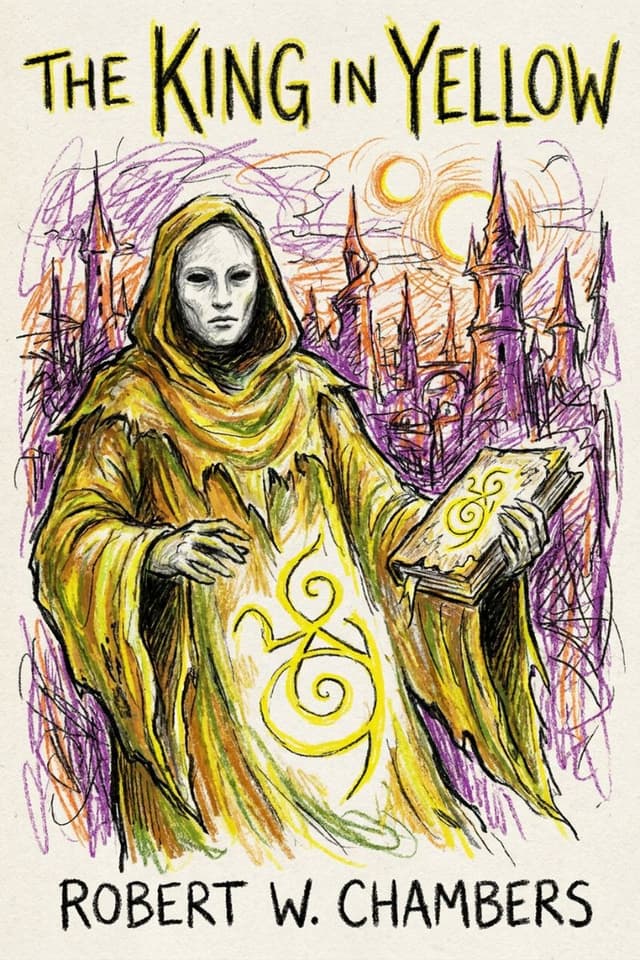
The play is called The King in Yellow, and it is the thread that stitches together the most haunting stories in this collection. No one can describe exactly what happens in that second act. The people who have read it can only tell you that the truths it reveals are irresistible and terrible, that it opens a door in the mind that cannot be closed. They mention a place called Carcosa, where black stars hang in alien skies and twin suns sink behind a lake. They whisper about the Pallid Mask and a figure robed in yellow who may not be human at all.
And then, one by one, they come undone.
The Repairer of Reputations
The collection opens in a future version of New York City, sometime in the 1920s. The government has legalized suicide and built elegant chambers where citizens can end their lives painlessly. A young man named Hildred Castaigne has recently recovered from a fall that injured his head. He believes he is perfectly well. He also believes he is the rightful heir to the Imperial Dynasty of America.
Hildred has read the play. He keeps a golden crown locked in his safe. He visits a grotesque little man named Mr. Wilde, a self-proclaimed "repairer of reputations" who lives in a squalid room and may or may not be pulling the strings of a vast conspiracy. There is a plan in motion. There is a cousin who stands in the way.
The question is not whether Hildred is dangerous. The question is how much of what he tells you is real.
The Mask
In Paris, a sculptor has discovered something extraordinary: a liquid that turns living things to marble. He demonstrates it with a rose, a butterfly, a goldfish, each transformed into a perfect, cold, white statue. His friends watch in fascination and growing unease. One of them, a painter, is secretly in love with the same woman as the sculptor. Jealousy and longing simmer beneath polished manners.
The play hovers at the edges of this story. Someone has read it. Someone is changed by it. And the sculptor's impossible liquid raises a question that no one in the room wants to ask out loud.
In the Court of the Dragon
A man sits in a church in Paris during a Sunday service. The organ music begins to bother him. There is something wrong with the organist, something in the way he plays, something in the way he watches. The man tries to leave. He finds that leaving is not as simple as standing up and walking out.
This is one of the shortest stories in the collection. It is also one of the most unsettling. The pursuit that follows is quiet, relentless, and leads to a place that is very far from any church.
The Yellow Sign
An artist in New York is painting a portrait of his model in his studio overlooking a churchyard. Both of them have noticed the night watchman who patrols the graves below. He is pale, bloated, and moves with a boneless, crawling gait that makes their skin prickle. He looks, the artist thinks, like something that has fed on the dead.
The model finds a strange golden pin in the shape of a symbol neither of them recognizes. She gives it to the artist as a curiosity. That night, the nightmares begin. They dream of a hearse, of being carried through dark streets, of something waiting in the ground.
They have both read the play. The yellow sign has found them. And the watchman is coming.
The Demoiselle d'Ys
The collection shifts here, moving away from cosmic horror toward something gentler but no less strange. A man hunting in the French countryside becomes lost and stumbles onto an estate that should not exist. The woman who lives there is beautiful, warm, and completely at ease with falcons and customs that belong to another century. Time bends. The world outside the gates feels impossibly far away.
What follows is a love story, but one shaded with the knowledge that something is deeply, quietly wrong with the place and the moment in which it is happening.
The Streets of Paris
The remaining stories leave the supernatural behind almost entirely and immerse the reader in the world of young American artists living in Paris, studying, falling in love, arguing about art, and navigating the gap between their ambitions and their realities. These tales are lighter, warmer, sometimes funny, and carry traces of the atmosphere that haunts the earlier stories without ever returning to their darkness.
They are a different kind of unsettling. After what you have read, the ordinary world feels thinner. The colors are a little less reliable. You keep glancing at shadows that should not be moving.
About the Author: Robert W. Chambers
Early Life
Robert William Chambers was born in 1865 in Brooklyn, New York, into a prominent family. His father was a successful corporate lawyer. His mother was a direct descendant of Roger Williams, the founder of Providence, Rhode Island. His brother Walter would become a renowned architect.
Chambers was educated at the Brooklyn Polytechnic Institute before entering the Art Students' League in New York at about age twenty. There, his classmate was Charles Dana Gibson, who would become one of the most famous illustrators in America.
The Paris Years
In 1886, Chambers left for Paris to study painting at the Ecole des Beaux-Arts and the Academie Julian, two of the most prestigious art schools in the world. He lived in Paris for seven years, exhibiting his work at the Salon by 1889. These years immersed him in the bohemian world of expatriate artists, studios, and cafes that would later fill the pages of his fiction.
Paris in the late 1880s and early 1890s was steeped in the Decadent movement, a culture of aesthetic extremity, fascination with beauty and decay, and a taste for the morbid and the strange. Chambers absorbed all of it.
The Turn to Writing
When Chambers returned to New York, he sold illustrations to Life, Truth, and Vogue. Then, for reasons no one has fully explained, he pivoted from art to writing. His first novel, In the Quarter, drew on his Paris experiences. But it was his second book, The King in Yellow (1895), that made his name, a slim collection of interconnected stories that blended supernatural horror with the Parisian art world he knew firsthand.
Critics were startled. One called it a masterwork of horror. Another suggested it must have been written under the influence of drugs. Chambers was irritated by both responses.
The Bestselling Novelist
After The King in Yellow, Chambers largely abandoned supernatural fiction and turned to romance and historical novels. The shift was commercially brilliant. He became one of the most popular and highest-paid authors in America, publishing dozens of novels that sold enormously well. His historical fiction, particularly novels set during the American Revolution and Civil War, drew on his passion for colonial history.
His daily routine was rigid: he went to a private office whose address he kept secret from everyone, including his family, and wrote from ten in the morning until six in the evening. He used his earnings to collect Chinese and Japanese antiquities, rare furniture, and fine art. He was also an avid outdoorsman, butterfly collector, and conservationist who once planted 25,000 trees on his estate in upstate New York.
Later Life
Chambers married Elsa Vaughn Moller in 1898 and had one son, who also became a writer. He spent summers at Broadalbin, his family's estate near the Adirondacks. He died on December 16, 1933, following intestinal surgery, and was buried beneath his favorite oak tree on the property.
During his lifetime, Chambers was famous for his romantic bestsellers. After his death, almost all of that work was forgotten. The only book that survived was The King in Yellow.
Fun Facts About the Book
The Play That Does Not Exist
The genius of the collection is that the play at its center, The King in Yellow, is never shown to the reader. Chambers provides only tantalizing fragments: a few lines of dialogue, a song, scattered references to characters named Cassilda and Camilla and a figure called the Stranger. The horror comes not from what is revealed but from what is withheld. Several authors over the years have attempted to write the full play. None have matched the power of the empty space Chambers left.
Borrowed Names, Original Horror
Chambers took the names Carcosa, Hali, and Hastur from the stories of Ambrose Bierce. But he used them in entirely new ways. Carcosa, a ruined city in a Bierce story, becomes a place of alien skies and cosmic dread. Hastur, a shepherd god in Bierce, becomes something far more ominous. Chambers built a new mythology out of borrowed syllables.
An Artist's Book
Chambers's seven years as an art student in Paris are woven into every story. The characters are painters, sculptors, and models. The settings are studios and galleries and the streets of the Latin Quarter. The book has the texture of a world the author knew intimately, which makes the supernatural intrusions feel all the more disturbing.
The Yellow Nineties
The color yellow was loaded with meaning in the 1890s. The Yellow Book was a famous literary journal associated with Oscar Wilde and the Aesthetic movement. Yellow suggested decadence, transgression, and the deliberate pursuit of sensation. Chambers knew exactly what he was doing when he dressed his cosmic horror in that particular shade.
Chambers Moved On
After The King in Yellow, Chambers published a few more collections with supernatural elements but largely turned to romance and historical fiction for the rest of his career. He reportedly did not consider The King in Yellow among his best work. This is one of literary history's great misjudgments by an author of their own output.
A Future That Never Was
"The Repairer of Reputations" is set in a speculative 1920s New York that features government-run suicide chambers, a reformed social order, and a political landscape that bears no resemblance to the actual 1920s. Written in 1895, it is one of the earliest examples of dystopian fiction in American literature, predating the genre's more famous landmarks by decades.
Themes
Forbidden Knowledge
The central conceit is devastatingly simple: there is a text that, once read, destroys the reader. The first act is harmless. The second act is irresistible. You cannot unread it. You cannot unsee what it shows you. The stories ask what it would mean if there were truths so fundamental and so terrible that knowing them would end you.
The Fragility of Sanity
Every character who encounters the play loses their grip on reality. But Chambers does not portray madness as raving and obvious. His mad characters are articulate, persuasive, and internally consistent. The horror is that you cannot always tell when the narrator has crossed the line, and you begin to wonder whether the line exists at all.
Art and Obsession
The book is populated by artists, and it takes their work seriously. But art in these stories is not safe. It is a doorway. The sculptor who turns living things to stone, the painter who cannot stop staring at the thing in the churchyard, the model who picks up a golden pin without understanding what it means: all of them are drawn to beauty and strangeness, and all of them pay for it.
The Unknowable
Chambers never explains what the King in Yellow is. He never describes Carcosa in full. He never tells you what the second act contains. The horror lives in the gaps, in the things that are suggested but never confirmed. This is a book about the terror of encountering something that your mind is not built to process.
Decay Beneath Beauty
Paris is beautiful in these stories. The streets are charming, the studios are full of light, the young artists are talented and hopeful. But something rotten runs beneath all of it: a bloated watchman patrolling a graveyard, an organist who will not stop following you, a liquid that turns warm flesh to cold marble. The beauty is real. So is the decay. They are the same thing.
The Book's Legacy
The King in Yellow is one of the most influential works of supernatural fiction ever written. H. P. Lovecraft read it in 1927 and immediately began incorporating its mythology, the Lake of Hali, the Yellow Sign, the name Hastur, into his own Cthulhu Mythos. Through Lovecraft, Chambers's inventions became part of the shared vocabulary of modern horror fiction.
The book's influence extends far beyond literature. The first season of HBO's True Detective (2014) drew heavily on the collection, referencing Carcosa and "The Yellow King" as central elements of its plot. The show introduced Chambers's work to millions of viewers who had never heard of it, and sales of the 120-year-old book surged.
Critics have called The King in Yellow the most important work of American supernatural fiction between Edgar Allan Poe and Lovecraft. Lin Carter described it as an absolute masterpiece of weird fantasy. What makes this praise remarkable is that only the first four stories in the collection are horror. The rest are light romantic fiction. Those four stories were enough.
Chambers pioneered a technique that would define the best weird fiction for the next century: the art of the incomplete revelation. He understood that what you do not show is more frightening than what you do, that a mythology half-glimpsed is more powerful than one fully explained, and that the most terrifying thing a story can do is make you feel, for just a moment, that you have read something you should not have.