Novelhalla
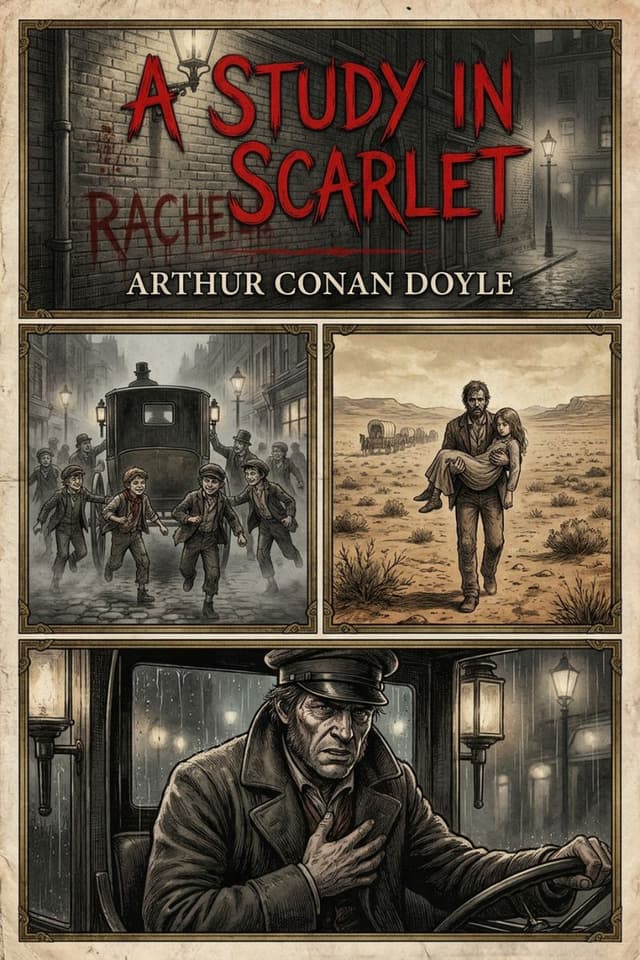
A Study in Scarlet
Read A Study in Scarlet by Arthur Conan Doyle for free on Novelhalla, and try out our easy-to-read modern edition of this classic book. You can also download the EPUB and read it on any device if you prefer!
The Plot
A Wounded Doctor Needs a Roommate
Dr. John Watson comes home from the war in Afghanistan with a bullet wound in his shoulder, a ruined constitution, and not nearly enough money to live comfortably in London. He's drifting, lonely, and burning through his savings when an old acquaintance mentions a fellow who's also looking to split the rent on some rooms.
That fellow turns out to be Sherlock Holmes. The first thing Holmes says to him, before they've even exchanged names, is that Watson has obviously been in Afghanistan. Watson has no idea how he could possibly know that.
The Strangest Man in London
The two settle into lodgings at 221B Baker Street, and Watson quickly realizes his new roommate is unlike anyone he's ever met. Holmes knows everything about poisons, soil types, and the sensational crimes of the last century, but couldn't care less whether the Earth goes around the Sun. He plays the violin at odd hours, disappears for days, and receives a parade of mysterious visitors. Watson becomes a little obsessed with figuring out what this man actually does for a living.
He finds out soon enough.
A Body in Brixton
A letter arrives from Scotland Yard. A man has been found dead in an empty house off the Brixton Road. He's well dressed, carrying cards that identify him as an American from Cleveland, and his face is twisted into a look of absolute horror. There's blood spattered around the room, but not a single wound on his body. And on the wall, scrawled in blood, is one word: RACHE.
The two official detectives on the case, Gregson and Lestrade, are already competing to solve it and arguing about what the word means. Holmes walks in, examines the scene with a tape measure and a magnifying glass, and starts telling them things about the killer that seem flat out impossible to know. Then a woman's wedding ring turns up at the scene, and Holmes sets a trap of his own.
Meanwhile, in the American Desert
And then, just when the London investigation is heating up, the story does something no one expects. It jumps across an ocean and back in time, to the vast, deadly alkali plains of the American West in 1847. A starving man and a little girl are the last survivors of their wagon party, waiting to die in the dust, when a great column of pioneers appears on the horizon.
They're rescued, but rescue comes with conditions. Years later, in a thriving settlement in the Utah wilderness, that little girl has grown into a young woman with a fearless suitor and a father who would do anything for her. But the community that saved them has its own rules about who she's allowed to marry, and someone has begun leaving numbers in their house each morning, counting down the days.
What does a frontier family's desperate struggle have to do with a dead man in a London house? You'll have to read it to find out.
About the Author: Arthur Conan Doyle
Early Life
Arthur Conan Doyle was born in Edinburgh, Scotland, in 1859, into a large Irish Catholic family with artistic roots and very little money. His father, Charles, was a talented illustrator who struggled with alcoholism, and his mother, Mary, was a gifted storyteller who filled young Arthur's head with tales of knights and chivalry. He was sent off to Jesuit boarding schools in England and later studied medicine at the University of Edinburgh.
The Doctor Who Wrote
At medical school, Doyle trained under Dr. Joseph Bell, a surgeon famous for diagnosing patients' jobs, habits, and histories just by looking at them. Doyle never forgot it. While still a student, he signed on as a ship's surgeon aboard an Arctic whaler, and later sailed to West Africa as a ship's doctor.
In 1882 he opened a medical practice in Southsea, near Portsmouth. Patients were scarce, which gave him plenty of time to write. He'd been selling short stories to magazines for years, and in 1886 he wrote a detective novel featuring a brilliant, eccentric investigator modeled partly on his old professor.
Fame He Didn't Always Want
Holmes didn't make Doyle famous right away, but once the short stories started running in The Strand Magazine in 1891, he became a sensation. Doyle, though, thought of himself as a serious historical novelist and grew tired of the detective overshadowing everything else he wrote. In 1893 he sent Holmes over the Reichenbach Falls. Readers were furious. Doyle eventually gave in, bringing Holmes back first in The Hound of the Baskervilles and then for good in 1903.
A Public Life
Doyle was much more than a mystery writer. He volunteered as a doctor during the Boer War and was knighted in 1902. He campaigned to overturn wrongful convictions, ran for Parliament (twice, unsuccessfully), and wrote adventure classics like The Lost World. After losing his son and other family members around the First World War, he became one of the world's most prominent believers in spiritualism, which baffled many fans who couldn't square it with the coolly rational detective he'd created.
Final Years
Doyle spent his last years lecturing around the world on spiritualism. He died of heart disease at his home in Crowborough, Sussex, in July 1930, at age 71.
Fun Facts About the Book
The Very First Sherlock Holmes Story
This is where it all began. A Study in Scarlet is the first appearance of Sherlock Holmes and Dr. Watson, the story of how they met, and the first time anyone ever walked through the door of 221B Baker Street.
Sold for £25, Forever
After being turned down by several publishers, including the Cornhill Magazine, Doyle finally got an offer from Ward, Lock & Co. They paid him £25 for the complete copyright and refused his request for a share of sales. He never earned another penny from the book, and he never again gave away a copyright.
Written in a Matter of Weeks
Doyle dashed the novel off in roughly six weeks in the spring of 1886, between waiting for patients who mostly didn't show up.
It Almost Had Different Names
The working title was A Tangled Skein. The detective was originally going to be called Sherrinford Holmes, and his friend was going to be Ormond Sacker. It's hard to imagine "Elementary, my dear Sacker" catching on.
Where the Title Comes From
The title comes from a line where Holmes describes murder as a scarlet thread running through the colorless skein of life, and says it's their job to unravel it. The crime is his "study in scarlet."
One of the Rarest Magazines in the World
The story first appeared in Beeton's Christmas Annual in November 1887. It sold out before Christmas, but almost no copies survived. Only a few dozen are known today, and around a dozen are complete. One sold at Sotheby's in 2007 for $156,000.
Illustrated by Doyle's Father
When the story was published as a book in 1888, it featured six drawings by Charles Altamont Doyle, the author's father.
The Baker Street Irregulars Debut Here
The scruffy gang of street kids Holmes pays to be his eyes and ears around London first shows up in this book. Their leader, Wiggins, became so iconic that the world's most famous Sherlock Holmes fan society named itself after them.
Holmes Doesn't Know the Earth Orbits the Sun
One of the funniest scenes has Watson discovering that Holmes has no idea the Earth goes around the Sun, and has no interest in learning. Holmes explains that the mind is like an attic, and he refuses to clutter his with anything that won't help him in his work.
Watson's Wandering Wound
In this book, Watson's war wound is in his shoulder. In later stories, it seems to have moved to his leg. Fans have spent over a century trying to explain the discrepancy.
Themes
The Science of Deduction
This book introduced the idea that crime could be solved through careful observation and logical reasoning rather than luck, confessions, or brute force. Holmes reads footprints, ash, and scratches the way other people read newspapers, and it was thrilling to readers who had never seen a detective work like this.
Friendship
At its heart, this is the story of two very different men finding each other. Watson is adrift and lonely, and Holmes is brilliant but odd and isolated. Watching them become a team is a huge part of the book's charm, and the beginning of one of the great friendships in fiction.
Justice Versus the Law
The book keeps poking at the gap between what the law says and what's actually right. It asks whether justice can exist outside the courts, and what happens when people decide to take it into their own hands.
Love and Loyalty
The American section is a love story as much as anything else, about a father's devotion to his daughter and how far people will go to protect the ones they love.
The Past Never Stays Buried
Crimes in this story don't come out of nowhere. They have roots that stretch back years and across continents, and the book shows how old wounds can travel a very long way before they finally surface.
Clever Amateurs and Bumbling Professionals
Gregson and Lestrade are the official detectives, but they're more interested in beating each other and taking credit than in getting things right. Holmes, the outsider, sees what they miss, and the book has a lot of fun at the expense of the professionals.
The Book's Legacy
It's hard to overstate how much this one book changed popular culture. A Study in Scarlet didn't make much of a splash at first, and Doyle himself said it had no particular success at the time. But an American publisher liked it enough to commission a second Holmes novel, The Sign of the Four, at the very same 1889 dinner where Oscar Wilde was asked to write The Picture of Dorian Gray. From there, the detective's popularity exploded.
Sherlock Holmes went on to star in four novels and fifty-six short stories, and became the template for nearly every fictional detective who came after him. The brilliant, eccentric investigator with a loyal, more ordinary friend telling the story is a formula you can find everywhere from Agatha Christie's Poirot to Dr. House.
Holmes is one of the most portrayed characters in film and television history. A Study in Scarlet itself was adapted as early as 1914, and the BBC's Sherlock opened its hit series in 2010 with "A Study in Pink," a modern retelling of this exact story, complete with Watson returning wounded from Afghanistan.
The book also gave us the whole Baker Street world that fans still love today: the cluttered sitting room, the violin, the chemistry experiments, the Irregulars, and the moment two strangers met in a hospital laboratory and one of them said, "You have been in Afghanistan, I perceive."