Novelhalla
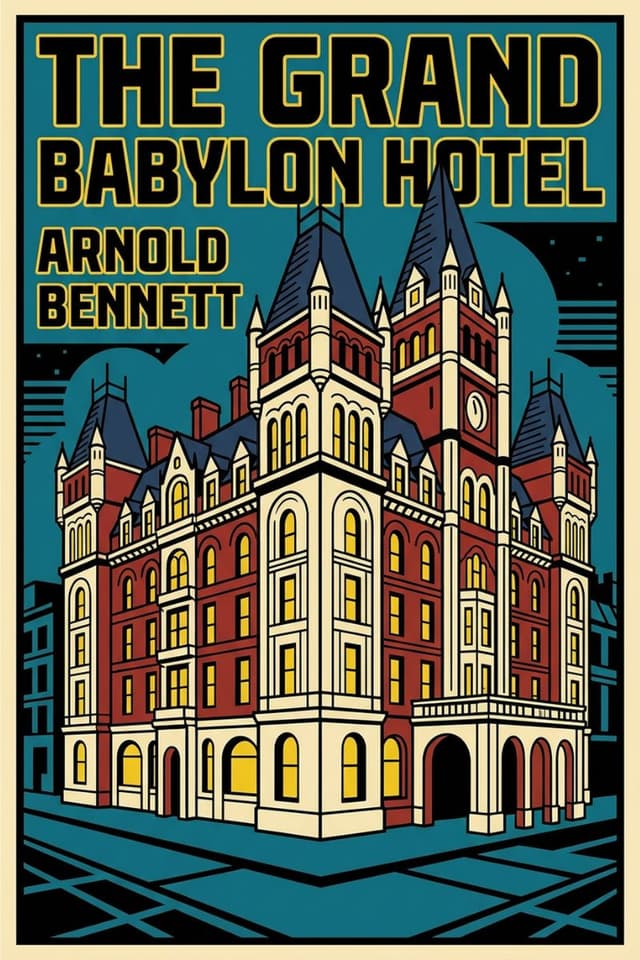
The Grand Babylon Hotel
Read The Grand Babylon Hotel by Arnold Bennett for free on Novelhalla, and try out our easy-to-read modern edition of this classic book. You can also download the EPUB and read it on any device if you prefer!
The Plot
The Millionaire and the Steak
Theodore Racksole is one of the richest men in America. He's sharp, confident, and used to getting what he wants. So when he and his twenty-three-year-old daughter Nella sit down to dinner at the Grand Babylon Hotel, the most exclusive hotel in London, and Nella orders a steak and a bottle of Bass beer, neither of them expects the headwaiter to refuse.
But the Grand Babylon has rules. The Grand Babylon does not serve Bass beer. The Grand Babylon does not take orders from its guests. The Grand Babylon tells you what you're having.
Theodore Racksole does not take no for an answer. By the end of the evening, he has bought the entire hotel. Four hundred thousand pounds and a guinea. The guinea was so the previous owner, the legendary Felix Babylon, could tell people he'd haggled.
It's the kind of outrageous, impulsive move that only a man with limitless money can make. And it's about to plunge him into something money alone can't fix.
Something Wrong at the Grand Babylon
On his very first night as the new owner, Racksole catches Jules, the imperious headwaiter, exchanging a secret signal with a young man named Reginald Dimmock. Dimmock is an equerry to Prince Aribert of Posen, a minor German royal, and he's at the hotel to prepare for the arrival of Aribert's nephew, Prince Eugen, the reigning Grand Duke.
Racksole fires Jules on the spot. The next morning, Miss Spencer, the hotel's long-serving and seemingly irreproachable bureau clerk, has vanished without a trace. And then Dimmock turns up dead. Poisoned.
Before anyone can make sense of it, the body disappears.
Prince Eugen, who was expected for dinner, never arrives. Last seen in Ostend, somewhere between the Belgian coast and London, a reigning European prince has simply evaporated.
The Father-Daughter Investigation
Theodore Racksole is not a detective. He's a businessman. But there is a dead man who was alive in his hotel, a missing body, a missing prince, and a growing certainty that the Grand Babylon has been used for years as a stage for schemes far more dangerous than anyone suspected. The old owner warned him. The hotel shelters the greatest powers in the world, and where power gathers, so do the people who want to manipulate it.
Nella, meanwhile, is not the kind of woman who sits in her room and waits. She's sharp, fearless, and more than a little reckless. When Prince Aribert confides in her that his nephew has vanished, Nella throws herself into the mystery with a directness that alarms everyone around her, including the people she's chasing.
The trail leads from the gilded corridors of the Grand Babylon to the Belgian coast, through secret messages hidden in cream puffs, disguised identities, midnight confrontations, and a conspiracy that reaches into the courts of Europe. Jules, the fired headwaiter, is not gone. He's orchestrating something from the shadows, and his network runs deeper than anyone imagined.
The Stakes
Prince Eugen owes a fortune. He's engaged to a princess. If he doesn't show up, if he doesn't secure a loan, if his debts become public, the political consequences ripple across half a continent. There are people who want exactly that. There are people who will kill for it.
Theodore and Nella Racksole have stumbled into a game of European power politics played out in hotel suites and harbor towns, with poisoned drinks and disappeared bodies. They're Americans. They don't know the rules. They don't particularly care about the rules.
But the people they're up against have been playing this game for a very long time. And Nella has just followed a lead to Ostend. Alone.
About the Author: Arnold Bennett
The Potteries Boy
Arnold Bennett was born in 1867 in Hanley, Staffordshire, in the heart of the industrial region known as the Potteries. His father, Enoch, had worked his way up from potter to pawnbroker to solicitor, and he expected his eldest son to follow him into law. Bennett worked as a clerk in his father's office, passed the London University entrance exam, but was kept home to keep working. At twenty-one, he'd had enough. He left for London and never moved back.
He would spend the rest of his life writing about the place he'd fled.
The London Years
In London, Bennett worked as a solicitor's clerk before winning a literary competition that pushed him toward journalism. He joined the staff of Woman magazine and eventually became its editor. All the while he was writing fiction, studying the French realists, particularly Flaubert and Balzac, and training himself to see the world with a novelist's eye.
His first novel, A Man from the North, appeared in 1898. In 1902, everything changed. He published both Anna of the Five Towns, his first serious literary novel set in the Potteries, and The Grand Babylon Hotel, a wildly different book that sold fifty thousand copies in hardback and was translated into four languages almost immediately.
Paris and the Masterworks
In 1903, Bennett moved to Paris, where he lived for nearly a decade. He threw himself into the artistic life of the city, befriending writers, painters, and musicians. A chance observation in a Paris restaurant, watching a beautiful young woman laughing at a bitter old one, sparked the idea for The Old Wives' Tale (1908), which is now considered his masterpiece and one of the great English novels of the twentieth century.
He married French actress Marguerite Soulie in 1907. The marriage would eventually fail, but the Paris years were among his most productive and happy.
Later Life
Bennett returned to England in 1912 and served in the Ministry of Information during the First World War, declining a knighthood for his services. He separated from Marguerite and began a relationship with actress Dorothy Cheston, with whom he had a daughter.
He remained enormously prolific, writing novels, plays, journalism, and a literary column for the Evening Standard in which he championed emerging writers like James Joyce, D.H. Lawrence, and William Faulkner. Virginia Woolf famously attacked him as an old-fashioned materialist in her essay "Mr. Bennett and Mrs. Brown," but later scholars have pushed back hard against that judgment.
Bennett died in London on March 27, 1931, of typhoid fever, reportedly contracted from drinking tap water at a Paris restaurant after being warned against it by the waiter. He was sixty-three.
Fun Facts About the Book
Written on a Lark
Bennett wrote The Grand Babylon Hotel quickly and largely for fun. It was a deliberate departure from his serious literary ambitions, a romp meant to entertain. He later noted that it was being promoted as the best thing of its kind since The Mystery of a Hansom Cab, and he was happy to ride that wave.
The Savoy Connection
The Grand Babylon Hotel was modeled on London's Savoy Hotel, where Bennett was a regular guest and eventually a semi-resident. The Savoy's chef later created a dish in his honor, the Omelette Arnold Bennett, made with smoked haddock, cream, and cheese. It's still served today and remains one of the most famous dishes in British culinary history.
A Surprise Bestseller
While Bennett considered his Five Towns novels his serious work, it was The Grand Babylon Hotel that made him financially secure. Fifty thousand hardback copies sold quickly, and it was almost immediately translated into four languages. The book proved you could write something "for a lark" and have it outperform your literary ambitions.
The Prisoner of Zenda Effect
Contemporary reviewers compared the novel to Anthony Hope's The Prisoner of Zenda, another story of European intrigue involving minor royalty. Bennett took Hope's template, added an irreverent American sensibility, and produced something that reads less like a Victorian adventure and more like a screwball thriller.
Serialized Suspense
The novel was originally serialized in the magazine Golden Penny, with short chapters ending on cliffhangers designed to keep readers desperate for the next installment. The breathless pacing and wild plot twists owe a lot to this format.
Nella the Trailblazer
Nella Racksole is a remarkably modern heroine for 1902. She chases suspects, travels alone to foreign countries, handles firearms, and drives the investigation as much as her father does. At one point she declares that in America, even if they don't teach revolver-shooting in boarding schools, plenty of girls can handle a gun. Readers loved her.
Two Film Adaptations (Both Lost)
The novel was adapted into a British film in 1916 and a German thriller in 1920 by director E.A. Dupont. Both films are now considered lost. A BBC Radio 4 adaptation aired in 2009, and a stage production was mounted in 2025.
Themes
The Power of Money
Theodore Racksole solves his first problem by buying an entire hotel on impulse. But the novel quickly tests the limits of wealth. Money can purchase property, but it can't buy loyalty, safety, or truth. The deeper Racksole gets into the mystery, the more he discovers that the real currency at the Grand Babylon is information, and the people who trade in it don't accept checks.
Americans in Europe
The novel plays with the culture clash between brash, practical Americans and the ancient, layered hierarchies of European aristocracy. The Racksoles don't genuflect. They don't wait for permission. They act. Bennett treats this partly as comedy and partly as genuine admiration for a kind of directness that old Europe badly needs.
Hidden Lives in Luxury Hotels
The Grand Babylon is a world within a world. Kings, financiers, and ambassadors pass through its corridors, but so do conspirators, blackmailers, and killers. Bennett was fascinated by the idea that the most respectable spaces in the world are also the most dangerous, precisely because everyone there has something to protect.
Women and Agency
Nella Racksole refuses to be a spectator. In a world where women of her class are expected to be decorative, she's resourceful, brave, and frequently smarter than the men around her. The novel doesn't make a speech about it. It just lets her act, and the reader draws their own conclusions.
Performance and Identity
Almost everyone in the novel is pretending to be someone they're not. Princes travel under false names. Hotel clerks disguise themselves as baronesses. The headwaiter runs a criminal network. The Grand Babylon is a stage, and everyone is performing. The question is who's performing for whom.
The Book's Legacy
The Grand Babylon Hotel was one of the first major novels to combine mystery, international intrigue, and sharp social comedy in a luxury setting. It helped establish a genre that would flourish throughout the twentieth century and remains alive today in everything from Agatha Christie's hotel mysteries to modern thrillers set in the world of the ultra-wealthy.
Bennett went on to become one of the most successful and influential British writers of his generation, though his reputation was complicated by Virginia Woolf's famous critique. Later reassessments, particularly by Margaret Drabble and John Carey, have restored his standing as a major figure in English literature.
The novel itself has been adapted for film, radio, and stage, and continues to charm readers with its wit, pace, and the sheer audacity of its premise. It's the kind of book where a man buys a hotel because the waiter annoyed him, and somehow that's only the beginning of the trouble.