Novelhalla
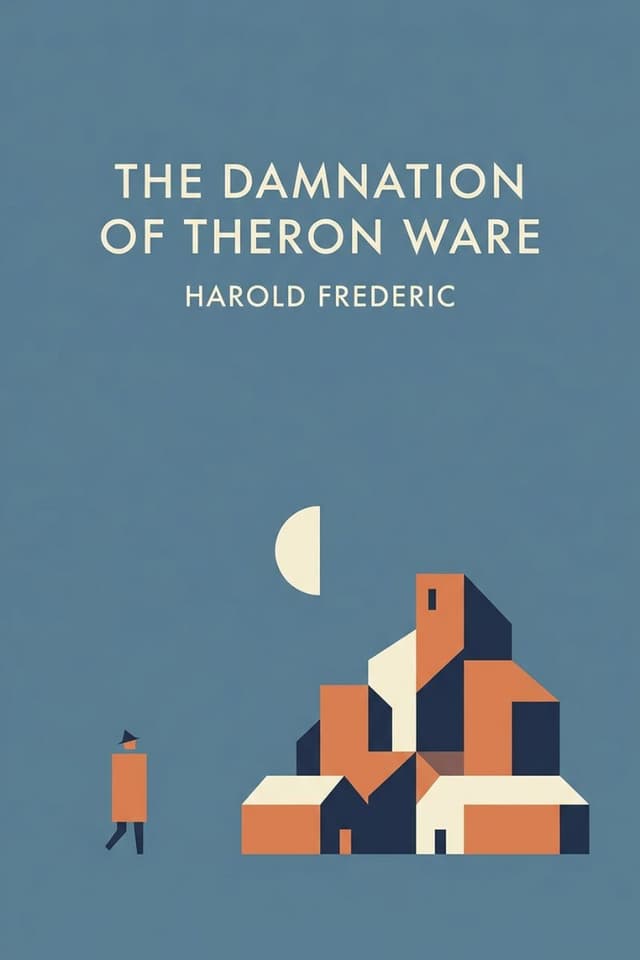
The Damnation of Theron Ware
Read The Damnation of Theron Ware by Harold Frederic for free on Novelhalla, and try out our easy-to-read modern edition of this classic book. You can also download the EPUB and read it on any device if you prefer!
The Plot
The Promising Young Minister
Theron Ware is a rising star. Young, handsome, a gifted preacher with a silver tongue and an adoring wife named Alice, he arrives at the annual Methodist conference expecting to be assigned to a prestigious congregation. Instead, the church sends him to Octavius, a small upstate New York town with a penny-pinching congregation who want their sermons plain and their minister's wife to stop wearing flowers on her bonnet.
It's a humiliation. Theron is better than this and he knows it. He has plans. He's going to write a book about Abraham. He's going to become somebody.
The problem is that Theron Ware doesn't know what he doesn't know. And Octavius is about to teach him.
Three New Friends
It starts with a dying man. Theron stumbles onto a scene in the street where workers are carrying an injured laborer into his home. He follows, out of pastoral instinct, and watches a Catholic priest named Father Forbes administer the last rites. It's the first time Theron has ever set foot in a Catholic space, and the ritual is strange, beautiful, and unsettling.
Forbes is nothing like what Theron expected. He's urbane, brilliantly educated, and casually skeptical of the very doctrines he performs. Over dinner at his richly appointed home, Forbes and his friend Dr. Ledsmar, a retired physician and avowed atheist, discuss biblical scholarship with a depth and ease that makes Theron's seminary education feel like a pamphlet. These men know things. They've read things. They treat ideas about God and history the way a surgeon treats anatomy: with precision, detachment, and zero sentimentality.
Theron is dazzled. And then he hears the organ.
Walking past the Catholic church, he's stopped in his tracks by music so gorgeous it pulls him through the doors. The organist is Celia Madden, the red-haired, independently wealthy daughter of the richest man in town. She's beautiful, fiercely intelligent, uninterested in marriage, and devoted to art, beauty, and a personal philosophy she calls Greek. She has a private room filled with paintings, nude statues, candles, and a piano where she plays Chopin.
Celia is the most extraordinary person Theron Ware has ever met. She talks to him like an equal. She seems interested. She invites him into her world.
And just like that, the book Theron was going to write about Abraham doesn't matter anymore. Nothing in his old life matters anymore.
The Education of Theron Ware
What happens next is one of the most precise portraits of self-destruction in American fiction. Theron doesn't fall because someone pushes him. He falls because he mistakes the feeling of being flattered for the experience of being transformed.
He reads the books Forbes and Ledsmar lend him, books about the loss of religious faith, about science and biblical criticism, and they blow the roof off everything he was raised to believe. But Theron doesn't wrestle with these ideas the way a serious thinker would. He just absorbs the conclusions and starts looking down on everyone who hasn't had the same revelation. His congregation seems crude. His wife seems simple. His own faith seems embarrassing.
He begins spending more time with his new friends and less time being a pastor. He lies to Alice about where he's going. He drinks beer for the first time at a Catholic picnic in the woods. He walks with Celia into the forest, and she kisses him, and his entire world reconfigures around that moment.
Meanwhile, the novel introduces the Soulsbys, a husband-and-wife team of professional revivalists brought in to raise money for the church. They're theatrical, manipulative, and surprisingly wise. Sister Soulsby in particular sees Theron clearly, and she offers him advice he isn't ready to hear.
The Spiral
Theron's transformation accelerates. He becomes possessive, jealous, suspicious. He convinces himself that Celia returns his feelings. He grows paranoid that his wife is having an affair with one of the church trustees. He alienates Dr. Ledsmar by prying into the relationship between Celia and Father Forbes. He offends Forbes so badly that the priest's housekeeper is instructed to turn him away at the door.
Even the dying have something to say. Celia's brother Michael, wasting away from tuberculosis, tells Theron to his face that when he arrived in Octavius he had the face of an angel, but that in eight months his features have taken on a look of deceit and cunning. He warns Theron to go back to his own people before it's too late.
Theron doesn't listen. Theron never listens. He has mistaken the opening of his mind for enlightenment when what's actually happening is something much more dangerous. The question the novel keeps circling is whether Theron Ware is being illuminated or damned, and whether there's any difference.
The Pursuit
When Theron learns that Celia and Father Forbes have both left town, he does something reckless. He takes money from the church and follows them. What he finds, and what Celia tells him when he confronts her, will either break him or finally force him to see himself clearly.
The answer to which one it is might be the most unsettling thing about the book.
About the Author: Harold Frederic
A Utica Boy
Harold Frederic was born on August 19, 1856, in Utica, New York. His father was killed in a railroad accident when Harold was just eighteen months old, and the boy was raised primarily by his mother. He finished school at fifteen and went to work as a photographer, spending four years retouching portraits in Utica and Boston before pivoting to journalism.
The Newspaperman
Frederic started as a proofreader at the Utica Herald, moved up to reporter at the Utica Daily Observer, and by the age of twenty-four was its editor. His early journalism had a flair for the sensational, covering murders and hangings with an energy that would later find its way into his fiction. By 1882, he was editor of the Albany Evening Journal. He was a fierce Democrat in Republican territory, and his support of Grover Cleveland for governor helped shape his political connections and his reputation as someone who wasn't afraid to pick a fight.
London Correspondent
In 1884, at twenty-eight, Frederic took the job that would define his professional life: London correspondent for The New York Times. He never came back to America. From England, he covered cholera outbreaks in southern Europe, investigated the persecution of Jews in Russia, and filed dispatches on the rise of Kaiser Wilhelm II. He was, by all accounts, a brilliant reporter who never quite shed his American directness or bothered to learn a foreign language.
He also started writing novels. Seth's Brother's Wife, In the Valley, The Copperhead, all drew on his upstate New York roots. But none of them prepared anyone for what came in 1896.
The Masterpiece and the Scandal
The Damnation of Theron Ware made Frederic famous. It was the fifth best-selling book in America the year it was published. Critics recognized it immediately as something new and sharp in American fiction.
But Frederic's personal life was, by this point, spectacularly complicated. He had five children with his wife Grace and maintained a second household with his mistress Kate Lyon, with whom he had three more children. Lyon called herself "Mrs. Frederic" openly.
A Strange Death
In August 1898, Frederic suffered a stroke. He was forty-two. Kate Lyon was a devout Christian Scientist and insisted he be treated by a faith healer rather than a doctor. Frederic, who didn't share her beliefs, reportedly dismissed both the doctors and the healer and kept smoking cigars and drinking brandy.
He died on October 19, 1898. His wife Grace brought manslaughter charges against Lyon and the healer. Both were acquitted at trial, but the scandal consumed his reputation. The man who had written one of the sharpest novels about the collision between faith and reason died in a real-life collision between faith and medicine, and the irony was not lost on anyone.
Fun Facts About the Book
Two Titles
The novel was published simultaneously in 1896 under two different names. In England it appeared as Illumination. In America it was The Damnation of Theron Ware. Frederic reportedly preferred "Illumination," which carries a sly double meaning: is Theron being enlightened or is he just being lit up before the fire consumes him? The American title answers the question before you start reading. The British title lets you decide for yourself.
A Bestseller That Vanished
The novel was the fifth best-selling book in America in 1896 and was praised by critics as essential reading. Then Frederic died, the scandal eclipsed his work, and the book fell out of print for decades. It was rediscovered in the 1960s when Harvard University Press reissued it, and scholars began recognizing it as a precursor to the great American novels of disillusionment that followed.
The Utica Connection
Frederic modeled the fictional Octavius directly on his hometown of Utica, New York. The town's religious tensions, its class structure, its mix of Protestant establishment and Irish Catholic immigrant community all came from Frederic's own childhood observations. He was meticulous about the social details, even pressing a musician friend to play each of Celia's Chopin pieces so he could describe the music accurately.
Frederic's Research Habits
Despite writing quickly (sometimes four thousand words a day), Frederic was obsessive about getting things right. For Theron Ware, he studied Assyriology, read Schopenhauer, and researched ancient manuscripts. "I have waded in Assyriology and Schopenhauer," he wrote to a friend. "I pored over palimpsests and pottery." The intellectual conversations in the novel have a specificity that comes from genuine homework.
Sinclair Lewis's Favorite
Sinclair Lewis, who would go on to write Main Street, Babbitt, and Elmer Gantry, cited The Damnation of Theron Ware as a key influence. In Main Street, his heroine lists it among her favorite books. Lewis picked up where Frederic left off, turning the critique of small-town American life and Protestant hypocrisy into a career.
Themes
The Danger of Half-Knowledge
Theron's tragedy isn't that he learns too much. It's that he learns just enough to lose his old convictions without gaining the depth to replace them with anything solid. He picks up the vocabulary of sophistication without doing the actual work of thinking. It's a devastating portrait of intellectual tourism, the person who reads one book and thinks they've mastered the subject.
Faith and Performance
Almost nobody in the novel believes what they say they believe. Father Forbes performs Catholic rites while privately doubting Catholic doctrine. The Soulsbys manufacture religious ecstasy for profit. Theron preaches sermons he's losing faith in. The novel asks whether faith is something you hold in your heart or something you perform for a congregation, and whether the difference matters as much as we think it does.
The Seduction of Culture
Celia's world of art, music, Chopin nocturnes, Greek philosophy, and candlelit rooms filled with sculpture represents everything Theron's narrow Methodist upbringing denied him. The novel doesn't dismiss this world as false. It's genuinely beautiful. But it suggests that beauty can be as dangerous as any vice when it makes you despise the life you actually live.
Self-Deception
Theron never sees himself clearly. He thinks he's becoming enlightened when he's becoming arrogant. He thinks he's falling in love when he's falling apart. He thinks people admire his transformation when they're watching him unravel. The novel is a masterclass in unreliable self-perception, told from a third-person perspective that lets the reader see what Theron cannot.
The American Innocent Abroad (at Home)
Theron is a distinctly American character: optimistic, ambitious, confident that the next big idea will change everything. The novel places him in a collision with older, more complex traditions, Catholic intellectual life, European philosophy, aesthetic culture, and watches him try to absorb them without doing the hard work of understanding them. It's an immigration story that takes place without anyone crossing an ocean.
The Book's Legacy
The Damnation of Theron Ware occupies a strange and important place in American literature. It was a sensation in 1896, forgotten for decades after its author's scandalous death, and then rediscovered as one of the sharpest, most psychologically modern novels of its era.
Its influence runs through the major American novels of disillusionment that followed. Sinclair Lewis's portraits of small-town hypocrisy in Main Street and the religious charlatanism of Elmer Gantry are direct descendants. The novel's unflinching look at how intellectual pretension can mask moral collapse anticipates writers from F. Scott Fitzgerald to Richard Yates.
Frederic's Octavius remains one of the most vivid small towns in American fiction, a place where Protestants and Catholics eye each other across invisible lines, where money and piety are tangled together in ways nobody wants to examine too closely, and where a man can lose himself by trying too hard to become someone new.
The novel's central question, whether knowledge without wisdom is liberation or destruction, has only grown more relevant. In an age of instant access to information and ideas, Theron Ware's story reads less like a period piece and more like a warning.