Novelhalla
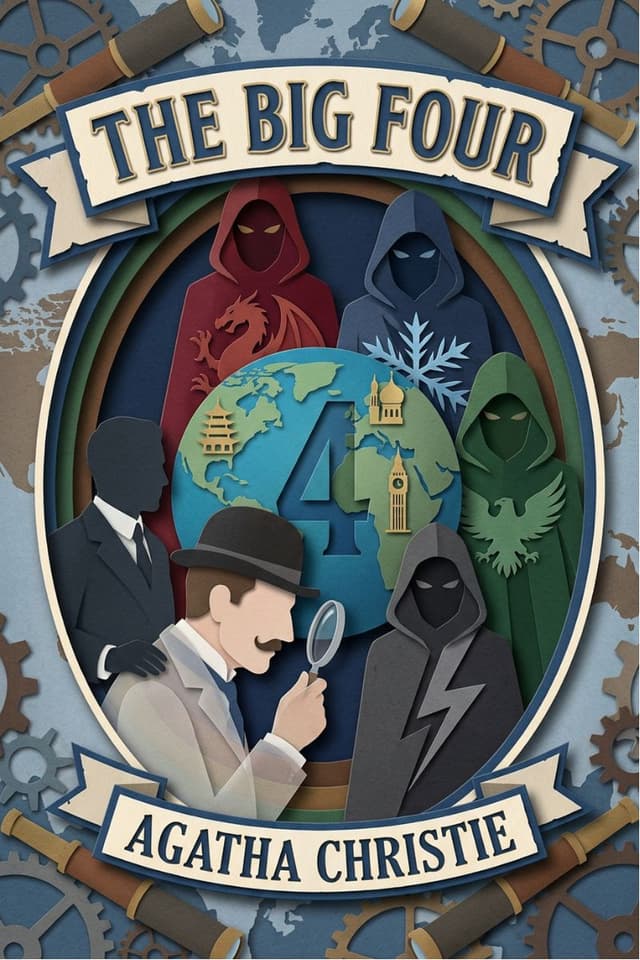
The Big Four
Read The Big Four by Agatha Christie for free on Novelhalla, and try out our easy-to-read modern edition of this classic book. You can also download the EPUB and read it on any device if you prefer!
The Plot
The Man Who Comes Through the Wrong Door
Hercule Poirot is packing. He's had an offer from one of the richest men on earth, something enormous involving a business matter in Rio de Janeiro, and he's decided to take it. Captain Hastings, arriving from his ranch in Argentina for a surprise visit, is dismayed to find his friend on the point of leaving England, possibly for good.
Then a man appears in the doorway of Poirot's bedroom. Not the front door. The bedroom. He's filthy, thin, caked in mud, and he doesn't seem to know where he is. He can say Poirot's name and address, and that's all. When they give him paper, he writes the figure 4 over and over again, dozens of times, until the page is covered.
When he finally speaks, what he describes is an organization: four people, working in perfect coordination, with reach into every government and every industry on earth. Number One is Li Chang Yen, a Chinese mandarin who never leaves Peking and who pulls, according to this man, the strings behind half the upheavals in the world. Number Two is American, and rich beyond measure. Number Three is a Frenchwoman. And Number Four has no name, no nationality, and no face. He's called the Destroyer.
Poirot cancels Rio.
A Case With No Body
Here's the trouble with hunting the Big Four. There's no drawing room full of suspects. There's no country house, no cook who heard something at half past nine, no rearranged clock. There's barely even a crime to start with, just a scattering of deaths across two continents that nobody has connected and most people have already explained away.
A recluse in a Devon cottage, killed for money that was never taken. A British scientist who walked out of a Paris conference and evaporated. A man found dead beside his own fire, having written two words on a newspaper before he went: yellow jasmine. A young American chess champion who slumped forward at the board mid game, dead of heart failure, in front of a room full of witnesses who saw absolutely nothing.
Each one is a tidy little puzzle. Poirot can solve those. What he can't do is stop the pattern, because behind every one of them is the same man, and Poirot has no idea what that man looks like.
The Destroyer
Number Four is the most unsettling villain Christie ever built, precisely because there's nothing to hold onto. He's a character actor, obscure and unmemorable, the kind of performer people work with for months and then fail to describe afterward. He doesn't wear disguises so much as become other people, complete with their walk, their voice, their history and their friends.
Which means every helpful stranger in this book is a question. The doctor at a sickbed. The chess master. The nervous witness who comes forward with exactly the right information. Poirot spends the novel realizing, over and over, slightly too late, that he has already met Number Four and shaken his hand.
There's one habit the man can't seem to shed, a small unconscious thing he does at a dinner table. Finding somebody who remembers it is another matter entirely.
The First Time Poirot Is Outmatched
Poirot sets traps. The Four know about them in advance. The Four set traps. Poirot walks around most of them and straight into the rest. His flat is watched. His movements are known. His mail is read. And because the organization understands him better than he'd like, it works out very quickly that the fastest way to a man who prides himself on his reason is through the people he loves.
Hastings has a wife in Argentina. Poirot has a reputation, a habit of routine, and a vanity that can be predicted. Both facts are noted, filed, and used.
This isn't Poirot solving a murder in a village. This is Poirot, on his own, with Hastings and one overworked Scotland Yard inspector, against an organization that has money, science, governments, and a weapon nobody outside the Four has ever seen demonstrated. He says himself that after this, everything else in his career will feel tame.
He isn't wrong. He's also, for a good stretch of this book, losing.
About the Author: Agatha Christie
Torquay
She was born Agatha Mary Clarissa Miller in September 1890 in Torquay, on the Devon coast, the youngest of three. Her father was American, her mother English, and her education happened mostly at home, with some later study in Paris. She taught herself to read young and grew up in a house full of stories.
She met Archie Christie, an aviator, at a dance in 1912, and married him on Christmas Eve 1914 while he was home on leave during the war. She spent the war working in a hospital dispensary, which is where she learned the poisons that would eventually kill a great many fictional people.
The Rise
Her first novel, The Mysterious Affair at Styles, introduced Hercule Poirot in 1920. She followed it with a steady output through the early twenties, mixing detective novels with straight thrillers, which were then the hotter commercial category. Her reputation was made in the spring of 1926 with The Murder of Roger Ackroyd, a book whose central trick caused an argument about the ethics of mystery writing that has never entirely stopped.
1926
That same year her mother died and her marriage collapsed. Archie asked for a divorce, having fallen in love with another woman. In early December, after a quarrel, Christie drove away from home, and her car was found abandoned. She was missing for eleven days.
The search was a national event. Hundreds of police, thousands of volunteers, a newspaper reward, and endless speculation about whether the country's most famous mystery writer had staged her own vanishing. She was eventually found at a hotel in Harrogate, registered under an assumed name. She said she remembered nothing, never gave a fuller explanation, and refused to discuss it for the rest of her life.
She was thirty six years old, grieving her mother, publicly humiliated, and contractually required to produce another book.
After
The divorce came through in 1928. In 1930 she married the archaeologist Max Mallowan, fourteen years her junior, and spent many of the following decades on digs in the Middle East, where several of her best novels were written and set. She kept working at an extraordinary rate: sixty six detective novels, fourteen story collections, a shelf of plays including The Mousetrap, and a set of straight novels published as Mary Westmacott.
She died in January 1976 at eighty five. Her sales are usually estimated in the billions, a figure normally reserved for religious texts.
Fun Facts About the Book
It Started Life as a Magazine Serial
This wasn't conceived as a novel at all. It began as twelve weekly stories published in The Sketch in early 1924 under the running title "The Man Who Was No. 4." Christie wrote them well before Roger Ackroyd made her famous, back when she was still finding her footing.
She Only Turned It Into a Book Because She Was Wrecked
By late 1926 she owed her publisher a Poirot novel and could not write one. Her brother in law, Campbell Christie, suggested she stop trying and instead stitch the old serial together into a full length book. He helped her rework the beginnings and endings so the episodes would flow. That's why the structure lurches the way it does, and it's also why the book exists at all.
The Author Hated It
Christie never came around on this one. Writing to her agent in 1942, she referred to it flatly as "that rotten book," and she used the same letter to argue that a writer should always keep a spare manuscript in the drawer so she'd never again have to produce something purely for money.
The Disappearance Sold It
The book came out in January 1927, only weeks after she'd been found in Harrogate. Her name was on every front page in Britain. The publicity turned an odd, patched together thriller into a hit, and by some accounts it sold more than twice as well as The Murder of Roger Ackroyd.
It's a Thriller, Not a Whodunit, and That Was a Business Decision
The biggest selling British crime writers of the 1920s weren't the puzzle novelists. They were thriller men like Edgar Wallace and Sax Rohmer, cranking out international conspiracies and criminal masterminds. Christie wrote in that mode more than modern readers remember, and this is her fullest attempt at it.
Li Chang Yen Has an Obvious Ancestor
The unseen Chinese mastermind who directs world events from a palace in Peking is a direct descendant of Sax Rohmer's Fu Manchu, then one of the most popular villains in English fiction. David Suchet, who played Poirot for twenty four years, thought the quartet also read as a dark mirror of Edgar Wallace's Four Just Men.
A Rare Sighting of the Countess
Countess Vera Rossakoff, the Russian aristocrat and jewel thief who is the closest thing Poirot has to a romantic weakness, turns up here. In 1927 that would have baffled anyone who only read the novels, since she'd debuted in a magazine story most book readers had never seen.
The Reviews Were a Mess
The Times Literary Supplement praised it and assumed the change of style was deliberate. The Observer thought the small embedded mysteries were far better than the world domination plot. The Scotsman decided it read like a parody of detective fiction and enjoyed it on those terms. Modern critics have been harsher, and it regularly turns up on lists of Christie's worst.
The Science Is Vintage Mad Science
The Four's ultimate weapon involves wireless energy, focused beams, radium and gamma rays, and the possibility that someone has quietly liberated atomic energy well ahead of anybody else. Written in 1924, this is Christie brushing up against science fiction, which she almost never did.
Themes
The Enemy With No Face
Every other Poirot book gives him a closed circle of suspects. This one gives him a man who could be anyone, and the tension comes entirely from that absence. Identity is not something to be uncovered here so much as something that keeps dissolving, and Poirot's method, which depends on reading people, becomes almost useless against someone with no self to read.
Reason Against Force
Poirot's whole faith is in order, pattern and the little grey cells. The Four don't play in that arena. They have money, chemistry, physics and a global network, and they can simply kill anyone who becomes inconvenient. The book is at its most interesting when it asks what a rational man is actually good for when the other side has stopped arguing.
Postwar Paranoia
Written a few years after the First World War and the Russian Revolution, this is a fantasy built out of a very real interwar anxiety: that the visible leaders of the world are marionettes, that the strikes and revolutions and collapses are connected, and that somebody unaccountable is holding the strings. Christie's readers recognized that fear immediately.
Friendship as a Liability
Hastings is often treated as comic relief, the loyal thickhead. Here his loyalty is a weapon that can be turned around, and the book is genuinely clear eyed about the fact that caring about people is what makes a man controllable. Some of the best moments are Poirot realizing he can be moved by pressure on someone else.
Performance and the Watching Eye
A villain who acts for a living, a detective who theatrically stages his own effects, a chess match, a sickroom, a dinner table. The novel keeps returning to the idea that people constantly perform versions of themselves and that everyone around them accepts the performance without checking.
Historical Context
This is a book of its moment in ways worth knowing before you open it. The Four are built out of 1920s British stereotypes: the inscrutable Oriental mastermind, the rapacious American plutocrat, the coldly brilliant Frenchwoman. Li Chang Yen in particular is straight out of the Yellow Peril fiction that was hugely popular at the time, and the language around him can be ugly by any modern standard. It isn't incidental, and it isn't hidden. Reading it now means reading a mainstream 1920s thriller with the assumptions of a 1920s thriller intact, which is either part of the interest or a reason to pick a different Poirot, depending on what you want from an evening.
The Book's Legacy
This is the odd one in the Poirot canon, and its reputation has swung around a lot. Contemporary reviewers were confused but mostly entertained. Later critics decided it was an embarrassment, with one prominent Christie scholar calling it demeaning to Poirot. Christie herself never defended it.
Recently the tide has turned somewhat, and it now gets defended as exactly what it is: a fast, ridiculous, tremendously energetic pulp thriller from a writer at the absolute bottom of her personal luck, containing several small mysteries good enough to have anchored better books. The chess match and the yellow jasmine in particular still get singled out.
It also matters as a road not taken. The success of this book, driven by the publicity around her disappearance, briefly suggested a future in which Christie became a thriller writer rather than the architect of the classical detective novel. She went the other way, and gave us Orient Express, Ackroyd, and And Then There Were None instead.
Its most visible afterlife is the 2013 television adaptation with David Suchet, made as part of the final run of his Poirot, which rebuilt the story almost from scratch. Writer Mark Gatiss cheerfully described the original as close to unadaptable. Beyond that, the Four have a long shadow: an unseen global syndicate with a numbered hierarchy, a secret mountain base and a scientific superweapon is a template that James Bond's enemies would make famous three decades later.