Novelhalla
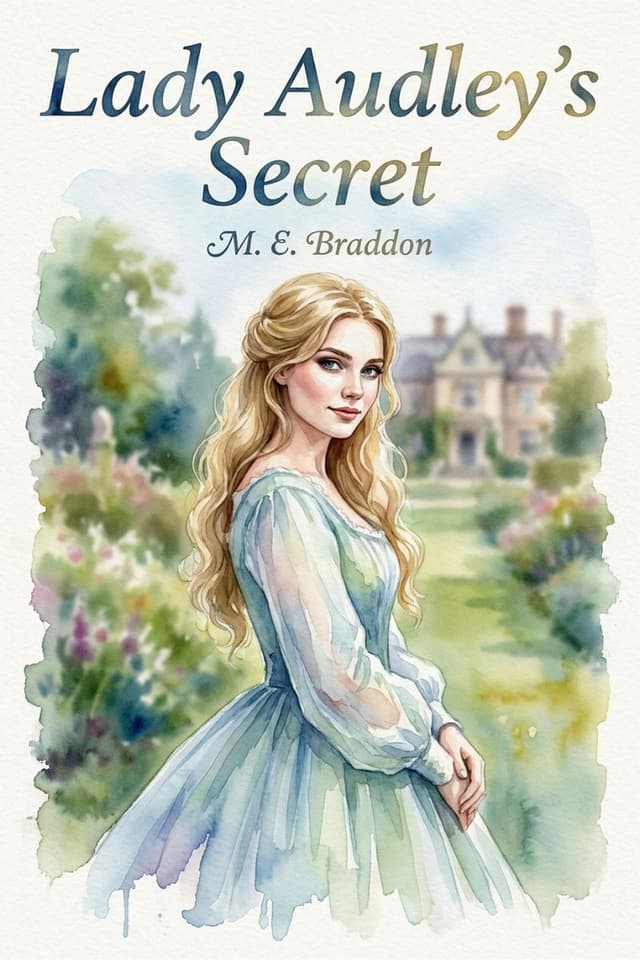
Lady Audley's Secret
Read Lady Audley's Secret by M. E. Braddon for free on Novelhalla, and try out our easy-to-read modern edition of this classic book. You can also download the EPUB and read it on any device if you prefer!
The Plot
The Beautiful Stranger
Lucy Graham arrives in a quiet Essex village with no past anyone can trace. She's young, golden-haired, and so charming that everyone she meets is instantly enchanted. She takes a position as governess for the local doctor's family, and within months, the wealthy Sir Michael Audley, a kind widower of fifty-six, is completely besotted. He proposes. Lucy accepts, but her acceptance speech is strange. Almost reluctant. As if she's calculating rather than swooning.
She becomes Lady Audley, mistress of the grand and crumbling Audley Court, with its hidden passageways and shadowed gardens. Sir Michael adores her. His eighteen-year-old daughter Alicia does not.
Nobody asks too many questions about where Lucy came from. Nobody wonders why her history before the doctor's household is a blank.
That's their first mistake.
The Man Who Came Back
George Talboys has spent three and a half years in the Australian goldfields, clawing together a fortune. He left behind a young wife, Helen, and a baby son. He left because he was broke and desperate, and he swore he'd come back rich. He did.
But when George returns to England, he finds a death notice in the newspaper. His wife is dead.
George is gutted. His old school friend Robert Audley, a cheerfully lazy London barrister who has never taken a serious interest in anything, tries to help him through the grief. Robert suggests a visit to his uncle's country estate to lift George's spirits.
They arrive at Audley Court. And Lady Audley suddenly has urgent business elsewhere.
Every time George and Robert try to meet the new Lady Audley, she vanishes. An excuse here, a telegram there, always just slipping out of reach. When the two men finally wander through her private rooms and see her portrait, George's reaction is not what Robert expects.
The next morning, George is gone. No note. No word. No explanation.
The Reluctant Detective
Robert Audley has never cared about much of anything. He's the sort of man who reads French novels and lets the days drift by. But George's disappearance gnaws at him. George wouldn't just leave. Something happened.
What starts as mild concern becomes obsession. Robert begins pulling at threads, following clues, and every trail leads him back to the same place. The same person. The lovely, golden-haired woman his uncle married.
Lady Audley is not what she seems. Robert becomes increasingly certain of this, but proving it means destroying his uncle's happiness. It means accusing the woman Sir Michael loves of things so terrible they would shatter the family.
And Lady Audley knows Robert is watching. She is not the kind of woman who waits to be caught.
The Secret
There's a maid named Phoebe who knows too much. A husband named Luke who smells money in what she knows. There are old letters and abandoned children and a trail of identities that don't quite add up. There's a portrait that tells one story and a woman who tells another.
Robert Audley is not built for this. He's a gentleman playing detective, stumbling through a case that grows darker with every discovery. The woman he's investigating is smarter than him, more desperate than him, and has far more to lose.
The question isn't just what Lady Audley is hiding. It's what she's willing to do to keep it hidden. And by the time Robert understands the answer to that question, it may already be too late.
About the Author: Mary Elizabeth Braddon
A Scandalous Start
Mary Elizabeth Braddon was born in London's Soho in 1835. Her parents separated when she was five after her mother discovered her father's infidelities. Raised by her mother alone in an era when that itself was a scandal, Braddon learned early that respectability was a performance and survival required nerve.
The Actress
To support herself and her mother, Braddon did something shocking for a middle-class young woman. She went on the stage. Performing under the name Mary Seyton, she spent nearly eight years touring the provinces, playing everything from Shakespeare to pantomime to melodrama. She reached leading-lady status but couldn't crack London. By her late twenties, her acting career was fading, and she turned to writing instead.
The theatre never left her work. Her novels move like plays, with entrances and exits, dramatic reveals, and scenes built for maximum tension.
The Writer and the Publisher
In 1861, Braddon met John Maxwell, a publisher of periodicals. She moved in with him almost immediately. There was a problem: Maxwell was already married. His wife was living with her family, not in an asylum as was sometimes claimed. Braddon became stepmother to Maxwell's five children and began having children of her own. They couldn't marry until his first wife died in 1874, and when their "irregular" arrangement became public, the scandal was fierce enough that all their servants quit.
During these years, Braddon wrote at a furious pace. She produced two novels a year, founded and edited her own literary magazine, Belgravia, and became one of the best-selling authors in England.
A Life in Letters
Braddon published more than eighty novels over a career spanning five decades. She was friends with literary figures including Bram Stoker, and her sons W.B. Maxwell and Gerald Maxwell both became novelists. She kept writing into her seventies, even as her health declined after a stroke in 1907. She died in Richmond in February 1915 at the age of seventy-nine. Her final novel, Mary, was published posthumously the following year.
Fun Facts About the Book
The Bestseller That Built a House
The novel was such a massive commercial hit that its publisher, William Tinsley, used the profits to build himself a villa in Barnes. He named it "Audley Lodge." Braddon herself achieved financial independence for life from the book's success.
Life Imitating Art
Braddon was writing a novel about bigamy while living in a relationship that was itself technically bigamous. Maxwell couldn't marry her because his first wife was still alive. Readers who knew about the arrangement found the irony delicious.
The Constance Kent Connection
The novel drew on the real-life Constance Kent case of 1860, in which a young woman from a respectable family was suspected of murdering her four-year-old half-brother. The case gripped the nation for years and fed directly into the sensation fiction craze. The idea that violence could lurk inside genteel homes was both the novel's premise and the public's obsession.
A Novel Written at a Sprint
Braddon wrote the final third of the book in less than two weeks. The breathless pacing of the later chapters may owe something to the speed at which they were composed.
Serialized Sensation
The novel was serialized three separate times in three different magazines before being published as a book. The serial format let Braddon build suspense week by week, and the cliffhanger endings of each installment turned casual readers into addicts. This strategy helped the book reach both middle-class and working-class audiences who couldn't afford full novels.
The Critics Hated It (The Public Didn't Care)
Victorian critics were horrified. One called Braddon's writing "one of the abominations of the age." Another complained she had "succeeded in making the literature of the Kitchen the favourite reading of the Drawing-Room." Readers bought the book by the hundreds of thousands anyway.
The Beautiful Villain
Braddon is credited with a genuinely new idea in popular fiction: making her villain beautiful. Before this, literary villains tended to look the part. Lady Audley's golden curls and china-blue eyes are the whole point. Evil doesn't announce itself. It charms you.
Themes
The Mask of Respectability
The novel's central terror is that you cannot trust surfaces. Lady Audley is lovely, gracious, and adored by everyone. She is also hiding something monstrous. Braddon suggests that Victorian respectability is itself a kind of performance, and that the people who perform it best may have the most to hide.
Women and Power
Lady Audley has no money, no family connections, and no safety net. The only tools available to her are beauty, charm, and ruthlessness. The novel is surprisingly sympathetic to her predicament even as it condemns her actions. In a world that gives women almost no legitimate power, what happens when a woman decides to take it anyway?
Madness and Manipulation
The novel engages with Victorian ideas about insanity, particularly female insanity. Who gets to decide if a woman is mad? Is calling a woman crazy a diagnosis or a weapon? These questions run beneath the plot and give the book a sharp, uncomfortable edge that still resonates.
Class and Ambition
Lucy Graham is poor. Lady Audley is rich. The distance between those two identities is the entire plot. Braddon understood that in Victorian England, class was both everything and a lie. You could cross its boundaries, but only if you were willing to become someone else entirely.
Secrets and Surveillance
Robert Audley becomes a detective not by training but by stubbornness. The novel is fascinated by the mechanics of uncovering hidden truths: reading old newspapers, tracing addresses, comparing handwriting, interviewing witnesses. It's a procedural wrapped in a gothic nightmare, and the tension comes from knowing that as Robert gets closer to the truth, the truth gets more dangerous.
The Book's Legacy
When it was published in 1862, nearly everyone in England seemed to read it. The novel helped define sensation fiction, a genre that moved Gothic terror out of haunted castles and into ordinary English homes. Along with Wilkie Collins's The Woman in White, it proved that the most frightening stories are the ones that happen behind closed doors in respectable neighborhoods.
The book was adapted for the stage almost immediately, with multiple competing theatrical versions running in London by early 1863. Film adaptations followed in the silent era, though most are now lost. A PBS television adaptation aired in 2000.
After decades of critical neglect, the novel has been reclaimed by scholars interested in Victorian gender, class, and the history of popular fiction. It's now widely taught in university courses and recognized as a landmark in the development of the mystery and thriller genres.
Lady Audley herself remains one of the most compelling villains in English literature. She's terrifying not because she's evil in any cartoonish way, but because her crimes grow out of circumstances that feel understandable, even sympathetic. She is the woman the Victorian world created and then punished for existing.