Novelhalla
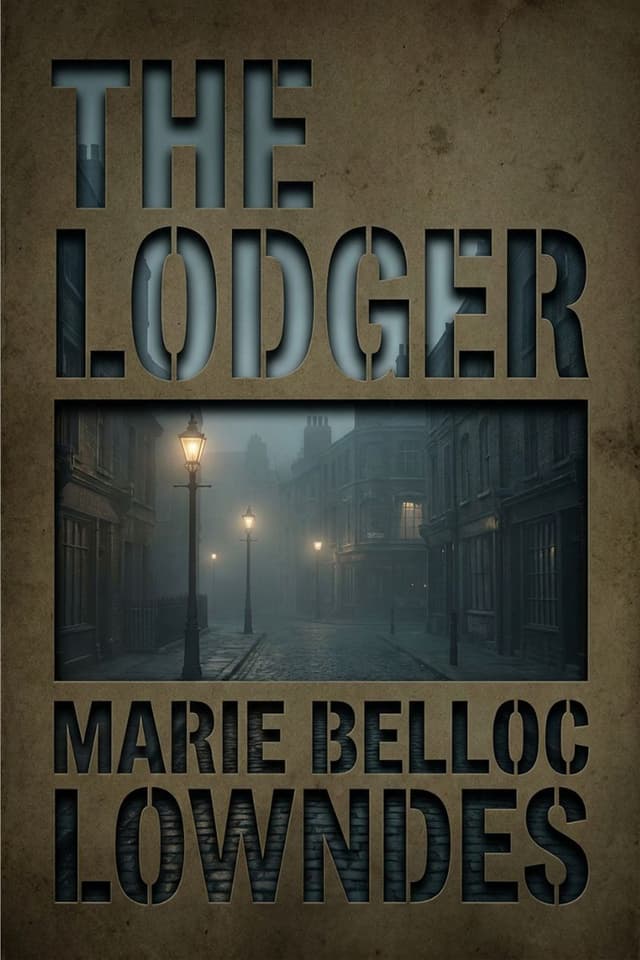
The Lodger
Read The Lodger by Marie Belloc Lowndes for free on Novelhalla, and try out our easy-to-read modern edition of this classic book. You can also download the EPUB and read it on any device if you prefer!
The Plot
The Last Pennies
Robert and Ellen Bunting are running out of time. The married couple, both former domestic servants, sank their savings into a London lodging house and have watched it fail. No tenants. No income. They've sold off their small comforts one by one, given up tobacco, started skipping meals. The fire in the grate is banked low to save coal, and the gas in the hallway stays dark because there's no point advertising rooms nobody wants. They sit in their painfully clean parlor on a bitter winter evening, each quietly trying to work up the nerve to tell the other it's over.
Then someone knocks at the door.
Mr. Sleuth
The man on the doorstep is tall, gaunt, and dressed in black. He speaks softly, almost trembling, and his manner is that of an educated gentleman. He wants rooms. All of them. He insists on being the only lodger. He will pay generously, in advance, with gold sovereigns.
His name, he says, is Sleuth.
Mrs. Bunting doesn't care that he has no luggage, no references, and no explanation for the pile of gold coins he carries. She doesn't care that he wants the pictures of pretty women in his room turned to face the wall. She doesn't care that he asks for a Bible and spends hours reading aloud from its darker passages. What she cares about is that Mr. Sleuth has, in a single evening, saved her and her husband from ruin.
He is, in every practical sense, an answer to prayer.
The Avenger
Meanwhile, London is gripped by terror. A killer the newspapers have dubbed "The Avenger" is stalking the streets, murdering women at night and leaving a triangular scrap of paper pinned to each body. The city is horrified and thrilled in equal measure. Mr. Bunting reads every detail in the papers with grim fascination. Mrs. Bunting would rather not hear about it.
But she can't help noticing things.
Mr. Sleuth goes out late at night, slipping down the stairs in rubber-soled shoes. He returns before dawn. He conducts strange "experiments" on the gas ring in his upstairs room. He mutters scripture about punishment and wickedness. And the mornings after his nighttime absences have a terrible habit of coinciding with fresh headlines about The Avenger.
Mrs. Bunting begins to suspect what no sane, respectable woman wants to suspect about the gentleman paying her rent.
The Silence
Here is where the novel becomes something extraordinary. Mrs. Bunting does not go to the police. She does not confront her lodger. She does not even tell her husband what she fears. Instead, she carries her suspicion alone, turning it over in her mind, rationalizing, doubting, dreading.
Because if she's right, and Mr. Sleuth is The Avenger, then reporting him means losing everything. The money. The house. Their reputation. They'd be known as the couple who harbored a murderer. No one would ever hire them again.
And if she's wrong? He'll leave. And they'll be back to starving.
So she says nothing. She brings him his meals. She tidies what he'll let her tidy. And she listens to the footsteps above her head, night after night, trying not to think about where those feet have been.
Daisy
Then the situation gets worse. Mr. Bunting's daughter from his first marriage, young Daisy, comes to stay. She's bright and pretty and eighteen, and Mrs. Bunting's blood runs cold at the thought of her under the same roof as Mr. Sleuth.
At the same time, a young police detective named Joe Chandler starts coming around. Joe is sweet on Daisy, and he's working the Avenger case. He sits in the Buntings' kitchen, cheerfully sharing details about the investigation, completely oblivious to the fact that his prime suspect may be eating breakfast one floor above him.
The tension becomes almost unbearable. Mrs. Bunting is caught between a detective who can't see what's in front of him and a lodger whose nighttime errands leave questions she doesn't dare answer. Her husband begins to share her unspoken fears. The couple circles each other's dread without ever putting it into words.
Madame Tussaud's
When Mr. Sleuth makes a sudden, strange request to take Mrs. Bunting and Daisy on an outing to Madame Tussaud's waxworks, the story lurches toward a reckoning. Inside those gaslit rooms, surrounded by wax figures of criminals and their victims, secrets have a way of surfacing.
What Mrs. Bunting overhears there changes everything she thought she knew about Mr. Sleuth. And what Mr. Sleuth believes about Mrs. Bunting may be even more dangerous than the truth.
The fog is thick outside. The lodger's gold is almost spent. And the question that has haunted this household from the very first knock on the door still hasn't been answered: What do you do when the person keeping you alive might be the most dangerous man in London?
About the Author: Marie Belloc Lowndes
A Literary Family
Marie Belloc Lowndes was born in 1868 in London's Marylebone district, but spent much of her childhood in France. Her family was remarkable. Her father was a French barrister, her mother an English feminist and magazine editor, her paternal grandfather a celebrated French painter, and her maternal great-great-grandfather was Joseph Priestley, the scientist credited with discovering oxygen. Her younger brother was Hilaire Belloc, who became one of the most prominent writers of the early twentieth century.
Lowndes considered herself French at heart, though she wrote in English and spent most of her adult life in London. She had her first story published at sixteen.
Marriage and Writing Life
In 1896, she married Frederick Lowndes, a journalist and editor at The Times. The couple worked opposite schedules that suited them both: he worked from afternoon to three in the morning, while Marie rose at five to write for several hours before the day began. In the afternoons and evenings, she entertained and dined with London's literary elite. Her circle included Henry James, Oscar Wilde, H.G. Wells, and Prime Minister Asquith.
She was a dedicated supporter of women's suffrage and served as President of the Women Writers' Suffrage League in 1913, the same year The Lodger was published. Unlike many of her contemporaries, she actively used her platform to advocate for women's rights.
A Prolific Career
Lowndes published roughly seventy books over a career spanning nearly fifty years, producing novels, plays, biographies, and memoirs at the rate of about one per year. She specialized in psychological suspense and crime fiction, often drawing from real-life criminal cases, though she resented being classified strictly as a crime writer.
Ernest Hemingway praised her insight into female psychology. Gertrude Stein was also a fan. The Lodger alone sold over a million copies in the decades following its publication.
Final Years
Frederick Lowndes died in 1940 after falling suddenly ill. Their London home was destroyed by bombing during World War II, and Marie retreated to the countryside. She continued writing almost until the end, completing her last works in 1946. She died in November 1947 at age seventy-nine, at the home of her elder daughter in Hampshire, and was buried in France, in the village where she had spent her childhood.
Fun Facts About the Book
Born at a Dinner Party
The idea for The Lodger came from a conversation Lowndes overheard at a dinner party around 1910. A fellow guest told the story of a butler and cook who had married and opened a lodging house, and who believed that Jack the Ripper himself had once spent a night under their roof before committing one of his murders. That single anecdote lodged in Lowndes's imagination and wouldn't let go.
Short Story First
The Lodger began as a short story published in the final issue of McClure's Magazine in 1911. Two years later, Lowndes expanded it into a full novel, which was serialized in The Daily Telegraph before being published as a book by Methuen in 1913. The novel allowed her to deepen Mrs. Bunting's psychological torment far beyond what the short story could contain.
The First Jack the Ripper Novel
The Lodger holds the distinction of being the first known novelization of the Jack the Ripper story. While penny dreadful stories about the Ripper had circulated in the years after the 1888 murders, Lowndes was the first to build a serious, psychologically complex fiction around the case. Every Ripper novel, film, and television series that followed owes her a debt.
A Composite Killer
Mr. Sleuth wasn't modeled on any single Ripper suspect. Lowndes drew on several real figures and theories: the physical appearance of Dr. Neill Cream (the Lambeth Poisoner), the behavioral profile assembled by psychiatrist L. Forbes Winslow, and the popular "lodger theory" that had circulated as urban legend since the 1880s. The result is a character who feels both specific and mythic.
The Hitchcock Connection
Alfred Hitchcock's 1927 silent film adaptation was his first true thriller and is widely considered the movie that launched his career as the "Master of Suspense." However, the studio forced Hitchcock to change the ending so that the lodger was innocent, because their star, Ivor Novello, couldn't be seen playing a murderer. Hitchcock always said he preferred the novel's ambiguity.
Million-Copy Bestseller
The Lodger became a massive commercial success, selling over a million copies in its first few decades. It was adapted for film at least five times, turned into a radio drama by Hitchcock for CBS in 1940, and even became an opera composed by Phyllis Tate in 1960.
Mrs. Bunting as Detective
Literary scholars have noted something unusual about the novel's structure: the real detective isn't the police officer, Joe Chandler, who is friendly but oblivious. It's Mrs. Bunting, a working-class woman with no authority, no resources, and no voice. She solves the mystery that eludes the entire Metropolitan Police, using nothing but domestic observation and quiet intelligence.
Themes
Complicity and Survival
The novel's most unsettling question isn't whether Mr. Sleuth is the killer. It's what Mrs. Bunting is willing to overlook to keep food on the table. Her silence isn't born of evil but of desperation, and Lowndes forces the reader to sit with the discomfort of understanding exactly why she doesn't speak up.
The Terror of Respectability
For the Buntings, the threat of social ruin is almost as frightening as the threat of violence. Being associated with a murderer would destroy their standing, their livelihood, everything they've built. The novel quietly shows how the obsession with respectability can become its own kind of prison.
What Goes Unsaid
The Lodger is a masterclass in silence. Husband and wife suspect the same thing but can't bring themselves to say it aloud. Mrs. Bunting and Mr. Sleuth share a house and a strange, unspoken understanding. The novel's tension comes not from what happens but from what everyone refuses to acknowledge.
Women's Invisibility and Power
Mrs. Bunting is overlooked by nearly everyone. Her husband is oblivious. The detective ignores her. Mr. Sleuth sees her only as a servant. But her invisibility is precisely what gives her access to the truth. Lowndes subtly argues that the systems designed to catch killers fail because they don't value what women see.
The Domestic and the Monstrous
The horror of The Lodger isn't set in dark alleys. It's set in a tidy parlor, a narrow staircase, a kitchen where breakfast trays are prepared. Lowndes understood that the most terrifying thing isn't a monster in the fog. It's the possibility that a monster is upstairs, and you're the one bringing him his tea.
The Book's Legacy
The Lodger essentially invented a genre. Before Lowndes, crime fiction focused on detectives solving puzzles. She shifted the lens to the ordinary people caught in the orbit of violence, the bystanders who must decide what they know, what they'll ignore, and what price they'll pay for their choices. That perspective influenced generations of psychological thriller writers.
The novel spawned at least five film adaptations, the most famous being Hitchcock's 1927 version, which is studied in film schools worldwide as a foundational work of cinematic suspense. The story was also adapted for radio and opera, and its influence echoes through every domestic thriller that asks the question: What if the danger isn't out there, but already inside your house?
The Lodger was a bestseller in its time and has experienced periodic revivals of interest, most recently as scholars have recognized Lowndes as a pioneering female voice in crime fiction, one who used the genre to explore women's limited options, the psychology of complicity, and the quiet power of domestic observation decades before these became fashionable literary themes.
For modern readers, The Lodger remains startlingly effective. Its slow-building dread, its refusal to sensationalize, and its compassionate but unflinching portrait of a woman trapped between conscience and survival make it feel less like a novel from 1913 and more like the kind of taut, psychologically rich thriller we think we only recently learned how to write.