Novelhalla
The English at the North Pole
Read The English at the North Pole by Jules Verne for free on Novelhalla, and try out our easy-to-read modern edition of this classic book. You can also download the EPUB and read it on any device if you prefer!
The Plot
A Ship Nobody Understands
In April 1860, half of Liverpool turns out on the wharves to watch a brig leave. She's called the Forward, and for three months she's been the only thing the city wants to talk about.
The reasons pile up fast. She was built at Birkenhead to a plan nobody's seen, with teak ribs plated in iron and a steel prow sharp enough to cut a three-decker in half. She carries no cargo except coal and food, six years' worth of both, plus sealskins, woollens, lime juice, ice saws, and enough blasting powder to level a customs house. Her crew were hired at five times the going rate on the condition that they be English, unmarried, sober, and, oddly, of a full-blooded constitution, on the theory that such men carry more heat in their bodies. There will be no beer and no spirits aboard.
And nobody knows where she's going. Richard Shandon is commanding her, but he isn't her captain. He took the job eight months ago on the strength of an anonymous letter from Aberdeen and sixteen thousand pounds sitting in a Liverpool bank, signed with two initials and nothing else.
The Dog
The letter also promised something else, and it arrived by rail in February: a large Danish dog, tawny with black stripes, surly, sinister, with the ship's name on his brass collar and a look in his eye that unsettles grown sailors.
He won't eat in front of anyone. He won't be tamed, not even by the ship's doctor, whose charm works on absolutely everyone else. He paces the poop on the windward side and changes his position when the brig changes tack, exactly as a captain would. He howls at night, miles out on the ice, and the men listen to it in the dark and start doing arithmetic they don't like. By the time the Forward clears the Mersey, half the crew have stopped joking about the dog-captain and the other half never started.
Then, as the last moorings drop and a thousand spectators watch, the dog bursts through the crowd, jumps onto the poop, and drops a letter at Shandon's feet.
Sailing Blind
The letter gives a heading and nothing else. Cape Farewell by April 20th, then across Davis's Straits and up into Baffin's Sea. No destination, no explanation, no captain.
So they sail. And the voyage north becomes one of the best sustained pieces of adventure writing Verne ever produced: the first iceberg, the icebergs by the hundred, the crow's nest lashed to the mizzenmast, the ice saws going day and night, the brig squeezing through a pass so narrow her yards scrape the walls on both sides. There's a Greenland trading post of three wooden huts and a governor who can't quite read. There are foxes and bears and a chase after a whale. There are the Crimson Cliffs, where the snow is genuinely red.
Aboard, Doctor Clawbonny is having the time of his life. He's a plump, unstoppable, endlessly talkative Liverpool scientist who signed on with no idea where the ship was headed and cheerfully didn't care, and he knows something about everything, including how to make a seabird taste like game. He is also, increasingly, the only reason the crew hasn't come apart.
Somebody Is Already Aboard
Because the letters keep coming. Shandon walks into his own locked cabin and finds a new one on the table, congratulating the crew on their courage during a crisis that happened the day before, and ordering the brig north into Smith's Straits, which is not the route to anywhere anyone sane wants to go.
The doctor draws the obvious conclusion and says it out loud. Shandon refuses to hear it. He has known every man on that crew for two years. He knows their faces and their names, and not one of them is a stranger.
And then, deep in Melville Bay, with the ice closing and the men on the edge of open revolt, the captain of the Forward steps forward and gives his name. It's a name the crew knows. It's a name that empties a room. Because John Hatteras has done this before, and the last time, he came home alone, on foot, across two hundred miles of ice, and every other man who sailed with him stayed behind forever.
What He Actually Wants
Hatteras is the only son of a London brewer who died leaving him a fortune he doesn't care about. He has no interest in the Northwest Passage, no interest in the Franklin search, no interest in trade or glory in any form that can be shared. What he wants is the Pole, and he wants it for England, and the thing that keeps him awake is that an American got closer to it than he did.
He believes, as a good many respectable geographers of the day believed, that beyond the ice lies an open polar sea. He intends to reach it. And he has arranged matters so that by the time his crew learn what they've signed up for, going back is more dangerous than going on.
What follows is the ice closing anyway. A winter that arrives early and hard. A sun that sets in October and won't come back until February. Coal that burns down toward nothing while the thermometer goes places the thermometer isn't supposed to go. A crew who took the job for money and are now doing sums about what money is worth out here. And a captain who has already decided, privately, exactly how far he's willing to push men who never agreed to be pushed this far.
Somewhere out on the ice there may be fuel. Getting to it means leaving the ship.
About the Author: Jules Verne
The Lawyer Who Wouldn't
Jules Gabriel Verne was born on February 8, 1828, in Nantes, a busy French seaport where ships came and went in front of him every day of his childhood. His father Pierre was a lawyer and expected his eldest son to become one too, so he packed Jules off to Paris to study law. Jules finished the degree and then never practiced a day. He'd fallen in love with the theatre instead, and spent his twenties writing plays and libretti, working as secretary of the Théâtre Lyrique, and quietly not telling his father what he was actually doing with his life.
The Stockbroker with a Library Card
He married Honorine de Viane, a widow with two daughters, in 1857, and took a job as a broker at the Paris exchange to pay for it. He wrote in the early mornings before work. The rest of his free hours went to the Bibliothèque Nationale, where he built the habit that would define his whole career: reading everything, on every subject, and taking notes. He wasn't inventing his science. He was researching it obsessively and then putting characters inside it.
In September 1862 a mutual friend introduced him to the publisher Pierre-Jules Hetzel, and everything changed. Hetzel published Five Weeks in a Balloon in 1863, signed Verne to a long contract demanding a punishing number of novels per year, and invented a name for the series they'd produce together: the Voyages Extraordinaires. Hetzel wasn't a passive publisher. He edited hard, pushed for optimism over pessimism, and killed at least one Verne novel outright.
The Amiens Years
The books made him rich and internationally famous. He bought yachts, sailed around Europe, crossed the Atlantic on the Great Eastern in 1867, and eventually settled in Amiens, his wife's home town, where he worked every morning with the regularity of a clerk and served on the municipal council. His personal life was harder than the public image. His son Michel was a long-running source of grief. In 1886 his nephew Gaston, suffering from mental illness, shot him in the leg over money, and Verne limped for the rest of his life. Hetzel died a week later. His mother died the year after.
The Dark Turn
The later novels get colder. Technology stops being a wonder and starts being a threat. He kept writing anyway, and kept selling, and by the end had produced more than sixty books in the series. He died at home in Amiens on March 24, 1905, at seventy-seven. He's now among the most translated authors who has ever lived, second only to Agatha Christie, and the phrase "father of science fiction" gets attached to him roughly as often as it gets attached to H. G. Wells.
Fun Facts About the Book
This Is Where the Whole Thing Starts
Hetzel built the Voyages Extraordinaires around this novel and used it as the flagship serial for his new family magazine, the Magasin d'éducation et de récréation, beginning in 1864. Verne had it underway before he finished Journey to the Centre of the Earth. Confusingly, it ended up numbered second in the sequence, because three earlier Verne books were folded into the series retroactively once the series existed. The first book of the Voyages Extraordinaires is the second book of the Voyages Extraordinaires.
It's Half a Novel
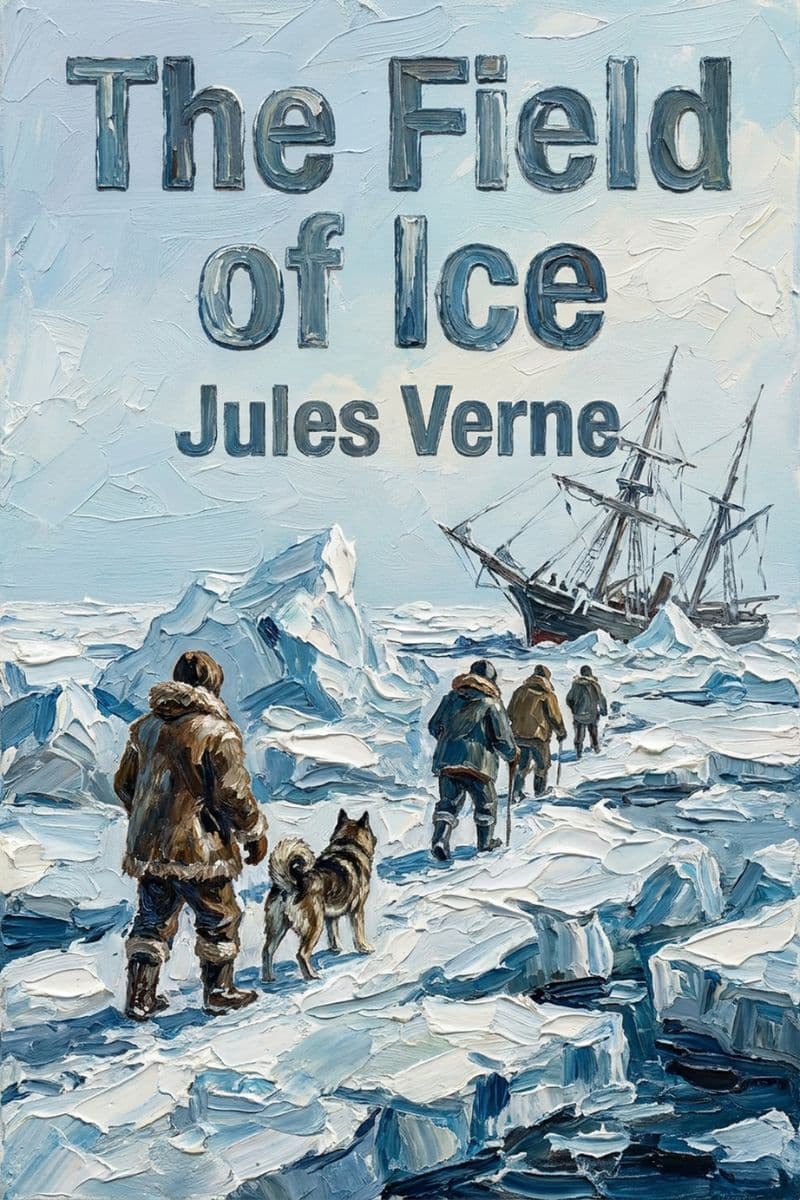
English publishers cut Verne's single novel in two and sold the halves separately. This is part one. Part two runs under the title The Field of Ice in Britain and The Desert of Ice in America, both published in 1874, both translated from the same French original by different hands. Verne wrote one book. The English-speaking world got three titles out of it.
The Fox with the Collar Is Real
When the crew shoot a white fox and find a worn brass collar under its fur, that isn't invention. James Clark Ross really did trap Arctic foxes during his wintering, rivet engraved collars around their necks naming his ships the Enterprise and Investigator and the locations of his supply depots, and turn them loose in the hope that one might reach Franklin's starving men. Verne found that in the record and put it in the book almost unchanged.
The Crew Is Exactly the Size of a Real One
Eighteen men, and Verne makes the boatswain point out why: that's precisely the complement Elisha Kent Kane took north aboard the Advance in 1853, on the American expedition that reached 82 degrees and made Hatteras's life a misery. The whole novel is stitched together like this, with real voyages, real latitudes and real names load-bearing on nearly every page.
The Timing Is Deliberate
The story opens in April 1860, months after McClintock returned from the Arctic with the first hard proof of what happened to Franklin. Verne is writing into a moment when the search was over, the grief was fresh, and the question of what lay further north was still completely open. Half the tension in the early chapters comes from Liverpool trying to work out what possible reason anyone could have for going back.
The Only Frenchman Is a Real Dead One
Verne wrote a novel about English and American polar ambition and gave it no French hero. The one Frenchman who matters is Joseph René Bellot, a real naval lieutenant who died in the Arctic in 1853 while searching for Franklin, and whose death Verne folds into the story through a character who was actually there. It's a quiet piece of tribute in a book otherwise dedicated to English pride.
Verne Never Saw Any of It
Every glacier, hummock, ice-blink and red-snow cliff came out of a library. He worked from Parry, Ross, Franklin, Kane, McClure, McClintock and Belcher, in French translation, because he couldn't read English. He then had his characters cite those same sources aloud, which turns the novel into a strange hybrid of adventure story and annotated bibliography, and somehow makes it better rather than worse.
The Hiring Terms
The recruitment conditions in the mystery letter are worth reading twice: English only, bachelors only, teetotal, and preferably men of sanguine constitution because they generate more body heat. Five times normal wages, rising ten percent a year, with five hundred pounds waiting at the end. Verne understood that the most efficient way to make a reader nervous is to show them what a job pays.
A Long Wait for a Good Translation
The Victorian English versions were rushed, anonymous and frequently abridged, which is part of why this book stayed in the shadow of Verne's famous titles for so long in the English-speaking world. Oxford World's Classics eventually issued a new unabridged translation, the first in more than a century, and readers who'd written the book off went back to it.
Themes
Obsession Wearing a Uniform
Hatteras isn't ambitious in the ordinary way. He's possessed, and the novel is unusually clear-eyed about what that costs other people. He conceals his identity for one reason: because telling the truth would have meant sailing alone. Verne lets you admire the man's iron and be appalled by his methods, often in the same paragraph.
Authority Without a Face
For a third of the book the crew are obeying somebody who doesn't appear to exist. Orders arrive from nowhere. A dog seems to be the ranking officer. It's a genuinely eerie setup, and it lets Verne ask what discipline actually rests on: the man, the money, or the habit.
What Loyalty Costs
The crew were bought. They said yes to a mystery because the wages were absurd, and the novel keeps returning to the moment when the arithmetic flips and no amount of money is worth another mile north. Verne doesn't sneer at them for it. The men who want to turn back have reasons, and he gives them their say.
National Pride as a Motive Force
The engine of the plot is not science. It's that an American got closer to the Pole than an Englishman did. Verne, a Frenchman, watches that rivalry from the outside with something between amusement and alarm, and treats it as exactly what it is: a real force, as powerful as hunger and considerably less rational.
Curiosity as a Way of Living
Clawbonny is the counterweight to everything grim in the book. He signs on without knowing the destination because there might be something to learn there. He cooks the seabird nobody will eat. He reads about the ice while standing on it. In a story about a man consumed by one question, he's the argument for being interested in all of them.
The Ghosts of the Map
Every cape in these waters is named for someone's disaster, and the doctor notices: Cape Farewell, Cape Desolation, Repulse Bay, Turnagain Point. Verne turns the chart itself into a memorial, and the presence of Franklin's dead sits over the whole voyage like weather.
Historical Context
Two real obsessions run directly under this book.
The first is Franklin. Sir John Franklin sailed in 1845 with the Erebus and the Terror to find the Northwest Passage and vanished with every man aboard. The search consumed British and American attention for over a decade, cost enormous sums, and mapped huge stretches of the Arctic almost by accident. McClintock came back in 1859 with the proof. Verne starts his story a few months later.
The second is the open polar sea. It sounds absurd now, but for much of the 1800s serious geographers argued that the ring of pack ice enclosed a warm, navigable ocean at the top of the world. Matthew Fontaine Maury and August Petermann theorized it from ocean currents. Elisha Kent Kane and Isaac Israel Hayes reported open water and fed the optimism. Explorers pushed north for decades on the strength of it, and the idea wasn't really finished off until the 1880s, when George De Long's Jeannette went looking for the gateway and was crushed by ice instead.
Hatteras isn't a crank. He's a man betting his life on the best available science of 1860, which happened to be wrong.
The Book's Legacy
This is the novel that set the template. The formula Verne locked in here, exhaustive real-world research wrapped around a driven protagonist and a genuinely lethal journey, is the one that produced Twenty Thousand Leagues Under the Sea, Journey to the Centre of the Earth and Around the World in Eighty Days. Everything downstream starts on this brig.
Its most famous adaptation is Georges Méliès's 1912 silent film The Conquest of the Pole, one of the last major works by the man who made A Trip to the Moon. Méliès borrowed loosely, added a man-eating frost giant, and produced something now regarded as one of his masterpieces even though it lost money and helped ruin him. Beyond that the story has been strikingly under-adapted, which is either an oversight or an opportunity.
Among Verne readers it has a particular standing. It's colder and stranger than his crowd-pleasers, and Hatteras belongs to the small, distinguished company of literary captains destroyed by the thing they're chasing, arriving there a decade after Ahab and a generation after Poe sent Arthur Gordon Pym toward a polar mystery of his own.
It also survives as something Verne never intended: a working portrait of Arctic knowledge as it stood in 1864, written with total sincerity by a man who had read every account he could find and never once set foot on the ice.