Novelhalla
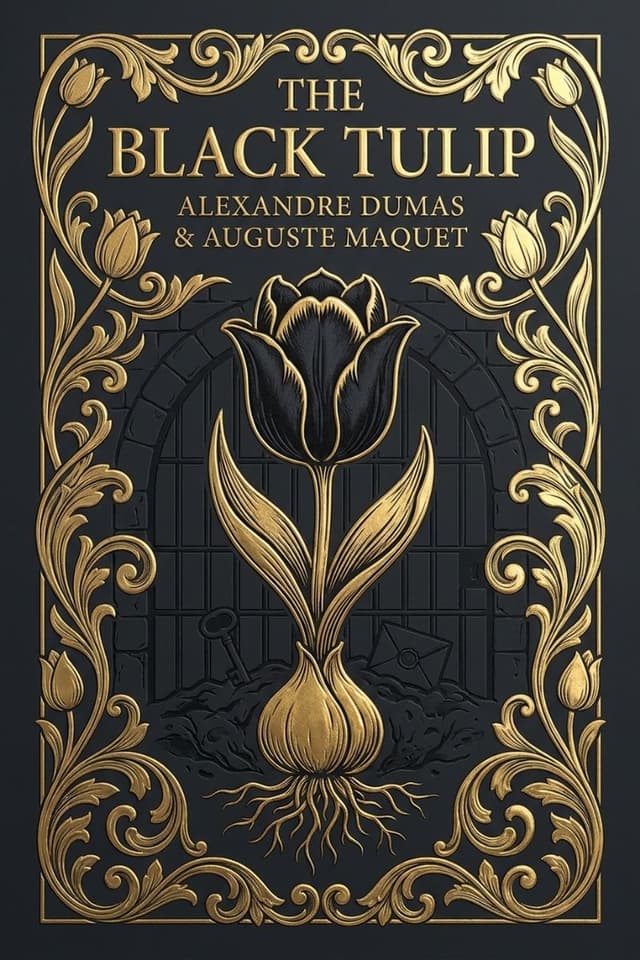
The Black Tulip
Read The Black Tulip by Alexandre Dumas and Auguste Maquet for free on Novelhalla, and try out our easy-to-read modern edition of this classic book. You can also download the EPUB and read it on any device if you prefer!
The Plot
The Day the Republic Went Mad
It opens on the worst afternoon in Dutch history.
August 1672. The French army is inside the country, the English are on the water, and the Dutch Republic is falling apart so fast the people have coined three rhyming words for the state of things: the citizens are irrational, the government is helpless, the nation is beyond saving. Somebody has to be blamed, and the crowd in The Hague has picked its men.
Johan de Witt has run the Republic for twenty years. His brother Cornelis is in the prison at the Gevangenpoort, having been tortured without confessing to a thing. When Johan walks in to collect him, the mob is waiting outside, the cavalry that should be guarding the gate has quietly been ordered elsewhere, and the young Prince of Orange is somewhere out of sight, not stopping any of it.
What the crowd does to those two men that afternoon is one of the ugliest things that ever happened in a civilized European capital, and this book does not look away from it.
The Man Who Wasn't Paying Attention
Twenty miles away in Dordrecht, a young man named Cornelius van Baerle has no idea any of this is happening.
He's a doctor by training, rich by inheritance, and completely uninterested in the world outside his own garden. He has never voted, never argued politics, never wondered which faction is up or down. What he has is tulips. Rare ones, beautiful ones, varieties he's coaxed into existence himself, and one obsession that has eaten his entire life.
The Horticultural Society of Haarlem has offered a hundred thousand guilders to whoever can grow a tulip that is truly black. Not dark red. Not deep violet. Black, like jet, like nothing that has ever existed on this earth. Everyone agrees it can't be done, and van Baerle is quietly, methodically, going to do it anyway. He has three bulbs from a cross he's spent years working toward, and he believes with his whole heart that what's sleeping inside them is the black tulip.
One thing he's forgotten. His godfather, the man he's named after, the man who dandled him as a child, is Cornelis de Witt.
And shortly before everything comes apart, that godfather stops by and leaves a small packet of papers in his keeping. Van Baerle doesn't read them. He doesn't ask what they are. He puts them somewhere safe and goes back to his bulbs.
The Neighbor With the Telescope
Isaac Boxtel grows tulips too.
He lives next door, and for years he had a respectable little reputation. Then van Baerle got interested in flowers, and van Baerle had money, land, and an unfair natural gift for it, and Boxtel watched himself get quietly annihilated by a man who wasn't even trying to compete with him. When van Baerle put up a new building that threw Boxtel's beds into permanent shade, Boxtel couldn't even complain. You don't sue a van Baerle in Dordrecht.
So Boxtel stopped growing anything. He bought a telescope instead, and pointed it over the wall, and now he spends every hour of daylight watching his neighbor's garden with an attention that has gone somewhere well past hatred.
Which means Boxtel knows about the three bulbs. He knows what they might be worth. And through that telescope, on a very interesting day, he has also seen exactly where a certain packet of papers went.
There is a mob loose in Holland right now with an appetite for traitors, and all Boxtel has to do is point.
Three Bulbs and a Cell
Van Baerle is arrested for treason, a charge so far outside his understanding of his own life that he can barely follow the questions. His property is seized. His flowers are trampled. Everything he built is being taken apart by people who don't know what any of it was for.
He gets one moment of warning, and in that moment he doesn't grab money or papers or anything sensible. He grabs the three bulbs, wraps them in a page torn from his godfather's Bible, and hides them on his body.
Where he ends up is Loevestein, a state fortress out where the rivers meet, and his jailer is a brute named Gryphus who has decided that his job description includes making this particular prisoner suffer. There is no soil in a cell. No sunlight worth the name. No time, no tools, and no reason on earth for a condemned man to be thinking about flowers.
Then Gryphus's daughter comes to the door.
Rosa is nineteen, kind, sharper than anyone in that fortress suspects, and she cannot read a word. What she can do is get into rooms her father can't watch, and carry things, and keep a secret. Between the two of them there's a plan taking shape that involves a windowsill, some smuggled earth, a lot of lying to a violent man, and the most valuable object in the Dutch Republic sitting in the middle of the last place anyone would look for it.
But Boxtel didn't stop at the arrest. He's still out there. He still has the telescope, and he has worked out that his rival is not finished, and he is willing to go further than anyone has yet realized to make sure that when a black tulip finally opens in Holland, it opens with his name attached to it.
Somewhere in a locked room, three bulbs are waiting to become something impossible. And two of them are already gone.
About the Authors
Alexandre Dumas: The General's Son
Dumas was born in 1802 in Villers-Cotterêts, and his family history reads like one of his own novels. His grandfather was a French marquis in the colony of Saint-Domingue. His grandmother, Marie-Cessette Dumas, was an African woman the marquis enslaved. Their son Thomas-Alexandre took his mother's surname, joined the French army in 1786 as a private, and by 1793 had risen to full general, the highest rank ever reached in a European army by a man of his descent.
He then made an enemy of Napoleon, spent two years in a foreign prison, and came home broken. He died in 1806, when his son Alexandre was three, leaving the family with nothing.
The boy grew up poor in a town that remembered his father as a hero. He had almost no formal education, but he had extraordinary handwriting, and that was enough to get him a clerk's job in Paris with the household of the future king.
Alexandre Dumas: The Machine
He broke through in the theater. Henri III and His Court in 1829 made him one of the leaders of French Romantic drama at twenty-seven, and for a decade he wrote plays.
Then came the serialized newspaper novel, and Dumas became the most productive engine in the history of popular fiction. The Three Musketeers in 1844. The Count of Monte Cristo the same year. Twenty Years After in 1845. Queen Margot. The Vicomte de Bragelonne. Dozens more.
He made a fortune and spent it faster than it came in, on houses, on parties, on an unending succession of mistresses, on a theater of his own, and on an actual castle at Port-Marly that he named after his most famous book. By 1851 the money was gone, the theater had failed, and he fled to Brussels to escape his creditors. He spent his later years traveling, running a newspaper in Naples, throwing himself into the fight for Italian unification alongside Garibaldi, and writing, always writing, to stay ahead of what he owed.
He died on December 5, 1870, at his son's house near Dieppe, with the Prussian army advancing through France. In 2002 his remains were moved to the Panthéon in Paris, carried in a coffin flanked by four Republican Guards dressed as Athos, Porthos, Aramis, and d'Artagnan.
Auguste Maquet: The Other Name
Maquet was born in Paris in 1813, the son of a prosperous industrialist. He was a serious student who became a professor of history at the Lycée Charlemagne at eighteen, then abandoned the classroom for the bohemian literary world, publishing under the pen name Augustus MacKeat and running with Théophile Gautier and Gérard de Nerval.
He approached Dumas in 1838, and the partnership that followed produced eighteen novels.
The division of labor was roughly this. Maquet, the trained historian, dug through the archives, worked out the plot, and wrote a first draft of the chapters. Dumas took that draft and rewrote it into the prose that made the world fall over, adding the dialogue, cutting characters, adding characters, and giving it the pace nobody has ever matched. Both men were essential. Only one name went on the cover.
The Break
It held for years, and then it didn't. Maquet was paid by the chapter and later by flat fee, never by royalty, while Dumas's name sold the books. When Dumas's finances collapsed in the early 1850s, Maquet's payments dried up with them.
Between 1856 and 1858 he sued three times. The first for unpaid fees. The second for a share of the royalties. The third and largest, in February 1858, asked a Paris court to put his name on the covers of the eighteen books he had helped write.
The judge ruled against him. He'd signed contracts that gave him money and no credit, and the contracts held.
Maquet went on writing his own work, outlived Dumas by eighteen years, and died in Paris in 1888. He's buried in Père Lachaise. His heirs kept a closer eye on the accounts than he had, and in the early twentieth century they successfully sued for money still owed on the novels.
Fun Facts About the Book
The Opening Massacre Is Real
Everything in the first chapters happened. Johan and Cornelis de Witt were taken by a mob at The Hague on August 20, 1672, and what was done to their bodies afterward is so extreme that people frequently assume Dumas invented it for effect. He didn't. A painting of the aftermath, attributed to Jan de Baen, still hangs in the Rijksmuseum as one of the highlights of the Dutch national collection.
The Flower Still Doesn't Exist
Nobody has ever grown one. Not in 1672, not now. The famous near-black varieties, including the celebrated Queen of the Night, are deep purple or oxblood that reads as black in low light and gives itself away the moment the sun hits it. Dutch breeders have been chasing the true thing for well over a century. The flower at the center of this novel remains, botanically speaking, fiction.
The Novel Helped Create Its Own Legend
Growers have long credited Dumas with kicking off the modern hunt. Nineteenth-century breeders read the book, caught the obsession, and started crossing toward the darkest flower they could produce. The cultivars that exist today with names like Black Parrot and Black Beauty are, in a real sense, descendants of a novel.
Dumas Wrote It Broke
This came out in 1850, right at the point where the money was collapsing. The theater was going under, the château was about to be sold, and within a year he'd be over the border in Brussels dodging creditors. Some readers hear that in the book: it's shorter, tighter, and more focused than the sprawling adventures, and its hero is a man who loses absolutely everything and keeps working on the one thing he still has.
It Wasn't Just Dumas
Maquet's hand is in this one as it is in the more famous books, which is why he shares the credit here. The historical scaffolding, the 1672 politics, the archive work behind the de Witt chapters, that was his department.
The Most Famous Movie Has Nothing to Do With It
If you search for La Tulipe Noire you'll find a 1963 film starring Alain Delon, and it's a good time, but it borrowed the title and essentially nothing else. It's closer to The Scarlet Pimpernel. Several genuine adaptations exist, going back to a Dutch and British co-production in 1921.
The Prison Was Real
Loevestein was an actual fortress at the confluence of the Waal and the Meuse, used by the Dutch as a state prison for exactly the kind of political prisoner van Baerle is taken for. It still stands, and you can visit it.
Dumas Wrote About Race Elsewhere
Seven years before this book, Dumas published Georges, a novel dealing directly with European racism, a subject he had personal reasons to think about as the grandson of an enslaved woman and the son of a general who was pushed out of the army partly because of it.
Themes
Obsession as a Way of Life
Van Baerle's whole existence is organized around a flower that might not be possible. Dumas doesn't mock him for it. The book takes seriously the idea that a person can pour their entire soul into something small and useless and beautiful, and that this is not a waste but the thing that makes them worth saving.
Envy, Close Up
Boxtel is one of the great portraits of jealousy in fiction, and what makes him frightening is how understandable he is at the start. He isn't evil. He's a competent man watching a richer, luckier man beat him at his own craft without effort, and the book follows the exact steps by which a legitimate grievance rots into something monstrous.
Politics You Didn't Choose
Van Baerle never picked a side. He's not a republican or an Orangist. He was simply born into a family, and the family had a name, and in a year when a country needs traitors, that's enough. The novel is about how completely private a life has to be before politics can't reach it, and the answer is that no life is that private.
The Mob
Dumas opens with an entire city losing its mind, and he never lets you forget it's the same people the rest of the book is populated with. Ordinary Dutchmen, neat and thrifty and law-abiding, who on one particular afternoon did something unspeakable. Everything that happens to van Baerle happens downstream of that.
What Rosa Learns
The most quietly radical thing in the novel is a nineteen-year-old jailer's daughter learning to read. Cornelius teaches her because they need to exchange notes, but Dumas makes it clear that this is the real transformation happening in the fortress. Literacy is power, and Rosa acquires it in a place designed to strip power away.
Love Under Surveillance
The romance here is conducted through a grate, in whispers, at the risk of a beating for one of them and something worse for the other. There's no privacy, no touching, and almost no time, and the constraint makes it more intense rather than less. Dumas understood that the best love stories are the ones where every single word costs something.
Historical Context
Why 1672 Broke Holland
The Dutch Republic in the seventeenth century was the wealthiest, most sophisticated commercial society in Europe, run not by a king but by a merchant class through a Grand Pensionary. Johan de Witt held that job for two decades and was very good at it.
Then in 1672 France, England, and two German states attacked at once. The navy performed brilliantly. The army was overrun almost immediately. Within weeks the Republic was in genuine danger of ceasing to exist, and twenty years of resentment against the merchant oligarchy came out all at once in favor of the young Prince of Orange, who was standing right there ready to be handed the country.
Van Baerle is arrested in the two or three weeks when the whole thing was up in the air, which is exactly the sort of window Dumas loved to write in.
The Tulips
The other piece of context is that Holland had already gone insane over these flowers once before. In the 1630s, tulip bulbs were traded at prices that could buy houses, until the market collapsed in 1637 and took a lot of people with it. By 1672 the mania was history but the prestige was not, and a hundred thousand guilders for an unprecedented bloom was the kind of prize a whole country would follow.
The Book's Legacy
This is the short, strange, perfect one. It doesn't have the length of Monte Cristo or the swagger of the Musketeers, and for a long time that made people underrate it. What it has instead is one of the tightest premises Dumas ever built: a wrongful imprisonment story, a revenge story, a romance, and a gardening story, all fitted into each other so neatly that pulling out any one of them collapses the rest.
It has been adapted for film and television repeatedly since 1921, and generations of European schoolchildren have read it as their first Dumas, because it's the one that fits in a term.
Its strangest legacy is horticultural. A novel about a flower that doesn't exist sent real breeders into a century-long hunt for it, and the darkest tulips in the world today are on nursery shelves partly because a broke French novelist and a historian he wouldn't credit decided in 1850 to make one up.
And the comparison people always reach for is right. Van Baerle is Edmond Dantès with a trowel. Same wrongful arrest, same envious neighbor, same fortress, same years disappearing. But where Monte Cristo is a book about revenge, this one is a book about a man who gets thrown into a hole and decides to spend his time in it growing something beautiful. It's a much rarer thing to write, and Dumas only really did it once.