Novelhalla
The Picture of Dorian Gray
Read The Picture of Dorian Gray by Oscar Wilde for free on Novelhalla, and try out our easy-to-read modern edition of this classic book. You can also download the EPUB and read it on any device if you prefer!
The Plot
The Portrait
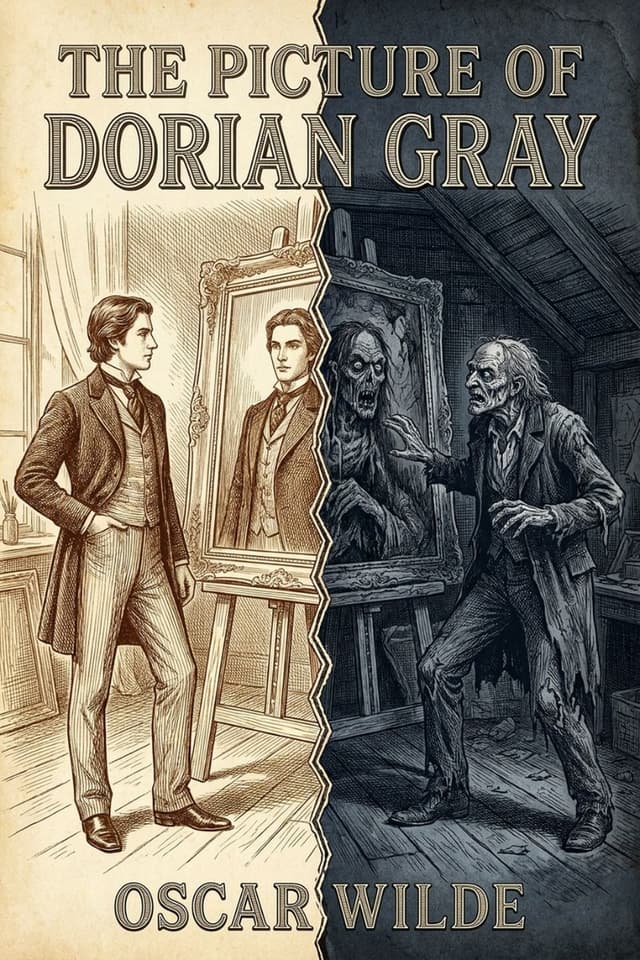
Dorian Gray is young, beautiful, and completely unaware of his own power. He sits for a portrait in the studio of Basil Hallward, a painter who is utterly captivated by him. Basil believes Dorian's face has unlocked something in his art, something he's never been able to paint before. The portrait is a masterpiece. Everyone who sees it knows it.
But there's someone else in the room. Lord Henry Wotton, Basil's witty and dangerously charming friend, takes one look at Dorian and decides to make a project of him. Henry believes that youth and beauty are the only things worth having in life, that pleasure is the highest pursuit, and that morality is just a word dull people use to make interesting people feel guilty. He says all of this to Dorian. He says it beautifully.
And Dorian listens.
Standing before the finished portrait, Dorian feels something shift inside him. The painting will always be young. The painting will always be beautiful. He will not. He makes a wish, half-desperate, half-careless: let the portrait grow old instead of him. Let the canvas bear the weight of time.
He doesn't know what he's just done.
The Actress
Dorian falls in love with Sibyl Vane, a young actress performing Shakespeare in a shabby little theater in the East End. She's extraordinary on stage, luminous, transforming herself into Juliet and Rosalind and Portia with a conviction that takes his breath away. He's enchanted. He brings Basil and Lord Henry to see her perform.
She's terrible. She's in love now, really in love, and she tells Dorian she can no longer pretend to feel emotions on stage because she finally feels them in life. The art has left her.
Dorian is horrified. He didn't love the girl. He loved the performance. And what he does next, what he says to her, is cruel enough to send him running home to the portrait. Where he notices the first change. The mouth in the painting has shifted. There's something hard there now. Something that wasn't there before.
He's shaken. He resolves to make things right with Sibyl. He'll go to her, apologize, marry her as he promised. But the next morning, Lord Henry arrives with news that changes everything.
The Descent
Years pass. Dorian doesn't age. The portrait does.
He hides the painting away in a locked room at the top of his house, and he begins to live. He collects beautiful things. He studies perfumes, jewels, music, embroidery, the decorative arts of centuries. He reads a poisonous yellow-backed French novel that Lord Henry gives him, and it becomes a kind of bible for his new life, a story of a young man who devotes himself entirely to sensation and experience.
London society watches Dorian with a mixture of fascination and unease. He moves through ballrooms and drawing rooms and dinner parties looking impossibly young, impossibly perfect. But rumors begin to follow him. Men who spend time with Dorian seem to come to ruin. Reputations are destroyed. Lives unravel. No one can prove anything, and Dorian's angel face makes accusations feel absurd.
Only the portrait knows the truth. And the portrait is becoming something terrible.
The Reckoning
Basil Hallward, who has heard the rumors but refuses to believe them, confronts Dorian directly. He can't reconcile the boy he painted with the monster people describe. He wants to know the truth.
Dorian shows him.
What happens in that locked room changes everything. And it sets Dorian on a path he cannot walk back from. He needs help disposing of something, and the only person he can turn to is a man whose life he has already destroyed, a former friend who now has every reason to hate him and no power to refuse.
Meanwhile, someone from Dorian's past is hunting for him. Someone with a very personal reason to want him dead. And the yellow fog of London is full of places where a man can disappear, opium dens and dockside shadows where Dorian goes to forget what he's becoming.
The portrait waits in its locked room. It has been patient for eighteen years. The question is whether Dorian can live with what it shows him, and what happens when he finally decides he can't.
About the Author: Oscar Wilde
Early Life
Oscar Wilde was born in Dublin in 1854 to extraordinary parents. His father, Sir William Wilde, was Ireland's leading eye and ear surgeon and a prolific writer on archaeology and folklore. His mother, Jane Wilde, was a poet and fierce Irish nationalist who wrote under the pen name Speranza and hosted one of Dublin's most celebrated literary salons. Oscar and his older brother Willie grew up listening to the conversations of artists and intellectuals at their parents' dinner table. His younger sister Isola died at ten, a loss that haunted him for life.
Education
Wilde was a brilliant student from the start. He won a scholarship to Trinity College Dublin, where he excelled in classics and won the Berkeley Gold Medal for Greek. From there he went to Magdalen College, Oxford, on another scholarship, where he fell under the influence of John Ruskin and Walter Pater, two thinkers who shaped his ideas about beauty, art, and how to live. He won the Newdigate Prize for poetry, cultivated a reputation as a wit and a dandy, and graduated with first-class honors.
Fame
After Oxford, Wilde settled in London and set about becoming the most talked-about man in England. He lectured across America in 1882, married Constance Lloyd in 1884, and had two sons. He edited a women's magazine, published fairy tales, wrote essays and criticism, and then, starting in the early 1890s, produced a stunning run of work: his only novel, four sparkling comedies, and some of the most quotable prose in the English language. By 1895, he had two plays running simultaneously in the West End and was arguably the most famous writer in the English-speaking world.
The Fall
It ended with terrifying speed. Wilde's relationship with Lord Alfred Douglas, a young aristocrat he called Bosie, drew the fury of Douglas's father, the Marquess of Queensberry. When Queensberry publicly accused Wilde, Wilde sued for libel. The case collapsed, and Wilde was arrested, tried, and convicted of gross indecency. He was sentenced to two years of hard labor. In prison he wrote De Profundis, a long, devastating letter to Douglas. After his release in 1897, Wilde left England for good, living in poverty in France and Italy under an assumed name. He wrote one final major work, The Ballad of Reading Gaol, and died in Paris on November 30, 1900, at the age of forty-six.
Fun Facts About the Book
Wilde's Only Novel
Wilde wrote plays, poems, fairy tales, essays, criticism, and short stories. But he only ever wrote one novel. He poured into it his philosophy of art, his fascination with beauty and corruption, and enough of himself that he later said Basil Hallward was what he thought he was, Lord Henry was what the world thought he was, and Dorian was what he wanted to be.
The Dinner That Started It All
The novel exists because of a dinner. In 1889, an American publisher named J.M. Stoddart took Oscar Wilde and Arthur Conan Doyle out for dinner in London to commission stories for Lippincott's Monthly Magazine. Doyle went home and wrote The Sign of the Four. Wilde went home and wrote Dorian Gray. One dinner, two masterpieces.
The Scandal
When the story was published in Lippincott's in 1890, critics were vicious. They called it unclean, poisonous, and nauseating. The influential bookseller W.H. Smith refused to stock the issue. Reviewers warned that the story would corrupt young readers. Much of the outrage centered on the novel's homoerotic undertones, which Wilde's publisher had already tried to censor before publication, cutting about 500 words from the manuscript.
The Revised Edition
Undeterred by the backlash, Wilde expanded the novel from thirteen chapters to twenty, added six new chapters and a preface, and published the book edition in 1891. The preface is a series of brilliant aphorisms about art that doubled as a preemptive defense against moral criticism. It includes one of Wilde's most famous lines: that all art is quite useless.
Used Against Him
The novel came back to haunt Wilde. During his 1895 trials, passages from Dorian Gray were read aloud in court as evidence of his character. The prosecution pointed out that Wilde had revised the novel after its initial publication, calling the changes a kind of purging that proved he knew the content was indecent. The novel that was supposed to demonstrate that art exists beyond morality was used as a moral weapon against its creator.
The Portrait's Inspiration
Wilde himself told the story of how the idea came to him. In 1887, he sat for a portrait by a Canadian artist. When the sitting was finished, he looked at the painting and said, half-joking, that it was tragic the portrait would never grow older while he would. The moment the words left his mouth, he realized he had the plot for a story.
The Yellow Book
The mysterious French novel that corrupts Dorian is never named in the text, but Wilde confirmed it was inspired by Joris-Karl Huysmans' À Rebours (Against Nature), a real novel about a French aristocrat who retreats from society to pursue increasingly exotic sensory experiences. It was a landmark of the Decadent movement and clearly fascinated Wilde.
Themes
Art and Morality
The novel's central philosophical argument, delivered through Lord Henry's witticisms and Wilde's preface, is that art and morality occupy separate territories. A book is neither moral nor immoral, Wilde insists. It is well written or badly written. The irony is that the novel itself seems to prove the opposite: Dorian's life becomes a kind of art project, and the results are monstrous.
The Price of Eternal Youth
Dorian gets exactly what he wishes for, and it destroys him. The novel treats eternal youth not as a gift but as a curse, a way of escaping consequences that ultimately makes consequences inescapable. Without the visible marks of experience, Dorian becomes disconnected from his own life. He can do anything because nothing leaves a trace on him. Only on the canvas.
Influence and Corruption
Lord Henry's influence over Dorian is the engine of the story. He doesn't tell Dorian to do terrible things. He simply gives him a philosophy that removes the guardrails. The novel asks whether the person who plants an idea bears responsibility for what grows from it, and whether some people are simply waiting to be corrupted.
Surface and Depth
Wilde was obsessed with the relationship between appearances and reality. Dorian's beautiful face hides a rotting soul. The portrait, hidden away in darkness, tells the truth no one wants to see. Victorian society judges entirely by surfaces, which is exactly why Dorian gets away with everything for so long.
The Double
The portrait is Dorian's other self, the version of him that records what he refuses to acknowledge. It functions like a conscience made visible, a mirror that reflects not what he looks like but what he is. The horror of the novel is not just that the portrait changes. It's that Dorian keeps going back to look at it.
Sin and Self-Destruction
For all Lord Henry's talk about living without guilt, the novel traces a clear arc of corruption. Each transgression makes the next one easier. Each cruelty costs Dorian something he doesn't realize he's losing. The question is not whether sin has consequences but whether those consequences can be outrun.
Side Characters
Lord Henry Wotton
Lord Henry is one of literature's great tempters, not because he's evil but because he's entertaining. He speaks almost entirely in paradoxes and epigrams, turning conventional wisdom inside out with such elegance that you find yourself nodding along before you realize what you've agreed to. He never does anything terrible himself. He simply makes terrible things sound delightful.
Basil Hallward
The painter who creates the portrait and adores Dorian with an intensity that frightens him. Basil represents everything Lord Henry does not: sincerity, moral seriousness, genuine love. He believes beauty and goodness must go together. The novel tests that belief to destruction.
Sibyl Vane
A young actress from the London slums whose talent is inseparable from her innocence. She calls Dorian "Prince Charming" and believes in romance the way she once believed in Shakespeare's heroines. She is the first person Dorian destroys, and her fate is the first mark on the portrait.
James Vane
Sibyl's brother, a sailor who swears to protect his sister and avenge any harm done to her. He disappears from the story for years and then returns at exactly the wrong moment, a ghost from Dorian's past who represents the one thing Dorian can never fully escape: accountability.
The Book's Legacy
The novel has been adapted for film and television over thirty times since the first silent film version in 1910, making it one of the most frequently adapted works in English literature. The 1945 film starring Hurd Hatfield and George Sanders remains the most celebrated version, with its striking use of Technicolor for the portrait against an otherwise black-and-white film. More recent adaptations include the 2009 film with Ben Barnes and Colin Firth and a 2020 version reimagining Dorian in the age of social media.
Beyond film, the novel has inspired operas, musicals, graphic novels, and countless literary retellings. Dorian Gray has become a cultural shorthand for vanity, hidden corruption, and the dark side of beauty. The concept of a portrait that ages while its subject doesn't has entered the popular imagination so deeply that people reference it without ever having read the book.
The novel occupies a unique place in literary history as both a work of art and a piece of evidence. It was used against its author in a criminal trial and helped send him to prison. And yet it outlived the scandal, the trial, and the century that produced it. What was once condemned as dangerous and immoral is now taught in universities and read by millions.
Wilde would probably appreciate the irony. The man who insisted that art should be judged only by its beauty created a work that has been judged by everything except its beauty, and has survived every judgment.