Novelhalla
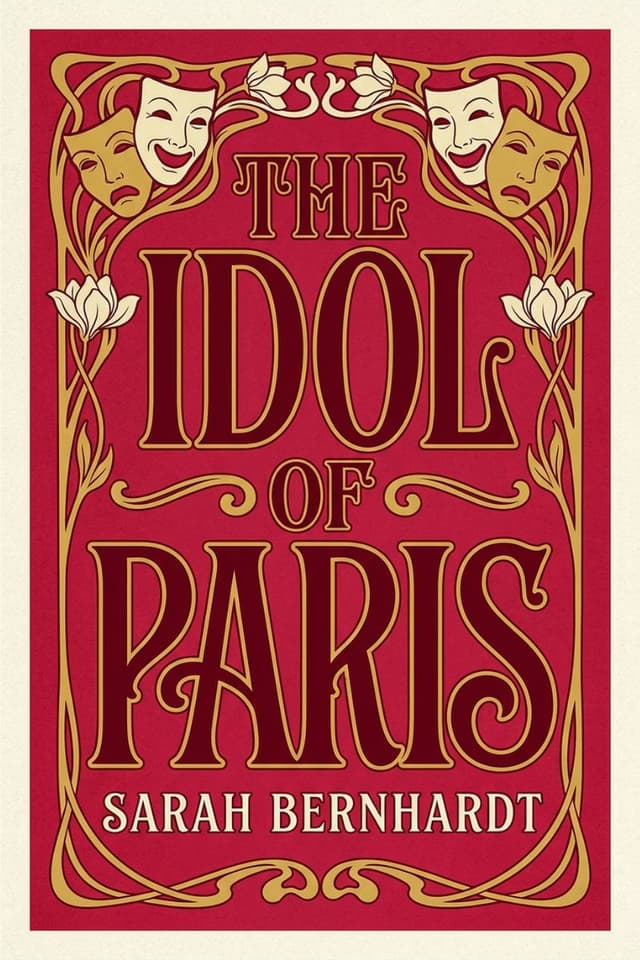
The Idol of Paris
Read The Idol of Paris by Sarah Bernhardt for free on Novelhalla, and try out our easy-to-read modern edition of this classic book. You can also download the EPUB and read it on any device if you prefer!
The Plot
A Girl on Fire
Esperance Darbois is fifteen years old, the only daughter of a celebrated philosophy professor, and she wants to be an actress. In late nineteenth-century Paris, this is roughly equivalent to announcing she'd like to set the family name on fire.
Her father, François Darbois, is a brilliant and gentle man who believes in reason, liberty, and letting people choose their own paths. In theory. In practice, the idea of his daughter on the stage fills him with quiet dread. Her mother adores her but can barely hold back tears at the thought. Her godfather, the blustering Adhemar Meydieux, thinks the whole idea is a catastrophe and says so at full volume.
But Esperance has a gift, and she knows it. She has a voice that stops people mid-sentence. She has been memorizing Racine and Hugo since she was a child, reciting them alone in her room while her parents assumed she was simply a girl who loved poetry. She wasn't practicing poetry. She was rehearsing for a life.
The family convenes a council. Arguments fly. Esperance, trembling with emotion, makes her case so passionately that she faints dead away in the middle of the dining room. When she opens her eyes, her father has made his decision.
The Stage
Esperance enters the Conservatoire, where she immediately turns heads. The judges are captivated. Victorien Sardou, the great playwright himself, watches her perform and calls her heavenly. She wins the top prize and is offered a place at the Comédie-Française, the most prestigious theatre in all of France.
Her debut is a sensation. Before the public has even seen her, the newspapers are already buzzing. On opening night, every seat is filled with society figures, intellectuals, and diplomats. From her very first line, the audience belongs to her. The applause is thunderous. The curtain calls seem endless.
Among the audience sits Count Albert Styvens, a young Belgian diplomat. When Esperance appears on stage, the color drains from his face. He can barely speak. He follows the Belgian minister backstage to be introduced, and stands there, speechless, gazing at her like a man who has just been struck by something he cannot name.
Hearts in Orbit
Esperance is not thinking about love. She is sixteen and a half, consumed by her art, protected by her innocence. She believes love is something that comes after marriage, not before. The passions she performs on stage remain safely in the realm of the ideal.
But the people around her are not so immune. Her cousin Maurice, a young painter, has been sketching her obsessively and watching her with an intensity he doesn't fully understand. Jean Perliez, a fellow actor at the Conservatoire who helped her through her very first audition, is quietly, hopelessly devoted to her. Maurice sees it. He tells Jean plainly that he suspects neither of them will be the lucky one.
Meanwhile, Count Styvens writes a glowing review in one of Paris's most important newspapers. He blushes when anyone mentions Esperance's name. He positions himself at every social event where she might appear.
And then Belgium calls.
Brussels
A catastrophe strikes the lower quarters of Brussels, leaving families homeless. The Comédie-Française organizes a grand benefit performance at the Royal Theatre de la Monnaie, and when the leading actress falls ill, Esperance is asked to step in as Dona Sol in Victor Hugo's Hernani. She will perform on a foreign stage, in front of Belgian high society, in one of the most demanding roles in French theatre.
Maurice and Jean insist on accompanying her. The journey to Brussels puts all three young people in close quarters, and the tensions that have been simmering beneath polite smiles begin to surface. Esperance remains oblivious, dazzling audiences and charming dignitaries while the men in her life watch each other warily.
Brussels is also Count Styvens's home territory. His family, his connections, his world. And the Countess Styvens, his mother, has her own ideas about who her son should be paying attention to.
Dangerous Territory
The novel sweeps from the theatres of Paris to the drawing rooms of Brussels, from country retreats to a grand château, each setting raising the emotional stakes. Esperance's fame grows, but fame is a double-edged thing. It draws admirers and enemies in equal measure. The press adores her and savages her. Jealousies bloom in dark corners. A duel is fought. Hearts are broken with the casual devastation of a closed door.
Esperance must navigate a world where a woman's reputation is as fragile as glass, where the wrong glance at the wrong party can undo years of work, and where the people who love her most may be the ones who hurt her. The philosopher's daughter is learning that real life contains passions far more dangerous than anything she has ever performed on stage.
And the stage, it turns out, is the easy part.
About the Author: Sarah Bernhardt
A Complicated Beginning
Sarah Bernhardt was born Henriette-Rosine Bernard in Paris in 1844. Her mother, Julie Bernard, was a Dutch Jewish courtesan with wealthy, influential clients. Her father's identity remained uncertain for years. A baby was inconvenient for a woman in her mother's profession, so young Sarah was sent away, first to a nurse in Brittany, then to boarding schools, and finally to a convent near Versailles.
At the convent, Bernhardt was devout and passionate. She wanted to become a nun. But the Duke de Morny, one of her mother's lovers and the half-brother of Napoleon III, had other plans. He decided the girl should be an actress and arranged for her to enter the Paris Conservatoire at sixteen.
Rise to Glory
Bernhardt's early career was rocky. She was dismissed from the Comédie-Française after slapping a senior actress who had been rude to her younger sister. She drifted, questioned her talent, and gave birth to a son, Maurice, whose father was a Belgian prince who could never marry an actress.
Then something caught fire. At the Odéon theatre, Bernhardt found her voice. By the 1870s, she was the most talked-about actress in France. By 1880, she had formed her own touring company and become an international phenomenon. She performed across Europe, America, Australia, and South America. Victor Hugo praised her "golden voice." Oscar Wilde threw lilies at her feet and called her "the Divine Sarah."
Beyond the Stage
Bernhardt was never just an actress. She was a sculptor who exhibited at the Paris Salon. She was a painter. She managed her own theatre for over two decades. She wrote a memoir, a treatise on acting, and this novel. She kept exotic pets, including an alligator. She slept in a coffin, which she claimed helped her understand her many dramatic death scenes.
In 1915, after an injury sustained on stage years earlier, her right leg was amputated. She was seventy years old. She continued performing, using strategically placed furniture and a sedan chair to move across the stage. She even entertained troops near the front lines during World War I.
Final Act
Bernhardt died in Paris in March 1923 at the age of seventy-eight. She had been working on a film when she collapsed. Thousands lined the streets for her funeral procession. Jean Cocteau is said to have coined the word "superstar" to describe her impact on popular culture.
Fun Facts About the Book
Written by the World's Most Famous Actress
When this novel was published in France in 1920 under the title Petite Idole, Sarah Bernhardt was seventy-five years old, had been performing for nearly six decades, and had lost a leg five years earlier. She was still acting, still managing a theatre, and apparently still had energy left over to write a novel.
A Thinly Veiled Self-Portrait
Scholars and readers have long noted the parallels between Esperance Darbois and Bernhardt herself. A young woman defying family expectations to pursue the stage, performing at the Conservatoire and the Comédie-Française, captivating audiences with a remarkable voice, attracting aristocratic admirers. The novel is widely considered an idealized, happier version of Bernhardt's own life and career.
The Real Belgian Prince
The romantic subplot involving a Belgian count bears a striking resemblance to Bernhardt's real-life affair with Henri, Prince de Ligne, a young Belgian aristocrat who fathered her only son. In the novel, the Belgian count is dashing and devoted. In real life, the prince's family considered marriage to an actress unthinkable.
Duels, Broken Hearts, and Melodrama
Contemporary readers describe the novel as pure, unapologetic melodrama. Duels are fought, characters collapse from emotional distress, and love declarations are delivered with operatic intensity. It reads exactly the way you'd expect a novel written by Sarah Bernhardt to read.
Sardou Makes a Cameo
The great playwright Victorien Sardou appears as a character in the novel, championing Esperance's talent. In real life, Sardou wrote several of Bernhardt's most famous roles, tailoring them specifically for her. The novel gave Bernhardt the chance to write herself the story she wished she'd lived, complete with all her favorite people cheering from the wings.
English Translation in 1921
The novel was translated into English by Mary van Arsdale Tongue and published in 1921, just two years before Bernhardt's death. It remains available today through Project Gutenberg.
Themes
A Woman's Right to Choose Her Own Life
The novel opens with a debate about whether a young woman has the right to choose her own career, and this question drives everything that follows. In a world where women's options are marriage or dependence, Esperance insists on a third path. The tension between her ambition and her family's fears for her reputation gives the novel its emotional engine.
Art as Calling
Esperance doesn't want to act for fame or money. She wants to act because something inside her demands it. The novel treats artistic vocation as a force as powerful and as uncontrollable as love, something that will make you faint at the dinner table if you try to suppress it.
The Price of Fame
Esperance's talent brings her adoration, but it also brings scrutiny, jealousy, and danger. The novel explores how public success makes private life treacherous, especially for a young woman in an era when an actress's reputation was always one scandal away from ruin.
Love and Loyalty
Multiple people love Esperance, each in their own way. Her parents' protective devotion, her cousin's artistic fascination, Jean Perliez's quiet constancy, Count Styvens's thunderstruck infatuation. The novel asks which kinds of love nurture and which kinds consume.
Class and Respectability
A philosopher's daughter on the stage. A count falling for an actress. A world where social position determines who you can love and what you can become. The collisions between talent and title, merit and birth, run through every chapter.
The Book's Legacy
The novel occupies a unique place in literary history as a work of fiction by one of the most famous performers who ever lived. It is less a great novel than a fascinating artifact, a window into how Sarah Bernhardt saw herself, or at least how she wished to be seen.
The book was adapted into a British film in 1948, though the adaptation bore little resemblance to the source material and was not a success.
For readers interested in the world of nineteenth-century theatre, the Belle Époque social scene, or the inner life of a woman who was arguably the first modern celebrity, the novel offers something no biography can: Bernhardt's own voice, telling her own story, with all the dramatic flair you'd expect from a woman who kept an alligator and slept in a coffin.