Novelhalla
The Forest Lovers
Read The Forest Lovers by Maurice Hewlett for free on Novelhalla, and try out our easy-to-read modern edition of this classic book. You can also download the EPUB and read it on any device if you prefer!
The Plot
Into the Forest
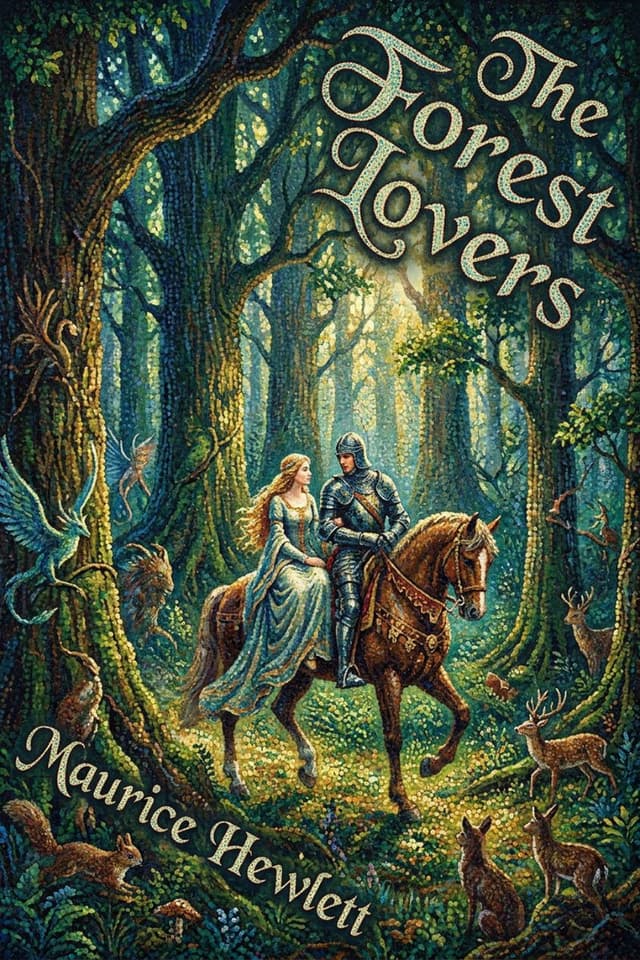
Prosper le Gai is a young knight with nothing but his armor, his horse, and his good spirits. Cast out of his family home by his bitter older brother Malise, who inherited their father's barony and wants nothing to do with his younger sibling, Prosper sets off into the world looking for adventure. He pins a sprig of holly in his cap and rides toward Morgraunt, a vast and mysterious forest spoken of only in whispers, a place deep and dark, haunted by the shadows of perpetual woods.
The forest does not disappoint. Prosper encounters bandits and bests them easily. He stumbles upon a tall, mysterious lady struggling to drag a dead knight to his grave. He hears horns in the distance and sees strange figures moving between the trees. The deeper he rides, the stranger things become.
The Witch's Daughter
At the edge of a quarry, Prosper discovers a girl in desperate trouble. Isoult la Desirous is young, thin as a hungry hawk, dressed in rags, with wild black hair and startled grey eyes. The local authorities have condemned her as a witch, the daughter of one at least, and she faces either the gallows or a fate worse still: marriage to Dom Galors, a corrupt monk from the Abbey of Holy Thorn who wants her for himself.
Prosper makes a decision that will change both their lives. To save Isoult from execution and from Galors, he marries her himself. But this is no ordinary romance. Prosper considers Isoult little more than a child, and he treats their marriage as an act of charity rather than love. He deposits her at a convent to be raised properly by nuns, intending to go about his adventures as though nothing has changed.
The Chase Begins
Nothing is ever so simple in Morgraunt. Galors has not given up his claim on Isoult, and the forest is full of dangers both human and otherwise. Isoult is taken from the convent, and Prosper must pursue her through a landscape of scheming abbots, proud countesses, and dark woods where the rules of the outside world do not apply.
Along the way, secrets emerge. Isoult is not merely a nameless peasant girl. The powerful Countess Isabel, Lady of Morgraunt, haunted by guilt and old sorrows, holds the key to Isoult's true identity. And Prosper himself has a history with this strange girl that neither of them remembers clearly, a moment from childhood when their paths crossed in a way that marked them both.
About the Author: Maurice Hewlett
Early Life
Maurice Henry Hewlett was born in 1861 at Weybridge in Surrey, the eldest son of Henry Gay Hewlett, a prominent attorney from a literary family. He was a troubled student, unhappy at the various British schools he attended, finding solace only in Greek mythology and the poetry of John Milton. He left college in 1878 without a degree and joined his cousin's law practice, where he developed an interest in antiquarian and medieval law.
In 1888 he married Hilda Beatrice Herbert, a vicar's daughter with a restless, adventurous spirit. They would have two children, but the marriage eventually grew distant. Hewlett was called to the bar in 1891 and from 1896 to 1901 served as Keeper of Lands, Revenues, Records and Enrolments, a government position advising on matters of medieval law. This deep immersion in the documents and customs of the Middle Ages would shape everything he wrote.
A Writer's Life
Hewlett did not begin writing seriously until he was thirty-six years old. His first novel, The Forest Lovers, published in 1898, brought him immediate fame and allowed him to abandon the law entirely. The book's success launched a literary career that would span two decades and include historical romances, travel essays, poetry, and drama.
His second major novel, The Life and Death of Richard Yea-and-Nay (1900), about Richard the Lionheart, became a favorite of T. E. Lawrence, who read it multiple times. The Queen's Quair (1904), about Mary, Queen of Scots, influenced Ford Madox Ford. Hewlett also wrote six novels based on Icelandic sagas, including Frey and His Wife and Thorgils of Treadholt. He considered himself primarily a poet, and his Song of the Plow (1916) was regarded by some as his finest work.
Later Years
Hewlett settled at Broad Chalke in Wiltshire, where he counted among his friends the mystic Evelyn Underhill and the young Ezra Pound, whom he met at the Poets' Club in London. His marriage to Hilda effectively ended around 1914, though they remained on friendly terms. Hilda had developed a passion for aviation that Maurice initially found bewildering, and in 1911 she became the first woman in Britain to earn a pilot's license. She went on to manufacture over 800 aircraft during the First World War.
Maurice Hewlett died in London on June 15, 1923, at the age of sixty-two. He was buried at All Saints Churchyard in Broad Chalke. His literary reputation, which had been considerable during his lifetime, faded in the decades that followed, though his best work remains in print.
Fun Facts About the Book
His First Novel
The Forest Lovers was Hewlett's debut novel, written when he was in his mid-thirties after years of working as a lawyer and government adviser on medieval law. Its immediate success gave him the confidence and financial freedom to devote himself entirely to writing.
Inspired by Malory
The novel draws heavily on the style and spirit of Sir Thomas Malory's Le Morte d'Arthur, the fifteenth-century text that defined the Arthurian legend for English readers. Hewlett was part of a broader Victorian and Edwardian fascination with medieval romance that also influenced the Pre-Raphaelite painters and poets like Tennyson.
The Name Isoult
Hewlett borrowed his heroine's name from the Arthurian legends, where Iseult (or Isolde) is the tragic lover of Tristan. The name carries immediate associations with doomed romance and impossible love.
Poet at Heart
Hewlett always considered himself a poet first and a novelist second. His prose style in The Forest Lovers is deliberately lyrical and archaic, meant to evoke the cadences of medieval romance. Some readers find it enchanting; others find it challenging.
The Forest as Character
Morgraunt Forest functions almost as a character in its own right, a place of mystery and transformation where the ordinary rules of society break down. The forest setting was popular in medieval romance, representing both danger and possibility.
A Remarkable Wife
Hewlett's wife Hilda became far more famous in her own field than Maurice ever was in his. As Britain's first licensed female pilot and the owner of a major aircraft manufacturing company during World War I, she was a genuine pioneer. The couple separated but never divorced, and Maurice reportedly came to admire her accomplishments despite his initial skepticism about aviation.
Max Beerbohm's Parody
Hewlett's ornate, deliberately archaic prose style made him an easy target for parody. The satirist Max Beerbohm included a send-up of Hewlett's style in his collection A Christmas Garland, in a piece titled "Fond Hearts Askew."
Falling Out of Fashion
Hewlett's elaborate medieval romances were enormously popular in the early 1900s but fell out of favor as literary tastes changed. Today he is largely forgotten, though readers who enjoy Pre-Raphaelite aesthetics and chivalric adventure still find much to appreciate in his work.
Themes
Love and Devotion
The novel traces the slow awakening of love between Prosper and Isoult. He marries her out of duty; she loves him from the first moment. The question that drives the story is whether Prosper will come to see Isoult not as a rescued waif but as the woman he was always meant to love.
Innocence and Experience
Isoult begins the novel as almost childlike in her simplicity and devotion. Through suffering and separation, she grows into a woman capable of claiming what she desires. Prosper's journey is the opposite: learning to set aside his knightly pride and recognize the worth of someone society has dismissed.
Corruption and Purity
The Abbey of Holy Thorn represents the corruption of religious institutions, with its scheming abbot and villainous monks. Against this stands the pure, almost mystical quality of the forest and of Isoult herself, who maintains her goodness despite everything the world throws at her.
Identity and Recognition
Secret identities and hidden connections run throughout the novel. Isoult's true parentage, Prosper's forgotten childhood encounter with her, the mysteries of Morgraunt Forest itself: all point to a world where nothing is quite what it seems and truth must be earned through adventure.
Chivalry and Its Limits
Prosper embodies the chivalric ideal of the knight errant, but the novel asks whether mere adventure and honor are enough. True knighthood, Hewlett suggests, requires not just courage but the capacity to love and to see others clearly.
The Book's Legacy
The Forest Lovers was a bestseller in its day, establishing Hewlett as a major literary figure and launching a career that would influence writers from T. E. Lawrence to Ford Madox Ford. The novel captured the late Victorian and Edwardian appetite for medieval romance, arriving at a moment when readers were hungry for tales of knights and ladies, enchanted forests and pure devotion.
The book's deliberately archaic style, which charmed readers in 1898, has made it less accessible to modern audiences. Unlike the Arthurian novels of writers like T. H. White, which approach the medieval world with irony and psychological complexity, Hewlett plays it straight, asking readers to surrender to a world of black and white morality and absolute devotion.
For readers who enjoy that surrender, The Forest Lovers offers genuine pleasures: lush descriptive prose, a vivid and atmospheric setting, and a love story built on the slow recognition of worth. It belongs to the same tradition as William Morris's prose romances and the paintings of Edward Burne-Jones, a tradition that valued beauty, mystery, and the dream of a nobler past.