Novelhalla
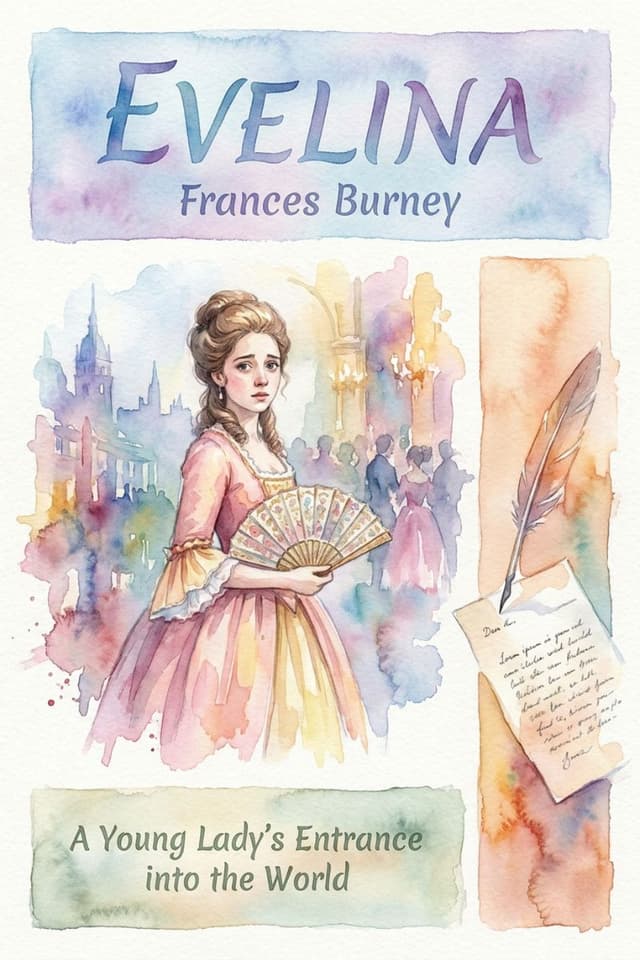
Evelina
Read Evelina by Frances Burney for free on Novelhalla, and try out our easy-to-read modern edition of this classic book. You can also download the EPUB and read it on any device if you prefer!
The Plot
Evelina Anville is seventeen years old and has never seen the world. Raised in rural seclusion by her guardian, the kindly Reverend Mr. Villars, she has been sheltered from society and its dangers. But she carries a secret burden: she is the unacknowledged daughter of a nobleman who cruelly abandoned her mother and destroyed their marriage certificate, leaving Evelina legally illegitimate and without a name.
Entering Society
When Evelina is invited to visit family friends in London, Mr. Villars reluctantly agrees to let her go. She enters the glittering world of eighteenth-century high society with no experience and no guide, armed only with her innate goodness and her guardian's letters of advice.
London is overwhelming. There are balls and operas, pleasure gardens and assemblies. Evelina must navigate a world governed by intricate social rules she doesn't know, where a misstep can ruin a reputation forever. She makes embarrassing mistakes. She doesn't know when to speak or stay silent, whom to trust or avoid. Her inexperience makes her vulnerable.
Two Suitors
At her first ball, Evelina catches the attention of Lord Orville, a wealthy and genuinely good nobleman who treats her with respect and kindness. She is immediately drawn to him, though she hardly dares hope someone so far above her station could have serious intentions.
But she also attracts Sir Clement Willoughby, a charming baronet whose attentions are more aggressive. He pursues her relentlessly, engineering private meetings and ignoring her clear discomfort. Where Lord Orville is considerate, Sir Clement is pushy. Where Lord Orville respects her boundaries, Sir Clement sees them as obstacles to overcome.
Vulgar Relations
Evelina's troubles multiply when her maternal grandmother, Madame Duval, appears. Madame Duval is loud, vulgar, and socially embarrassing. She drags Evelina into the company of her low-bred relatives, the Branghtons, whose crude manners and cheap entertainments mortify Evelina when she encounters her aristocratic acquaintances.
Caught between two worlds, Evelina suffers agonies of embarrassment. She fears that Lord Orville, seeing her among such company, will think she belongs there. The novel is often painfully funny about class anxiety and the terror of being seen with the wrong people.
A Mysterious Rival
The plot takes a dramatic turn when Evelina learns that a young woman named Miss Belmont has appeared in society, presented as the daughter and heiress of Sir John Belmont, Evelina's own father. But how can this be? If Evelina is Belmont's legitimate daughter, who is this other girl?
The mystery of Miss Belmont's identity threatens everything. If she is truly Belmont's heir, then Evelina's hopes of ever being acknowledged are destroyed. The question of which girl is the true daughter must be resolved before Evelina can claim her name or her future.
Finding Her Place
Evelina must ultimately confront her father, untangle the mystery of the rival claimant, and decide her own fate. Through it all, she grows from a naive girl into a woman capable of judging character and standing up for herself. The question is whether the world will allow her the place she deserves.
About the Author: Frances Burney
Early Life
Frances Burney was born in 1752 in King's Lynn, Norfolk, the daughter of the famous music historian Dr. Charles Burney. She grew up in a lively intellectual household frequented by the leading figures of the day, including Samuel Johnson, who became a close friend. She was largely self-educated, having taught herself to read and write.
A Secret Writer
Burney wrote compulsively from childhood but kept it secret, believing it was improper for a young woman to be known as an author. At fifteen, in a fit of shame, she burned all her early writings. But she couldn't stop. She began Evelina in secret, writing in private moments and hiding the manuscript from her family.
Anonymous Success
Evelina was published anonymously in 1778 when Burney was twenty-five. It was an immediate sensation. Readers were desperate to know who had written this sparkling novel. When Burney's authorship was revealed, she became a literary celebrity, praised by Johnson, Burke, and Reynolds. The shy, obscure daughter was suddenly famous.
Court Life
In 1786, Burney was offered a position as Keeper of the Robes to Queen Charlotte. It was an honor she could not refuse, though it made her miserable. The rigid etiquette and endless tedium of court life nearly broke her health. She finally escaped after five years, receiving a small pension.
Later Life
Burney married a French emigré, Alexandre d'Arblay, in 1793. They were happy despite poverty. She continued writing, producing more novels and eventually a biography of her father. She underwent a mastectomy without anesthesia in 1811 and wrote a harrowing account of the experience. She outlived her husband and son, dying in 1840 at eighty-seven.
Fun Facts About the Book
Published Anonymously
Burney was so anxious about being known as an author that she disguised her handwriting when submitting the manuscript and had her brother conduct all negotiations with the publisher. Even her father didn't know she had written it until after publication.
A Bestseller
Evelina was a genuine hit, going through four editions in its first year. It was read by everyone who mattered in London literary society. The combination of social comedy, romance, and genuine feeling struck exactly the right note for its audience.
Johnson's Praise
Samuel Johnson, the great literary lion of the age, was effusive in his praise. He reportedly sat up all night reading it and said he wished the ending had been different only so there could be more of it. His approval helped cement Burney's reputation.
The Novel of Manners
Evelina is often credited with establishing the novel of manners as a genre. Its focus on social embarrassment, the comedy of class anxiety, and a young woman's navigation of society directly influenced Jane Austen, who admired Burney's work enormously.
Written in Letters
The entire novel is told through letters, mostly from Evelina to Mr. Villars. This epistolary format was popular in the eighteenth century and allows readers direct access to Evelina's thoughts and feelings as events unfold. The immediacy creates both comedy and suspense.
Real London
Burney's London is vividly real. The pleasure gardens at Vauxhall and Ranelagh, the opera, the assemblies, the shops and auctions, all were actual places her readers would have known. The novel serves as a kind of guide to fashionable entertainment in 1770s London.
A Happy Ending
Unlike many novels of the period that punished their heroines for the slightest misstep, Evelina gets a genuinely happy ending. Burney believed goodness should be rewarded. The wish-fulfillment element is part of the novel's lasting appeal.
Themes
A Woman's Vulnerability
Evelina is constantly at risk. Without money, name, or worldly knowledge, she depends entirely on the goodness of others. The novel shows how precarious a young woman's position was in eighteenth-century society, where reputation was everything and protectors could not always be trusted.
Social Performance
Every social interaction in the novel is a kind of performance governed by invisible rules. Knowing when to laugh, whom to acknowledge, how to enter a room, these small things determine how others perceive you. Evelina's mistakes are funny but also genuinely threatening to her prospects.
Class and Vulgarity
The Branghtons and Madame Duval are comic figures, but the comedy has an edge. Evelina's horror at being associated with them reveals how much class anxiety shapes her world. The novel asks what really separates the vulgar from the refined, and the answers are not always flattering to the aristocracy.
True Worth vs. Rank
Lord Orville is noble in both senses: high-born and genuinely good. But not all aristocrats share his virtue. Sir Clement has rank but no honor. The novel suggests that true worth is moral rather than social, though it also acknowledges that society rarely sees it that way.
Finding a Voice
Evelina begins unable to speak for herself, literally tongue-tied at her first ball. Over the course of the novel, she learns to judge, to assert herself, and to claim her identity. Her journey is about finding her voice as much as finding her name.
The Book's Legacy
Evelina was groundbreaking. It took the domestic world of a young woman's social debut and made it the stuff of compelling fiction. The comedy of manners, the marriage plot, the heroine's growth into self-knowledge, all became staples of the English novel.
Jane Austen acknowledged her debt to Burney explicitly. The DNA of Evelina runs through Pride and Prejudice and Emma. Elizabeth Bennet's wit, her social vulnerability, her worthy suitor and unworthy one, all have precedents in Burney's novel.
Beyond influence, Evelina remains readable on its own terms. It is genuinely funny. Evelina's mortifications are painfully relatable to anyone who has ever felt out of place. The villains are satisfyingly awful, the hero is satisfyingly good, and the ending delivers exactly what readers want.
For anyone interested in where the romantic comedy came from, Evelina is essential. Burney figured out the formula that still works: a smart, good heroine, obstacles both external and internal, a love interest who sees her true worth, and a society that must be navigated and ultimately conquered.