Novelhalla
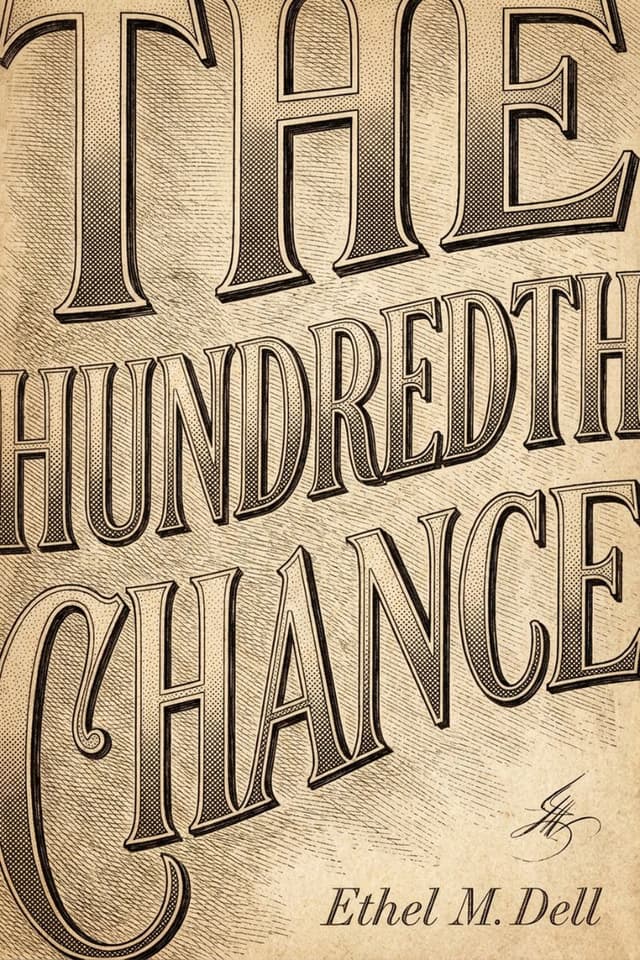
The Hundredth Chance
Read The Hundredth Chance by Ethel M. Dell for free on Novelhalla, and try out our easy-to-read modern edition of this classic book. You can also download the EPUB and read it on any device if you prefer!
The Plot
Beggars Can't Be Choosers
Maud Brian is twenty-five and has nothing. No money, no prospects, no profession, and no way out. Her father, a wild Irish baronet, is dead. Her mother, Lady Brian, is pretty, charming, forty-five and entirely useless, having lived on credit and the kindness of friends until both ran out. The family has washed up at Fairharbour, a shabby little South Coast resort, at the dead end of the season, with no way of paying even for that.
There is one more thing Maud has, and it's the only thing that matters to her. Her brother Bunny is fifteen and has been a cripple since a fall in his babyhood. He can't walk. He barely sleeps. He's in pain most nights and vicious about it most days, and Maud, who has looked after him since she was ten, absorbs all of it without complaint. She wheels him. She lifts him. She sits up with him until three in the morning. She has grown thin and sallow and tired in his service, and she'd do it all again tomorrow.
So when Lady Brian announces she's going to marry Giles Sheppard, the loud, red-faced, hard-drinking landlord of the Anchor Hotel down by the fishing quay, Maud understands exactly what's being sold and who's being paid for. Sheppard will take them all in. He'll house Bunny in the good ground-floor rooms. And in return he gets a titled wife, a roof full of people who depend on him, and a proud, disdainful stepdaughter he can spend the rest of his life taking down a peg.
He hates her from the first evening. She hates him right back. And neither of them can leave.
The Man Who Breaks Horses
Before any of this is settled, Maud and Bunny watch a man on the parade force a terrified young chestnut into the sea. He does it calmly, patiently, and then with a whip, and he does it with such unhurried certainty that Maud finds herself hoping the horse wins. The horse doesn't.
His name is Jake Bolton. He's short, thick-set, bull-necked and red-headed, with startlingly bright red-brown eyes that seem to see straight through people. He speaks in a soft voice that's almost a woman's. He has been a sailor, a gold prospector, a shopkeeper in California and a cowboy on a ranch, and he's now the trainer at Lord Saltash's racing stables up on the downs. They call him the Lynx on the turf, because nothing gets past him.
He also isn't a gentleman, and he says so cheerfully, and Maud, who has nothing left in the world but her pride, cannot forgive him for how little that seems to bother him.
He befriends Bunny in a single evening and can do things with the boy that Maud has never managed in fifteen years. He turns up whenever he likes. He notices too much. He catches her one black night on the edge of the parade in the dark, standing rather too close to the water, and hauls her back without ever quite saying what he thinks she was doing there. When she points out that the odds of him fishing anyone out of that sea would be ninety-nine to one, he tells her that he makes rather a habit of backing the hundredth one, and that he has won on it before.
That's where the book gets its name, and it's the closest thing Jake Bolton has to a philosophy.
An Offer She Can't Possibly Accept
Then Jake tells her something that changes the shape of her life. He knows a man, an American surgeon called Capper, one of the great spinal specialists in the world, who has already put one of Jake's own jockeys back together after an injury very like Bunny's. That jockey walks. Capper is coming to London in the spring. There is a risk, of course, a real one. But there is a chance.
Maud has no money for surgeons. She has one distant relative who won't answer her letters. And Jake, standing in a rain shelter on the parade with the sea moaning behind him, tells her he'll see the whole thing through himself, and then, without warming up to it at all, tells her to go home and seriously consider marrying him.
He isn't romantic about it. He points out that Bunny is too heavy a burden for her to carry alone. He points out that a husband like him might be less nauseating than a stepfather like Giles Sheppard. He says he'll be good to them both and gives his word on it. He also says, quite plainly, that he's taken a fancy to her and that he knows she'll never look at him.
She tells him it's an insult. She tells him it's impossible. He tells her the offer stays open day and night, in case an emergency arises that makes escape essential.
Then he leaves her standing there, and something in her that she doesn't want to name has begun to move.
The Other Man
There is one more complication, and his name is Charlie Burchester, Lord Saltash. He owns the racing stables, the castle behind the pines, and most of Fairharbour. He is rich, quick, faithless, funny and thoroughly disgraced, having been tangled up in a divorce scandal that was never quite proved. Years ago in London he paid Maud a great deal of attention, and she had a brief and splendid dream that faded and left her sure she'd never feel anything again.
She insists she couldn't marry him. She won't discuss him. Bunny, who has no tact whatsoever, tells her flatly that she's still in love with him.
And Saltash, who has not been down to his own estate in a long while, has a yacht in the vicinity, a house standing shuttered and empty a mile from Jake's stables, and a habit of turning up exactly when he shouldn't.
What happens to Maud between the emergency and the escape, between the man she can't have and the man she can't respect, is the whole engine of the book. She will make a bargain. She will keep it. And she will find out, quite slowly and at very close range, what she actually agreed to and what kind of man she agreed to it with.
About the Author: Ethel M. Dell
A Suburban Girl with an Enormous Imagination
Ethel May Dell was born on 2 August 1881, the youngest of three children in a comfortable middle-class family in South London. Her father was a clerk in the City. She was a shy, quiet girl who started writing stories almost as soon as she could hold a pen, and she sold them to popular magazines while she was still young.
What's remarkable is how little of the world she'd actually seen. She wrote passionate, violent, sun-blasted romances set in India and the far corners of the Empire, and among rough men on ranches and racecourses, and she did it from suburban southern England, out of pure imagination and an appetite for feeling that startled her own family. Her cousins reportedly amused themselves by keeping a running tally of how often she used the words passion, tremble, pant and thrill.
Rejected Eight Times, Then Unstoppable
She worked on her first novel, The Way of an Eagle, for years. Eight publishers turned it down. T. Fisher Unwin finally took it in 1911 and put it out in a series devoted to first novels, and it went through around thirty printings in four years.
After that she was one of the most popular writers alive. Book after book, roughly thirty novels and eight volumes of short stories, and at her peak she was earning something in the region of twenty to thirty thousand pounds a year, which in the 1910s and 1920s was a fortune. Four of her novels landed on the American bestseller lists of the 1910s alone.
The Recluse
Fame did nothing for her socially. She hated it. She lived quietly in the country, avoided her readers, gave interviews to nobody, and worked with an almost monastic discipline, reportedly getting out of bed to write through the night in her bathroom so as not to disturb the household. She gave a great deal of money away, much of it quietly.
Critics loathed her, or pretended to. Readers didn't care. The gap between what the literary world said about Ethel M. Dell and what the public did with its money was one of the widest of the century.
Later Years
In 1922 she married Lieutenant-Colonel Gerald Tahourdin Savage, who resigned his commission when they married, leaving Dell as the family's sole support. By all accounts he was devoted to her. She kept writing until the end of her life. She died in hospital at Hertford in September 1939, aged fifty-eight, just as another war was starting.
Fun Facts About the Book
A Top Ten Bestseller in the Middle of a War
It reached number ten on the American fiction bestseller list for 1917, a year topped by H. G. Wells and packed with novels wrestling directly with the war. This one doesn't wrestle with the war at all, which is very likely part of why people bought it.
The Villain Got His Own Sequel
Lord Saltash was too good to waste. Dell brought him back as the leading man of Charles Rex in 1922, a book so popular that plenty of readers came to this one afterwards, backwards, just to find out where he'd come from. The two novels share characters and a world, and Saltash is considerably more sympathetic when the story belongs to him.
The Epigraph Is Filed Under the Wrong Prophet
The verse at the front, about the plowman overtaking the reaper and the treader of grapes overtaking the sower, is credited to Obadiah. It's actually from Amos, chapter nine. Obadiah is a single chapter long and doesn't contain it. Nobody seems to have caught it at the time.
It's Built Like a Race
The book is split into two parts, titled The Start and The Race, and it closes with an epilogue called The Finish. Given that the hero is a racehorse trainer and the heroine is repeatedly described in the language of a nervous, high-strung young animal that needs handling, the structure isn't subtle. It is, however, completely deliberate.
Rebecca West Went After Her in Print
In 1922 Rebecca West published an essay called "The Tosh Horse," a full-dress attack on Dell as the embodiment of the bestseller, using the Saltash sequel as her exhibit. West's argument was essentially that you can't reach the top of the sales lists by thinking hard, you have to be carried there by something wilder and dafter. It's a famous piece of criticism and it did absolutely nothing to slow Dell's sales.
The Film Is Gone
Stoll Pictures adapted it as a British silent film in 1920, with Mary Glynne as Maud and Dennis Neilson-Terry as Lord Saltash. No copy is known to survive, so it's counted as a lost film. Dell also rewrote the story herself as a stage play in 1927.
Barbara Cartland Never Got Over It
Cartland read it as a young woman and was still enthusing about it sixty years later, eventually reissuing it with an introduction of her own in which she called it one of Dell's most passionate and dramatic tales and admitted she couldn't put it down. Georgette Heyer read Dell too. A significant chunk of twentieth century popular romance runs through this woman.
The Original Had a Frontispiece
Early American editions carried an illustration by Edna Crompton showing Jake laying his hand over Maud's and asking her whether she's afraid to say it. If you want to know which moment that is, you'll have to get to page ninety-eight.
Themes
Marriage as a Transaction
Almost every relationship in this book has a price attached. Lady Brian sells herself to Sheppard for room and board. Sheppard buys a title and a household to bully. Jake offers a surgeon in exchange for a wife, and is honest enough to say so out loud. The book is fascinated by what people will trade when they have nothing else, and by whether a bargain entered into coldly can ever turn into something else.
What Actually Makes a Gentleman
Maud has been raised to believe that breeding is everything, and she's clinging to that belief precisely because it's the only asset she has left. Jake, who has been a cowboy and a sailor and calls himself plain and rough, keeps quietly demonstrating that decency and rank have nothing to do with each other. The book has no patience for the well-born, and Sheppard makes it equally clear that being self-made doesn't automatically make you better either. Character is the only currency that holds its value.
The Weight of Caring for Someone
This is one of the most honest early portraits you'll find of what long-term caregiving does to a person. Maud is exhausted, physically diminished, socially invisible and never off duty. She loves Bunny absolutely, and Bunny is often cruel to her, and both of those things are true at once. The novel doesn't sentimentalise it. It shows her hauling a heavy chair up a hill she dreads, panting, while the boy in it complains about how slowly she's going.
Taming
Jake breaks horses for a living, and the book keeps drawing the parallel between how he handles a frightened animal and how he handles a frightened woman: patience, then pressure, then absolute refusal to let go. Modern readers will find some of this genuinely uncomfortable, and it's worth saying that the discomfort isn't accidental. Dell knew exactly what she was doing with the mastery-and-surrender dynamic, and it's the engine that made her the most popular novelist of her day.
Obligation and Pride
Maud's central objection to being rescued is that she cannot take what she can never repay. Pride is the last thing she owns, and every act of kindness in the book costs her some of it. The novel keeps asking whether refusing help is integrity or vanity, and whether there's any real difference between the two when someone else is paying the price for your principles.
The Glamour of the Wrong Man
Saltash is charming, quick, titled and a genuine scoundrel. Jake is blunt, ruddy, common and reliable. The novel is deeply interested in why the first kind of man occupies so much space in a woman's imagination, and what it costs her to find out what the second kind is worth.
Historical Context
It's worth knowing when this was published. In 1917 Britain was three years into a war that was sending men home with shattered spines and ruined bodies at a scale nobody had planned for, and here is a hugely popular novel whose central hope is an American surgeon who can make a broken boy walk again. The war itself never appears in these pages. The longing underneath the book was everywhere.
The Book's Legacy
Ethel M. Dell is one of the most commercially successful novelists of the twentieth century and one of the least respected, and this book sits right at the peak of that contradiction. It sold enormously. It was filmed within three years. Dell put it on stage herself a decade later. And the entire literary establishment treated her as a punchline while readers bought everything she wrote.
Her real legacy is structural. The marriage of convenience that becomes real love, the rough hero whose gentleness is a secret only the heroine gets to see, the aristocratic charmer who turns out to be the wrong answer, the heroine who marries for someone else's sake and has to work out what she wants afterwards: this is the machinery of modern popular romance, and Dell was one of the people who assembled it. Barbara Cartland idolised her. Georgette Heyer read her. Millions of paperbacks since have run on her chassis.
Read now, it's a strange and compelling object. The prose is heated to a degree that will make some readers laugh and pull others straight under. The class politics are sharp and often genuinely radical about who deserves respect. The violence, when it arrives, is more shocking than the packaging suggests. And Maud Brian, tired at twenty-five, invisible in her own family, holding herself together with nothing but pride, is a much better character than the genre's reputation would lead you to expect.
One warning worth having: this is a 1917 British novel and the language reflects it, including a racial slur used in passing and a period expression about being "white" that means honourable. It's jarring, and it's there.