Novelhalla
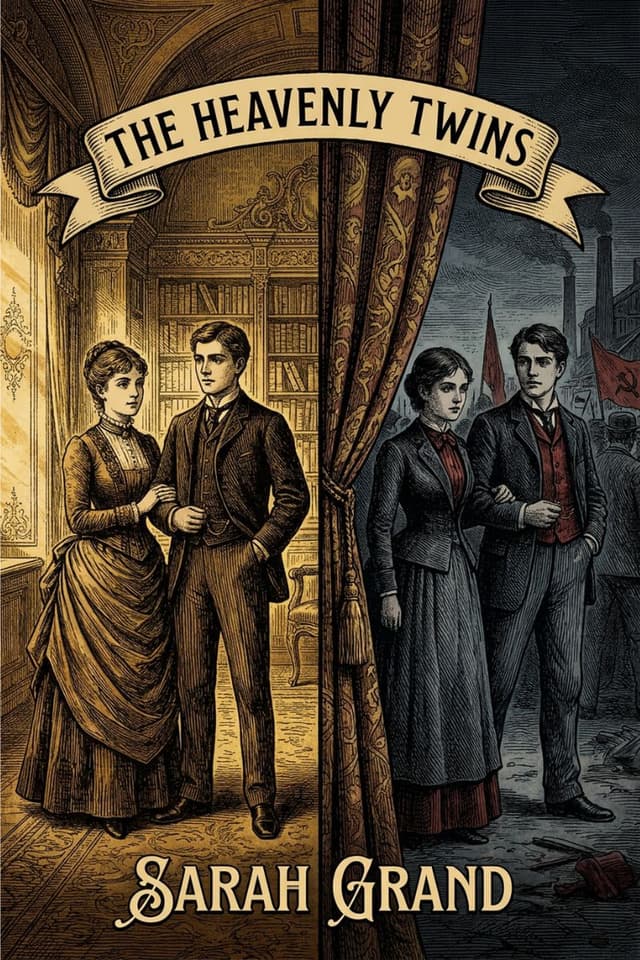
The Heavenly Twins
Read The Heavenly Twins by Sarah Grand for free on Novelhalla, and try out our easy-to-read modern edition of this classic book. You can also download the EPUB and read it on any device if you prefer!
The Plot
Three Women, Three Marriages, One Brutal Truth
In the cathedral city of Morningquest, three young women of privilege are about to discover that marriage is the most dangerous thing a woman can do.
Evadne Frayling is sharp, serious, and dangerously well-read for a girl in Victorian England. Raised by a father who believes women think like parrots, she has quietly educated herself in anatomy, pathology, and the kind of truths no one wants a young lady to know. When she accepts a proposal from Major George Colquhoun, a handsome military officer, she believes she is stepping into the life she was meant for. But on the eve of her wedding, Evadne stumbles across information about her new husband's past that changes everything. The marriage goes forward. The terms do not.
What follows is a slow suffocation. Evadne and her husband move to Malta with his regiment, performing the rituals of a happy marriage for the benefit of society while living under an arrangement that satisfies no one. Evadne is too principled to pretend and too trapped to escape. Her mind, once so hungry and alive, begins to turn inward.
The Bishop's Daughter
Edith Beale is everything Victorian society wants a woman to be. She is gentle, devout, trusting, and profoundly innocent. The daughter of the Bishop of Morningquest, Edith has been raised in a cloud of spiritual beauty, sheltered from every harsh reality of the world. When she marries the charming Sir Mosley Menteith, a naval officer, her friends are worried. Evadne tries to warn her. But Edith's parents see a fine match, and Edith sees no reason to question their judgment.
She should have questioned it. Sir Mosley is hiding something, and the secret he carries into that marriage is not the kind that fades with time. It festers.
The Heavenly Twins
And then there are the twins. Angelica and Diavolo Hamilton-Wells are the bright, chaotic heart of this story. Inseparable since birth, they are mirror images of each other in appearance but forced into opposite lives by the single fact of their sex. Diavolo gets tutors, freedom, adventure. Angelica gets told to sit still.
Angelica is smarter than her brother. Everyone knows it. No one cares. She is wild, brilliant, furious, and utterly wasted by the conventions that govern her life. She watches Diavolo receive every opportunity she is denied and decides that if the world will only listen to a young man, then a young man is what she will become.
What Angelica does with that decision, the moonlit nights it leads to, and the strange, intense friendship that develops between a cathedral tenor and a mysterious boy who appears from nowhere, is one of the most extraordinary passages in Victorian fiction.
The Reckoning
The three stories weave together across drawing rooms and garrison towns, cathedrals and sickrooms. Each woman makes a different choice. Each pays a different price. The question at the center of the novel is merciless: in a world where women are kept deliberately ignorant and then punished for that ignorance, is there any choice that leads to safety?
Evadne's mind is fracturing under the weight of what she knows and what she cannot say. Edith's innocence is carrying her toward something terrible. Angelica's rebellion is exhilarating, but the world does not forgive women who refuse to stay in their place.
The answers are not kind. And the novel does not blink.
About the Author: Sarah Grand
A Girl with Dangerous Ideas
Sarah Grand was born Frances Elizabeth Bellenden Clarke in 1854 in Donaghadee, County Down, Ireland. Her father was a naval officer; her mother, a cultivated Yorkshire woman. When her father died in 1861, the family returned to England.
Frances was a troublemaker from the start. Sent to the Royal Naval School at Twickenham at fourteen, she was expelled within a year for organizing a student group in support of Josephine Butler's campaign against laws that targeted women suspected of prostitution while leaving their male clients untouched. She was fourteen years old, and she was already fighting.
Marriage and Escape
At sixteen, Frances married David Chambers McFall, a widowed army surgeon twenty-three years her senior. She had one son and two stepsons. The family traveled to Hong Kong, Singapore, Japan, Ceylon, and China before settling in Lancashire.
The marriage was miserable. Through her husband's medical work, Frances gained detailed knowledge of sexually transmitted diseases and the devastating effects they had on women and children who had no idea what their husbands were bringing home. This knowledge would become the furious engine of her most famous novel.
After twenty years, she left. New laws allowing married women to keep their own property made independence possible. She moved to London, reinvented herself as "Madame Sarah Grand," and began the work that would make her notorious.
Fame and the "New Woman"
Grand published The Heavenly Twins in 1893, and the literary world exploded. The novel became a massive bestseller, reprinted six times in its first year in England alone. The American edition sold five times more. Newspapers refused to review it. Readers devoured it anyway. Thomas Hardy, George Bernard Shaw, and Mark Twain all praised it.
In 1894, Grand coined the phrase "New Woman" in a published debate, giving a name to the movement of educated, independent women who were refusing to accept the old rules. She became one of the most famous and controversial women in England.
Later Life
Grand threw herself into the suffrage movement, becoming president of the local branch of the National Union of Women's Suffrage Societies in Tunbridge Wells and lecturing across England and America. In 1920, she moved to Bath, where she served as Lady Mayoress from 1922 to 1929.
Her later novels never matched the explosive impact of The Heavenly Twins. The world had caught up to some of her ideas, and a new generation of writers had arrived. When a bomb damaged her Bath home in 1942, she moved to Calne in Wiltshire. She died there on May 12, 1943, a month before her eighty-ninth birthday, largely forgotten. She is buried in Lansdown Cemetery in Bath.
Fun Facts About the Book
The Book That Invented the "New Woman"
While The Heavenly Twins didn't literally coin the term, it was the novel that made the New Woman a cultural phenomenon. Grand followed it up in 1894 by explicitly naming and defining the concept in print. The Heavenly Twins became the flagship novel of an entire feminist movement.
Mark Twain's Marginal War
Mark Twain read the novel during a sea voyage and scribbled notes throughout his copy. His early comments are savage. He called the twins "valueless lumber" and wrote that blank paper in their place would improve the book. But as he kept reading, his opinion shifted dramatically. By the end he called it "a good strong book" despite imperfect grammar. His annotated copy is held in the Berg Collection at the New York Public Library.
A Publisher's Gamble
Grand struggled to find a publisher. William Blackwood reportedly threatened that if she went ahead with the book, he would refuse any future work from her. She was broke and desperate for independence from her husband. Young publisher William Heinemann recognized its bestseller potential and took the gamble. He was right.
The Book Newspapers Wouldn't Touch
The Times and several other major publications refused to review The Heavenly Twins because of its subject matter. The novel openly discussed syphilis, its transmission from husbands to wives and children, and the devastating physical consequences. In 1893, these were things you simply did not put in a novel. Grand did it anyway.
A Novel in Six Books
The Heavenly Twins is structured as six interconnected books, each with its own narrative style. The fourth book, "The Tenor and the Boy: An Interlude," was so distinct that Grand republished it as a standalone novella in 1899. It reads almost like a dreamlike fable dropped into the middle of a realist novel, and many readers consider it the most extraordinary section of the work.
One of the Last Three-Deckers
The novel was published in the traditional Victorian three-volume format, making it one of the last major novels to appear in this form before the format died out in the mid-1890s. Grand used the old form to deliver a radically new message.
Themes
The Price of Innocence
The novel makes a devastating argument: keeping women ignorant does not protect them. It destroys them. Edith's purity and trust, the very qualities her upbringing cultivated, leave her defenseless against a danger she was never allowed to know existed. The novel insists that ignorance is not virtue. It is vulnerability.
The Double Standard
Victorian society permitted men sexual freedom while demanding female purity. Grand attacks this arrangement with fury and precision. The men in the novel face no consequences for their behavior. The women absorb all of it. The novel asks why women are expected to be the moral guardians of civilization while being denied the knowledge they would need to actually protect themselves.
The Trap of Marriage
Each of the three marriages in the novel is a different kind of cage. Evadne's is a prison of silence. Edith's is a death sentence disguised as a blessing. Angelica's is a compromise that costs her the best parts of herself. Grand does not argue against marriage itself, but she is relentless about what happens when women enter it blind, powerless, and uninformed.
Gender and Freedom
Angelica and Diavolo are the same in nearly every way except one, and that one difference determines everything about their lives. The twins' story is the novel's most vivid illustration of how arbitrary gender roles are, and how much talent, intelligence, and joy is wasted when half the population is told to sit down and be quiet.
Knowledge as Power and Burden
Evadne's self-education gives her the ability to see the world clearly. It also makes her life unbearable. She knows too much to be happy and has too little power to change anything. The novel suggests that knowledge without agency is its own kind of torment.
The Book's Legacy
The Heavenly Twins was the bestselling feminist novel of the 1890s and one of the most talked-about books of its decade. It brought subjects like sexually transmitted disease, marital abuse, and gender inequality into mainstream fiction at a time when such topics were considered unfit for print.
The novel's influence rippled through the New Woman movement and into the suffrage campaigns that followed. Grand's insistence that women had a right to knowledge about their own bodies and the men they married was radical in 1893 and remained urgent for decades afterward.
The book fell out of print and out of memory for much of the twentieth century, a fate shared by many feminist writers of the period. It was rediscovered by scholars in the 1980s and 1990s and is now recognized as one of the most important novels of the Victorian fin de siecle. The University of Michigan Press reissued it in 1992 with a scholarly introduction.
For modern readers, the novel remains startlingly relevant. Its anger about sexual double standards, its compassion for women trapped by systems designed to keep them powerless, and its fierce argument that knowledge and freedom are inseparable feel anything but dated. The twins are still delightful. Evadne's story is still heartbreaking. And Grand's refusal to offer easy comfort still hits hard.