Novelhalla
The Mayor of Casterbridge
Read The Mayor of Casterbridge by Thomas Hardy for free on Novelhalla, and try out our easy-to-read modern edition of this classic book. You can also download the EPUB and read it on any device if you prefer!
The Plot
The Sale
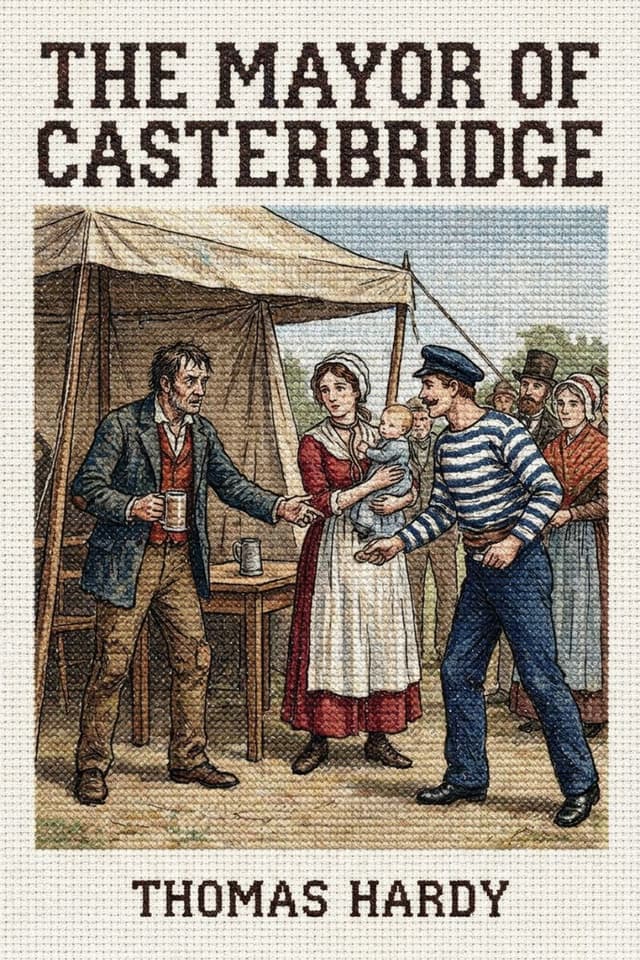
It begins with an act so shocking it barely seems possible. At a country fair in the village of Weydon-Priors, a young hay-trusser named Michael Henchard gets drunk on rum-laced furmity and, in a fit of bitter rage, auctions off his wife Susan and their infant daughter to a sailor for five guineas. The wife leaves her wedding ring on the table. The sailor takes them both and walks out into the night.
Henchard wakes the next morning in the empty tent with no wife, no child, and the slowly dawning horror of what he has done. He searches for them. He cannot find them. In a church, alone, he swears an oath: he will not touch alcohol for twenty-one years.
Then he disappears south, toward a town called Casterbridge.
The Mayor
Eighteen years pass. When we see Henchard again, he is unrecognizable. He is now the mayor of Casterbridge, a prosperous grain merchant, a man of standing and respectability. He has built everything from nothing through sheer force of will and hard work. No one knows about the wife sale. The town assumes he is a widower.
But Susan is not dead. When the sailor who bought her is lost at sea, she and her now-grown daughter, Elizabeth-Jane, set out to find the man Susan left behind nearly two decades ago. They arrive in Casterbridge and discover, to their astonishment, that the drunken hay-trusser has become the most powerful man in town.
Henchard is stunned to see them. Guilt, relief, and calculation collide. He arranges to court Susan publicly, as though they are meeting for the first time, and quietly remarries her. No one must know the truth. Elizabeth-Jane must never learn what happened at that fair.
The Scotsman
Into this fragile arrangement walks Donald Farfrae, a young Scottish traveler passing through town. He is everything Henchard is not: charming, modern, clever with numbers, easy with people. Henchard is instantly taken with him. He hires Farfrae to manage his grain business. The two become close. For a brief, bright moment, it looks like Henchard might actually have it all: the respectable wife, the surrogate son, the thriving business, the secret safely buried.
But Henchard's nature won't allow it. Farfrae is too good at the job. Too popular in town. Too warmly regarded by the people who used to look only to Henchard. The older man's affection curdles into jealousy with terrifying speed. He orders Farfrae out of his business. He forbids him from courting Elizabeth-Jane.
And then Susan dies. In the aftermath, Henchard discovers something in a sealed letter she left behind, something that rearranges everything he thought he knew about his family. The ground shifts beneath him, and it will not stop shifting.
The Woman From Jersey
There is another woman. Before Susan returned, Henchard had been involved with Lucetta Templeman, a well-born woman from Jersey who nursed him through an illness. He had promised to marry her. He broke that promise when Susan reappeared. Now Lucetta has inherited money, moved to Casterbridge, and she wants what she was promised.
But Lucetta meets Farfrae. And Farfrae meets Lucetta. And very quickly, the romantic entanglements in Casterbridge become a knot that no one can untie without someone getting hurt.
Henchard watches the young Scotsman take everything from him. First his business advantage. Then his reputation. Then the woman he was supposed to marry. Then, eventually, the mayoral office itself. The rise of Farfrae and the fall of Henchard begin to feel less like coincidence and more like the working of some merciless cosmic machinery.
The Reckoning
Henchard is not the kind of man who goes quietly. He fights back with every weapon he has, and some of them are ugly. He has Lucetta's old love letters. He has secrets that could destroy reputations. He has a temper that makes enemies of friends and a pride that won't let him ask for help even when he is drowning.
And the past is closing in. The old furmity-seller from that country fair is still alive. She remembers everything. And in a town as small and gossip-hungry as Casterbridge, a secret like Henchard's won't stay buried forever.
The twenty-one years of his oath are nearly up. The question is whether Henchard can hold himself together long enough to matter, or whether the man he was at that fair was the real man all along, and everything since has been borrowed time.
One thing is certain: in Casterbridge, the bill always comes due.
About the Author: Thomas Hardy
The Builder's Son
Thomas Hardy was born in 1840 in Higher Bockhampton, a tiny hamlet in Dorset, England. His father was a stonemason and builder; his mother, Jemima, was ambitious and well-read, the driving force of the household. Hardy was a frail child who didn't start school until he was eight, but he was fiercely intelligent and devoured books, developing a love of literature and music that would shape his entire life. His father played fiddle at local dances, and Hardy inherited the gift, learning to play as a boy and remaining moved to tears by music well into old age.
The Reluctant Architect
At sixteen, Hardy was apprenticed to a local architect who specialized in church restoration. He was good at it, and in 1862 he moved to London to work for a prominent ecclesiastical architect named Arthur Blomfield. In his spare time he wrote poetry, but no publisher would touch it. London excited and exhausted him in equal measure. By 1867, poor health drove him back to Dorset, where he began channeling his literary ambitions into prose fiction, a genre he considered inferior to poetry but far more likely to pay the rent.
Love in Cornwall
In 1870, Hardy was sent to evaluate a crumbling church in the remote Cornish parish of St. Juliot. There he met Emma Lavinia Gifford, the rector's lively sister-in-law. Their courtship was romantic and impulsive, and it gave Hardy material for one of his early novels. They married in 1874, the same year Far from the Madding Crowd made him famous enough to quit architecture for good.
The Great Novels
What followed was one of the most remarkable stretches in English fiction. Hardy wrote The Return of the Native (1878), The Mayor of Casterbridge (1886), The Woodlanders (1887), Tess of the d'Urbervilles (1891), and Jude the Obscure (1895), each one darker and more unflinching than the last. Tess was initially refused publication for its sympathetic treatment of a "fallen woman." Jude provoked such outrage over its handling of sex, religion, and marriage that one bishop reportedly burned his copy. The hostile reception of Jude, combined with growing tension in his own marriage, convinced Hardy to abandon novel-writing entirely.
The Poet Returns
For the last thirty-three years of his life, Hardy wrote only poetry. He and Emma grew increasingly estranged, living as near-strangers in Max Gate, the house Hardy had designed near Dorchester. When Emma died suddenly in 1912, Hardy was shattered by guilt and grief. He poured his remorse into a sequence of poems that many critics consider the finest he ever wrote, love poems to a dead wife he had neglected for decades. He married his secretary, Florence Dugdale, in 1914. He continued writing and receiving visitors until his death in 1928 at the age of eighty-seven. In a fitting final act of Hardy-esque irony, his body was split between two graves: his ashes in Poets' Corner at Westminster Abbey, his heart buried beside Emma in the Dorset churchyard where they had once been happy.
Fun Facts About the Book
The Full Title
The novel's complete title is The Mayor of Casterbridge: The Life and Death of a Man of Character. That subtitle is doing a lot of work. It tells you right from the start that this is a tragedy, and the word "character" carries a deliberate ambiguity, referring both to Henchard's personal qualities and to the question of whether he truly possesses the moral substance the word implies.
Wife-Selling Was Real
The novel's shocking opening scene was not pure invention. Hardy based it on documented cases of wife-selling in rural England, a practice in which unhappy husbands would lead their wives to market, sometimes literally by a halter, and auction them to the highest bidder. Newspaper accounts of such sales appeared throughout the eighteenth and nineteenth centuries. Hardy was fascinated by the practice and kept notes on several reported cases.
Hardy Wept While Writing It
Hardy told friends that this was the only novel that made him cry during the writing process. Given the bleakness of his other work, that is saying something.
The Tiny First Print Run
The publisher Smith, Elder & Co. was unimpressed with the manuscript. A reader for the firm complained that the lack of gentry among the characters made it uninteresting. The first edition was printed in a run of only 750 copies. It did not stay obscure for long.
Too Many Incidents
Hardy himself acknowledged a structural flaw. Because the novel was originally serialized in weekly installments, he felt pressure to pack dramatic incidents into every chapter. He later admitted he had added events too freely, resulting in a plot that sometimes strains credulity. The relentless piling on of coincidences and reversals is either the novel's great flaw or part of its strange, operatic power, depending on who you ask.
Casterbridge Is Dorchester
Hardy's fictional town is a thinly veiled portrait of Dorchester, the Dorset county town where he grew up. He intended Casterbridge to capture the town as he remembered it from childhood, a place caught between old agricultural ways and the pressures of modernization. Readers who visit Dorchester today can still trace many of the locations described in the novel.
The Skimmity-Ride
One of the novel's most memorable scenes involves a "skimmity-ride," or "skimmington," a real folk custom in which a community publicly shamed people accused of sexual misconduct by parading crude effigies through the streets. Hardy drew on actual rural traditions for the scene, and it remains one of the most vivid depictions of mob cruelty in Victorian fiction.
Themes
The Inescapable Past
Henchard builds an entire life on the assumption that he can outrun what he did at that fair. He cannot. Hardy's universe is one where the past does not stay buried. It surfaces in unexpected witnesses, in sealed letters, in old women with long memories. The novel asks whether reinvention is ever truly possible, or whether we are always, at bottom, the person we were at our worst moment.
Pride and Self-Destruction
Henchard is his own worst enemy, and he knows it. His pride drives him to jealousy, cruelty, and catastrophic decisions even when gentler options are available. Hardy is fascinated by people who cannot stop themselves from tearing apart the things they love, and Henchard may be his most vivid example.
The Old World Versus the New
Farfrae represents modernity: science, efficiency, calculation, adaptability. Henchard represents the old way: instinct, force of personality, handshake deals, brute will. Their rivalry is personal, but it is also a collision between two eras. Hardy watched the agricultural England of his childhood disappear during his lifetime, and the tension between tradition and progress runs through nearly everything he wrote.
Fate and Free Will
Hardy's characters often seem to be at the mercy of forces larger than themselves, bad timing, cruel coincidence, the indifference of a universe that doesn't care about human plans. But Henchard also makes choices, terrible ones, at almost every turning point. The novel refuses to let him off the hook by blaming fate alone. The tragedy is that he contributes to his own destruction even as larger forces conspire against him.
The Cost of Secrets
Nearly every disaster in the novel flows from someone trying to keep a secret. Henchard hides his past. Susan hides the truth about Elizabeth-Jane. Lucetta hides her history with Henchard. Hardy builds a world where concealment is both necessary and ultimately impossible, and the longer a secret is kept, the more devastating its eventual exposure.
The Book's Legacy
The Mayor of Casterbridge is widely considered one of Hardy's greatest achievements, a novel that combines the sweep of Greek tragedy with the granular detail of rural English life. Henchard has taken his place alongside Lear and Oedipus as one of literature's great self-destroying figures, a man you cannot quite forgive and cannot stop watching.
The novel has been adapted for television multiple times, most notably in a 1978 BBC serial starring Alan Bates, written by Dennis Potter, and a 2003 ITV production with Ciaran Hinds in the title role. Both adaptations were praised for their fidelity to the novel's emotional intensity, and both found in Henchard one of the most demanding and rewarding roles in period drama.
Hardy's portrait of Casterbridge itself has had a lasting effect on how readers imagine nineteenth-century rural England. The town feels simultaneously specific and universal, a place where everyone knows everyone else's business and where the forces of gossip and reputation can be as destructive as any storm. Visitors to Dorchester still follow Hardy trails through the streets, matching real locations to fictional scenes.
The novel's opening remains one of the most arresting in English fiction. A man sells his wife and child at a fair. It should not work as the premise for a serious novel. That it does, that Hardy makes you understand both the horror and the strange, awful logic of the act, is a measure of his power as a storyteller. You pick up this book knowing the first terrible thing that happens. You keep reading because you need to know what it costs.