Novelhalla
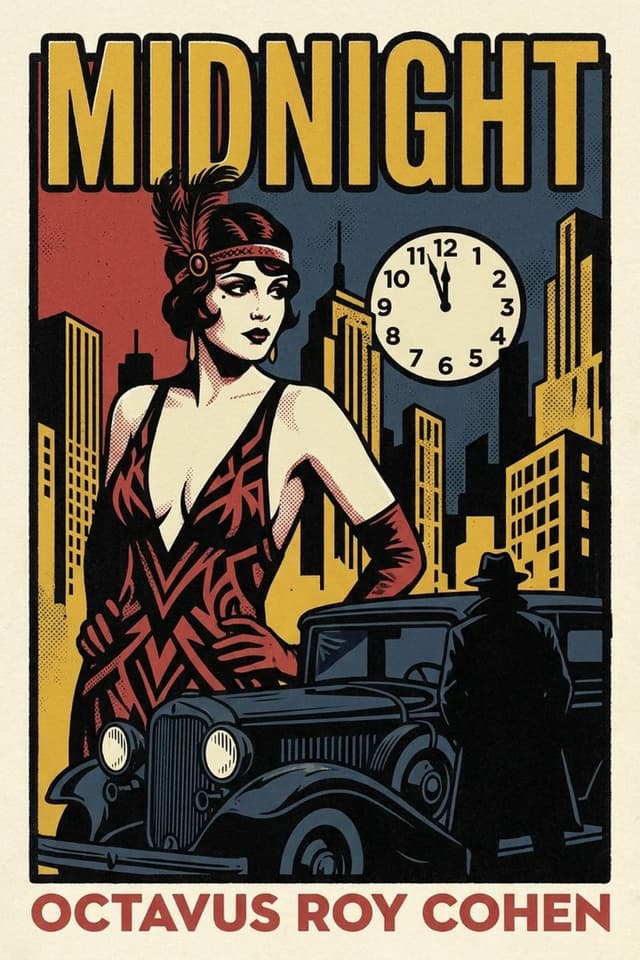
Midnight
Read Midnight by Octavus Roy Cohen for free on Novelhalla, and try out our easy-to-read modern edition of this classic book. You can also download the EPUB and read it on any device if you prefer!
The Plot
A Fare on the Coldest Night of the Year
It's a freezing December night, and young cab driver Spike Walters is stuck working the late shift. On a sleety December night taxi-driver Spike Walters picks up a fare at Union Station. The well-dressed, veiled woman instructs Walters to drive to a poorer part of town but when he arrives at the address given, she has vanished from his cab, leaving her suitcase — and a man's body. He's got no idea who she was, where she went, or how a corpse ended up in his back seat.
The dead man is no stranger off the street. The departed is identified as club man Roland Warren, a cad rumoured to have been involved with a number of socially prominent married women although there has been no open scandal, and just as well being as he is engaged. Then things get stranger. The suitcase the mystery woman carried into the cab doesn't belong to her. It belongs to the dead man.
The Quiet Detective
The case lands on David Carroll, who works so closely with the police that the line between private investigator and official detective barely exists. Carroll is happily losing a game of chess to his good friend Eric Leverage, the chief of police, when the call comes in. It was Carroll's very boyishness which was his greatest asset. He had a way of stepping into a case before the principals knew he was there, and of solving it in a manner which savored not at all of flamboyance.
Carroll isn't your typical hard-nosed cop. He doesn't believe in making hasty arrests or exhorting confessions with the third degree. He's tremendously polite, especially to women. He gets people to "spill the dope" by inspiring trust. That gentle approach is about to be tested, because nobody in this case wants to tell him the truth.
A Society Full of Secrets
It transpires every article in the suitcase belonged to him and this, along with certain other evidence, convinces the authorities and the public that Warren was planning to elope — but not with his fiancee. So who was he running away with? And was she the veiled woman in the fur coat?
The list of people with reasons to want Warren gone keeps growing. Given the dead man's reputation of not being too fussy about whose wife he romances, a number of upper crust persons naturally come under suspicion, and then there's Warren's just discharged valet, not to mention the bereaved fiancee. Husbands with wounded pride, wives with something to hide, friends who suddenly want the whole investigation dropped, and alibis that look rock solid until Carroll starts poking at them.
The Girl Who Can't Stop Talking
Carroll also picks up an unexpected sidekick he never asked for: Evelyn Rogers, a chatty teenage flapper who's decided the detective is the most fascinating man she's ever met. She's bubbly, gossipy, and completely incapable of keeping quiet. That makes her charming, but it also means she keeps letting slip little things that the important people in her circle would very much like to keep buried. Is she a help to Carroll, or is she about to get herself mixed up in something far more dangerous than she realizes?
Every new interview turns up a fresh lie, and every lie points to somebody different. The more Carroll learns about Roland Warren, the more people look like they had a motive, and the woman who vanished from that taxicab is still out there somewhere.
About the Author: Octavus Roy Cohen
Charleston Beginnings
Octavus Roy Cohen was born June 26, 1891, Charleston, S.C. to parents Octavus and Rebecca Ottolengui Cohen. Born and reared in Charleston, South Carolina, Octavus Roy Cohen attended Porter Military Academy, from which he was graduated in 1908. He went on to study engineering at Clemson, earning his degree in 1911.
Engineer, Reporter, Lawyer
Cohen took a while to land on writing. After Clemson he moved to Birmingham to work for the Tennessee Coal, Iron and Railroad Company briefly before turning to journalism. Cohen worked for several newspapers between 1910 and 1912, including the Birmingham Ledger, the Charleston News and Courier, the Bayonne Times, and the Newark Morning Star. Then he gave law a try. In 1912 he returned to South Carolina and clerked in his father's office before being admitted to the bar in 1913. He opened a law practice in Charleston which remained active for only two years before he got his first short story published and turned to writing full time.
In October of 1914, he was married to Inez Lopez; they had one son, named for his father.
A Popular Magazine Star
Cohen's first book, The Other Woman (1917; with J. U. Giesy), marked the beginning of his prolific literary career. He became a fixture in the big magazines of the day, especially The Saturday Evening Post. Mystery was his main territory. Cohen is probably best known for his stories and novels featuring three different private detectives. David Carroll, an atypical young and enthusiastic private eye, appeared in four of Cohen's early novels: The Crimson Alibi (1919), Gray Dusk (1919), Six Seconds of Darkness (1921), and Midnight (1922). His other well-known characters included the "Beau Brummell of Birmingham", Florian Slappey and oversized detective Jim Hanvey.
Birmingham became home base for years. In the 1920s, Cohen headed the "Department of Contemporary Literature" at Birmingham-Southern College. That same school awarded the honorary Litt. D., 1927, by Birmingham Southern College, for his services to Southern literature.
Hollywood and Radio
The Cohens remained in the Birmingham area until 1935 and then moved to New York and then Los Angeles. There he branched out into screenwriting and broadcasting, and he even had written for the highly popular Amos 'n' Andy radio show from 1945 to 1946. All told, he published more than 60 novels and short-story collections, five plays, and 30 film scripts.
Final Years
His wife died in 1953. He died of a stroke on January 6, 1959, in Los Angeles and is buried at Forest Lawn Memorial Park in Glendale, California. During his lifetime, many films were adapted from his works, but he is largely forgotten today.
Fun Facts About the Book
The Last David Carroll Novel
This was the fourth and final novel to star David Carroll, closing out a run that began with The Crimson Alibi and Gray Dusk in 1919. If you enjoy it, the earlier books are waiting for you.
A Dated Title Page
The book was published in 1922, but the original edition's title page carries the date 1921, and it's dedicated to Dr. Miles A. Watkins. It came out in America from Dodd, Mead and Co., and there was also a British edition: Eveleigh Nash, hc, 1922.
The Chess Game
The novel opens its investigation mid-chess match between Carroll and the police chief, and Cohen has a little fun at the chief's expense: Leverage was a policeman first and a chess-player second–a very poor second. Their warm friendship is one of the book's quiet pleasures.
Agatha Christie Comparisons
Modern readers often reach for Golden Age comparisons. One reviewer called it a good mystery, much like an Agatha Christie. The detective, David Carroll, is a bit like Poirot.
Jazz Age Slang
The dialogue is full of period flavor. As one reader put it, it's a little dated, with some Jazz Age slang in the dialogue, but still an entertaining read. Half the fun is hearing how people talked in 1922.
A Fan-Favorite Flapper
Evelyn Rogers tends to steal the show for a lot of readers. One reviewer said my favorite character is a teenage flapper, a fluffy blonde who talks incessantly. Another said I really loved the characterisation, especially of Carroll and Evelyn, and reading their banter was a real delight.
Free Audiobook Favorite
The novel has picked up a second life as a volunteer-recorded audiobook on LibriVox, narrated by Roger Melin, and listeners regularly single out his reading for praise.
Themes
Respectable Surfaces
Everyone in Warren's world has money, manners, and a good name. Underneath, nearly everyone is hiding something. The book keeps asking how much ugliness a polished social life can cover up, and what people will do to keep it covered.
Reputation and Scandal
In this world, a whispered rumor can do more damage than a crime. Older novels of detection often display social mores that seem strange to modern eyes, for example not mentioning a woman's name at the club, and that fear of scandal drives a lot of the lying Carroll has to cut through.
Kindness as a Detective's Weapon
Carroll solves cases by listening, not bullying. He's patient, courteous, and genuinely sympathetic, and that makes people open up to him. The book makes a quiet case that decency and sharp thinking can get further than force.
Jealousy and Desire
A man who romanced other men's wives has turned up dead. The novel digs into the messy feelings that come with that: jealousy, wounded pride, loyalty between friends, and the lengths people go to protect the ones they love.
Who Was the Woman in the Cab?
Identity sits right at the heart of the mystery. A veiled woman, a borrowed suitcase, and alibis that may or may not hold up all point to the same question. How well do we really know the people around us?
The Book's Legacy
Cohen was enormously popular in his day, but most of his work has faded from view. This book is the big exception. It's by far his most-read title today, with dozens of editions in print and a steady stream of new readers discovering it through ebooks and audiobooks.
It's a nice example of the early American detective novel in the years just before the hardboiled school took over. Carroll is a soft-spoken, thoughtful sleuth rather than a tough guy, and the book plays more like a puzzle-driven drawing-room mystery than a gritty crime story. Readers who love vintage mysteries keep recommending it, with one calling it fairly easy read with intertwined characters and story lines all culminating in a twisted conclusion.
For anyone who enjoys Golden Age whodunits, it's a fun find: a baffling setup, a likable detective, a talkative flapper, and a whole room full of well-dressed suspects with something to lose.