Novelhalla
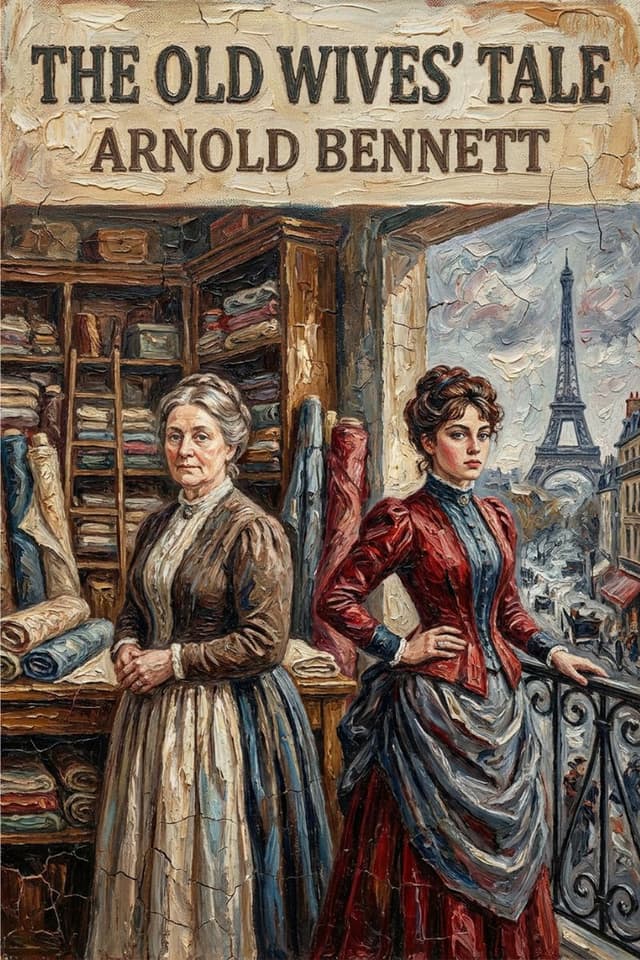
The Old Wives' Tale
Read The Old Wives' Tale by Arnold Bennett for free on Novelhalla, and try out our easy-to-read modern edition of this classic book. You can also download the EPUB and read it on any device if you prefer!
The Plot
Two Sisters, One Shop
Constance and Sophia Baines are teenagers growing up above their family's draper's shop in Bursley, a small town in the industrial Potteries of northern England. It's the 1860s. Their father has been bedridden since a stroke left him paralyzed, and their formidable mother runs both the household and the business with an iron grip.
Constance is the steady one. Pleasant, dutiful, content to learn the trade and stay close to home. Sophia is something else entirely. She's beautiful, restless, and burning with ambition. She wants to be a teacher. Her parents are horrified.
But Sophia's plans take a sharp turn the day a handsome young commercial traveler named Gerald Scales walks into the shop. He's charming, worldly, and represents everything beyond the narrow horizons of Bursley. Sophia is instantly, recklessly fascinated.
And then something terrible happens while Sophia is supposed to be watching her father. Something that will shadow her for years.
The Split
The sisters' lives fork in two directions so completely it's as if they're living on different planets.
Constance marries Samuel Povey, the quiet, unassuming shop assistant. It is not a dramatic love story. It's something more interesting than that. They settle into the rhythms of running the shop, raising a son, navigating the small politics and slow changes of a provincial town where electric tramcars are the most exciting thing anyone has seen in decades.
Sophia, meanwhile, makes a choice that shocks her family and cuts her off from everything she's ever known. She runs away with Gerald Scales. They flee to Paris. She writes home to say they're married and living abroad. Then the letters stop. An occasional Christmas card, no return address. That's it. For years, that's all her family will know.
Sophia in Paris
Gerald Scales is not the man Sophia believed he was. Not even close.
He has money when they arrive in Paris, an inheritance that should last. It doesn't. Gerald burns through it with a speed and carelessness that reveals his true character. He gambles, he wastes, he lies. Sophia watches her new life disintegrate and begins to understand exactly what she's done.
She's young, she's alone in a foreign city, and she's married to a man who is showing her, day by day, just how little she can depend on him. Sophia is many things, but she is not stupid. She starts hiding money. Sewing it into her clothes. Preparing for something she can feel coming.
When Gerald finally disappears, Sophia is stranded in Paris with almost nothing. She falls seriously ill. And then the Franco-Prussian War breaks out, and the city she's trapped in comes under siege.
Survival
What happens to Sophia during the Siege of Paris is extraordinary. The city is starving. Prices are insane. People are desperate. And Sophia, this sheltered English girl from a draper's shop in the Potteries, turns out to have a talent nobody could have predicted.
She is brilliant at business.
She stocks up on food before prices spike even further. She takes over a boardinghouse. She navigates the chaos and the danger and the hunger with a shrewdness that would have made her mother proud, if her mother had any idea she was alive. By the time the siege ends, Sophia isn't just surviving. She's building something.
Meanwhile, in Bursley
Constance's life looks nothing like adventure. It looks like motherhood and shopkeeping and the slow turning of seasons in a small town. But Bennett makes you feel every ounce of its weight. The birth of her son Cyril, the daily battles of running a business, the way a marriage settles and deepens and sometimes strains under the ordinary pressures of ordinary life.
The town is changing around her. New shops, new technologies, new ways of doing things that threaten the old draper's trade. Constance holds on. She endures. And she never stops wondering what happened to her sister.
Decades of Silence
For nearly thirty years, the sisters live their separate lives with almost no contact. Sophia builds her Parisian boardinghouse into a respected establishment. Constance ages quietly in the house where she was born. They are both becoming old women, shaped by choices made when they were barely more than girls.
The question the novel keeps circling is deceptively simple: whose life turned out better? The sister who stayed or the sister who ran? The answer is far more complicated and far more heartbreaking than you'd expect.
And then, after all those years, someone walks into Sophia's Paris boardinghouse and recognizes her name. A connection back to Bursley. A letter from Constance.
The reunion is coming. But what will be left of these two women when they finally face each other again? And what about Gerald Scales, who vanished decades ago but whose shadow has never quite lifted?
About the Author: Arnold Bennett
A Boy from the Potteries
Arnold Bennett was born in 1867 in Hanley, Staffordshire, in the heart of the industrial region known as the Potteries. His father, Enoch Bennett, had worked as a potter and a pawnbroker before clawing his way up to become a solicitor. The family was strict Wesleyan Methodist, respectable, and deeply rooted in the rhythms of provincial English life.
Bennett was expected to follow his father into law. He did try. He clerked in his father's office, studied half-heartedly, and chafed. At twenty-one, after a serious falling out with his domineering father, he left the Potteries for London and never came back to live.
London and Paris
In London, Bennett worked as a solicitor's clerk before drifting into journalism. He became the assistant editor of a women's magazine, then its editor. He began writing fiction, and his first novel appeared in 1898.
But it was Paris that transformed him. Bennett moved there in 1903, drawn by the French realist tradition he admired, particularly Flaubert and Balzac. The city relaxed him, softened his intense shyness, and gave him the cosmopolitan outlook that would distinguish his work from that of other English novelists. He married a Frenchwoman, Marguerite Soulie, in 1907 and lived in France for nearly a decade.
The Working Writer
Bennett was astonishingly prolific. Over his career he produced 34 novels, seven volumes of short stories, 13 plays, self-help books, journalism, and a daily journal that ran to over a million words. He was the most financially successful British author of his era. He bought two yachts. The second one required a crew of eight.
He was also a passionate champion of accessible literature. He believed novels should speak to ordinary people about ordinary lives, and he had no patience for literary snobbery. This put him squarely at odds with the modernists, especially Virginia Woolf, who publicly attacked his style as a catalog of surfaces. The argument became one of the defining literary feuds of the early twentieth century.
Final Years
Bennett separated from his wife in 1921 and spent his last years with Dorothy Cheston, an English actress, with whom he had a daughter. He continued writing prolifically and became an influential literary critic through his "Books and Persons" column in the London Evening Standard, where he championed younger writers.
He died in 1931 at age 63 of typhoid fever, reportedly contracted from drinking tap water in France to prove it was safe. His ashes were buried in Burslem Cemetery, back in the Potteries he had spent his life writing about.
Fun Facts About the Book
The Old Woman in the Restaurant
Bennett got the idea for the novel while dining at a small Paris restaurant in 1903. A grotesque old woman came in and the entire restaurant laughed at her. Bennett watched and thought: this woman was once young, perhaps beautiful. The gap between what she had been and what she had become struck him as profoundly tragic, and he decided to write a novel tracing that transformation. He wouldn't actually begin writing it for another four years.
Two Heroines Out of Bravado
Bennett originally planned to follow one woman's life, modeled on Maupassant's Une Vie. Then he decided that wasn't ambitious enough. He added a second heroine purely, as he later admitted, out of competitive swagger. Sophia was created because Bennett refused to accept that Maupassant had written the definitive novel about a woman's life and wanted to double the challenge.
The Execution He Never Saw
One of the novel's most powerful scenes involves a public execution by guillotine in France. Readers and critics were so convinced by its vividness that they insisted Bennett must have witnessed one himself. He hadn't. He'd gotten all his details from a series of newspaper articles in the Paris Matin. When the critic Frank Harris pointed out the scene's shortcomings, Bennett cheerfully admitted the deception.
Bennett's Omelette
Bennett may be the only major novelist to have a dish named after him at a luxury hotel. While staying at the Savoy in London, he ordered an omelette with smoked haddock. The hotel named it the Omelette Arnold Bennett and still serves it today. Some literary critics have joked that the omelette has outlasted his critical reputation.
Virginia Woolf's Famous Attack
Woolf used Bennett as her primary target in her influential 1924 essay "Mr. Bennett and Mrs. Brown," arguing that he buried his characters under mountains of material detail and missed the inner life entirely. Bennett's defenders have pointed out that Woolf's critique says more about modernist aesthetics than about Bennett's actual achievement. The debate has never fully been settled.
Written in France
Bennett wrote the novel while living in the French countryside, far from the Potteries landscape he was recreating on the page. He relied entirely on memory for his richly detailed portrait of Bursley and the Five Towns, which makes the vividness of the setting all the more remarkable.
The Subtitle
Some early editions carried the subtitle "A Novel of Life," which captures Bennett's ambition perfectly. This isn't a novel about events. It's a novel about what it feels like to live through time, to age, to watch the world change around you while you're busy with the small, consuming business of being alive.
Themes
The Passage of Time
Time is the true antagonist of this novel. Bennett set out to write a book in which time itself was both the hero and the villain, and he succeeded. The novel traces how two vibrant young girls are slowly, inevitably shaped by decades of living. It's not dramatic. It's relentless. And it's devastating precisely because it mirrors something every reader already knows but doesn't want to think about.
The Lives of Ordinary Women
Bennett takes two women whose lives would be considered unremarkable by any conventional measure and insists on their absolute significance. Constance runs a shop. Sophia runs a boardinghouse. Neither changes the world. But the novel argues, with quiet force, that every human life, no matter how outwardly uneventful, is epic to the person living it.
Choice and Consequence
Sophia chooses adventure. Constance chooses stability. The novel follows both paths to their conclusions without ever declaring a winner. Did Sophia's daring bring her freedom or just a different kind of imprisonment? Did Constance's contentment represent wisdom or merely a failure of imagination? Bennett refuses to answer. He just shows you both lives, in all their fullness, and lets you sit with the discomfort.
Women and Independence
Both sisters demonstrate remarkable competence in a world that gives women almost no room to operate. Mrs. Baines runs the family business while her husband lies helpless upstairs. Sophia builds a thriving enterprise from nothing in a foreign city during a war. Constance manages a household and a shop through decades of change. The novel doesn't make speeches about women's capabilities. It simply shows them, over and over, being the ones who actually keep everything running.
The Pull of Home
No matter how far Sophia travels or how long she stays away, Bursley never loses its hold on her. The draper's shop, the Square, the rhythms of provincial life: these things are woven into who she is. The novel explores how the places that shape us in childhood remain powerful long after we think we've outgrown them.
Character and Destiny
The sisters' names are not accidental. Constance is constant. Sophia, whose name means wisdom, must earn hers through hard experience. Bennett is fascinated by the idea that our fundamental natures are set early and that the rest of life is just those natures playing out against different backdrops. Whether you stay home or run to Paris, you're still yourself.
The Book's Legacy
H.G. Wells called this novel the finest long novel written in English in his generation. The Modern Library ranked it 87th on its list of the 100 best English-language novels of the twentieth century. For decades after its publication, it was considered one of the towering achievements of English realism.
The novel was adapted into a silent film in 1921 and a BBC television series in 1988, titled Sophia and Constance. Neither adaptation captured the full scope of the book, which relies so much on the accumulation of detail over time that it resists compression.
Bennett's reputation suffered in the decades after his death, largely due to the modernist critique led by Woolf. But a reappraisal beginning in the 1970s, championed by the novelist Margaret Drabble and the critic John Carey, has restored his standing. Today, The Old Wives' Tale is increasingly recognized not as a relic of pre-modernist realism but as a masterwork in its own right, a novel that does something no experimental technique could improve upon: it makes you feel, in your bones, what it means to grow old.
The novel endures because its central insight is universal and unavoidable. Time passes. We change. The world we grew up in disappears. And yet we go on, carrying within us every version of ourselves we've ever been. Bennett saw an old woman laughed at in a restaurant and wrote a novel to prove she mattered. That impulse, generous and humane and unflinching, is why people are still reading this book more than a century later.