Novelhalla
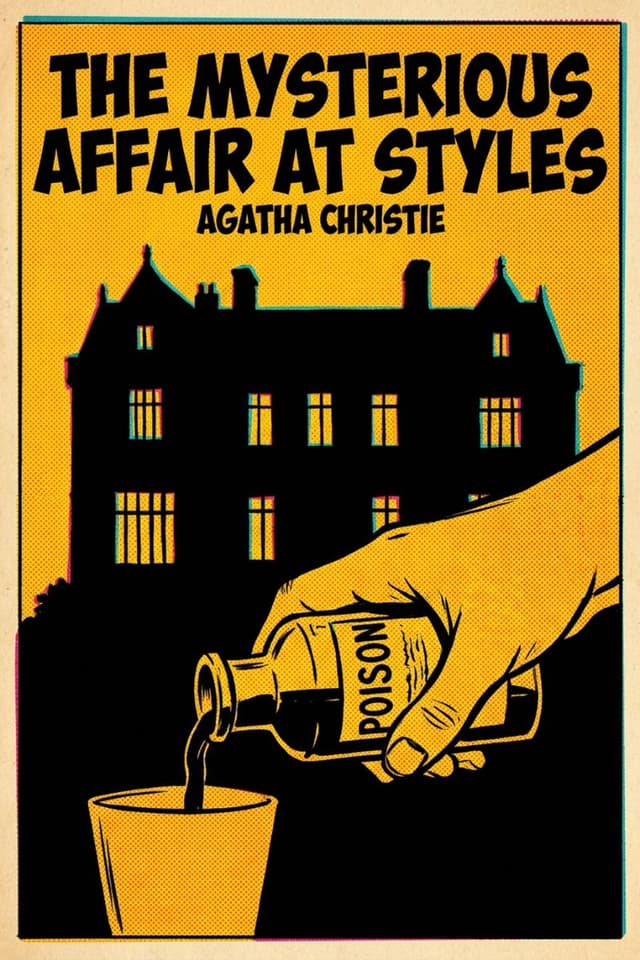
The Mysterious Affair at Styles
Read The Mysterious Affair at Styles by Agatha Christie for free on Novelhalla, and try out our easy-to-read modern edition of this classic book. You can also download the EPUB and read it on any device if you prefer!
The Plot
A Country House in Wartime
It's the middle of World War I, and Captain Arthur Hastings has been invalided home from the Western Front. He's recovering, aimless, and a little bit lost when he bumps into an old acquaintance, John Cavendish, who invites him to spend his sick leave at the family estate: Styles Court, a grand country house tucked into the flat green Essex countryside.
On the surface, it's idyllic. The war feels impossibly far away. But something is wrong at Styles, and Hastings can feel it the moment he arrives.
The Family
The house belongs to Emily Inglethorp, John's stepmother, a wealthy elderly woman who inherited Styles and the family fortune when her first husband died. She's generous, strong-willed, and deeply involved in wartime charity work. She is also newly remarried to a much younger man named Alfred Inglethorp, and no one in the household can stand him.
Alfred is a black-bearded, soft-spoken figure who appeared out of nowhere, wormed his way into Emily's life, and now controls much of the household. John thinks he's a fortune hunter. The household companion, Evelyn Howard, a blunt, no-nonsense woman fiercely loyal to Emily, openly despises him. She's convinced Alfred is having an affair with a neighbor and is simply waiting for Emily to die.
The tension is thick. John's wife Mary is beautiful but secretive, spending suspicious amounts of time with a local doctor named Bauerstein. John's younger brother Lawrence drifts around the house like a shadow, moody and withdrawn. Cynthia Murdock, a young orphan Emily took in, works at the nearby hospital dispensary mixing medicines. Everyone has something they're not saying.
The Night Everything Changes
One evening, voices are heard through a locked door. Emily is arguing with someone, furiously, but no one can make out the other voice. The next morning, the household is woken by a crash. Emily Inglethorp is found in her bedroom, convulsing. She dies within minutes.
She's been poisoned. Strychnine.
Enter Hercule Poirot
Hastings knows exactly who to call. Living in the nearby village, among a group of Belgian war refugees Emily helped settle, is an old friend: a small, meticulous, egg-headed former detective named Hercule Poirot. He's retired. He's fussy. He has an absurd mustache and an even more absurd ego. And he is brilliant.
Poirot arrives at Styles and immediately sees things everyone else has missed. A coffee cup. A candle grease stain. A scrap of fabric. The position of a vase. A fragment of a destroyed document in the fireplace. Nothing is too small for his attention. Nothing is irrelevant.
Everyone is a Suspect
The obvious answer is Alfred. He married an older woman for her money, everyone hates him, and someone matching his description was seen buying strychnine at the local pharmacy. Case closed, right?
Poirot doesn't think so. In fact, he seems to go out of his way to prevent Alfred's arrest, which infuriates Hastings and baffles Scotland Yard's Inspector Japp.
Because the deeper Poirot digs, the more tangled everything becomes. Mary Cavendish is hiding something about the night of the murder. Lawrence won't explain his strange behavior. The argument behind the locked door doesn't match anyone's account. There's a forged document. A suspicious will. A love affair that may or may not be real. A local doctor who turns out to be something else entirely.
Every person in that house had a reason to want Emily Inglethorp dead. And at least one of them is lying about far more than Hastings can see.
The Little Grey Cells
Poirot works his way through a maze of red herrings, false alibis, and planted evidence. He's playing a game several moves ahead of everyone, including the reader. He drops cryptic hints. He gets excited about details that seem meaningless. He refuses to explain himself to Hastings, who grows increasingly frustrated.
Then someone is arrested for the murder. The wrong person, according to Poirot. Or maybe the right person. He won't say.
What Poirot knows, and what he's waiting to prove, is that the truth behind Emily Inglethorp's death is far more devious than a simple poisoning. The clues are all there, scattered across the pages like breadcrumbs. The answer depends on a detail so small, so easy to overlook, that you'll want to go back and read the whole thing again once Poirot finally reveals what he's known almost from the beginning.
About the Author: Agatha Christie
Early Life
Agatha Mary Clarissa Miller was born in 1890 in Torquay, a seaside town in Devon, England. She was the youngest of three children in a comfortable, if not extravagantly wealthy, family. Her father was an American expatriate who loved socializing and did very little else. Her mother was imaginative and strong-willed.
Agatha was educated at home, largely by her mother, and spent much of her childhood alone, inventing imaginary friends and making up stories in the sprawling gardens of the family home, Ashfield. Her older siblings were nearly a decade ahead of her, which left her to develop a rich inner world from an early age. She taught herself to read at five.
The War and the Dare
In 1914, Agatha married Archibald Christie, a dashing young military officer she'd met at a dance. They married on Christmas Eve, just before he shipped out to France. While Archie fought in the war, Agatha volunteered first as a nurse and then as a dispenser in a hospital pharmacy in Torquay.
The pharmacy changed everything. Working with medicines and chemicals gave her an intimate, practical knowledge of poisons, and the long quiet hours between prescriptions gave her time to think. Her older sister Madge had once challenged her to write a detective story. Now, surrounded by bottles of strychnine and arsenic, she finally took up the dare.
The First Novel
Christie wrote most of her first novel on Dartmoor, working through the plot in her head while walking or bathing, then sitting down to put it on paper. She drew her detective from the Belgian refugees she'd encountered during the war, creating a fastidious little man with an outsized intellect and an even more outsized opinion of himself.
The manuscript was rejected by six publishers before John Lane accepted it. Christie earned twenty-five pounds. She had no idea she had just launched the most successful mystery-writing career in history.
The Queen of Crime
Over the next five decades, Christie wrote over eighty novels, numerous short story collections, and several plays. She created Miss Marple, wrote the longest-running play in theater history with The Mousetrap, and became the best-selling fiction writer of all time. Her books have sold over two billion copies worldwide, translated into more than a hundred languages.
In 1930, she married archaeologist Max Mallowan after divorcing Archie, and traveled with him on digs throughout the Middle East, which inspired many of her later novels. She was made a Dame Commander of the Order of the British Empire in 1971. She died in January 1976 at the age of eighty-five, having spent sixty years quietly redefining the mystery genre from the inside out.
Fun Facts About the Book
Born from a Dare
Christie's older sister Madge bet her that she couldn't write a detective novel where the reader wouldn't be able to figure out the murderer. Christie took the challenge personally. The result was a book so cleverly constructed that even seasoned mystery readers struggle to solve it before the final reveal. The original dust jacket proudly referenced the bet.
The Pharmacy Connection
Christie was working in the dispensary at Torquay Hospital when she wrote the novel, and her knowledge of poisons is on full display. The strychnine poisoning at the heart of the plot is depicted with clinical accuracy, down to the specific chemical interactions that make the murder method possible. This pharmaceutical expertise would become one of Christie's trademarks throughout her career.
Six Rejections
The manuscript bounced around for years before finding a publisher. It was rejected by at least six publishing houses before John Lane at The Bodley Head finally accepted it in 1920, four years after Christie finished writing it. She later said the contract she signed was exploitative, and the modest twenty-five pounds she earned didn't exactly signal the start of a literary empire.
The First Appearance of Hercule Poirot
This is the book that introduced the world to Hercule Poirot, the Belgian detective who would go on to star in over thirty novels and dozens of short stories. Christie based him partly on the Belgian refugees she encountered during the war and partly on her desire to create a detective who was the complete opposite of Sherlock Holmes: small, vain, immaculate, and obsessed with order rather than physical evidence.
Maps and Floor Plans
The original publication included maps of Styles Court, the murder scene, and a drawing of a fragment of a will. This was a hallmark of Golden Age detective fiction, where the reader was expected to play along at home and attempt to solve the mystery using the same evidence as the detective. Christie was establishing the rules of fair play right from the start.
Poirot's Bookend
Decades later, when Christie finally wrote Poirot's last case, she set it at Styles Court. The novel, called Curtain, was written during World War II and locked in a bank vault for over thirty years, only published in 1975 shortly before Christie's death. Poirot's career ends where it began, with Hastings by his side, in the same house where they first solved a murder together.
Christie Named Her House After It
Agatha and her first husband Archie liked the novel so much they named their own home "Styles." For the woman who would go on to write eighty more mysteries, the first one clearly held a special place.
Serialized Before It Was a Book
The novel was first published as a weekly serial in The Times before it appeared in book form. The serialization included the original maps and illustrations. The book edition followed in October 1920 in the United States and January 1921 in the United Kingdom.
Themes
The Danger of Assumptions
Nearly every character in the novel makes assumptions based on appearances, and nearly every one of them is wrong. The obvious suspect seems too obvious. The trustworthy friend seems too trustworthy. Christie plays with the reader's instinct to judge people at face value, and the entire mystery hinges on the gap between what people seem to be and what they actually are.
The Country House as a Pressure Cooker
Styles Court is beautiful, but it's also a trap. The family is held together under one roof by wartime necessity and financial dependence, and the resentments have been building for years. Christie understood that the most dangerous place in the world isn't a dark alley. It's a well-appointed drawing room full of people who have reasons to hate each other and nowhere else to go.
Order and Method
Poirot's philosophy is spelled out early and clearly: imagination is useful, but method is everything. He doesn't rely on hunches or dramatic leaps of logic. He gathers facts, arranges them in order, and lets the truth emerge. In a world thrown into chaos by war, there's something deeply reassuring about a man who believes that the truth can always be found if you're willing to pay attention to the small things.
War as Background, Not Spectacle
The Great War is everywhere in this novel, but always at the edges. It's in Hastings' injury, in the Belgian refugees, in the women doing farm work, in the poison expert who may be a spy. Christie doesn't write about the trenches. She writes about what the war does to the people left behind, how it reshapes families and communities and creates the conditions where terrible things can happen behind closed doors.
Money and Motive
Almost every relationship at Styles Court is shaped by money. Who has it, who controls it, who stands to inherit it. Emily's wealth holds the household together, and her death threatens to blow it apart. Christie understood that in a society built on inheritance and social standing, a change to a will is as dangerous as a loaded gun.
The Book's Legacy
This is where it all started. Not just for Agatha Christie, but for an entire tradition of mystery fiction. The country house murder, the gathering of suspects, the eccentric detective who sees what no one else can, the final drawing-room reveal: these elements existed before Christie, but she assembled them into a formula so perfect that it became the template for nearly a century of mysteries that followed.
Hercule Poirot would go on to become one of the most famous fictional characters ever created, appearing in thirty-three novels and over fifty short stories. He received a front-page obituary in The New York Times when Christie finally killed him off in 1975, making him one of the only fictional characters to receive such an honor.
The novel was adapted as a special episode of the beloved television series Agatha Christie's Poirot in 1990, with David Suchet in the role he would play for over two decades. It was broadcast to celebrate what would have been Christie's hundredth birthday.
For readers coming to Christie for the first time, this book is a fascinating starting point. It's a little rougher around the edges than her later masterworks, a little more generous with its clues, a little more earnest in its construction. But the bones are all there: the misdirection, the fair-play puzzle, the devastating final twist, and the small, brilliant Belgian who would go on to conquer the world.