Novelhalla
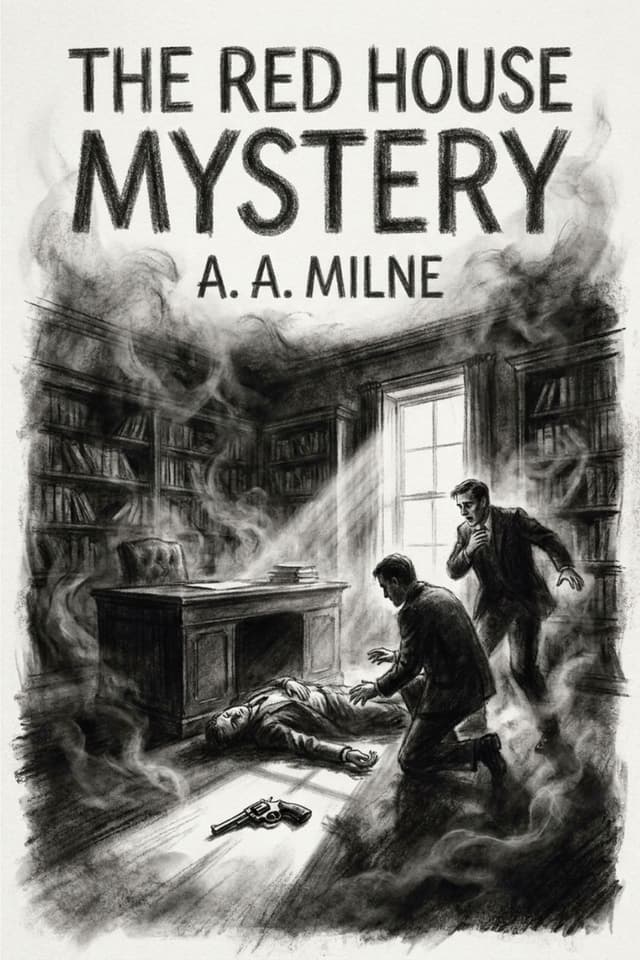
The Red House Mystery
Read The Red House Mystery by A. A. Milne for free on Novelhalla, and try out our easy-to-read modern edition of this classic book. You can also download the EPUB and read it on any device if you prefer!
The Plot
A Perfect Summer Day
It is a drowsy August afternoon at the Red House, a comfortable English country estate belonging to Mark Ablett, a wealthy bachelor with a talent for entertaining. Bees hum in the flower borders. Pigeons coo in the elms. A house party is in full swing: there's a widow angling to marry off her daughter, a retired major, a willful young actress, and Bill Beverley, an amiable young man about town who treats the whole visit like a holiday from having to think about anything at all.
In the kitchen, the pretty parlor maid Audrey is trimming her hat and chatting with her aunt, the housekeeper. The conversation turns, as it has been turning all morning, to the letter that arrived at breakfast. Mark's brother Robert is coming. Robert, the black sheep. Robert, who was shipped off to Australia fifteen years ago after some unspecified disgrace. Robert, who has not been heard from since and is most decidedly not welcome.
Mark is not taking the news well.
The Shot
Robert arrives at three o'clock, while the house guests are all out playing golf. He is shown into Mark's private office. The door closes. Mark's cousin and personal secretary, Matthew Cayley, the only other person in the house, waits nearby.
Then a gunshot.
Cayley rushes to the office door. It's locked from the inside. He pounds on it, gets no answer. And at that exact moment, a stranger walks up the front drive.
This is Antony Gillingham, a cheerful, curious young man who has come to pay a surprise visit to his old friend Bill. He has arrived at the worst possible time, or perhaps the best. Together, he and Cayley run around the outside of the house, break in through the French windows, and find a body on the floor, shot through the head.
It's Robert. And Mark is gone.
The Amateur Detective
The obvious explanation is that Mark killed his brother and fled. The police think so. Cayley, shaken and cooperative, seems to think so. The house guests are sent away. The investigation proceeds along predictable lines.
But Antony Gillingham is not satisfied.
There are small things that don't add up. The way Cayley led them around the long way to the windows, when a shorter route existed. The locked door. The missing key. The fact that no one at the house had actually seen Mark and Robert in the same room. And Cayley, who is helpful and calm and always, always nearby.
Antony decides, with the breezy confidence of a man who has never met a profession he didn't want to try on for size, that he will play detective. He recruits Bill as his Watson. Bill, who thinks the whole thing sounds like tremendous fun, agrees immediately. They make a pact: they will investigate the murder between games of billiards and bowls, over tea and sandwiches, like gentlemen.
The Game
What follows is a peculiar kind of treasure hunt, conducted with one eye on the clues and the other on Cayley, who seems to be watching them just as closely as they are watching him.
There are whispered conversations in the garden. A maid who overheard something she shouldn't have. A ghost story that might not be a ghost story. A pond that the police want to drag and that Cayley seems suspiciously eager to have dragged. And somewhere in the Red House, behind a shelf of dusty old sermons that no one has touched in years, there may be a door that leads somewhere it shouldn't.
Antony is charming and clever, filing away details without seeming to notice them, making connections that feel almost too easy, then suddenly pulling up short at something genuinely wrong. Bill is his perfect foil: loyal, enthusiastic, slightly out of his depth, and having the time of his life.
But the deeper they dig, the less the simple story holds together. The question isn't just who killed Robert. It's whether the man on the floor is who everyone thinks he is. And whether the man who vanished is really running, or whether something else entirely has happened inside that locked room.
The Red House has a secret. It's been hiding it in plain sight.
About the Author: A. A. Milne
Early Life
Alan Alexander Milne was born in 1882 in Kilburn, London, the youngest of three brothers. His father ran a small private school where one of young Alan's teachers happened to be a then-unknown H. G. Wells. Milne won a scholarship to Westminster School, then went on to Trinity College, Cambridge, where he was supposed to study mathematics. Instead, he spent most of his time writing. He edited the student literary magazine Granta and graduated in 1903 knowing that words, not numbers, were his future.
The Punch Years
Milne moved to London and began freelancing humorous essays and light verse. In 1906, he joined the staff of Punch, the leading British humor magazine, as assistant editor. For eight years he was one of its principal voices, producing the kind of sharp, witty, perfectly constructed prose that made Punch a national institution. He married Dorothy de Selincourt in 1913.
War and After
Despite being a committed pacifist, Milne enlisted when World War I broke out, serving as a signals officer in the Royal Warwickshire Regiment. He saw action at the Somme. The experience marked him deeply, and he later wrote passionately against war.
After the war, Milne reinvented himself as a playwright. His light comedies, including "Mr. Pim Passes By" and "The Dover Road," were West End hits. He published "The Red House Mystery" in 1922 to immediate popular success. By the early 1920s, he had eighteen plays and three novels to his name and was one of England's most versatile working writers.
The Bear
Then came the bear.
Milne's son, Christopher Robin, was born in 1920. Inspired by the boy and his stuffed animals, Milne published "When We Were Very Young" in 1924 and "Winnie-the-Pooh" in 1926. The books were phenomenally successful and completely eclipsed everything else he had ever written. Milne found this both gratifying and maddening. He had spent two decades building a reputation as a humorist, playwright, and novelist, and the world only wanted to talk about a bear.
He never wrote another detective novel. When he told his agent he wanted to, he was informed that the country now expected children's books from him. When he'd told the same agent about the children's poems years earlier, the agent had wanted another mystery. Milne later observed wryly that the only good reason to write anything was because you wanted to.
Final Years
Milne suffered a stroke in 1952 following brain surgery and spent his last years as an invalid at his country home, Cotchford Farm, in Sussex. He died in 1956 at the age of seventy-four. His relationship with his son had grown complicated; Christopher Robin resented the fame that his father's books had thrust upon him as a child. The real stuffed animals that inspired Pooh, Piglet, Eeyore, Kanga, and Tigger are on permanent display at the New York Public Library.
Fun Facts About the Book
Milne's Only Mystery
"The Red House Mystery" is essentially a one-off. Milne wrote it between his career as a Punch humorist and his career as a children's author, during a brief window when he was writing whatever interested him. He never returned to the genre, though the book remained continuously in print for decades.
The Dedication
Milne dedicated the book to his father, writing in the preface that his father had a weakness for detective stories and felt there weren't enough of them. The playful, affectionate tone of that dedication runs through the entire novel.
A Self-Aware Mystery
In his introduction to the 1926 edition, Milne laid out his rules for what a detective story should be. He demanded an amateur detective, not a professional. He wanted a likable Watson figure. The villain had to be an amateur too, not a career criminal. And the reader should be able to follow the detective's thinking chapter by chapter, not be ambushed by a twist in the final pages. He wrote the book as a love letter to the genre he adored.
The Chandler Fight
Raymond Chandler, the great American crime writer, used "The Red House Mystery" as his punching bag in his famous 1944 essay "The Simple Art of Murder." Chandler argued that the book's puzzle was clever but implausible, and that the amateur detective model was fundamentally broken. It was an unfair fight in some ways: Chandler was using a charming country-house lark to make a case for gritty realism. But the essay kept the book in the conversation for decades.
Alexander Woollcott's Endorsement
On the other side, the influential American critic Alexander Woollcott called it "one of the three best mystery stories of all time." The book lived comfortably between these two extreme verdicts for years, beloved by casual readers and debated by purists.
The Holmes and Watson of It All
Milne explicitly modeled the Antony-and-Bill dynamic on Sherlock Holmes and Doctor Watson, and the characters themselves know it. They reference Holmes constantly, sometimes with admiration and sometimes with gentle mockery. The book is as much a commentary on detective fiction as it is a detective story.
Before Pooh
For readers who only know Milne through Winnie-the-Pooh, the book is a revelation. The same warmth, wit, and deceptive simplicity are all there, just applied to a locked-room murder instead of a Hundred Acre Wood. You can see the same writer behind both: someone who makes everything look effortless and easy when it is, in fact, extremely carefully built.
Themes
Playing at Detection
Antony and Bill treat the investigation like a game, and the book never quite lets you forget that. There's something both delightful and unsettling about two upper-class young men hunting a killer between rounds of croquet. Milne seems aware of the tension between the fun of the puzzle and the fact that there is a dead man on the floor.
Appearances and Interiors
The Red House is comfortable, beautiful, and harboring a corpse. Mark Ablett is a perfect host who may be a murderer. Cayley is a helpful, steady presence who may be something else entirely. The novel keeps asking what's behind the surface: behind the locked door, behind the bookcase, behind the pleasant face.
The Amateur Spirit
Milne believed deeply in the amateur. His detective is a man who takes up professions for the pleasure of them and drops them when he gets bored. His investigation succeeds not because of forensic science or police procedure but because of curiosity, observation, and an instinct for when something doesn't feel right. The book is a quiet argument that the engaged, intelligent outsider sees things the professional misses.
Class and Comfort
The murder happens inside a world of extraordinary privilege: house parties, servants, billiard rooms, manicured lawns. The novel doesn't satirize this world exactly, but it does suggest that comfort can make people blind. The house guests scatter the moment trouble arrives. Only the outsider stays to look.
Friendship
Underneath the mystery, the book is really about the pleasure of having a friend who's up for anything. Antony and Bill's partnership is the engine of the novel: their banter, their midnight adventures, the way Bill throws himself into the investigation with the pure joy of a man who has been waiting his whole life for something interesting to happen.
The Book's Legacy
"The Red House Mystery" occupies a unique place in literary history. It was an immediate bestseller, staying in print on both sides of the Atlantic for decades. It helped define the "Golden Age" country-house mystery that would dominate British crime fiction through the 1920s and 1930s, the era of Agatha Christie and Dorothy L. Sayers.
And then its author went and created Winnie-the-Pooh, and this clever, funny little murder mystery was largely forgotten by the general public, remembered mainly by mystery enthusiasts and Milne completists.
That's a shame, because the book has a charm that very few mysteries can match. It doesn't take itself too seriously, but it takes its puzzle seriously enough. The dialogue sparkles. The pacing is brisk. And there's a warmth to it that feels distinctly Milne: the same writer who would soon make you believe a stuffed bear could have adventures in the woods first made you believe two friends could solve a murder over tea.