Novelhalla
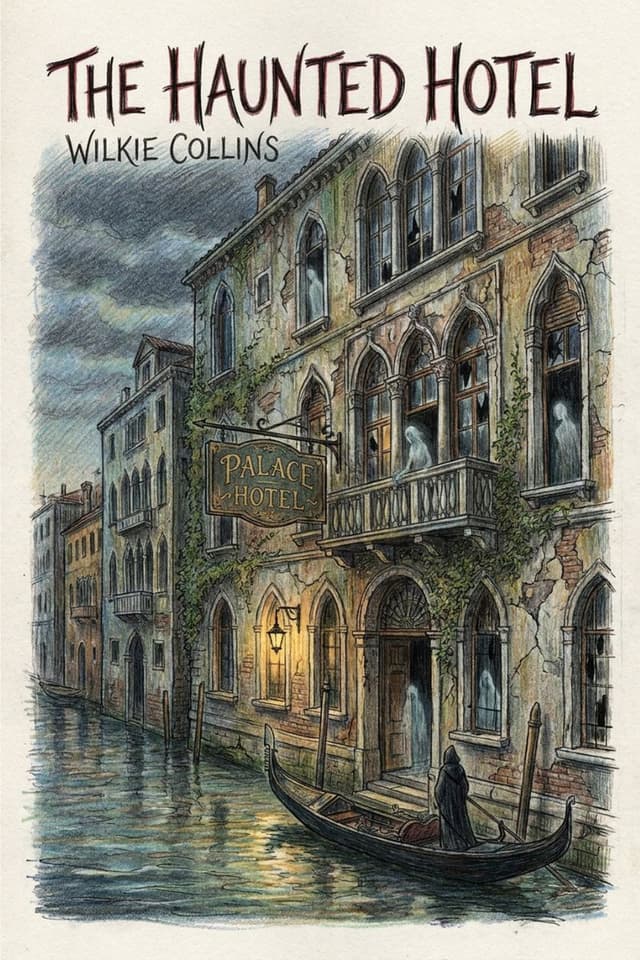
The Haunted Hotel
Read The Haunted Hotel by Wilkie Collins for free on Novelhalla, and try out our easy-to-read modern edition of this classic book. You can also download the EPUB and read it on any device if you prefer!
The Plot
The Countess
A woman walks into a London doctor's office, pale as a ghost, with striking black eyes and a question that no physician can answer: is she going mad?
The Countess Narona is about to marry Lord Montbarry, a wealthy English nobleman. There's just one problem. Montbarry was already engaged to someone else. A kind, gentle woman named Agnes Lockwood. He broke it off without explanation and took up with the Countess instead, a mysterious foreign widow with a reputation that precedes her and a brother, Baron Rivar, who never seems to leave her side.
The Countess tells the doctor she feels a creeping sense of doom. Something about meeting Agnes unsettled her in a way she can't explain. She wants to know if this dread is madness or something else entirely.
The doctor can't help her. Nobody can.
The Death
Montbarry marries the Countess and the couple disappears onto the continent, eventually settling into a crumbling Venetian palazzo with Baron Rivar and a courier named Ferrari. Then the news arrives: Montbarry is dead. Bronchitis, apparently. His life was insured for ten thousand pounds, all of it payable to his new wife.
The courier Ferrari has also vanished without a trace. His wife receives an anonymous envelope containing a thousand pounds and no explanation.
Montbarry's family is suspicious. His younger brother Henry, who has quietly loved Agnes Lockwood for years, pushes for an investigation. The insurance companies dig deep. But every inquiry comes back clean. No evidence of foul play. No sign of Ferrari. Nothing but a dead lord, a missing servant, and a very wealthy widow.
The Hotel
Time passes. The old palazzo where Montbarry died is gutted and refurbished into a fashionable new hotel. And then, in one of those coincidences that feels less like chance and more like fate, the Westwick family arranges to meet there. Henry is involved in the hotel venture. The family gathers in Venice for a wedding celebration. Agnes comes along as the children's caretaker.
Nobody realizes at first that they're sleeping in the room where Montbarry died.
But the room knows.
Something Wrong
One by one, the family members who stay in that room report the same things. Sleeplessness. Nightmares. A foul, nauseating smell that comes and goes with no source anyone can find. Something is deeply wrong with this room, and it's getting worse.
Then Agnes spends a night there. She wakes in the dark to find a figure in her room. And above her bed, descending slowly from the ceiling, something that will haunt her for the rest of her life.
Meanwhile, the Countess has also come to Venice. She says she was drawn back, compelled by something she calls Destiny. She is deteriorating, unraveling, gripped by a need to confess something she can barely bring herself to name. She begins writing a play. A ghost story set in a Venetian palazzo. A story about murder.
The line between fiction and confession is getting very thin. And whatever is hiding in the walls of this hotel is not finished making itself known.
About the Author: Wilkie Collins
Early Life
Wilkie Collins was born in London in 1824, the son of William Collins, a well-known landscape painter and member of the Royal Academy. His childhood was shaped by two forces: his father's strict religious piety, which he came to resent, and a two-year stay in Italy and France as a boy, which he later said taught him more than any school ever did. He credited his storytelling ability to a bully at boarding school who wouldn't let him sleep until he'd invented an original bedtime story.
His father pushed him toward respectability, first as a clerk at a tea merchant's firm, then as a law student at Lincoln's Inn. Collins was called to the bar in 1851 but never practiced a single day. He'd already decided his life belonged to writing.
Dickens and the Golden Years
In 1851, Collins met Charles Dickens, and the friendship changed both their lives. Dickens was already the most famous novelist in England. Collins was twenty-seven and virtually unknown. But they clicked immediately. Dickens admired Collins's discipline and craft. Collins loved Dickens's appetite for adventure. The two went on late-night expeditions into London's underworld, collaborated on plays, and published together in Dickens's literary journals.
Through the 1860s, Collins produced the novels that would make him immortal: The Woman in White (1860), No Name (1862), Armadale (1866), and The Moonstone (1868), widely considered the first modern detective novel. At the height of his career, he was as famous as Dickens himself.
The Unconventional Private Life
Collins never married but maintained two simultaneous households. He lived with Caroline Graves, a widow whose daughter he raised as his own, for most of his adult life. He also had three children with Martha Rudd, a younger woman he installed in a separate home under the name "Mrs. Dawson." When Caroline briefly married another man, Collins attended the wedding. She returned to him within a few years.
He was a gourmand, a deep drinker, and a flamboyant dresser. He was also increasingly dependent on laudanum, the opium tincture he took for agonizing bouts of gout. He reportedly consumed quantities that would have killed an ordinary person. He claimed to have written much of The Moonstone under its influence and barely recognized the finished work as his own.
Later Career and Death
Collins's health and writing both declined through the 1870s and 1880s, though he remained prolific. The Haunted Hotel, written in 1878, belongs to this later period. Critics were less kind to his newer work, but he never stopped producing. He wrote over thirty novels, more than sixty short stories, and fourteen plays.
He died of a paralytic stroke in 1889 at age sixty-five and was buried at Kensal Green Cemetery. Caroline Graves eventually joined him there.
Fun Facts About the Book
Written for Money
Collins was desperate for cash when he wrote The Haunted Hotel, and it shows in the best possible way. The story is lean, propulsive, and wastes nothing. He was so strapped that he sold the translation and international rights separately, getting himself into legal trouble with his original publisher for doing so without permission. Desperation, it turns out, can produce some very sharp writing.
Serialized in a Sensation Magazine
The novel first appeared in six monthly installments in Belgravia magazine from June to November 1878. Belgravia was founded by Mary Elizabeth Braddon, author of the sensation novel Lady Audley's Secret, and the magazine had a reputation for exactly the kind of lurid, thrilling fiction Collins excelled at. The story was published simultaneously in the Canadian Monthly.
Inspired by Real Crime
The novel appears to be loosely based on a case from French criminal history. Collins never confirmed the connection directly, but the blend of insurance fraud, identity swapping, and hidden remains has the unmistakable flavor of true crime dressed up in Gothic clothing.
T.S. Eliot Was a Fan
The modernist poet T.S. Eliot wrote admiringly about the Countess Narona, noting that she is "herself obsessed by the idea of fatality" and that "she compels the coincidences to occur, feeling that she is compelled to compel them." High praise from a man not known for handing out compliments to sensation novelists.
A Story Within a Story
In one of the novel's strangest and most inventive moments, the Countess sits down and writes a play called "The Haunted Hotel," a ghost story set in a Venetian palazzo that mirrors the events of the novel itself. It's a confession disguised as fiction inside a fiction. Collins, who was deeply involved in theater throughout his life, loved this kind of layered storytelling.
Collins's Most Supernatural Work
Most of Collins's mysteries have rational explanations. The Moonstone is solved by detective work. The Woman in White is a conspiracy, not a haunting. But The Haunted Hotel leans harder into the genuinely supernatural than almost anything else he wrote. The ghosts here aren't metaphors. Whatever is in that hotel room is real, and Collins isn't interested in explaining it away.
Themes
Guilt as a Haunting
The novel asks whether guilt can take on a life of its own. The Countess is tormented not just by what she may have done but by the feeling that her fate was sealed before she even acted. The haunting in the hotel might be supernatural, or it might be the physical weight of a conscience that refuses to stay quiet. Collins blurs the line deliberately.
The Femme Fatale
The Countess Narona is one of Collins's most compelling creations. She is beautiful, terrifying, and trapped. From her first appearance in the doctor's office, she seems to be both the architect and the victim of her own destruction. Collins gives her enough humanity that you almost sympathize with her, even as the evidence mounts.
Destiny vs. Free Will
The word "Destiny" appears throughout the novel like a drumbeat. The Countess believes she is compelled by forces beyond her control. Other characters resist that idea, insisting on rational explanations. Collins never fully resolves the question. Are we watching a woman destroy herself, or watching something destroy her?
The Commodification of Death
Montbarry's life insurance policy sits at the center of the mystery. His death is worth ten thousand pounds to someone. Collins was fascinated by the way Victorian society turned everything, even human life, into a transaction. The hotel itself is another kind of transaction: a place where someone died, renovated and sold as luxury.
Venice as a Character
Collins uses Venice the way a horror director uses a haunted house. The crumbling palazzo, the canals, the fog, the sense of a beautiful city built on something unstable. Venice isn't just the setting. It's the mood. Everything gorgeous on the surface, everything rotting underneath.
The Book's Legacy
The Haunted Hotel occupies a unique place in Collins's body of work. It's not his masterpiece. That title belongs to The Woman in White or The Moonstone. But it's one of his most atmospheric and unsettling stories, a tight, dark novella that does more with two hundred pages than many novels manage in five hundred.
The book is often cited as a key text in the development of the supernatural mystery, a genre that would flourish in the decades after Collins's death. Its blend of detective fiction and ghost story, rational investigation and inexplicable horror, anticipates writers from M.R. James to Daphne du Maurier.
For modern readers, The Haunted Hotel works as something rare: a Victorian thriller that still genuinely creeps you out. The scene in the hotel room remains one of the most effectively horrifying moments in nineteenth-century fiction. Collins knew that the best horror doesn't come from what you see. It comes from the slow, sickening realization that something is very wrong, and that it's too late to leave.